
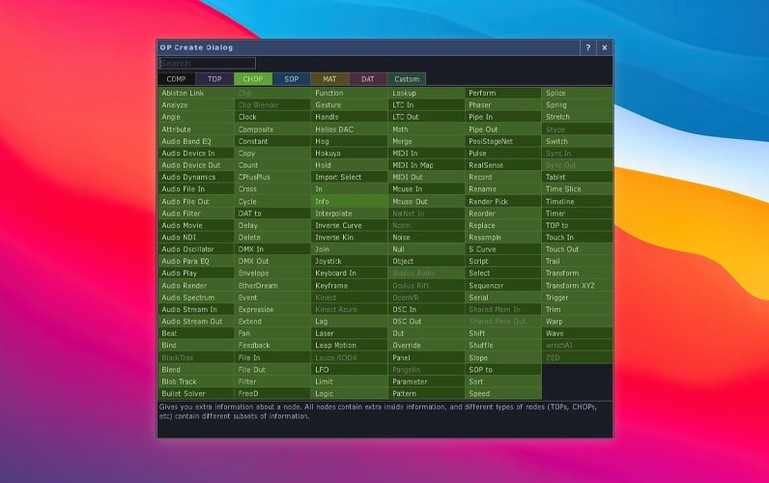
A lighting designer walks into a venue with a floor full of LED strips and a media server that needs to talk to the lighting desk. Everything has to react to the DJ's set in real time, and no off-the-shelf software quite bridges the gap. That's the kind of knot TouchDesigner was built to untie — one network of linked operators at a time.
Build a reactive audio-visual patch
Drop in an Audio Device In TOP, wire it to a Spectrum TOP, and you have live frequency data flowing. Pipe that into a Noise TOP and suddenly your LED map is dancing to the kick drum. Every connection is a cable you can drag on screen, so the signal chain stays visible even as it grows.
Generate and deform 3D geometry on the GPU
The new Point Operators family runs entirely on the GPU, letting you create, scatter, and reshape 3D point clouds without touching the CPU. Combine a POP with a Render TOP and a Light COMP, and you're rendering thousands of animated points in real time — all tweakable while the timeline plays.
Connect physical hardware and show-control systems
TouchDesigner speaks DMX, MIDI, OSC, and a handful of depth-camera SDKs out of the box. The upgraded Orbbec SDK now covers Intel-based Macs, and the Kinect Azure wrapper sits at 1.10.3. Drop a Serial DAT into your network, map incoming messages to a parameter, and the installation responds to the room the moment someone steps into the sensor's field.
TouchDesigner versus the tools you might already know
Coming from Max/MSP, the difference hits you in the first ten minutes. Max feels like a modular synth patched with virtual cables; TouchDesigner feels like a signal-flow diagram that happens to render 3D scenes. Both are node-based, both speak OSC and MIDI, but Max leans hard into audio processing while TouchDesigner treats audio as just another signal family alongside video, geometry, and data tables. If your project is primarily a generative sound piece, Max stays the natural choice. Once you need 4K real-time compositing, projection mapping, or a VR preview window, TouchDesigner pulls ahead.
People sometimes hunt for a touchdesigner crack or a touchdesigner torrent because the learning curve looks steep and they want to test the water. The non-commercial build handles that honestly — it limits output resolution rather than features, so you can build a full patch and see every operator work before committing. Compared to vvvv, which lives exclusively on Windows and leans on its VL language for logic, TouchDesigner keeps everything inside one visual environment that runs identically on macOS. The trade-off is that vvvv's community library of pre-built nodes is enormous; TouchDesigner expects you to wire more from scratch, which suits the kind of person who enjoys seeing every connection on screen.
Resolume is the other comparison that comes up at live shows. Resolume is a clip launcher with real-time effects; TouchDesigner is the tool you'd use to build Resolume itself. For a VJ who needs to fire off loops and crossfade between decks, Resolume wins on speed. For an installation where video reacts to five sensor inputs and drives a DMX lighting rig, TouchDesigner is the platform you'd build that controller inside.
Switch to real-time rendering before you build
Open the Preferences dialog before you drop a single operator. The first thing to change is the Real-Time flag under the Performance tab. With it off, the timeline loops at a fixed frame rate; with it on, every frame renders as fast as the GPU allows, which matters the moment you add a Beat CHOP or an audio-reactive chain. Next, bump the Cook Time Slice from the default 2ms up to 4ms if you're running on an older Intel Mac. It gives the scheduler breathing room when a dozen TOPs fire simultaneously.
Turn on Expert Mode in the right-click context menu of any pane. It unhides the Viewer Active toggle, which stops background panels from redrawing when they're not visible — a small thing that adds up once your network hits fifty operators. While you're there, check that Hardware Acceleration is set to OpenGL rather than Software in the Display section. It sounds obvious, but the installer doesn't always detect the GPU correctly on macOS.
Last one: in the Dialogs tab, enable Auto-Compile .tox on Save. Every time you save a component, TouchDesigner writes a self-contained .tox file you can drag into another project. It turns your best experiments into a personal library without extra steps.
Drag a folder of OBJ scans straight onto the canvas
You start with an empty network and a folder of 3D scans from an afternoon photogrammetry session. The scans are OBJ files sitting on the desktop. Drag a Folder DAT onto the canvas, point it at the folder, and it instantly lists every file path in a table. Wire a Select DAT to grab the first row, then route that string to the File parameter of a Geometry COMP. A textured mesh appears in the viewer.
Next, drop an Audio Device In CHOP and select the laptop's microphone. Add a Math CHOP to multiply the signal by a constant — you're just boosting the gain so quiet sounds register. Feed the output into a Lag CHOP with a 0.5-second rise time; the numbers now move like a slow wave instead of a jittery meter. That smoothed value gets piped to the Uniform Scale parameter of the Geometry COMP. Clap your hands, and the mesh pulses outward.
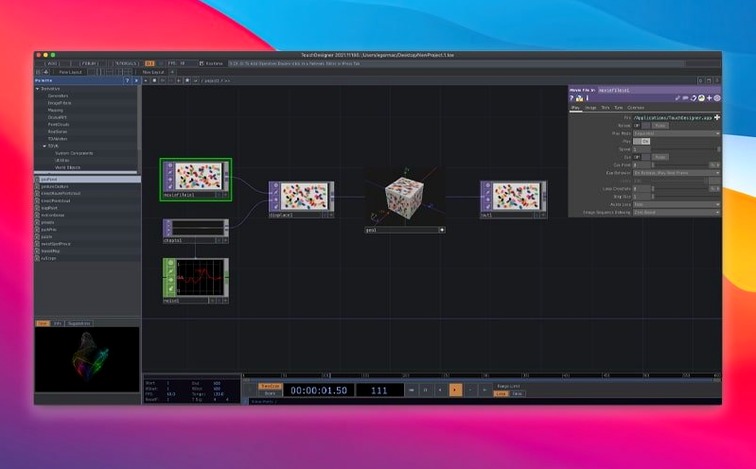
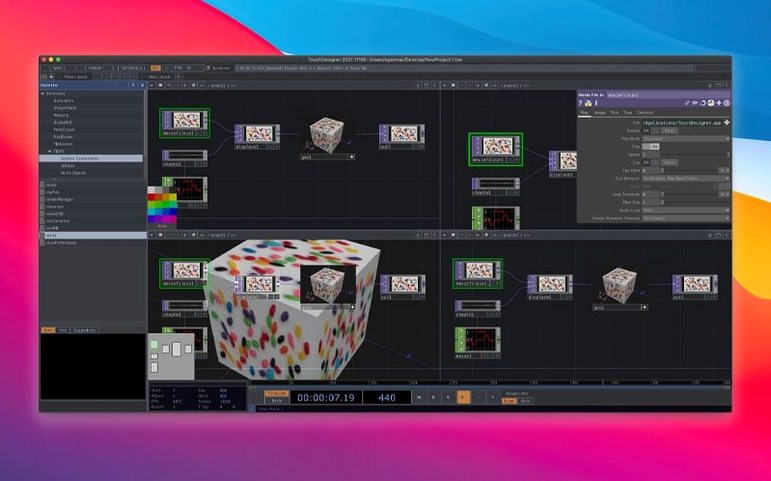
Now the fun part. Duplicate the Geometry COMP four times, swap each to a different OBJ from the folder, and pack them inside a Container COMP. Feed the same audio-driven scale value to all five. Add a Transform TOP after the container's render output, dial the Rotate Y parameter to a Speed CHOP that ramps from zero to one over ten seconds, and the whole scene starts a slow, meditative spin. The entire network — from audio input to final render — stays visible as a single screen of connected tiles.
Small conveniences that sneak past the tutorials
- Middle-click any parameter label to reset it to its default. Works on sliders, text fields, color pickers — everywhere.
- Right-click a cable and choose Insert Operator to place a new node between two already-wired ones without breaking the chain. Saves re-wiring a dozen connections by hand.
- Press U on a selected operator to jump to its upstream neighbor; press I to see every downstream node. It's like a browser's back/forward buttons for your signal flow.
- Drag a .tox file from Finder directly onto the network pane — no import dialog, no menu diving. The component lands exactly where you dropped it.
- The Perform CHOP sits in the palette but gets overlooked. It records any slider movement as editable keyframes. Drag a parameter onto it, wiggle the slider during playback, and you have an animation track without opening a timeline editor.
- Hold Shift while connecting two operators and TouchDesigner auto-routes the cable around existing nodes instead of drawing a straight line through them. Small thing, but your network stays readable when the node count climbs past thirty.
For those who found their way here through a TouchDesigner torrent or a TouchDesigner crack Mac search, the non-commercial download on Derivative's site gives you the full operator set and a 1280×720 output ceiling — enough to build an entire installation, test every sensor input, and see real-time performance before you need higher resolution. It's the same build, not a stripped-down demo.
The 2025 release brings a fresh operator family and broader hardware support.
- Point Operators (POPs) — a new family for GPU-based 3D point creation and manipulation.
- Most TOPs now natively support 3D textures and 2D arrays.
- Orbbec SDK bumped to 1.10.16, adding Intel Mac compatibility.
- macOS 10.14 or later
- Intel-based Mac
Questions I actually get
Does TouchDesigner work on Intel Macs?
Yes. The current build requires macOS 10.14 or later and runs on Intel-based Macs. The Orbbec SDK also gained Intel Mac support in this release.
What are Point Operators in TouchDesigner?
Point Operators, or POPs, are a new operator family introduced in 2025. They run on the GPU and handle creating and modifying 3D point data for real-time rendering and effects.
Porch talk 0
Come in or pull up a chair to leave a comment.
Nobody has pulled up a chair yet. If you used it on a real Saturday, say what the hour was.
More for the same hour
Everything in Mac Apps
 Transmit
5.11.7 Mac Apps
Updated 34 MB
Transmit
5.11.7 Mac Apps
Updated 34 MB

 Topaz Video AI
1.7.1 Mac Apps
1.6 GB
Topaz Video AI
1.7.1 Mac Apps
1.6 GB
 Topaz Photo AI
2.1 Mac Apps
Updated 36 MB
Topaz Photo AI
2.1 Mac Apps
Updated 36 MB
 Topaz Gigapixel AI
1.3.5 Mac Apps
372 MB
Topaz Gigapixel AI
1.3.5 Mac Apps
372 MB
 TunesKit iPhone Unlocker
2.7.0.16 Mac Apps
64 MB
TunesKit iPhone Unlocker
2.7.0.16 Mac Apps
64 MB
 Tuxera NTFS
2023.1 Mac Apps
111 MB
Tuxera NTFS
2023.1 Mac Apps
111 MB

 Typeface
4.5.0 Mac Apps
23 MB
Typeface
4.5.0 Mac Apps
23 MB
 UltraEdit
25.0.0.11 Mac Apps
28 MB
UltraEdit
25.0.0.11 Mac Apps
28 MB