
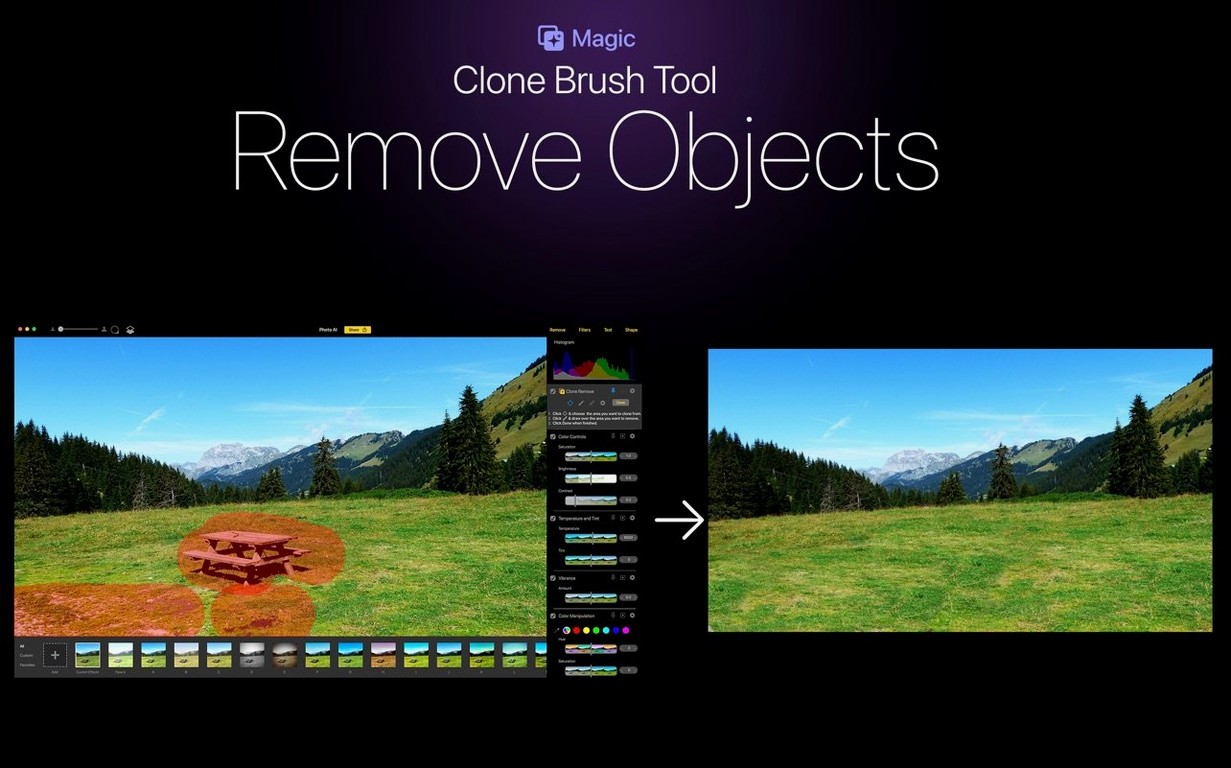
If you've spent time with older versions of Topaz Labs plugins, the name itself sets a certain expectation for detail recovery and noise reduction. Topaz Photo AI, now the legacy discontinued app, picks up part of that lineage as a standalone editor.
What to expect when you open it
- It's a desktop photo editor built around AI enhancement, so you're not juggling multiple plugins.
- Content-aware object removal lets you clean up a scene without switching to another tool.
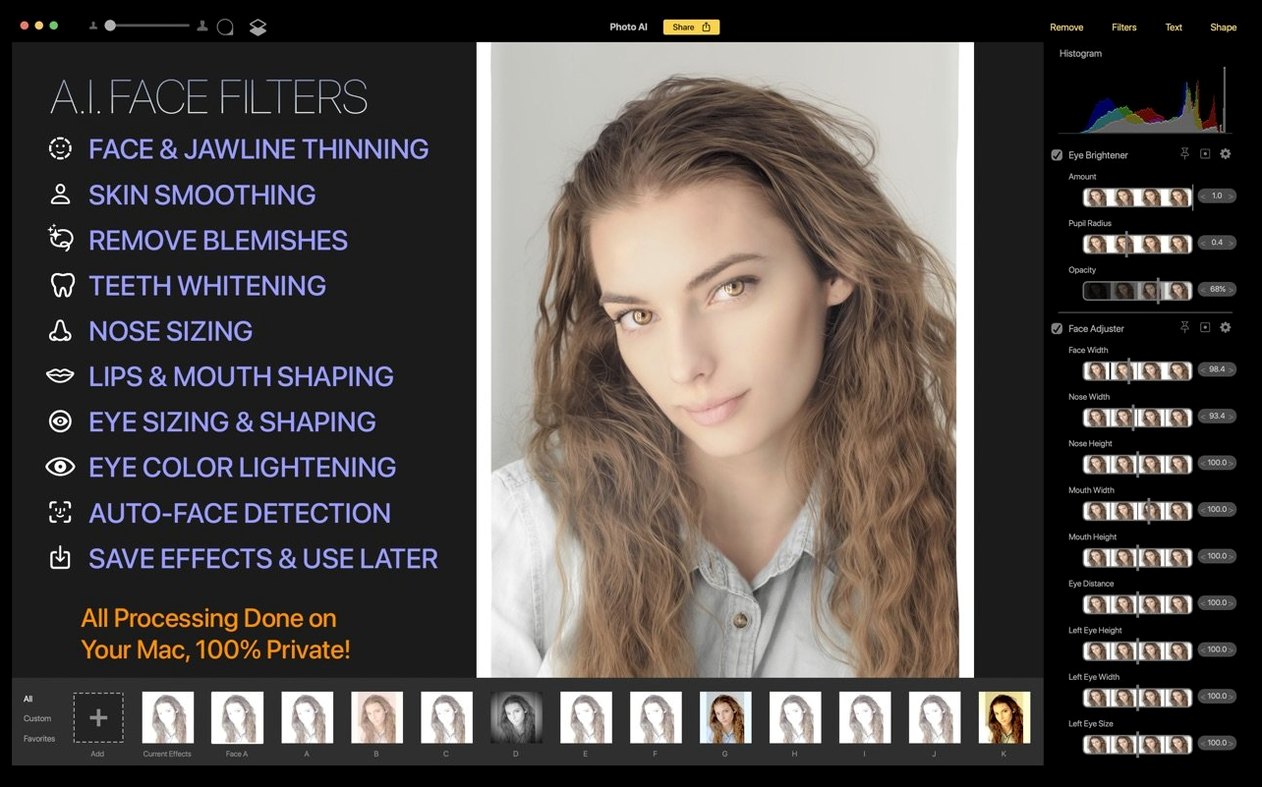
- Face filters are included for quick portrait adjustments.
- You can add text and shapes for simple overlays and callouts.
- The interface runs in English or Simplified Chinese, and it still works on Intel Macs running macOS 11 or later.
Portrait retouchers skipping round-trips
Not every photo tool suits every photographer, and Topaz Photo AI leans toward a particular kind of user. Portrait retouchers who need quick face filters without round-tripping through Lightroom or Photoshop tend to settle in fast. The face-aware adjustments cover smoothing, eye sharpening, and subtle reshaping, all in one panel, so a headshot session doesn't turn into an afternoon of layer masks.
Real estate and product photographers get mileage from the content-aware removal. Cleaning a scuff mark off a floor or erasing a stray cable from a tabletop shot happens in a few clicks, and the fill usually blends well enough that you don't feel the urge to open a dedicated cloning tool. Hobbyists who shoot events or family gatherings also appreciate the non-destructive pipeline — you can push sliders around, save a version, and still walk back to the original if the crop changes later.
If you're the kind of Mac user who keeps an older Intel machine running and wants one app that handles cleanup, enhancement, and basic compositing without a subscription-shaped clock ticking in the background, this is the audience the legacy version still serves. It's less about batch-processing a wedding and more about the deliberate, frame-by-frame polish that a weekend session affords.
Twelve RAW files and a morning coffee
Picture a Saturday morning with a coffee and a card full of shots from yesterday's walk around the neighborhood. You mount the disk image, open the app, and drag a dozen RAW files onto the window.
One frame catches your eye — a slightly underexposed shot of a street musician, ISO 3200, grain creeping into the shadows. You start with the AI denoise controls. A preview renders in about three seconds on a 2019 iMac, showing the noise pattern smooth out while the texture in the guitar neck stays legible. You pull the luminance slider to about 40 and leave the color noise reduction at its default; the result looks natural, not waxy.
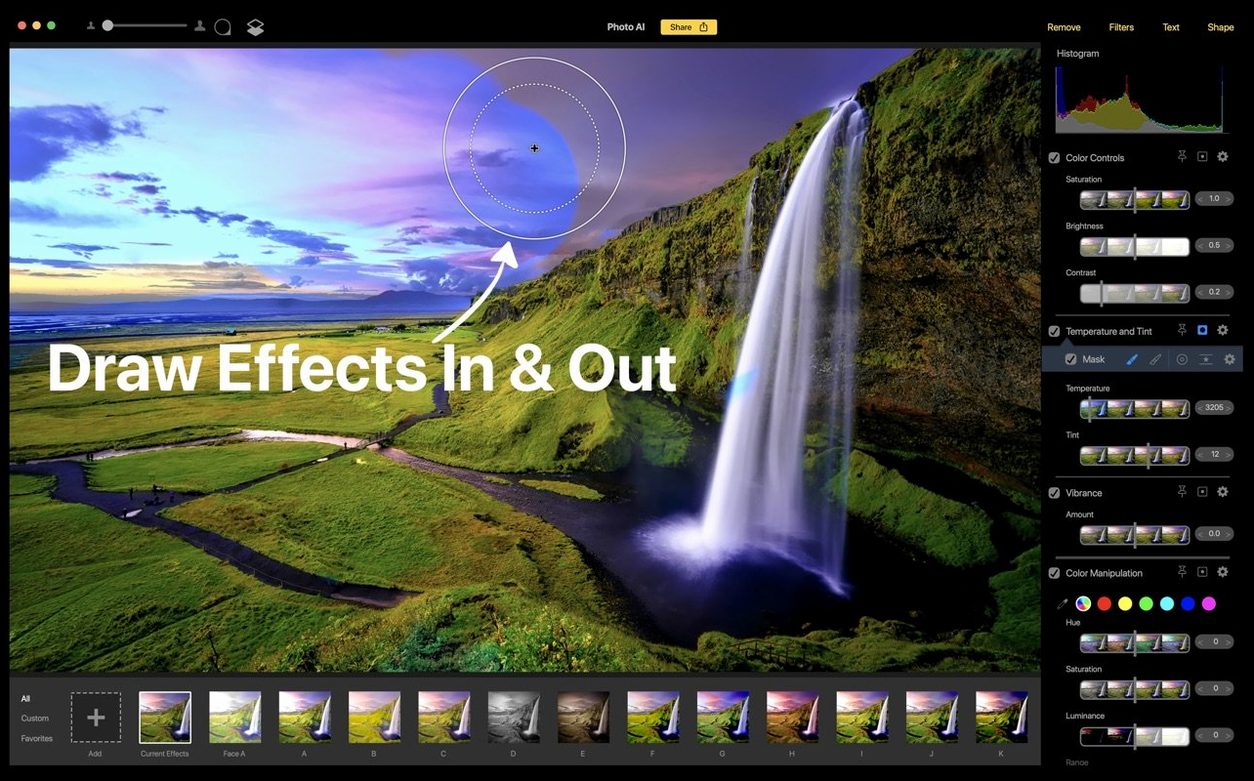
Next you notice a discarded coffee cup near the musician's case. The object removal tool lets you brush loosely over it. The app pauses for a beat, calculates the fill, and the cup vanishes into the cobblestone pattern. A second pass cleans up a faint edge, and you move on.
The musician's face is partly shaded by a hat brim, so you open the face filter section. A subtle eye brighten and a touch of shadow recovery bring the expression forward without making the shot look processed. You add a thin white border with the shape tool — just a frame to separate the image from the dark background of your photo blog — and save a full-resolution TIFF alongside the original RAW. The whole edit takes under four minutes, and nothing leaves your hard drive.
Stacked face filters add a few seconds
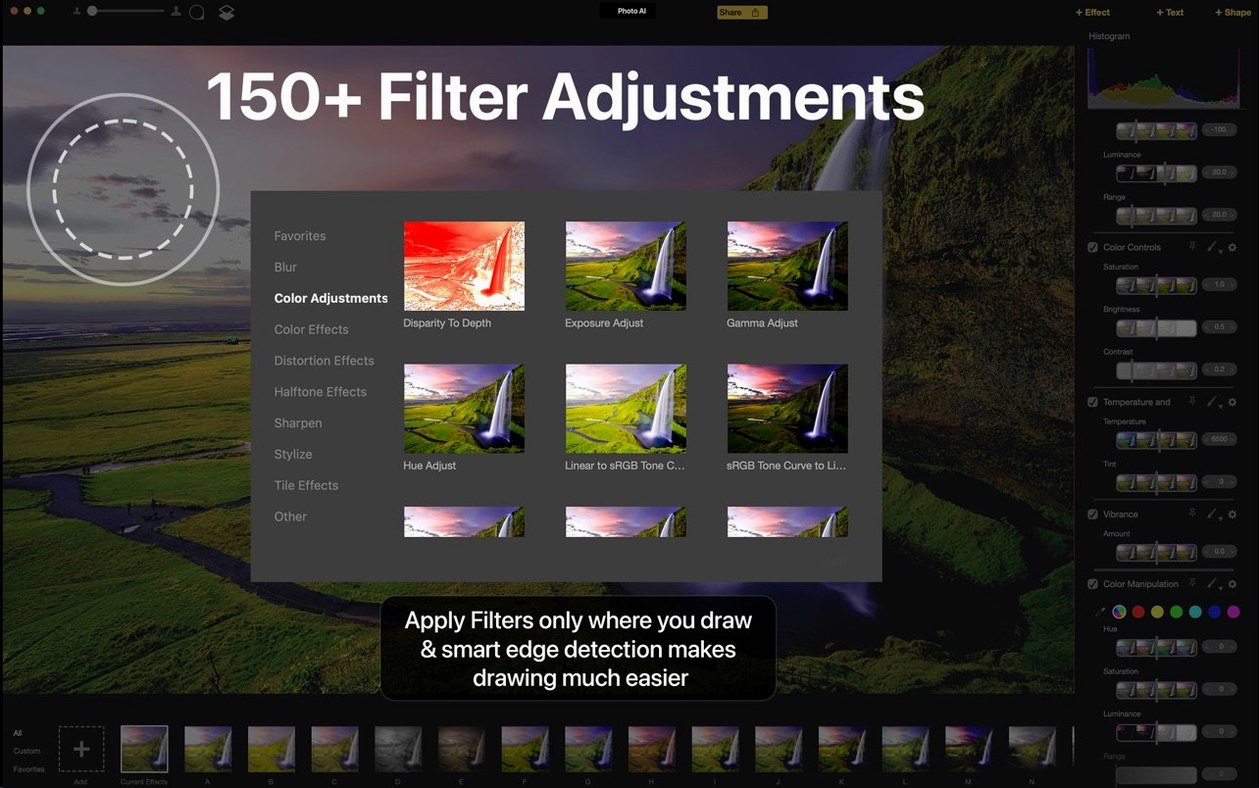
Speed varies with the task, though the pattern is predictable. Denoising and sharpening previews render quickly on Intel machines with 16 GB of RAM or more; the heavier face filters add a few seconds, especially if you stack multiple adjustments. The content-aware removal is the most processor-hungry operation, sometimes taking eight to ten seconds on a 24-megapixel file, but it runs entirely locally, so there's no upload lag or server queue to contend with.
Stability on macOS 11 and later is uneventful in the best sense. I haven't seen the app beachball during a brush stroke or crash mid-export. Memory usage hovers around 1.2 GB with a handful of open files, which leaves room for a browser and a music player in the background. The non-destructive editing means the undo stack can grow, but even after thirty steps the responsiveness doesn't degrade noticeably.
For anyone who has gone looking for a topaz photo ai torrent mac download to try before committing, the local processing model is one of the quiet strengths. There's no account sign-in required, no cloud watermark appearing on exports, and no internet connection needed once the models are downloaded. If you've previously searched for a topaz photo torrent and want to make sure you're getting the complete package, the full feature set here includes every AI model and the additional models that the newer Topaz Photo carries forward.
Legacy app still packing all original models
Does it still make sense now that it's a legacy app? If you're running an Intel Mac and want the complete set of AI enhancement tools that originally shipped with Topaz Photo AI — plus the extra models — version 2.1 delivers exactly that. The newer Topaz Photo includes these same models, so you're not losing capability by staying on the legacy release; you're just on a branch that won't see feature updates. For a stable, mature toolset on older hardware, that's often an advantage.
How does the TNT activation work? The disk image includes a Gatekeeper-friendly opener script. You mount the image, run the opener, press Enter in Terminal when prompted, and then drag the app into your Applications folder. That's the whole sequence. Once it's in place, the app launches without further steps.
Will the in-app purchases nag me? The interface includes built-in purchase options, but all core editing — denoise, sharpening, face filters, object removal, text and shape tools — works without them. The non-destructive pipeline, export, and filter stack are fully available from the first launch.
Can I use it alongside other editors? Yes. You can open a file directly, or you can use it as a dedicated enhancement station: export a TIFF from your raw processor, run it through Topaz Photo AI for cleanup and face work, then bring the result back for final color grading. The save dialog preserves metadata well enough that Lightroom and Capture One recognize the files without complaint.
If you've been curious enough to search for a topaz photo ai crack mac thread or a topaz torrent listing just to see what the models can do on your own files, the installer here answers most of those questions with the confidence of a complete bundle. It's a full, self-contained editor that runs where you need it, on the Mac you already have.
If you're on an older Intel machine and want a single window for cleanup and enhancement work, it's a comfortable fit.
Version 2.1 moves purchases inside the app itself, so you handle everything from one place instead of visiting an external store.
- macOS 11 or later
- Intel 64‑bit (Apple Silicon Macs run it via Rosetta)
Porch talk 0
Come in or pull up a chair to leave a comment.
Nobody has pulled up a chair yet. If you used it on a real Saturday, say what the hour was.
More for the same hour
Everything in Mac Apps
 Topaz Gigapixel AI
1.3.5 Mac Apps
372 MB
Topaz Gigapixel AI
1.3.5 Mac Apps
372 MB

 Topaz Video AI
1.7.1 Mac Apps
1.6 GB
Topaz Video AI
1.7.1 Mac Apps
1.6 GB
 TouchDesigner
2025.31550 Mac Apps
615 MB
TouchDesigner
2025.31550 Mac Apps
615 MB

 Transmit
5.11.7 Mac Apps
Updated 34 MB
Transmit
5.11.7 Mac Apps
Updated 34 MB
 TunesKit iPhone Unlocker
2.7.0.16 Mac Apps
64 MB
TunesKit iPhone Unlocker
2.7.0.16 Mac Apps
64 MB
 Tuxera NTFS
2023.1 Mac Apps
111 MB
Tuxera NTFS
2023.1 Mac Apps
111 MB

 Typeface
4.5.0 Mac Apps
23 MB
Typeface
4.5.0 Mac Apps
23 MB

 TG Pro
2.104 Mac Apps
Updated 15 MB
TG Pro
2.104 Mac Apps
Updated 15 MB