
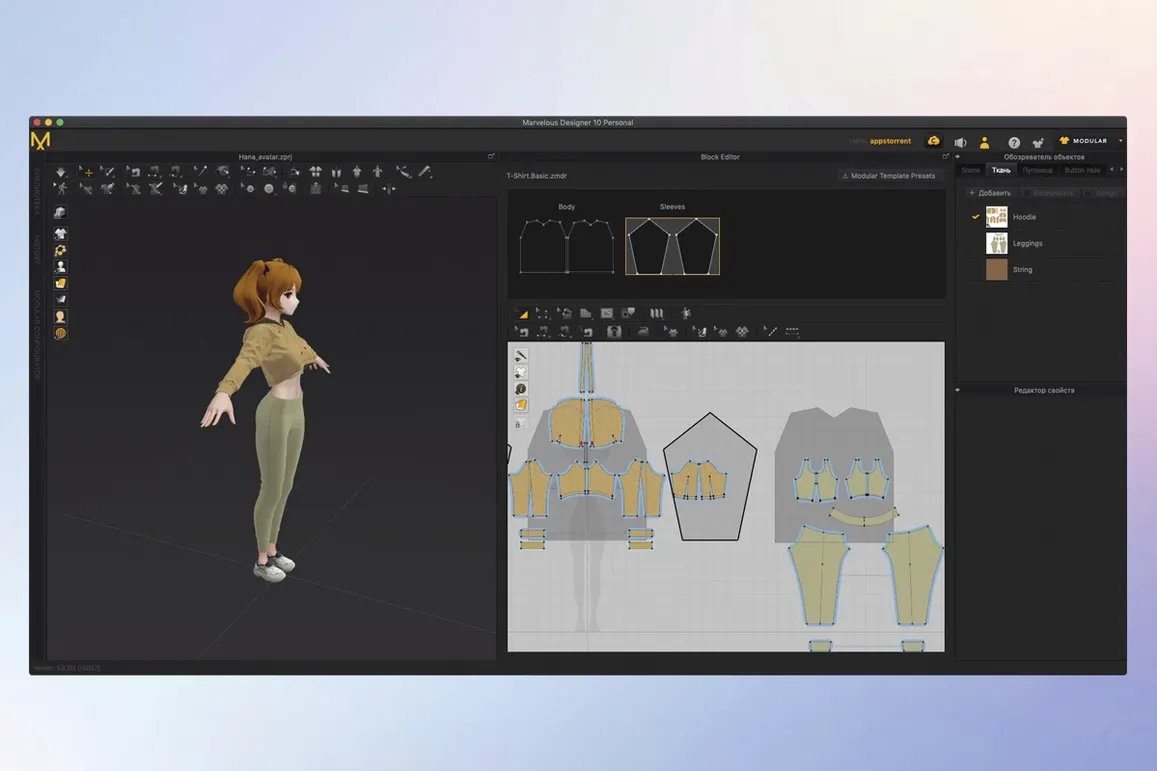
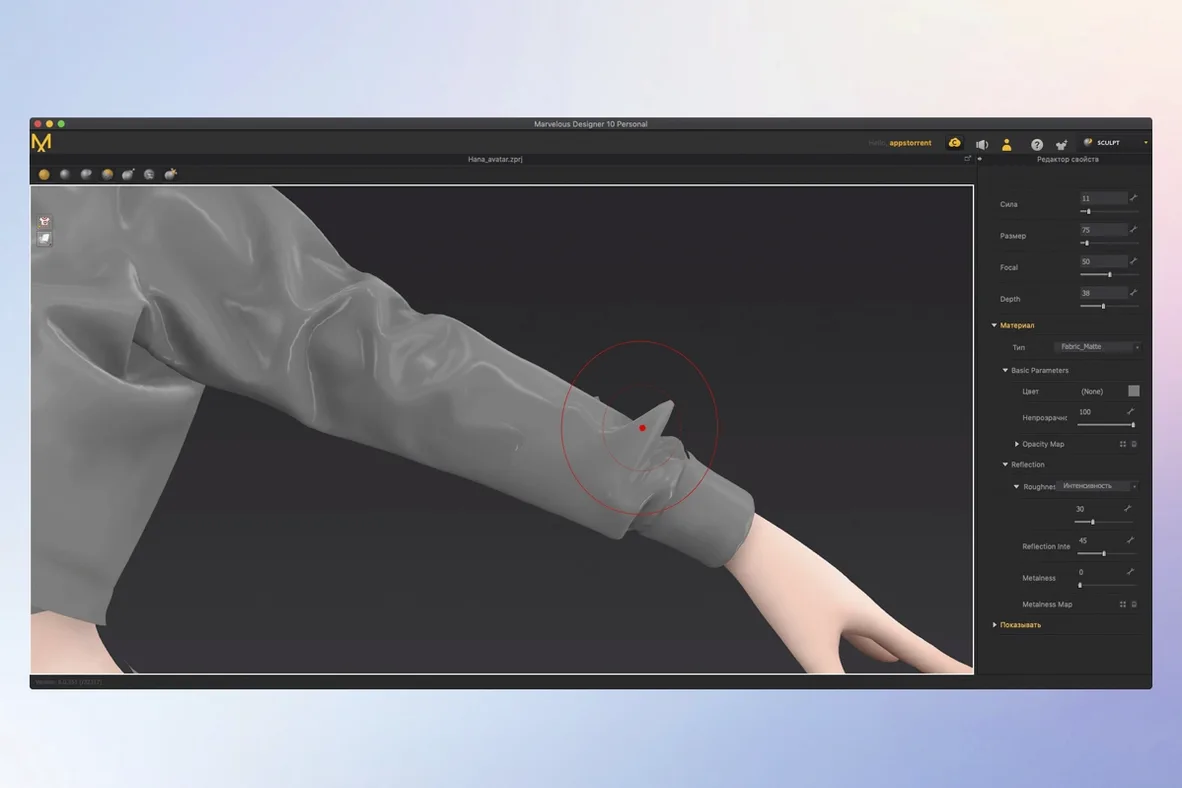
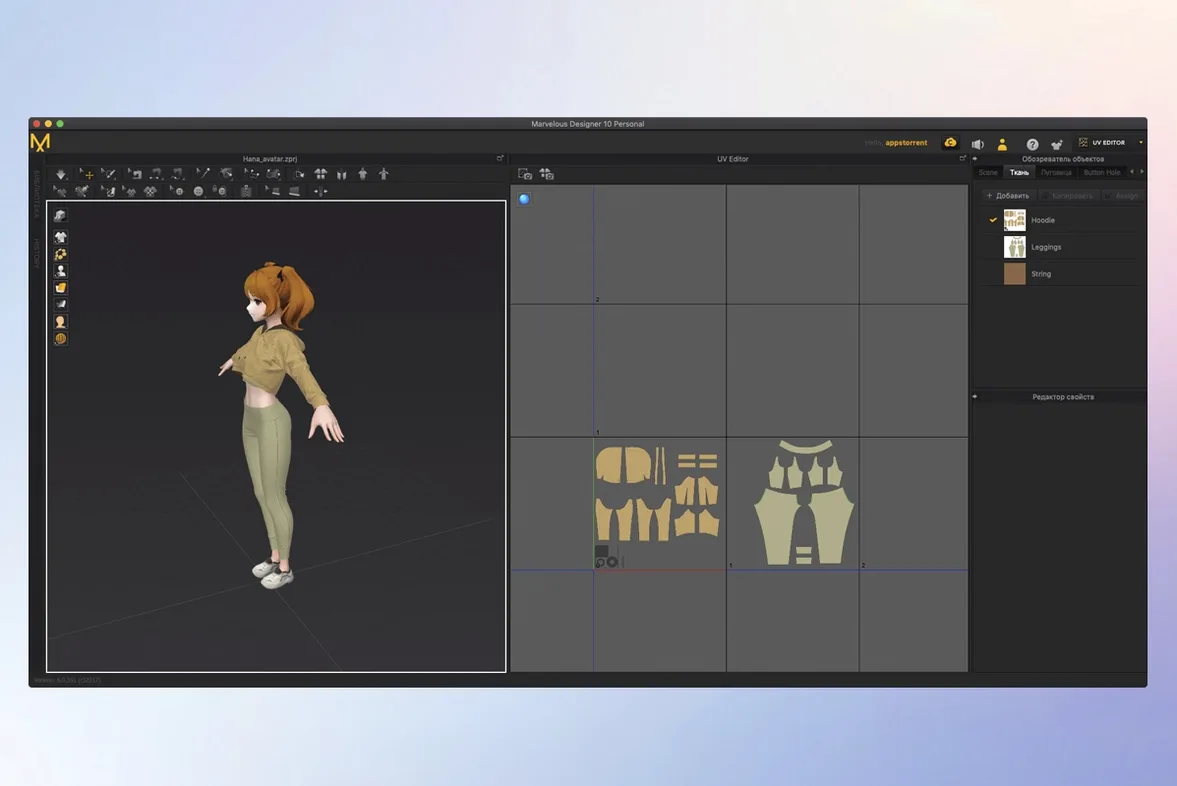
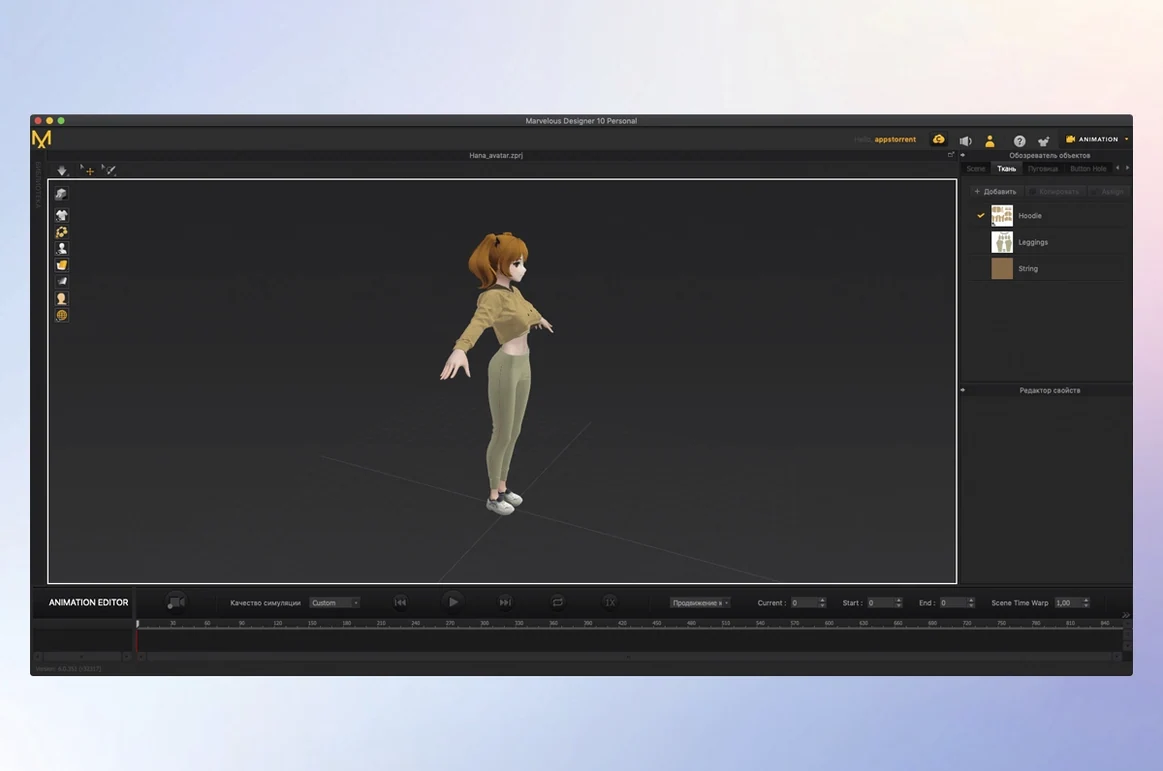
Costume designers, character artists, and 3D illustrators reach for Marvelous Designer when fabric needs to drape, fold, and move like the real thing. It’s a dedicated workshop for building digital clothing from scratch—pattern-based, physics-aware, and ready for animation.
Pattern-based garment creation — Start from flat 2D pattern pieces that you sew together around a 3D avatar. Point placement tools and an approachable interface make the sewing process feel direct, not buried in menus.
Fabric simulation engine — The software calculates textures and physical properties across every element: buttons, pleats, accessories. You can record realistic clothing motion on moving characters and save the result for reuse.
Wardrobe and interchange — Saved garments become reusable wardrobe items. Import and export data moves cleanly with Maya, 3ds Max, Softimage, Modo, and ZBrush, so a jacket built here can live in a larger production pipeline.
Stylized and technical workflows — Template-based rigging through EveryWear, Toon Shader for non-photoreal looks, and garment sketching tools give you room to pivot between tech packs and stylized character work.
Why Pattern-Based Workflow Outshines Blender’s Sim
When you have a character that needs a hoodie with natural shoulder slouch, Blender’s cloth sim will get you partway there. It’s free, tightly integrated with a full 3D suite, and plenty of Mac artists start with it. The trade-off shows up fast when you need multiple fitted garments on one character or want pattern pieces that mirror a real tailor’s logic. Blender expects you to build the garment mesh first, then let the solver figure out draping. Marvelous Designer flips that order: you draw seam lines, cut pattern shapes, and the simulation responds to the sewing relationships you set up. For a single quick cape, Blender holds its own; for a wardrobe of layered pieces that need to fit the same avatar across scenes, the dedicated tool saves hours of manual tweaking.
CLO, from the same developer, lives on the fashion-industry side of the fence. It shares the same pattern-and-simulation core but adds tech-pack tools, grading, and fabric libraries aimed at garment production. If your work stays in real-time rendering, game art, or VFX, Marvelous Designer gives you the simulation engine without the manufacturing toolkit. Clo is the tailor’s workbench; Marvelous Designer is the costume department’s.
Substance Painter handles texturing, not cloth, yet it comes up in conversation because people use them side by side. Painter can’t simulate a sleeve riding up a forearm, but it excels at the wear and tear that goes on top of that sleeve. The two apps share a USD and Alembic bridge, so a garment draped in Marvelous Designer lands in Painter with UVs intact and ready for material work.
Near-Real-Time Draping on Apple Silicon Chips
Simulating fabric on an animated character is a hungry task, and the software wears that appetite openly. On Apple Silicon, garment calculations stay responsive through moderate-poly scenes; a fitted shirt with a few thousand triangles drapes in near real time. Push into multi-layer outfits with linings, collars, and accessories, and you’ll notice the simulation queue stacking up. The GPU contributes to viewport smoothness, but the heavy lifting of collision and cloth solve still leans on the CPU, so a machine with solid single-core speed matters more than a bulging GPU core count.
Memory use is proportional to scene complexity. A single garment on a static mannequin runs lean—well under a gigabyte in many cases. Add an animated character, four layered garments, and a particle-based trim, and the working set climbs past six gigabytes without much ceremony. The app rarely crashes during straightforward draping sessions, though the occasional freeze can arrive when you override too many simulation parameters at once during a live solve. Saving incrementally becomes second nature after the first complex dress fitting.
Startup time is modest; the interface draws its panels without the sluggish splash-screen wait some 3D tools carry. Exporting a deforming mesh to Alembic—the step that connects your work to a renderer or game engine—runs at disk speed once the simulation cache is baked. That cache can grow large on dense animations, so keeping a tidy project folder helps.
Exporting Tunics and Alembic Sequences for Game Engines
Game character artists sit squarely in the sweet spot. You need a tunic that flows during a sprint animation, and you need it to export cleanly to your engine’s cloth system or as a baked Alembic sequence. The pattern-based workflow means you can build a library of shirts, coats, and trousers that share the same avatar rig, then mix and match across characters without re-sculpting from scratch.
VFX generalists who handle costume close-ups benefit from the same precision. A hero jacket with working zipper geometry, stitched seams, and believable collar roll gives a compositing team material they can light and texture without fighting a stiff, unconvincing mesh. The USD export pipeline means that jacket can travel through a Solaris workflow while keeping its structure intact.
Indie illustrators and toon-shade enthusiasts will find a quieter, less obvious gift in the Toon Shader. Building a stylized dress with clean, readable folds—then seeing those folds hold as the character turns—removes a lot of the hand-drawn correction that normally chases any pose change. It is a tool for people who enjoy the logic of sewing and want that logic to carry through to the final render, whether that render is photoreal or a cel-shaded splash page.
- macOS 12 or later
- Runs on Intel and Apple Silicon Macs
- Interface available in Russian, English, Arabic, Spanish, Italian, Chinese (Traditional and Simplified), Korean, Portuguese, Turkish, French, and Japanese
Porch talk 0
Come in or pull up a chair to leave a comment.
Nobody has pulled up a chair yet. If you used it on a real Saturday, say what the hour was.