

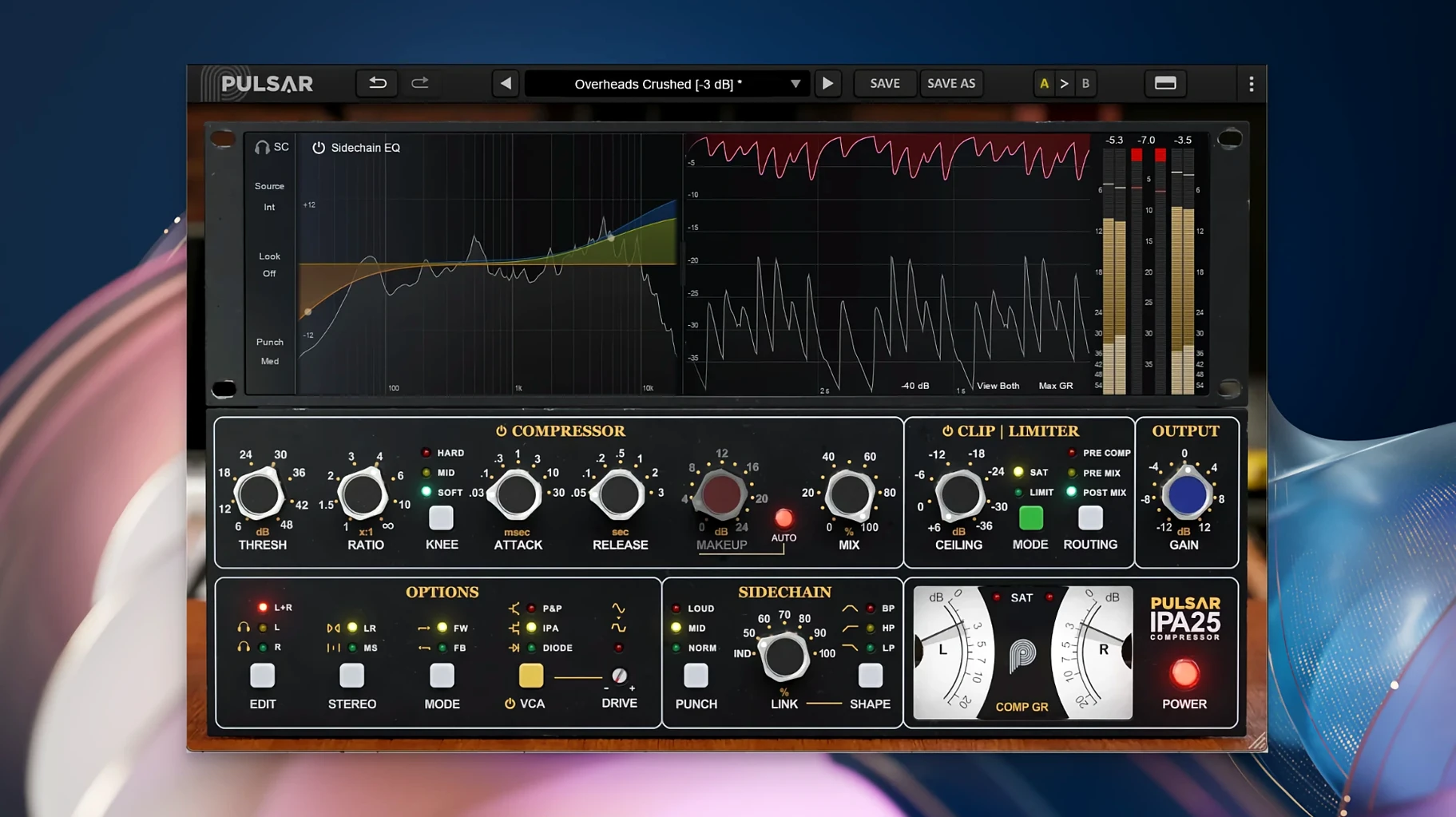
Before you dial in a single setting, know that Pulsar Audio IPA runs natively on Apple Silicon Macs and any Intel machine still on macOS 11 or later. It needs a host — there’s no standalone app — but the format support is generous: Audio Unit, VST 2.4, VST 3, and AAX Native are all in the box, so it slides right into Logic Pro, Ableton Live, Pro Tools or whatever DAW you call home.
| Key detail | What you get |
|---|---|
| Plugin type | Multi-VCA dynamics processor |
| Formats | AU, VST 2.4, VST 3, AAX Native |
| Architecture | Apple Silicon native, 64-bit |
Sonically, IPA takes its cues from the classic API 2500 bus compressor but pulls the idea forward with three switchable VCA modes. You get the punchy, named IPA mode, a smoother P&P/Mu option, and a Diode setting that brings a different grip to the gain reduction. The Mid/Side matrix lets you treat the center and the edges of a mix independently, and a visual sidechain EQ sits right on the faceplate so you can carve away low-end rumble from the detector path without guessing. A built-in clipper and limiter round out the output stage, which makes this as much a tone shaper as a dynamics tool. If you’re a music producer or mix engineer who leans on the drum bus or the master fader for glue, the layout here feels familiar on day one and rewards a little exploration.
Three VCA flavors for drum shells that cut
Mixing engineers who already think in terms of bus compression will feel at home in about ten minutes. The three VCA modes map neatly onto real-world habits — grab the IPA mode for drum shells that need to cut, switch to P&P/Mu when a vocal subgroup feels brittle, and reach for Diode mode on a bass line that wants some growl without losing its fundamental. Electronic producers get a lot of mileage out of the Mid/Side matrix, especially on synth-heavy choruses where the stereo field can turn into a wash if the sides aren't held in check. Tracking engineers who don't normally print compression find the clipper-limiter combo useful as a safety net: it catches transients that sneak past the VCA stage without flattening the performance. If you produce rock, pop, or electronic music and spend time massaging full mixes, the IPA fits the way a hardware console-style workflow does — one knob usually gets you most of the way there.
Sidechain EQ neglect skews the detector
The single biggest stumble is ignoring the sidechain EQ. Because the visual display sits front and center, it's tempting to leave it flat and just work the threshold and ratio. But on a full mix, low-frequency energy dominates the detector and makes the compressor pump in ways that feel unmusical. A gentle high-pass filter in the sidechain — even a subtle shelf — tightens the low end without thinning the mix itself. Another common misstep: running the input too hot into the clipper before setting the VCA stage. The clipper sounds best when it's catching the last couple of decibels, not working as the primary dynamics control. And if you're new to Mid/Side compression, start with the side channel at a gentler ratio than the mid; beginners often clamp the sides too hard and end up with a mix that feels narrow and over-controlled. The Diode mode is the least forgiving with fast attack times, so if the transients start to smear, back it off before you blame the plugin.
Beyond Logic’s single Vintage VCA nod
Logic Pro's stock Compressor includes a "Vintage VCA" circuit that nods toward the same API 2500 lineage. It's quicker to set up and integrates tightly with Logic's mixer, but it doesn't offer the three distinct VCA flavors or the visual sidechain EQ. The Logic compressor tends to sound a bit more rounded in the low mids, while IPA's IPA mode pushes the midrange forward with more insistence — useful for rock vocals and snare drums.
Waves API 2500 sticks closer to the original hardware's control set and has a well-worn reputation on the mix bus. It's got the thrust circuit and the familiar dual-channel layout, but it lacks the Mid/Side matrix and the built-in clipper-limiter stage that IPA includes. If you want the straight-up console sound, the Waves plugin delivers it. If you want that flavor with a wider toolkit — sidechain shaping, three VCA curves, output clipping in one window — IPA carves out its own lane.
TDR Kotelnikov is a different philosophy altogether: a clean, surgical compressor with an emphasis on transparency and an extremely flexible sidechain. It doesn't chase analog coloration the way IPA does, and it won't give you the same grab and push on a drum bus. But for mastering engineers who want precise control over the stereo field, Kotelnikov's implementation of dual-stage release and frequency-dependent ratio is deeper. IPA trades some of that precision for character, and on sources where you want the compressor to leave a fingerprint — a pulsing synth pad, a room mic — that's the right trade.
- macOS 11 or later
- Apple Silicon or Intel processor
- 64-bit plugin host (DAW)
- No standalone operation
Porch talk 0
Come in or pull up a chair to leave a comment.
Nobody has pulled up a chair yet. If you used it on a real Saturday, say what the hour was.
More for the same hour
Everything in VST Plugins RC-20 Retro Color
1.5.1 VST Plugins
170 MB
RC-20 Retro Color
1.5.1 VST Plugins
170 MB
 Plugin Alliance Shadow Hills OptoMax
1.0.0 VST Plugins
73 MB
Plugin Alliance Shadow Hills OptoMax
1.0.0 VST Plugins
73 MB
 reFX Nexus
5.5.21 VST Plugins
Updated 72 MB
reFX Nexus
5.5.21 VST Plugins
Updated 72 MB
 Plugin Alliance Brainworx Bundle
2025.06.16 VST Plugins
2.1 GB
Plugin Alliance Brainworx Bundle
2025.06.16 VST Plugins
2.1 GB
 Revoice Pro
5.1.30 VST Plugins
39 MB
Revoice Pro
5.1.30 VST Plugins
39 MB
 RipX DAW Pro
8.0.3 VST Plugins
1.6 GB
RipX DAW Pro
8.0.3 VST Plugins
1.6 GB
 Roland Cloud Legendary Series
2025.06.29 VST Plugins
1.3 GB
Roland Cloud Legendary Series
2025.06.29 VST Plugins
1.3 GB
 Roland ZENOLOGY Pro
2.0.7 VST Plugins
1.8 GB
Roland ZENOLOGY Pro
2.0.7 VST Plugins
1.8 GB