
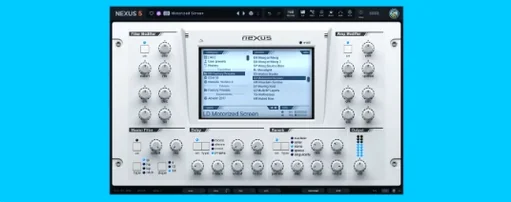
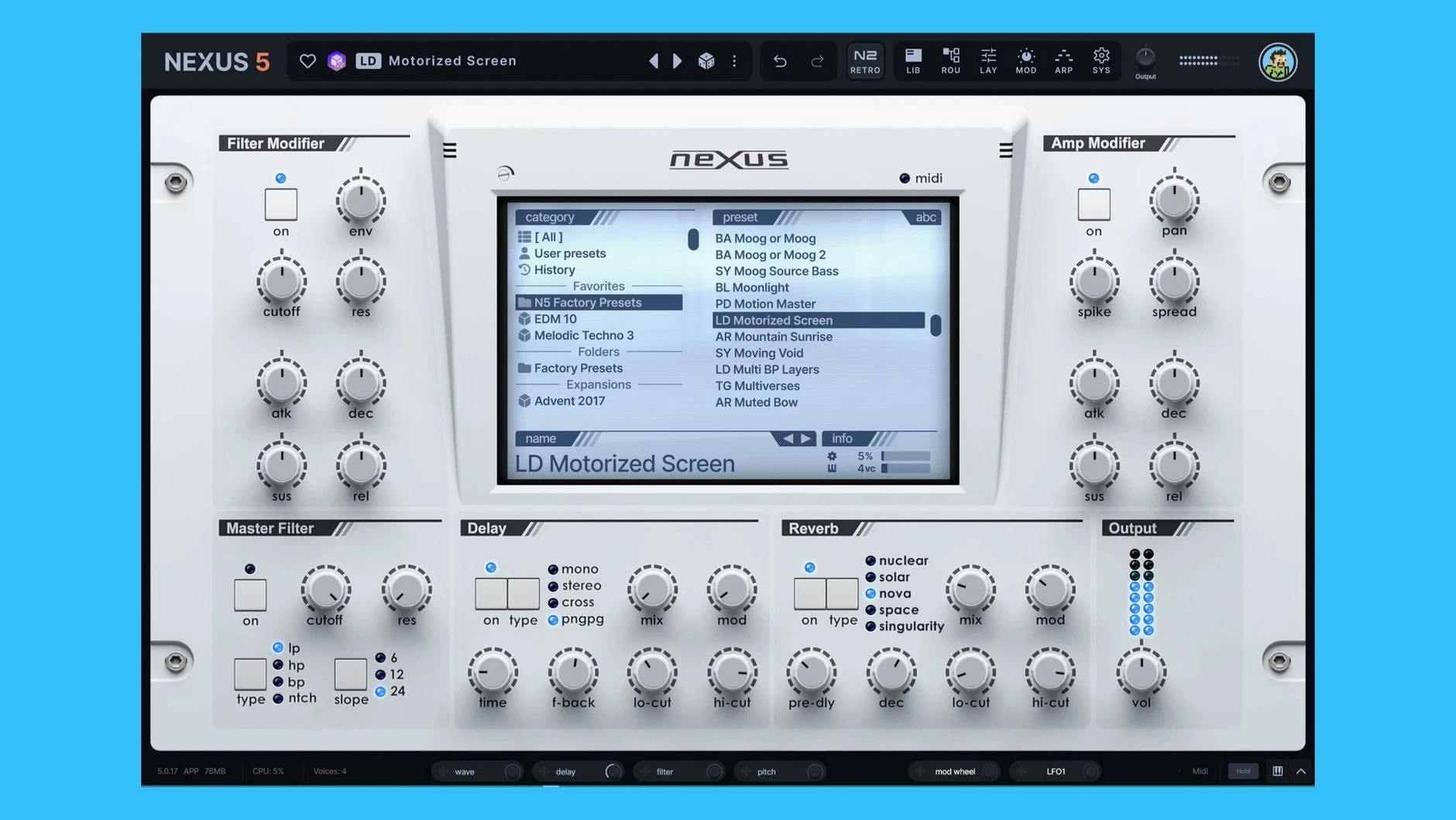
If you've ever used a classic rompler, you know the deal—great sounds, locked-down architecture. Nexus 5.5.12 takes that familiar starting point and hands you the keys to the engine room.
Plugin type — A sample-based sound design instrument, not a traditional rompler. It loads, edits, and creates presets rather than just playing back a static library.
Host compatibility — Runs in any DAW that supports VST or Audio Unit plug-in formats on macOS 10.15 and later, natively on both Intel and Apple Silicon machines.
Existing projects — Fully compatible with older NEXUS projects and expansion libraries, so your previous work opens right up.
Sound engine — Built around editing, slicing, looping, and crossfading audio files. Custom routings let you wire up modulation however you want, and a built-in effects section handles processing without leaving the window.
Custom expansions — You can build your own expansions from scratch, not just tweak factory content.
Visual customization — A new skin editor means the interface can look the way you want it to.
Presets So Efficient the CPU Barely Registers
After a few hours with Nexus 5.5.12 on a Mac, the first thing that stands out is how little it fights you. Loading a complex preset with layered oscillators, a full modulation matrix, and four effects slots barely moves the CPU meter on an Apple Silicon machine. On older Intel hardware it still holds its own—expect about the same footprint as a typical wavetable synth, nothing that'll choke a session with 20 other tracks running.
Memory use stays reasonable too. The plugin streams samples from disk by default rather than loading everything into RAM, which means those 2 GB expansion libraries don't bring your project to a halt. Patch switching is quick, usually under a second even on large multisampled instruments. I've had it running in Logic Pro alongside three instances of Serum and a heavy convolution reverb without a single dropout or crackle.
Stability has been solid through version 5.5.12. No unexpected quits during long editing sessions, no corrupted preset saves. The only minor hiccup shows up when you stack all 16 unison voices on a dense granular patch and play ten-note chords—at that point you're asking a lot of any synth, and the fan might spin up. For everyday work, it stays out of the way.
What impresses most is the consistency. Some plugins behave differently depending on the DAW, but Nexus loads identically in Ableton Live, Logic Pro, and FL Studio. The BPM readout on the SYS page syncs reliably with host tempo, and previewing presets now matches that tempo automatically. Small things that add up when you're moving fast.
Building a Pad from Scratch: A Walkthrough
Say you need a warm, evolving pad for a downtempo track. Here's how the workflow plays out start to finish.
Start by initializing a blank patch—clear out the default oscillators and effects so you're working with silence. Head to the oscillator section and load a slow-attack string multisample as layer one. Drop the amp envelope attack to around 800 ms and set the release to match, so notes bloom in and fade out gently. Add a second oscillator with a wavetable source, something metallic or glassy, and tune it up an octave. Blend it in at about 30% volume so it sits behind the strings.
Now open the modulation section. Route an LFO to the wavetable position of oscillator two, set the rate to a slow sync value like 2 bars, and give the depth ring about a quarter turn. The texture shifts over time without calling attention to itself. While you're in the mod matrix, assign velocity to the filter cutoff on both oscillators—lighter keystrokes stay soft, harder hits open up the top end.
Move to the effects section. Insert a reverb on slot one, dial the mix to 40%, and push the decay past three seconds. Slot two gets a subtle chorus to widen the stereo field. The new Clipper effect goes on slot three, set gently just to catch peaks and add a touch of saturation before the output stage.
Hit the SYS page and check the BPM readout—make sure the LFO sync lands where you want it. Play a few chords. Adjust the unison voices up to four on the string layer for thickness, leave the wavetable layer at one voice for clarity. Save the preset, name it meaningfully, and you've got a pad that'll sit in a mix without crowding the midrange. The whole process takes about ten minutes once you know where everything lives.
Unlock the Hidden Sample Editor Under the Hood
A few things trip up new users consistently. The biggest one is treating Nexus like a preset player and ignoring the sample import tools. The plugin ships with a capable editor for slicing, looping, and crossfading audio—dragging in your own field recordings or drum hits is where it stops being someone else's instrument and starts being yours.
Another common stumble: overloading unison voices on every patch. Sixteen voices per oscillator sounds huge in isolation, but in a dense arrangement it turns into mud. Use it on lead sounds and thin it out on pads and keys. The unison overhaul in this version makes high voice counts cleaner than before, but restraint still pays off.
Beginners also tend to skip the modulation destination for oscillator phase minimum and maximum, added in 5.5.12. It's not the flashiest feature, but tiny phase offsets between layers can create stereo width that doesn't collapse to mono. Set one oscillator a few degrees off from another and listen on headphones—the difference is immediate.
Finally, the reFX Cloud manager trips people up when they move between machines. If you switch from a Mac Studio to a MacBook, make sure the cloud app has finished syncing your expansion libraries before launching the plugin. Half-loaded content causes missing-sample errors that look like bugs but are just sync issues.
Apple Silicon Native and Your Old Libraries Intact
Does it work on Apple Silicon natively? Yes, the plugin runs native on ARM without Rosetta. Install times are short, and there's no performance penalty from translation layers.
Will my old NEXUS expansions still load? Every library from previous versions opens in 5.5.12. The architecture changed significantly from version 2, but reFX maintained backward compatibility throughout the 5.x line. If you've got content from Nexus 2, those expansions carry forward without conversion steps.
Can I use my own samples, or am I locked into the factory library? You can load, edit, and multisample your own audio files directly in the oscillator section. The slicing and crossfading tools are built into the interface, and custom expansions you create behave like any other content in the browser.
Is it stable with large projects? In daily use across Logic Pro and Ableton Live, crashes are rare. The plugin handles 50-plus track sessions without becoming the weak link, and preset recall remains snappy even when the project file references several expansion libraries at once. Users coming from earlier versions notice the difference immediately—5.5.12 tightened up a lot of the loose ends from the initial 5.0 release.
Does the skin editor let me redesign the whole interface? You can recolor, reposition, and restyle most elements. It's not a full vector rebuild, but you can match the look to your studio setup or just make the text larger for late-night sessions. The editor saves skins separately from presets, so switching between light and dark setups takes one click.
Anyone searching for refx nexus mac info usually wants confirmation on that Apple Silicon support—it's there and it's solid. If you're coming from an older version or exploring refx nexus torrent packages to test the waters, the 5.5.12 build is the one that finally feels complete. The jump from refx nexus 2 mac compatibility to the current engine is substantial, and the upgrade path preserves everything you've already built.
Anyone who felt boxed in by first-generation romplers should take a fresh look. This is sound design territory now.
Version 5.5.21 brings a handful of interface polish updates and fixes that make Nexus feel just a bit more put-together — especially if you enjoy customising the look of your synth.
- The Skin Editor now handles dialog styling: background, title, text, and buttons are all customisable.
- You can open a skin file directly from the skin browser via the context menu.
- Color names in the Skin Editor appear without internal prefixes, so they're easier to read at a glance.
- The Impulse oscilloscope now matches the color scheme used by other effect displays.
- Fixed loading, saving, and thumbnail display for skins with dots in their filenames.
- Knob colors now save correctly when switching back from a light skin to the default.
- The oscilloscope in the Impulse import window follows the skin styling properly.
- Dialog text updates immediately when you switch skins while a window is open.
- Double-pressing Save As no longer reopens the window twice.
- macOS 10.15 or later
- Works natively on Apple Silicon and Intel 64-bit Macs
Questions I actually get
Can I create my own sounds in Nexus 5.5.12?
Yes. You can edit, slice, loop, and crossfade audio files, create custom presets, and build entirely new expansions.
Does Nexus 5 work with older Nexus libraries?
It does. Version 5.5.12 maintains compatibility with existing NEXUS projects and expansions.
What Mac formats does Nexus support?
Nexus runs as a VST or Audio Unit plugin on macOS 10.15 and higher, with native support for both Intel and Apple Silicon processors.
Porch talk 0
Come in or pull up a chair to leave a comment.
Nobody has pulled up a chair yet. If you used it on a real Saturday, say what the hour was.
More for the same hour
Everything in VST Plugins RC-20 Retro Color
1.5.1 VST Plugins
170 MB
RC-20 Retro Color
1.5.1 VST Plugins
170 MB
 Revoice Pro
5.1.30 VST Plugins
39 MB
Revoice Pro
5.1.30 VST Plugins
39 MB
 RipX DAW Pro
8.0.3 VST Plugins
1.6 GB
RipX DAW Pro
8.0.3 VST Plugins
1.6 GB
 Roland Cloud Legendary Series
2025.06.29 VST Plugins
1.3 GB
Roland Cloud Legendary Series
2025.06.29 VST Plugins
1.3 GB
 Pulsar Audio IPA
1.0.9 VST Plugins
75 MB
Pulsar Audio IPA
1.0.9 VST Plugins
75 MB
 Roland ZENOLOGY Pro
2.0.7 VST Plugins
1.8 GB
Roland ZENOLOGY Pro
2.0.7 VST Plugins
1.8 GB
 Safari Pedals Everything Bundle
2026.05 VST Plugins
628 MB
Safari Pedals Everything Bundle
2026.05 VST Plugins
628 MB
 Scaler 3
3.3.2 VST Plugins
1.4 GB
Scaler 3
3.3.2 VST Plugins
1.4 GB