

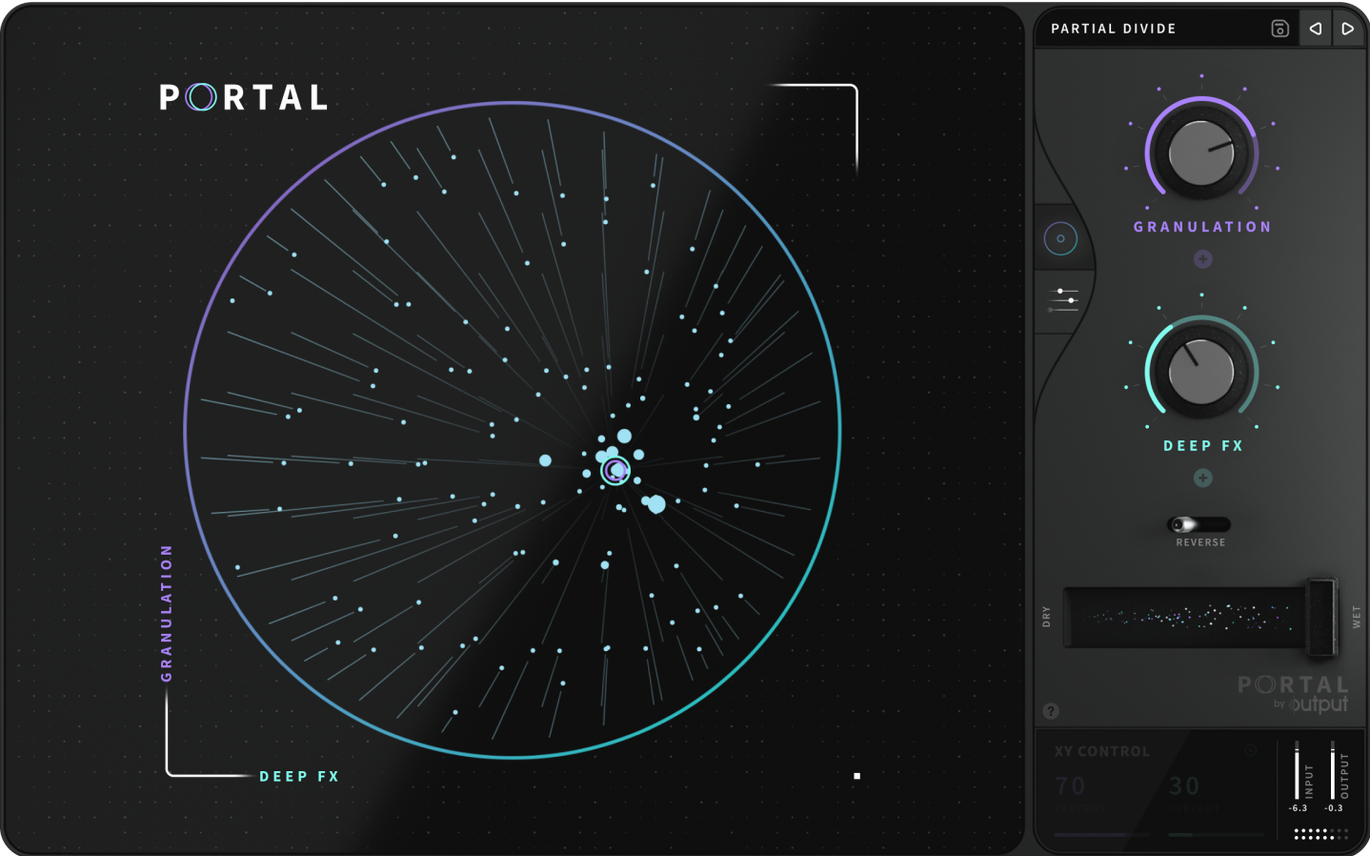
The dry/wet knob is where the conversation starts, but the grain controls are where you really get to know Portal. It listens to an incoming signal and reimagines it as a shifting cloud of tiny sonic particles. You can push the pitch of those grains up or down without ever altering the duration, keeping a loop locked in time while its harmonic character drifts somewhere else entirely.
Envelopes and Movement
What keeps the effect from sounding static is the natural variation you can introduce to each grain's envelope. Instead of a sterile on/off click, the grains breathe with subtle, organic shapes. It's this quality that places Portal squarely among Output's effects products, a textural processor that can run synchronized to your main tempo for rhythmic granular stutters or unsynchronized for a wash of free-floating sound.
In a Mix
Used on a synth pad, it creates a bed of pitched ambience that follows your chord changes. On a drum bus, it adds a metallic, time-stretched shimmer that stays locked to the beat. It's an effects plugin, not a software instrument, so it's all about what you feed it and how far you push those grain controls.
Installation is a familiar two-step process. You mount the downloaded disk image, run the standard installer, and pick the destination folder. On an Apple Silicon machine with macOS the plugin scans cleanly in Logic Pro and Ableton Live 11 without any security workarounds beyond what any third-party Audio Unit requires the first time. Rosetta isn't involved; the ARM binary loads natively and doesn't keep the fans guessing.
Timing Glitch Between Sync Modes Eliminated
Version 1.2.1 tightened a few things that matter in a long session. The grain engine used to drift slightly when you switched between synchronized and unsynchronized modes during playback; that timing glitch is gone now. Loading a preset while audio was running no longer causes a brief CPU spike that could trip up a dense project on older Intel machines. The scale lock for pitch also received a quiet fix — previously, certain microtonal offsets would snap back to equal temperament when you reopened a session, but they stick now.
On the everyday-use side, the plugin recalls its window position correctly across multiple monitors, a small mercy if you keep Portal open on a secondary display while arranging. The visual feedback on the grain density display updates more smoothly, so you're not left guessing whether a knob turn registered during a tempo change.
Default Patch Sips 3–5% CPU on Apple Silicon
How heavy it feels depends almost entirely on grain density and how many voices you've asked it to juggle. With the default patch you'll see roughly three to five percent CPU on a modern Apple Silicon chip, which leaves plenty of room for other processing. Crank the density high while feeding it a stereo piano recording and the meter might hover around twelve percent, still manageable on an M1 or M2. Intel machines work fine but show their age once the grain count climbs past 200 voices — expect occasional buffer underruns if your project is already near the ceiling.
RAM usage stays modest because Portal streams grains in real time rather than pre-computing a large buffer. I've run it alongside Thermal and Movement without any memory pressure warnings, even in sessions pushing forty tracks. Stability has been uneventful in the current build; no sudden dropouts or corrupted plugin states have appeared across a few weeks of daily use.
iLok Machine-Based or USB Key, No Cloud Option
Process Audio Instantly, Not a Deep Sample Mapper
Not quite, and that's by design. Portal processes whatever you route into it, so you don't get the deep sample-mapping or multi-layered voice architecture of something like Quanta or Pigments' granular engine. What you gain is immediacy — slap it on a vocal take and you're sculpting grains within seconds rather than building a patch from scratch. If you already own soft synths you love, Portal extends their tonal reach without asking you to learn a new instrument paradigm.
Can it handle live input without hiccups?
Yes, with a small buffer setting the latency stays low enough for real-time guitar or vocal processing. The grain window is short by default, so you hear the transformation almost instantly. Many users grab the Output Portal torrent to test exactly this scenario before committing; feeding a live mic through a reverb into Portal produces moving, harmonized textures that sit beautifully under a sung phrase.
Is it redundant if I already have Thermal?
They occupy different territory. Thermal is about saturation, distortion and dynamic spectral shaping. Portal is about time, pitch and granular space. The two work together on a single channel without stepping on each other's toes, and the portal mac torrent community often pairs them on synth leads to add grit and grain in equal measure.
If you build ambient beds, cinematic transitions or rhythmic vocal chops, the portal torrent download fits neatly into a workflow that already relies on Output's other effects. It doesn't duplicate what you have; it adds a textural layer that modulation plugins alone can't reach.
- Works on Intel and Apple Silicon Macs
- English interface
Porch talk 0
Come in or pull up a chair to leave a comment.
Nobody has pulled up a chair yet. If you used it on a real Saturday, say what the hour was.
More for the same hour
Everything in VST Plugins Omnisphere
3.0.2c VST Plugins
205 MB
Omnisphere
3.0.2c VST Plugins
205 MB
 Nudist Audio Nudistort
1.2.5 VST Plugins
45 MB
Nudist Audio Nudistort
1.2.5 VST Plugins
45 MB
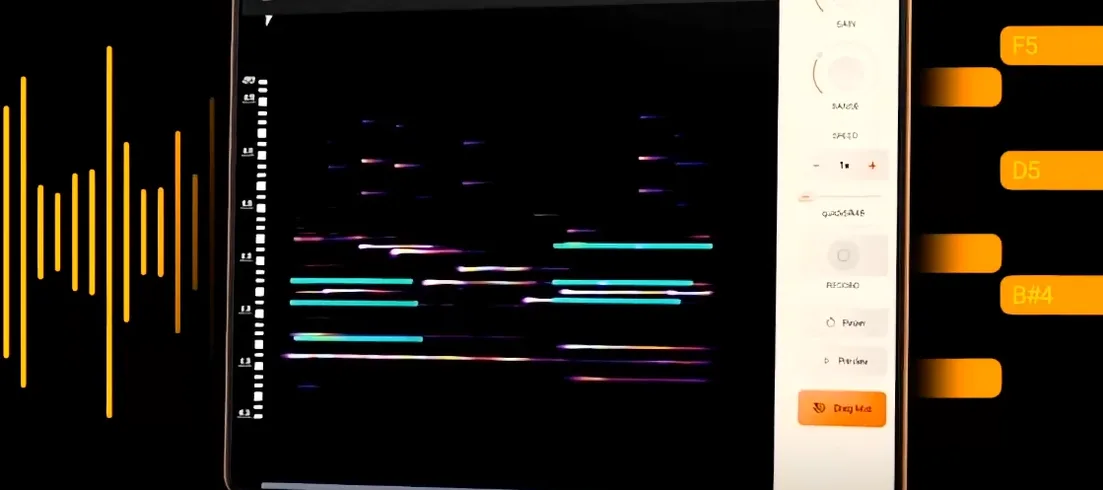 noteGRABBER
2.0.0 VST Plugins
35 MB
noteGRABBER
2.0.0 VST Plugins
35 MB
 Neural DSP Soldano SLO-100 X
1.0.0 VST Plugins
340 MB
Neural DSP Soldano SLO-100 X
1.0.0 VST Plugins
340 MB
 Neural DSP Parallax X
1.0.0 VST Plugins
179 MB
Neural DSP Parallax X
1.0.0 VST Plugins
179 MB
 Plugin Alliance Brainworx Bundle
2025.06.16 VST Plugins
2.1 GB
Plugin Alliance Brainworx Bundle
2025.06.16 VST Plugins
2.1 GB
 Neural DSP Fortin Nameless Suite X
1.0.1 VST Plugins
441 MB
Neural DSP Fortin Nameless Suite X
1.0.1 VST Plugins
441 MB
 Neural DSP Archetype Rabea X
1.0.1 VST Plugins
742 MB
Neural DSP Archetype Rabea X
1.0.1 VST Plugins
742 MB