
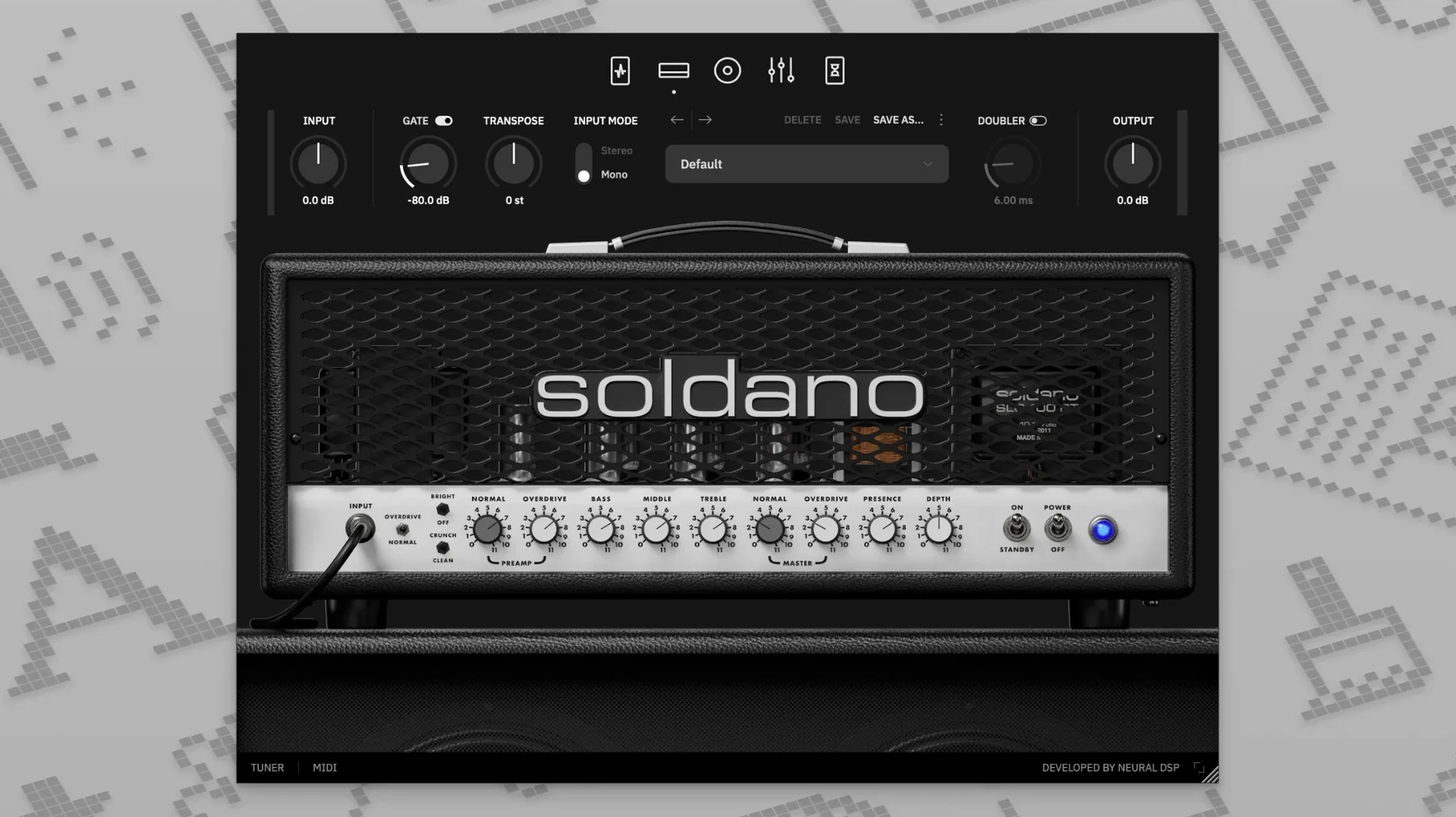
The Neural DSP Soldano SLO-100 X is a plugin recreation of the amplifier that gave American rock and metal its signature high-gain voice.
Dial in the preamp character
The preamp section goes well beyond a standard tone stack. A built-in compressor, clean boost, overdrive, and a vintage chorus sit right before the gain stages, letting you push the amp into saturated lead tones or add a watery shimmer without inserting extra plugins. It all reacts like hardware chained together on a pedalboard.
Shape the cabinet response
Hundreds of impulse response options sit inside the cabinet simulator, covering everything from tight modern metal to airy cleans. If you have a favorite IR collection, you can load your own cabinet files and the plugin treats them as a native part of the signal path.
Widen the stereo field
A doubling effect sits at the end of the chain, thickening single takes into wide stereo spreads. It is a straightforward control that can turn a dry rhythm part into something that fills the sides of a mix without artificial chorus modulation.
Give yourself the first three days to just turn knobs and listen. It’s tempting to load a preset and call it done, but the SLO-100 X rewards a slower approach. Start with the Clean mode, set the gain where the signal hovers just below breakup, and run your guitar’s volume knob through its full sweep. That alone will teach you more about the amp’s dynamic range than any demo video. On day two, pair the onboard overdrive with the Crunch channel and keep the drive low — use the pedal’s level to hit the preamp harder instead. By day three you’ll know exactly where the Bright switch belongs in your own mixes, and you won’t have to guess anymore.
Another early habit worth forming: save a blank template in your host with the plugin loaded in stereo, nothing else, ready to go. When an idea strikes, you skip the routing steps and start playing immediately. The standalone app works the same way — keep it in your dock for quick practice sessions through headphones, and you’ll stumble onto tones you’d never find while staring at a session timeline.
Medium-gain bloom after the engine rework
The biggest question is always whether the X version feels different from the original 2021 release. The modeling engine underneath got a thorough rework, and the difference shows most in the way notes bloom at medium gain. It’s not a night-and-day transformation — it’s more like the amp finally breathing the way you remembered it. Another common hesitation is about CPU load. On Apple Silicon Macs the plugin sits comfortably in a typical rock mix session with other tracks running, though a full spread of the onboard delay and reverb together nudges the meter a bit higher. Intel users should expect slightly hungrier behavior, same as with any modern amp sim, and freezing tracks solves it cleanly.
People also wonder if the cabinet section holds up against third-party IR loaders. The built-in cabs are voiced specifically for this amplifier’s output stage, and you can hear the intention behind each mic placement. Loading your own IRs remains an option, but plenty of players never feel the need to leave the stock selections. And yes — the plugin runs natively on Apple Silicon, no Rosetta required, so anyone hunting for a neural dsp soldano slo-100 free download that keeps pace with an M-series Mac will find this version ready from the first launch.
Thursday-evening rhythm rescue with a single cab swap
Imagine a Thursday evening. You’ve got a rhythm part that sounds decent through another amp sim, but it’s not sitting right against the bass. You open a fresh stereo track, insert the SLO-100 X, and bypass every effect except the amp and cabinet. Overdrive mode, gain at noon, master volume pulled back a touch. The nine-band EQ sits flat, but you dip 400 Hz by a few decibels and pull the low-pass filter down to 8 kHz — instantly the mud clears and the pick attack pushes through.
Now you switch to the cabinet section. The default pairing is close, but you scroll to a blend of a dynamic and a ribbon mic on a 4×12, panned slightly apart. The stereo image widens. You add the doubler next, keeping the detune subtle enough that it feels like a second take rather than a chorus pedal. A short plate reverb from the post-amp section gives the part a room sound without washing it out. You record the take in one pass, then mute the plugin and unmute it again — the difference is the kind that makes you lean forward. Before closing the session you save the whole chain as a user preset named after the song. Three weeks from now, when the band wants a revision, that sound is waiting.
Drop your tuning at the top of the chain
A few features sit quietly in the interface and don’t announce themselves until you need them. The transposition control, for instance, lives at the top of the signal chain and can drop your tuning by whole steps without touching the instrument. It’s not just for detuning heavy riffs — a quick shift up a minor third turns a baritone part into a convincing twelve-string simulation when paired with the chorus.
The vintage chorus module itself deserves a second look. Modest depth and a slow rate turn it into a subtle widener rather than an obvious effect, especially useful before the Crunch channel for clean arpeggios that need motion without warble. Meanwhile, the delay offers a ping-pong mode that follows the tempo from your host, and you can set it to duck behind your playing so the repeats never mask the dry signal. Hold the Option key while dragging any EQ band — the Q narrows, and surgical cuts become surprisingly precise for a guitar plugin. These aren’t flashy additions, but they’re the details that keep you from reaching for extra plugins when the session is moving fast. If you arrived here after looking for a neural dsp mac torrent and expected a barebones amp emulation, the depth of these small touches will probably surprise you in the best way.
Version 1.0.0 brings the X treatment to this classic amp. The modeling engine has been revisited with updated technology, giving the gain structure and dynamic response a fresh pass under the hood.
- macOS 10.15 or later
- Apple Silicon (native) or 64-bit Intel processor
- 64-bit host software for plugin use
Questions I actually get
Does the SLO-100 X plugin run natively on Apple Silicon Macs?
Yes, it offers native ARM support alongside 64-bit Intel Macs, so it runs without Rosetta translation on Apple Silicon machines running macOS 10.15 or later.
Which DAWs are officially supported on macOS?
The user guide confirms Pro Tools 12 through 2020 as a supported AAX host, and the plugin works in any 64-bit host supporting VST or AU formats.
Porch talk 0
Come in or pull up a chair to leave a comment.
Nobody has pulled up a chair yet. If you used it on a real Saturday, say what the hour was.
More for the same hour
Everything in VST Plugins Neural DSP Parallax X
1.0.0 VST Plugins
179 MB
Neural DSP Parallax X
1.0.0 VST Plugins
179 MB
 Neural DSP Fortin Nameless Suite X
1.0.1 VST Plugins
441 MB
Neural DSP Fortin Nameless Suite X
1.0.1 VST Plugins
441 MB
 Neural DSP Archetype Rabea X
1.0.1 VST Plugins
742 MB
Neural DSP Archetype Rabea X
1.0.1 VST Plugins
742 MB
 Neural DSP Archetype Petrucci
1.0.0 VST Plugins
745 MB
Neural DSP Archetype Petrucci
1.0.0 VST Plugins
745 MB
 Native Instruments Massive X
1.7.1 VST Plugins
1.6 GB
Native Instruments Massive X
1.7.1 VST Plugins
1.6 GB
 noteGRABBER
2.0.0 VST Plugins
35 MB
noteGRABBER
2.0.0 VST Plugins
35 MB
 Nudist Audio Nudistort
1.2.5 VST Plugins
45 MB
Nudist Audio Nudistort
1.2.5 VST Plugins
45 MB
 Omnisphere
3.0.2c VST Plugins
205 MB
Omnisphere
3.0.2c VST Plugins
205 MB