

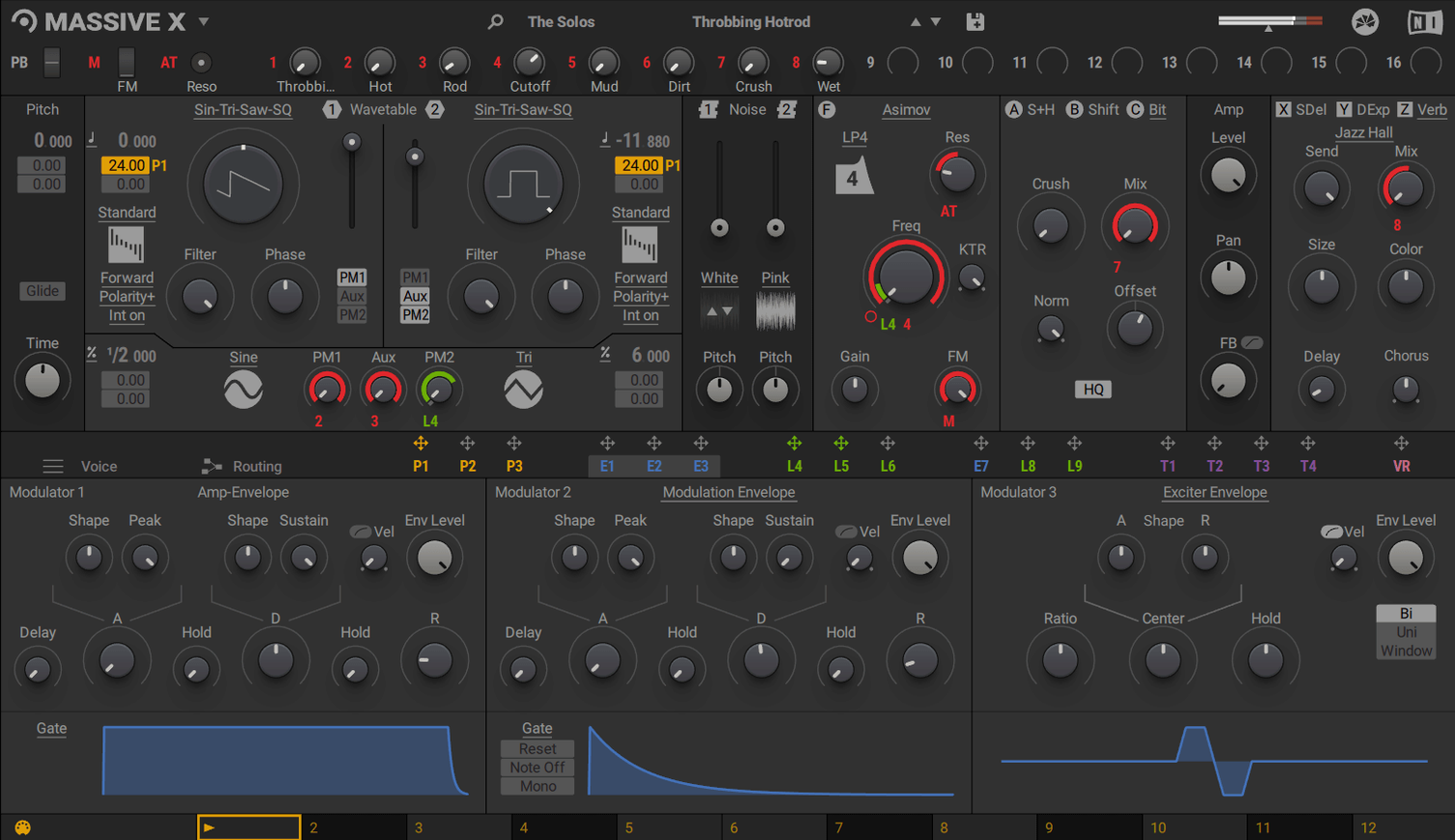
If you know Massive, think of Massive X as its more flexible younger sibling — same family, sharper tools for building sounds from scratch.
Successor to Massive — It sits alongside the original, so older DAW projects and Massive sounds keep working.
Polyphonic wavetable synth — A plugin instrument built for shaping evolving, detailed tones from wavetable oscillators.
Two phase modulation generators — A newer oscillator section that pushes beyond the sound of the original Massive.
Open routing — Any output can be connected to any input, which invites unusual signal paths and happy accidents.
Remote Octave control — Lets you trigger Performer patterns straight from the keyboard, handy for live tweaking.
It does not run standalone, so you will need a DAW. If you already enjoy Massive and want a deeper workbench, this one fits right in.
“Will This Replace My Original Massive?”
People digging into Massive X for the first time usually have a handful of the same worries. I hear them in forums, group chats, and late-night production threads. Here are the ones that matter.
Does it replace Massive, or do I need both? They coexist. Massive X does not open Massive patches, and Massive does not understand Massive X presets. If you have old projects with Massive instances, leave the original installed — it will keep loading just fine. Think of Massive X as a separate instrument that happens to share part of a name, not a version-two upgrade that overwrites anything.
Will my Mac handle it? The synth asks for macOS 13 or later and runs on both Apple Silicon and Intel machines. On Intel, the processor needs AVX support, which most chips from the last decade have. RAM-wise, 4 GB is the floor, but 6 GB or more makes a real difference once you stack unison voices and crank the effects. The installer also wants an internet connection for activation and a graphics card that speaks OpenGL 2.1 or higher — not a heavy lift for any Mac made in recent years.
Can I use it without a DAW? No standalone mode here. You will need a host that loads VST, VST3, AU, or AAX instruments. Logic Pro, Ableton Live, FL Studio, Cubase, Reaper — they all qualify. If you are used to opening a synth and playing immediately, the extra step of launching your DAW first takes about ten seconds to get comfortable with.
What if I found a massive x torrent mac download and want to know if the library is complete? A proper installation includes the full 780-preset factory library, all wavetables, and the noise samples. If patches sound thin or banks are missing, the library did not land in the right folder. The synth itself does not hide sounds behind a paywall — everything ships in one package, and the browser should show all categories the moment the plugin scans its content location.
Is the learning curve steep? If you have programmed a wavetable synth before, the signal flow makes sense within an afternoon. If this is your first deep synthesizer, expect a couple of evenings clicking through routing nodes and wondering why a modulator is not moving. The good news: 780 presets give you a lot of starting points to reverse-engineer while you learn.
A Session With Massive X, Step by Step
Here is how a typical first evening might go once the plugin is installed and your DAW has scanned it.
You open a blank project, add a software instrument track, and pick Massive X from the menu. The interface appears — dark, mostly black with orange accents, and wider than you expected. The patch browser sits at the top. You click through a few categories — Basses, Pads, Keys — and land on a wobbly, low-end patch that rattles your desk.
Curiosity kicks in. You switch over to the oscillator section. Two wavetable oscillators sit side by side, each with a dropdown holding more than 170 wavetables. You swap the first one from a saw-like shape to something called "Formant Sweep" and immediately the character shifts — nasal, vocal, nothing like where you started. The ten playback modes sit below the wavetable display. You cycle from "Normal" to "Bend+" and the harmonic content stretches in a way that makes you reach for the mod wheel.
Time to add movement. You open the Performer section and draw a jagged little pattern across eight steps, then assign it to the filter cutoff. Suddenly the sound breathes. You map the Remote Octave control so different keyboard ranges trigger different pattern variations, and now a simple held chord evolves over four bars while you play a melody higher up.
Routing gets playful next. You drag a virtual cable from an LFO output to the phase modulation input on oscillator two. The tone warps into metallic territory. You send the same LFO, scaled differently, to the reverb dry/wet mix. A clean pluck becomes a cavernous, shifting tail that changes character with every note. Before you realize it, forty minutes have passed and you have saved three new patches of your own.
By the end of the session, you have a bass sound that pulses with the Performer, a pad that morphs under slow phase modulation, and a lead that responds to velocity in ways the factory preset only hinted at. Nothing felt buried; every section has a clear visual cue for what is modulating what.
Near-Instant Preset Surfing on Apple Silicon
On a modern Apple Silicon Mac, Massive X loads quickly — a couple of seconds from clicking the plugin to seeing the interface. Preset browsing feels immediate; the browser filters by category and type without lag, even when scrolling through all 780 entries quickly.
CPU usage depends heavily on unison counts and effect chains. A single-voice patch with moderate reverb sits comfortably in the background. Stack four unison voices per oscillator, add both insert effects, and turn on the chorus, and you will see the meter climb. On an M1 or M2 chip, you can run several instances before needing to freeze tracks. Intel Macs with AVX handle moderate patches fine, though large sessions benefit from bouncing in place when the arrangement fills out.
Stability has been solid through the 1.7.1 update. No sudden dropouts or corrupted states during all-day sessions. The plugin remembers routing configurations when you save and reopen a project — a small thing that matters when you spent an hour wiring modulators. Occasional graphics hiccups on older Intel integrated GPUs disappear if you close and reopen the plugin window, and they do not affect audio.
RAM stays reasonable. The synth itself uses a few hundred megabytes; the content library sits on disk and streams wavetables as needed. If your Mac meets the 6 GB recommendation, you will not feel Massive X crowding out other plugins.
One Patch Library Across Logic, Live, and Pro Tools
Massive X slots into a Mac production workflow without friction. It shows up as an AU in Logic Pro, a VST3 in Ableton Live and Cubase, and an AAX in Pro Tools — same patch library across all formats. If you switch between DAWs depending on the project, your saved presets follow you through Native Instruments' standard user content folder.
The synth plays nicely with Komplete Kontrol keyboards. The browser, parameter mapping, and Performer remote triggering all light up on the hardware without extra setup. Even without NI hardware, standard MIDI mapping works for the parameters you tweak most — filter cutoff, envelope decay, macro knobs — so any controller with assignable knobs or faders integrates in seconds.
macOS features like Audio Units hosting and multi-channel routing work as expected. You can send Massive X through external effects on an aux track, sidechain its output to a compressor, or layer it with other instruments in a summing stack. The plugin respects Core Audio buffer settings, so latency stays consistent with the rest of your session.
For sound designers who collect wavetables, Massive X reads its own format, and the included set covers enough ground that most people will not exhaust it quickly. The open routing architecture also means you can process external audio through its effects section if your DAW supports sidechain input to instrument plugins — a less obvious trick that turns the synth into a creative effects processor in a pinch.
If you grabbed a massive torrent or a massive vst torrent and got curious about what the synth actually does day to day, the answer is straightforward: it is a deep sound design tool that plays well with everything else on a modern Mac, asks for reasonable resources, and rewards the time you put into learning its signal flow. The 780 presets give you immediate musical results, and the routing system keeps you exploring long after the factory library feels familiar.
The latest update for Massive X is version 1.7.1.
- macOS 13 or later
- Apple Silicon or Intel processor (Intel Macs require AVX support)
- 4 GB RAM listed; 6 GB recommended
- Graphics card supporting OpenGL 2.1 or higher, or DirectX 9 or 11
- Internet connection for download and activation
Porch talk 0
Come in or pull up a chair to leave a comment.
Nobody has pulled up a chair yet. If you used it on a real Saturday, say what the hour was.
More for the same hour
Everything in VST Plugins Neural DSP Archetype Petrucci
1.0.0 VST Plugins
745 MB
Neural DSP Archetype Petrucci
1.0.0 VST Plugins
745 MB
 Neural DSP Archetype Rabea X
1.0.1 VST Plugins
742 MB
Neural DSP Archetype Rabea X
1.0.1 VST Plugins
742 MB
 Neural DSP Fortin Nameless Suite X
1.0.1 VST Plugins
441 MB
Neural DSP Fortin Nameless Suite X
1.0.1 VST Plugins
441 MB
 Neural DSP Parallax X
1.0.0 VST Plugins
179 MB
Neural DSP Parallax X
1.0.0 VST Plugins
179 MB
 Neural DSP Soldano SLO-100 X
1.0.0 VST Plugins
340 MB
Neural DSP Soldano SLO-100 X
1.0.0 VST Plugins
340 MB
 noteGRABBER
2.0.0 VST Plugins
35 MB
noteGRABBER
2.0.0 VST Plugins
35 MB
 Nudist Audio Nudistort
1.2.5 VST Plugins
45 MB
Nudist Audio Nudistort
1.2.5 VST Plugins
45 MB
 Minuit Solstice
1.2.0 VST Plugins
117 MB
Minuit Solstice
1.2.0 VST Plugins
117 MB