

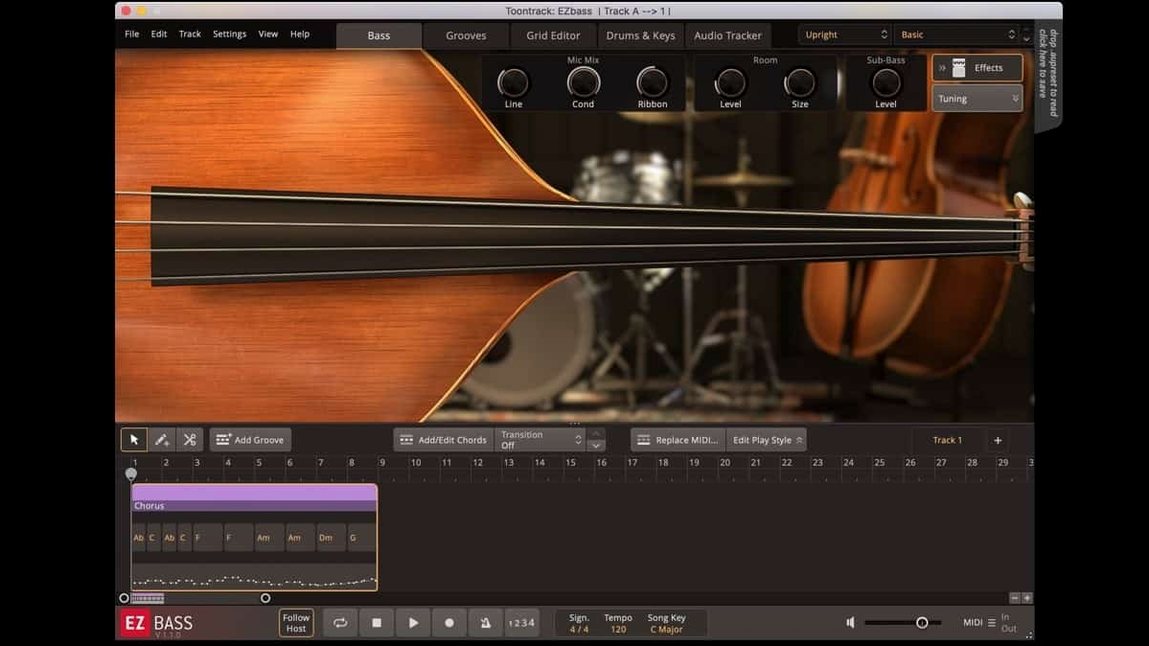
Tap the Audio Tracker button and a drum loop suddenly isn't just a rhythm anymore — it's a bassline waiting to happen. That conversion from audio to MIDI is where EZbass shows its hand early, and it makes sense to unpack the format and host side before getting into the sound itself.
What plug-in formats and hosts does it use?
EZbass 1.3.3 runs as an AU or VST instrument and also works as a standalone application. That means it slots into Logic Pro, Ableton Live, Studio One, and most other DAWs on a Mac without extra bridging.
Runs natively on Intel and Apple Silicon
Yes, the software is a universal binary that runs natively on both Intel and Apple Silicon machines. It asks for macOS 10.15 or later, so it covers a wide span of setups from the last several years.
What kind of bass sounds are actually inside?
You get two complete sampled bass guitars — one with a warm vintage character and one clean modern instrument — recorded by Toontrack. The MIDI library that ships with it covers a broad range of styles, and you can generate fresh parts by feeding it drum or keyboard MIDI when you want the software to suggest something new.
Can I edit the bass parts without leaving the plug-in?
Absolutely. You can arrange, compose, change, and rearrange bass parts right inside the interface, using its built-in grid editor and the audio-to-MIDI feature to pull ideas from existing recordings.
You’ll spend the first hour just clicking through presets and tapping keys, and that’s fine — but carve out a little time on day two to build a habit around the Audio Tracker. Drag in a rough guitar or drum clip, even a voice memo, and let the engine give you a MIDI bassline you can tweak. The conversion isn’t magic, but it’s close enough to jump-start a writing session when you’re staring at an empty track lane.
One thing that trips up newcomers is leaving the grid quantize too tight. EZbass defaults to a clean, locked-in feel, and for some genres that’s perfect. For anything with a little swing, loosen the grid strength early — around 70–80 percent keeps the note placement human without sounding sloppy. The same goes for velocity: the software’s sample layers respond noticeably to small changes, so a few minutes with the velocity lane pays off in a bass part that breathes instead of one that just sits there.
If you grabbed an ezbass torrent or found an ez bass torrent to get started, you’ll want to check a couple of settings that are easy to overlook. In the Settings pane, you can remap a handful of keyboard shortcuts — version 1.3.3 added that — and it’s worth setting up a dedicated key for “Toggle Audio Tracker” right away. The default shortcut is buried under a menu, and you’ll use the tracker often enough that muscle memory matters.
Small touches worth finding in the first week
A few conveniences sit just below the surface and are easy to miss when you’re focused on sounds. First, holding Option while dragging a MIDI block in the song track copies it instantly — no right-click menu needed. Second, the browser search field accepts more than preset names; you can type a style like “reggae” or “punk” and it filters the MIDI library accordingly, which is faster than clicking through category folders.
The right-hand mute articulation support added in 1.3.3, originally for the Rock Legend EBX, also works on the stock instruments if you’re using a MIDI keyboard with enough keys to reach the upper octaves. It’s a subtle texture — a slight damped pluck — that can tighten up a busy chorus without changing the note pattern. If you’re working from a Toontrack EZbass torrent or a straight download, this behavior is already baked in; it just needs a controller that can send the right note range.
Feed it solo tracks, not full mixes
The most common stumble is feeding the Audio Tracker a full mix and expecting a clean bassline. It works best with a single monophonic source — a bass guitar recording, a keyboard part, or a drum loop with a clear pitch center. Dense audio confuses the pitch detection, and you end up with a MIDI part full of ghost notes you didn’t want. Solo the source material first, or bounce a stripped-down version before converting.
Another early misstep is ignoring the sample rate mismatch fix that arrived in 1.3.3. If your project runs at 48 kHz or 96 kHz, audio export was dicey in older builds; the timing could drift. The update squashed that, but only if your standalone app and DAW session agree on the sample rate. When you open the standalone version for the first time — maybe after an ezbass free download or a fresh install — set its sample rate to match your usual project setting before you record anything.
Finally, don’t sleep on the MIDI transpose knob. New users often drag notes around manually to fit a key, but the transpose control shifts the entire generated phrase in semitones and keeps the original groove intact. It’s a small knob near the top right of the grid editor, and it can save you from rebuilding a part just because the song moved up a step and a half during a late-night rewrite.
Version 1.3.3 is a modest but welcome refresh. It polishes the Mac experience with updated icons in the Tahoe style and adds a few functional touches.
- Added support for the right-hand mute articulation used in the Rock Legend EBX expansion
- Added the ability to change select keyboard shortcuts in Settings
- Updated standalone and project icons to the macOS Tahoe style
- macOS 10.15 or later
- Runs natively on Intel and Apple Silicon Macs
- English interface
Questions I actually get
Can EZbass generate basslines from my drum MIDI?
Yes. Drop a drum or keyboard MIDI clip onto its track, and the software can suggest matching bass parts that follow the rhythm and chord changes.
What does version 1.3.3 add for Mac users?
It updates the standalone and project icons to the macOS Tahoe style and adds support for the right-hand mute articulation found in the Rock Legend EBX expansion.
Porch talk 0
Come in or pull up a chair to leave a comment.
Nobody has pulled up a chair yet. If you used it on a real Saturday, say what the hour was.
More for the same hour
Everything in VST Plugins EZdrummer
3.1.2 VST Plugins
786 MB
EZdrummer
3.1.2 VST Plugins
786 MB
 FabFilter Total Bundle
25.06.2026 VST Plugins
347 MB
FabFilter Total Bundle
25.06.2026 VST Plugins
347 MB
 elastiquePitch
2.5.0 VST Plugins
17 MB
elastiquePitch
2.5.0 VST Plugins
17 MB
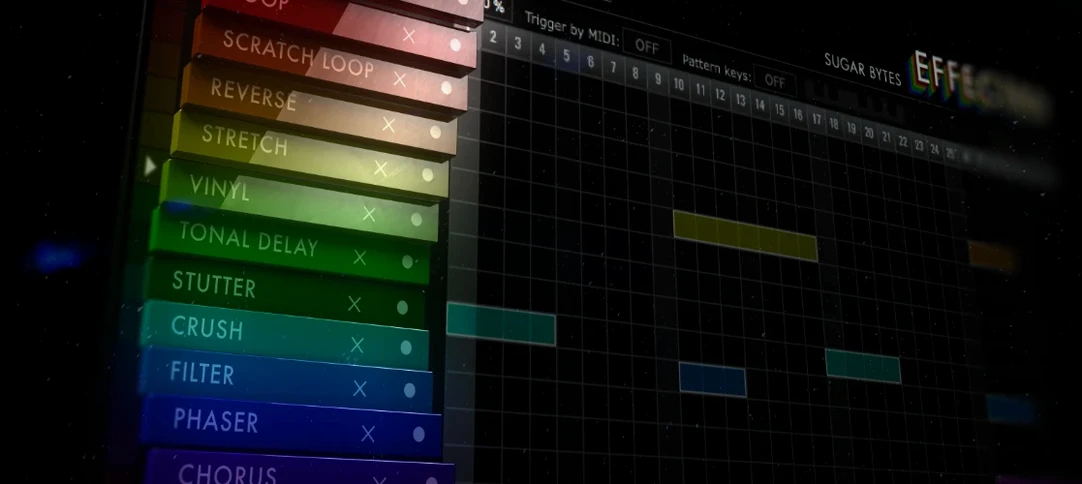 Effectrix
1.4.8 VST Plugins
20 MB
Effectrix
1.4.8 VST Plugins
20 MB
 Devious Machines Infiltrator
2.5.26 VST Plugins
46 MB
Devious Machines Infiltrator
2.5.26 VST Plugins
46 MB
 Cymatics VOXITY
1.0.0 VST Plugins
97 MB
Cymatics VOXITY
1.0.0 VST Plugins
97 MB
 Cymatics QUAKE
1.0.0 VST Plugins
1.6 GB
Cymatics QUAKE
1.0.0 VST Plugins
1.6 GB
 iZotope Insight
2.4.0 VST Plugins
iZotope Insight
2.4.0 VST Plugins