
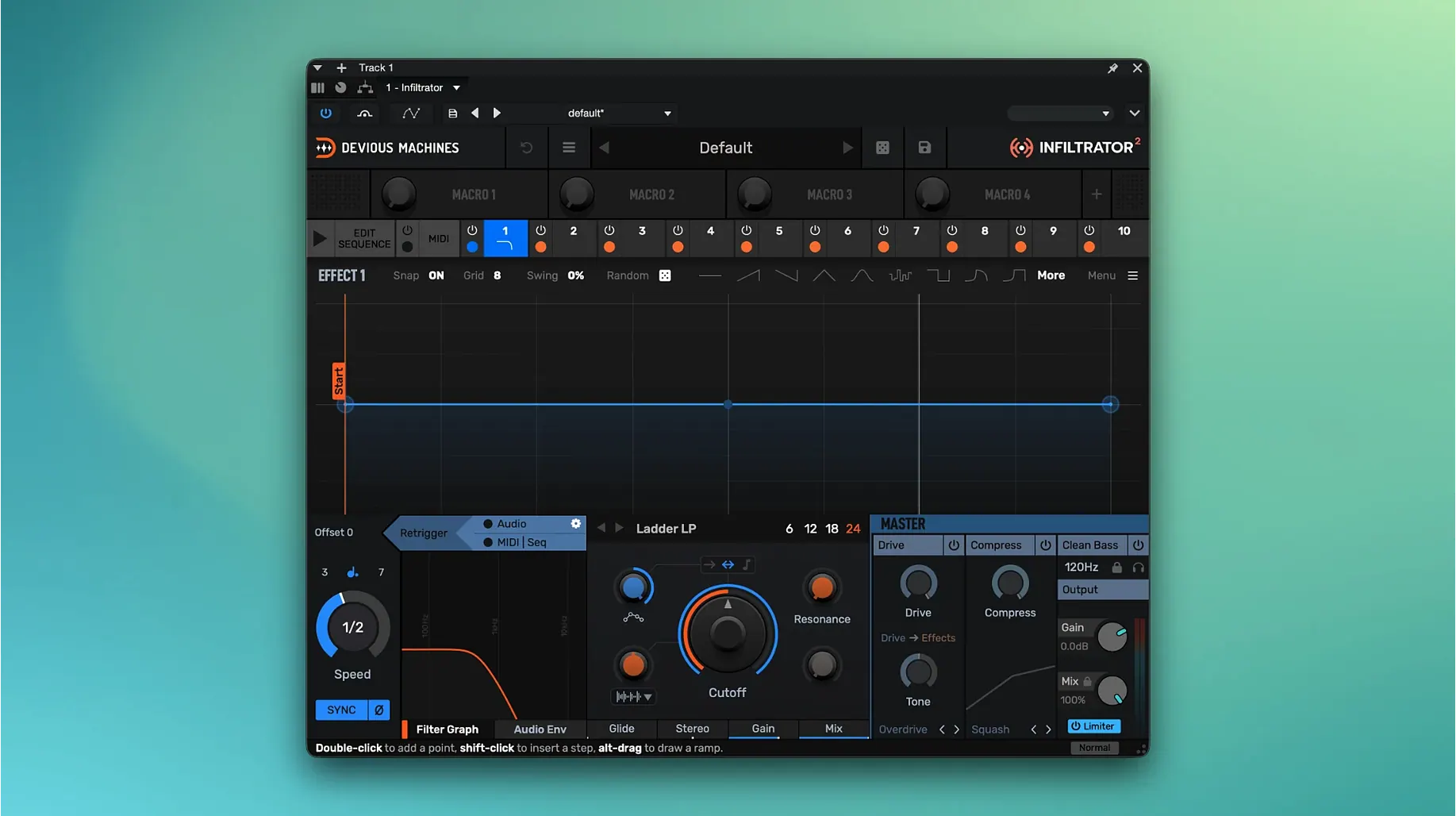
Version 2.5 landed with a couple of sensible additions that make an already deep plugin a little more polished. The new output limiter catches peaks when you push the modulation into unpredictable territory, and custom beat divisions let you sync the sequencer to odd time signatures without workarounds.
Runs Natively on Intel and Apple Silicon Macs
- Runs as VST2, VST3, AU and AAX — covers most DAWs on the Mac.
- Native Apple Silicon support alongside Intel, so no Rosetta translation needed on M-series machines.
- Requires macOS 10.11 or later. The current build is version 2.5.26.
- Interface is in English, with 64-bit ARM and x86 architecture support baked in.
Stacking, sequencing and shaping sound
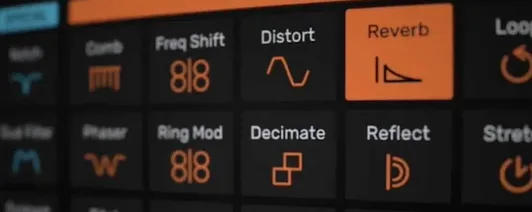
Infiltrator 2 works as an envelope-controlled multi-effect processor where you chain up to ten effects in a single instance. You can sequence the order, sync modulation to the host tempo, and draw custom curves for filters, distortion, and time-based blocks. The envelope follower reacts to incoming audio, so the processing can duck, swell, or warp in response to the source material rather than a static LFO. It is the successor to the original Infiltrator and keeps the same core idea — stacking and modulating effects — while adding the sequencing layer that turns a chain into a performance tool. If you enjoy sound design that moves with the music instead of sitting on top of it, the current build is worth a close look.
Right-Click Randomization and Other Hidden Shortcuts
There are a handful of thoughtful touches tucked into the interface that don't announce themselves loudly. Once you spot them, they shave seconds off every patch-building session and keep the creative flow from stalling out.
- Right-click to randomize a single module. Instead of rolling the dice on the whole chain, you can target just the filter or just the distortion block. Right-click its name and pick Randomize — handy when one slot feels close but not quite there.
- Shift-drag for fine control. Nearly every knob and envelope node responds to a shift-drag for precise adjustments. It is the difference between landing on 47% and dialing in exactly 50% without squinting.
- Copy and paste curves between slots. If you have shaped a modulation curve for the filter cutoff and want the same movement on the ring modulator, you can copy it with a keyboard shortcut and paste it directly into another module's curve editor.
- Alt-click to solo a module. When you are troubleshooting a chain of eight or nine effects, alt-clicking a module temporarily bypasses everything else so you can hear exactly what that one block contributes.
- Preset morpher crossfades. The morph slider between two loaded presets is more than a gimmick. Drag it slowly and listen to the in-between states — some of them turn into usable patches you would never have dialed in deliberately.
Effect Chains Built Around a Central Sequencer
Placing Infiltrator next to a couple of familiar names helps clarify what kind of toolbox you are reaching for. It is not the only multi-effect on the Mac, but it carves out a distinct corner by tying everything to an envelope follower and a step sequencer that runs across the whole chain.
Compared with Soundtoys Effect Rack, the biggest difference is the sequencing layer. Effect Rack excels at rich analog-style processing and lets you reorder modules freely, but the modulation is per-effect and disconnected. Infiltrator gives you a unified sequencer where filter sweeps, bit-crushing, and pitch shifts all follow the same rhythmic grid — or deliberately stray from it with custom beat divisions.
Against Kilohearts Snap Heap, the gap is in modulation depth. Snap Heap keeps things modular and visual, with a drag-and-drop signal flow that is fast to build. Infiltrator goes further once you start drawing envelope curves per step and assigning multiple destinations. Snap Heap is quicker for assembling a handful of insert effects; Infiltrator pulls ahead when you want the chain to feel like an instrument that breathes with the track.
If you have been trying to get similar results by chaining separate VSTs and automating bypass lanes, Infiltrator wraps that whole process into one window — and saves the patch as a single recallable preset.
Workflow: turning a dry drum loop into a shifting rhythmic texture
Here is a start-to-finish path for taking a static four-bar loop and making it morph over time. The goal is a groove that feels reactive rather than looped.
- Drop Infiltrator onto the drum bus. Start with an empty chain and load a utility gain module in slot one. This is your safety net for level matching later.
- Add a multimode filter in slot two. Set it to bandpass and assign the cutoff to the envelope follower with a medium attack and fast release. The filter now opens and closes with the transients of the drums themselves.
- Slot three gets a lo-fi block. Dial the sample rate reduction down to around 6 kHz and the bit depth to 10. Use the sequencer to enable this module only on the last two steps of a 16-step pattern — the loop stays clean for three beats, then crunches on the fourth.
- Place a delay in slot four, synced to dotted eighth notes. Modulate the feedback amount with a slow triangle LFO so repeats swell in and out across eight bars instead of staying static.
- Slot five holds a ring modulator, mixed low at 20% wet. Sequence its frequency to jump between two dissonant pitches every other bar, adding a metallic flicker that barely registers on its own but gives the whole texture an unsettled edge.
- Draw a global curve for the output gain. Add a subtle dip on beat one of every fourth bar so the loop ducks slightly before the next cycle hits — creates a push-pull feel without touching the DAW fader.
- Save two versions of the patch. Morph between them slowly while printing the audio, and you end up with a long evolving take that sounds nothing like the original four-bar loop.
That entire chain runs inside one plugin instance, with every modulation locked to the host tempo. The new output limiter in version 2.5 catches the gain spikes when the filter resonance and delay feedback overlap, so the signal stays controlled without extra compression downstream.
Version 2.5 added a couple of practical refinements. A new output limiter keeps levels in check, and custom beat divisions open up tempo-based effects for time signatures that do not fit the usual grid. The current Mac download is build 2.5.26.
- macOS 10.11 or later
- Apple Silicon or Intel processor
- 64-bit host (VST2, VST3, AU, AAX)
Porch talk 0
Come in or pull up a chair to leave a comment.
Nobody has pulled up a chair yet. If you used it on a real Saturday, say what the hour was.
More for the same hour
Everything in VST Plugins Cymatics VOXITY
1.0.0 VST Plugins
97 MB
Cymatics VOXITY
1.0.0 VST Plugins
97 MB
 Cymatics QUAKE
1.0.0 VST Plugins
1.6 GB
Cymatics QUAKE
1.0.0 VST Plugins
1.6 GB
 Effectrix
1.4.8 VST Plugins
20 MB
Effectrix
1.4.8 VST Plugins
20 MB
 elastiquePitch
2.5.0 VST Plugins
17 MB
elastiquePitch
2.5.0 VST Plugins
17 MB
 EZbass
1.3.3 VST Plugins
81 MB
EZbass
1.3.3 VST Plugins
81 MB
 EZdrummer
3.1.2 VST Plugins
786 MB
EZdrummer
3.1.2 VST Plugins
786 MB
 FabFilter Total Bundle
25.06.2026 VST Plugins
347 MB
FabFilter Total Bundle
25.06.2026 VST Plugins
347 MB
 Cableguys Snapback
1.1 VST Plugins
37 MB
Cableguys Snapback
1.1 VST Plugins
37 MB