
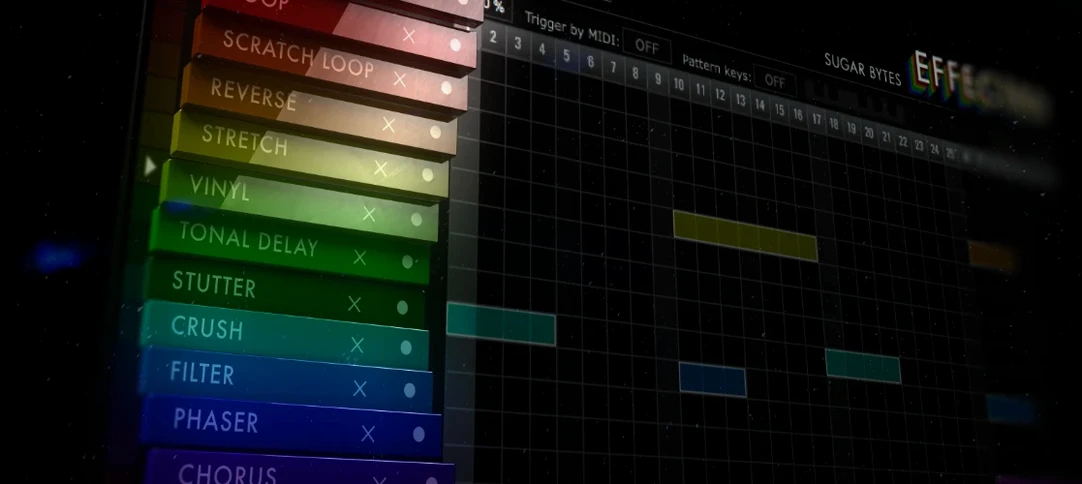
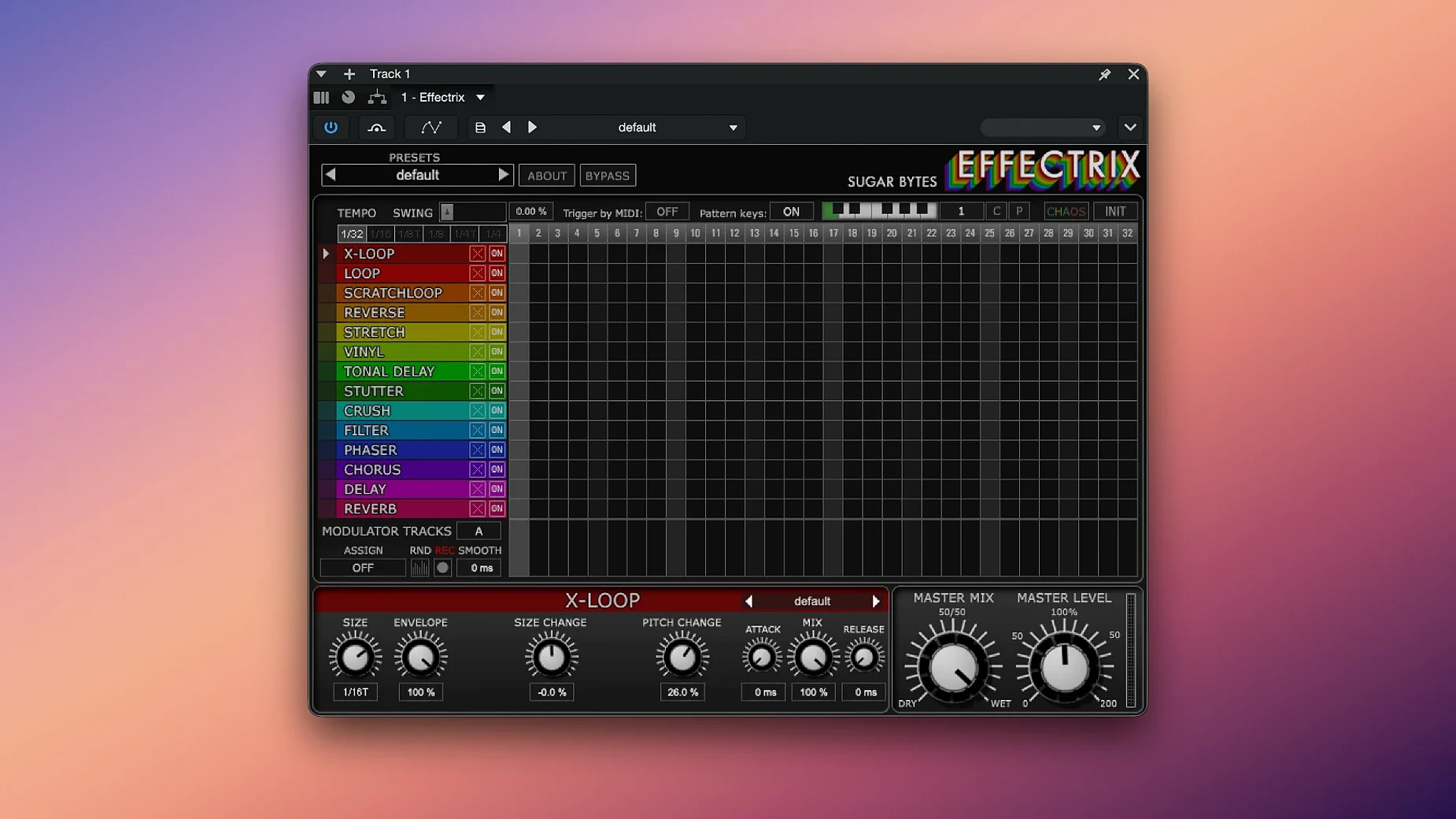
Effectrix is a professional multi-effect sequencer that turns a familiar step-grid interface into a canvas for rhythmic audio manipulation. Instead of triggering notes, each step applies one of 14 synchronized effects — from loopers and vinyl stops to bit-crushers and filters — directly onto your audio, locked to the host tempo.
Per-step variation for drum loops and buses
- Drum loops and percussion buses that need evolving, bar-by-bar variation without manual automation.
- Synth lines and arpeggios where a tonal delay or a reversed grain can flip a static pattern into something unpredictable.
- Vocal tracks sent to a bus for stutter, scratch, and glitch treatments that stay tight to the beat.
- Live performance setups where switching between up to 12 saved sequences in a single preset keeps the energy moving.
One effect, one parameter set at a time
- Each of the 14 effects has its own parameter set, so dialing in a sequence rewards a bit of step-by-step attention.
- The Chaos button introduces random modulation, which is great for happy accidents but can quickly overrun a delicate sequence if left unchecked.
- With two modulation tracks available, you can push parameters beyond static steps, but complex routings benefit from a clear plan.
What 1.4.8 smoothed out in daily use
The jump to 1.4.8 didn't rewrite the playbook, but it ironed out a handful of friction points that regular users had learned to work around. On Apple Silicon machines, the plugin now loads without the brief hesitation some producers noticed when opening older sessions. The Audio Unit validation process in Logic Pro completes reliably on the first scan, which matters when you're rebuilding a template at midnight and every extra restart costs you momentum.
- Preset recall across the 12 pattern slots feels snappier — switching sequences via MIDI program changes lands on the beat without the tiny audio dropout a few users encountered in earlier builds.
- The copy-and-paste behavior between patterns now preserves effect parameter states exactly as you set them, where previously an obscure edge case with the looper effect could shift the loop length by a 32nd note.
- Standalone operation on newer macOS releases handles audio device switching more gracefully; unplugging an interface mid-session no longer requires a full app restart.
None of this is flashy, but it's the kind of stability work that keeps a sequencer glued into a production template rather than relegated to the "fun but finicky" folder.
Where Effectrix sits in a real signal chain
Effectrix works best when you treat it as a rhythmic insert, not a catch-all channel strip. Slap it directly on a drum bus, a bassline, or a vocal group and it locks to your DAW's transport immediately. Because it's a MIDI-controlled effect and not a synthesizer, you can feed it anything — a live guitar input through a preamp plugin, a frozen reverb tail from Valhalla Supermassive, or a chopped sample from Serato Sample — and the sequencer will step through effects in perfect sync.
The 12-pattern recall from a MIDI keyboard turns any controller with a few assignable pads into a pattern launcher. In Ableton Live, dragging a MIDI clip onto the Effectrix track and drawing program change messages lets you automate pattern switches across an arrangement without touching the mouse. In Logic, the same trick works through the external MIDI instrument routing, and the standalone app can sit in a macOS aggregate audio device setup for hardware jams where a DAW isn't running.
Two modulation tracks mean you can tie effect parameters to an LFO or an envelope follower that reacts to incoming audio — useful for ducking the bit-crusher intensity on a kick hit or sweeping the filter cutoff only when the input level crosses a threshold. It's not a replacement for a full modulation system like Bitwig's modulators, but it adds a layer of movement that static step values can't achieve on their own.
Quick routing ideas
- Place Effectrix before a reverb on a send and use the vinyl stop effect only on the last step of every four bars — the reverb tail catches the pitch drop and stretches it out.
- Run it after a transient shaper on a snare bus, then assign the looper to steps 5 and 13 for a tight, predictable stutter that doesn't fight the transient punch.
- Insert it on a sidechain source track — something muted but feeding a compressor's detector input — to create rhythmic ducking patterns that follow the effect sequence rather than a static kick pattern.
Built for the 16-step grid mindset
Electronic producers working in beat-driven genres — hip-hop, trap, drum and bass, house — tend to reach for Effectrix most often, because the 16-step grid mirrors the drum machine workflow they already think in. Laying out a pattern of tonal delays on a hi-hat loop or programming a reverse grain on the offbeats feels immediate; you hear the result before you finish moving to the next step.
Sound designers who build transitional effects and risers get a lot of mileage from the Chaos button paired with the cycle length control. Shortening the cycle to 5 or 7 steps and letting Chaos randomize which effects fire on each step produces textures that would take half an hour to draw as automation lanes. The swing function pulls those irregular patterns into a groove that still feels musical rather than random.
Live performers benefit from the single-preset, 12-pattern architecture. A keyboardist running a synth through Effectrix can map pattern changes to octave-shifted keys and step through sequences without looking at a screen. DJs processing a send return with it can treat the step grid as a tactile performance tool — muting effects on certain steps by clicking them off in real time — though the plugin's interface benefits from a mouse or touchpad; it's not optimized for touch screens.
Presets that save an entire 12-pattern bank
A few small features sit just outside the main workflow but reward anyone who stumbles onto them. The global preset system doesn't just recall an effect chain — each of the hundreds of presets stores a full 12-pattern bank, so loading a single preset can reconfigure the entire performance layout. Producers searching for an effectrix crack mac often find that the factory library alone covers enough ground to skip sound design entirely on a tight deadline.
The copy-paste function works across effect slots, not just across patterns. If you dial in a perfect tonal delay setting on step 3 and want it on step 11 as well, copying that single step and pasting it elsewhere preserves every nuance of the delay time, feedback, and filter setting — no need to screenshot the parameter values.
Right-clicking any step clears it instantly, and holding Shift while clicking toggles an effect on or off without opening its parameter panel. These shortcuts cut the time between idea and execution when you're building a sequence during playback. If you've gone looking for an effectrix torrent just to test whether the workflow suits you, it's these small touches that reveal themselves over the first few hours and make the grid feel like an instrument rather than a utility.
- macOS 10.14 or later
- Intel or Apple Silicon Mac
- 64-bit host
Porch talk 0
Come in or pull up a chair to leave a comment.
Nobody has pulled up a chair yet. If you used it on a real Saturday, say what the hour was.
More for the same hour
Everything in VST Plugins elastiquePitch
2.5.0 VST Plugins
17 MB
elastiquePitch
2.5.0 VST Plugins
17 MB
 EZbass
1.3.3 VST Plugins
81 MB
EZbass
1.3.3 VST Plugins
81 MB
 EZdrummer
3.1.2 VST Plugins
786 MB
EZdrummer
3.1.2 VST Plugins
786 MB
 FabFilter Total Bundle
25.06.2026 VST Plugins
347 MB
FabFilter Total Bundle
25.06.2026 VST Plugins
347 MB
 Devious Machines Infiltrator
2.5.26 VST Plugins
46 MB
Devious Machines Infiltrator
2.5.26 VST Plugins
46 MB
 Cymatics VOXITY
1.0.0 VST Plugins
97 MB
Cymatics VOXITY
1.0.0 VST Plugins
97 MB
 Cymatics QUAKE
1.0.0 VST Plugins
1.6 GB
Cymatics QUAKE
1.0.0 VST Plugins
1.6 GB
 iZotope Insight
2.4.0 VST Plugins
iZotope Insight
2.4.0 VST Plugins