
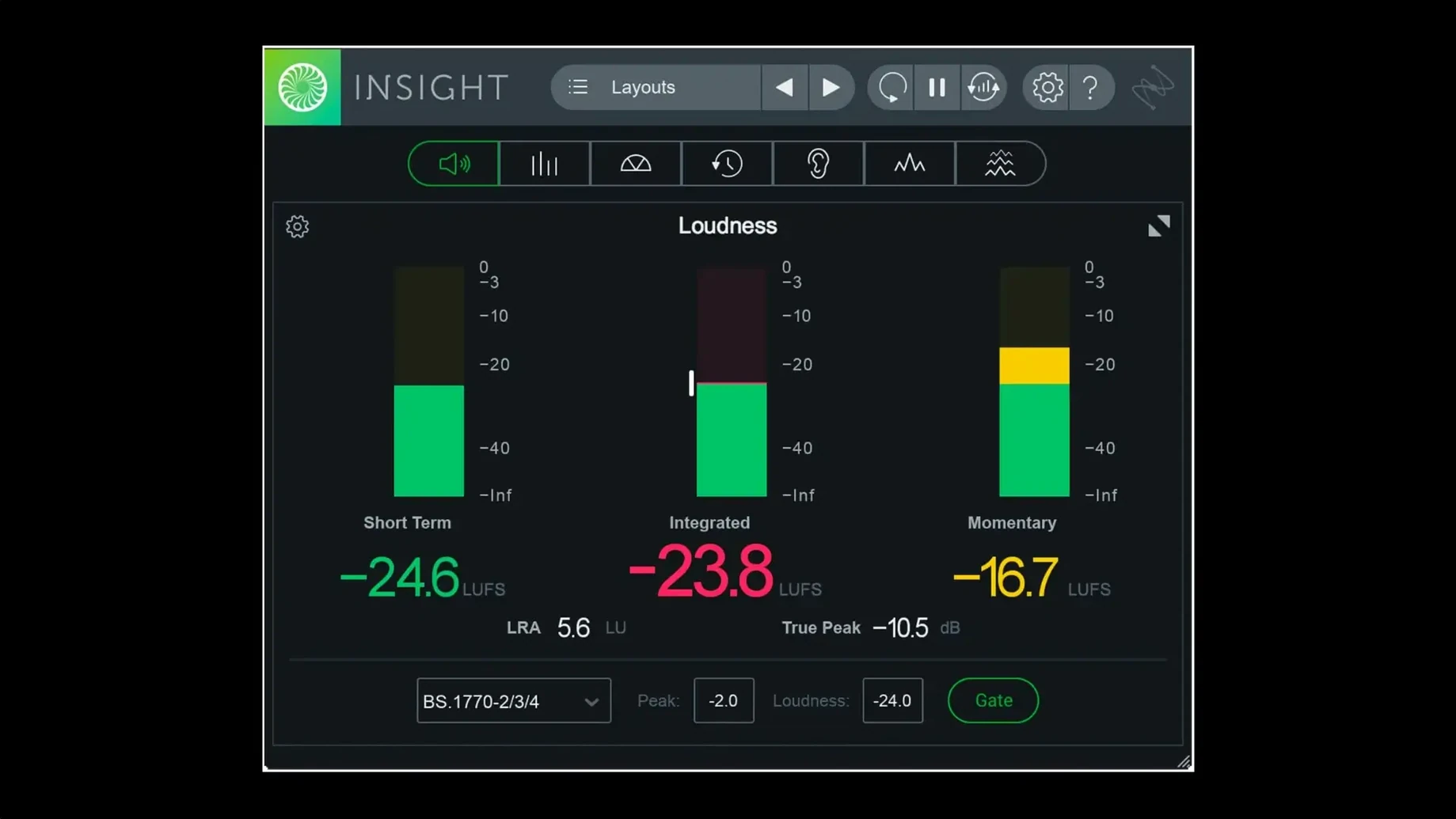
You’ve been staring at a mix for hours, and something still feels off. The low end is a guess, the stereo image a hope. iZotope Insight 2 pulls the real numbers up onto the screen so you can see exactly what’s happening before it leaves the room. It’s a dedicated metering and analysis plug-in that runs in your DAW, checking loudness, intelligibility, spectral balance, and phase from any track or bus.
- True Peak Meters and Loudness Meters with updated broadcast standards
- Loudness History Graph for tracking dynamics over a full session
- Stereo Vectorscope, 2D and 3D Spectrogram, and Spectrum Analyzer
- Surround Scope with multichannel support up to Dolby Atmos 7.1.2
- Resizable, configurable meters that can route audio from any track or bus
- Native arm64 install for Apple silicon Macs and AAX support for Pro Tools 2023.3+
Everything can be scaled and rearranged to match the session you’re in. If you’re chasing a problematic master or just want a second opinion on a broadcast delivery, Insight 2 gives you the visual reference to back up what your ears are telling you.
Mix Not Translating? Here’s What People Ask Before Downloading
A lot of folks download Insight 2 because a mix isn’t translating, and they want hard numbers instead of guesswork. Before the plug-in lands in the session, a few questions tend to repeat.
Does it run natively on Apple silicon? Yes. Version 2.4.0 added arm64 install support, and it also brought native AAX for Pro Tools 2023.3 and later. If you’re on an M1 or M2 Mac, the meters stay responsive without Rosetta getting in the way. Intel Macs work the same as they always did, so no one’s left out.
Which DAWs does it play nicely with? Insight 2 loads as an AU, VST3, or AAX plug-in. That covers Logic Pro, Ableton Live, Cubase, Nuendo, Pro Tools, and Studio One without jumping through extra hoops. Drop it on the master bus, an aux track, or any individual channel that needs a closer look.
Is the installation straightforward? The package includes clear instructions and an activation workflow that’s been simplified since earlier versions. Multi‑user installation is supported too, so a small studio with a couple of machines can set things up without repeating every step on each Mac.
Can I trust the loudness readings for broadcast? The loudness meters follow current international standards. If you’re delivering for television or streaming, the numerical readouts and color‑coded alerts give you a reliable compliance check before you export.
Interface Draws Instantly, Even with Three Modules Open
On a modern Apple silicon Mac, Insight 2 opens like any other plug‑in and settles into the session without fuss. The interface draws quickly, even when you’re running a full‑screen Spectrogram alongside a Loudness History Graph and a Vectorscope. Resizing the meters is smooth; dragging a corner snaps the layout into something that fits a second monitor or a tight laptop screen.
CPU load stays modest for a visual analysis tool. If you’re already pushing a heavy session with dozens of tracks and processing, adding Insight 2 on the master bus won’t tip things over. The plug‑in is designed to observe, not to process audio, so it sips resources rather than gulping them. On older Intel machines, the same holds true—just leave a little headroom if the session is already near its limit.
Stability has been solid through long editing days. No sudden disappearances, no graphics freezing mid‑playback. The native arm64 build feels like a proper citizen of the macOS Big Sur environment and newer. For anyone who’s wrestled with Rosetta‑translated plug‑ins that stutter during playback, that bit of news matters.
Taming a Dense Indie-Rock Mix on the Master Bus
Imagine a late afternoon mastering pass. The track is a dense indie‑rock mix with three guitar layers and a bass line that wanders into the sub range. You drop Insight 2 onto the master bus and open the Loudness Meter and the 2D Spectrogram side by side.
First, you play the loudest chorus. The True Peak readout immediately shows a few spots nudging into the red, so you pull the limiter threshold down by half a decibel. The Loudness History Graph scrolls quietly in the background, painting a green trace of integrated loudness that stays within the target for a streaming deliverable.
Next, you check the low end with the Spectrum Analyzer. There’s a buildup around 60 Hz that you felt more than heard on the nearfields. The analyzer confirms it, so you open a dynamic EQ on the mix bus and notch half a dB. The Spectrogram shows the change in real time, the hot spot cooling from orange to a calmer yellow.
Finally, you glance at the Stereo Vectorscope during the wide guitar break. The pattern stays mostly in phase, a diagonal smear that leans left but never collapses into a vertical line. Satisfied, you close the plug‑in window and export the final file. The session took ten minutes, and every decision had a visual reference to back it up.
Confirmation for Engineers Who Already Trust Their Ears
Insight 2 clicks hardest for people who already know what they’re hearing but want confirmation they can point to. Mixing engineers who bounce between rooms, or between headphones and monitors, lean on the loudness meters and frequency displays to keep perspective consistent. A mix that sounds balanced on one system often hides a 2 kHz spike or a phase issue, and Insight 2 surfaces those before a client notices.
Mastering engineers live in the Loudness History Graph and the True Peak Meters. When a record has twelve tracks, the graph makes it easy to compare loudness across the sequence and spot a ballad that’s too quiet or a single that’s squashed. The Surround Scope earns its keep in post‑production suites delivering Dolby Atmos 7.1.2 beds, where visual feedback on channel balance saves a trip back to the render queue.
Bedroom producers who are still training their ears benefit just as much, maybe more. Watching the Spectrogram light up while sweeping a filter teaches frequency relationships faster than reading about them. The color‑coded problem detection is forgiving—it flags potential trouble without making you feel like the mix is broken.
If you’re the kind of user who already reaches for a spectrum analyzer on every channel, adding Insight 2 to the master bus will feel natural. And if you’ve been searching for something like izotope insight 2 free download mac to try before committing, this version gives you the full metering suite to work with, no demo restrictions that cut off mid‑session. Grab it, drop it on a busy mix, and watch the meters light up—sometimes seeing really is believing.
Version 2.4.0 brings Insight fully onto Apple silicon. Here's what changed:
- Native arm64 install support for Apple silicon Macs
- Native arm64 AAX support for Pro Tools 2023.3+ on Apple silicon
- Factory and custom preset tabs added to the preset manager
- macOS Big Sur or later
- Intel or Apple silicon Mac
- Host DAW supporting AU, VST, or AAX formats
Questions I actually get
What metering tools does iZotope Insight 2 include?
It includes True Peak Meters, Loudness Meters, a Loudness History Graph, a Stereo Vectorscope, Surround Scope, 2D and 3D Spectrograms, and a Spectrum Analyzer.
Does Insight 2 run natively on Apple silicon Macs?
Yes, version 2.4.0 added native arm64 install support for Apple silicon Macs, along with native arm64 AAX support for Pro Tools 2023.3 and later.
What surround formats does iZotope Insight 2 support?
It includes a Surround Scope and supports multichannel audio up to Dolby Atmos 7.1.2.
Porch talk 0
Come in or pull up a chair to leave a comment.
Nobody has pulled up a chair yet. If you used it on a real Saturday, say what the hour was.
More for the same hour
Everything in VST Plugins iZotope Nectar
4.1.0 VST Plugins
545 MB
iZotope Nectar
4.1.0 VST Plugins
545 MB

 iZotope Neutron
5.2.0 VST Plugins
928 MB
iZotope Neutron
5.2.0 VST Plugins
928 MB
 iZotope RX
12.0.0 VST Plugins
2.1 GB
iZotope RX
12.0.0 VST Plugins
2.1 GB
 iZotope Tonal Balance Control
3.0.0 VST Plugins
264 MB
iZotope Tonal Balance Control
3.0.0 VST Plugins
264 MB
 Kalifornia Dynamic KD Alkane
1.0.17.0 VST Plugins
270 MB
Kalifornia Dynamic KD Alkane
1.0.17.0 VST Plugins
270 MB
 Komplete FX Bundle
2026.1 VST Plugins
3.2 GB
Komplete FX Bundle
2026.1 VST Plugins
3.2 GB
 Komplete Kontrol
3.5.4 VST Plugins
785 MB
Komplete Kontrol
3.5.4 VST Plugins
785 MB
 KORG Collection
1.0.3 VST Plugins
175 MB
KORG Collection
1.0.3 VST Plugins
175 MB