A colleague sends over a contract PDF, but there's a typo in your address and a blank signature line staring back at you. Nitro PDF Pro is built for exactly that kind of quick correction.
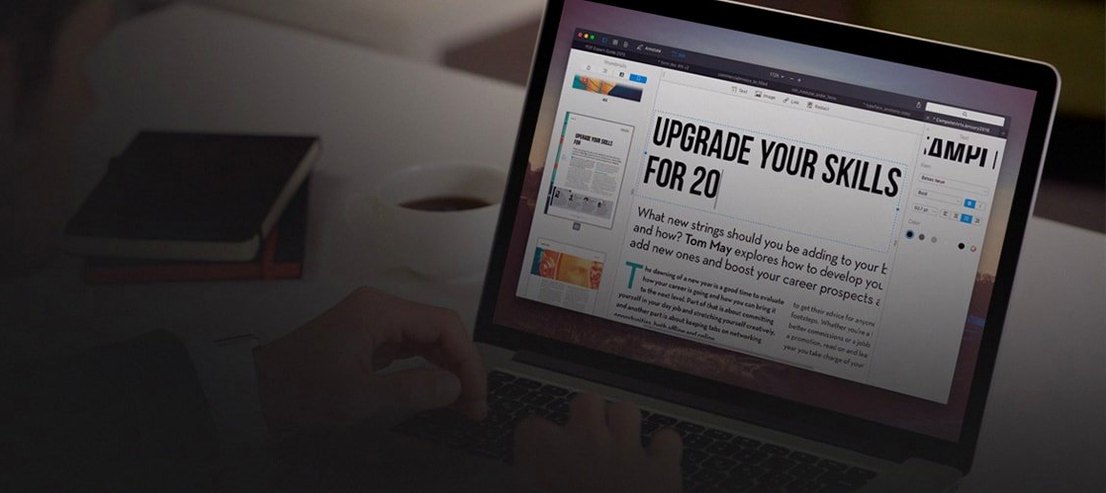
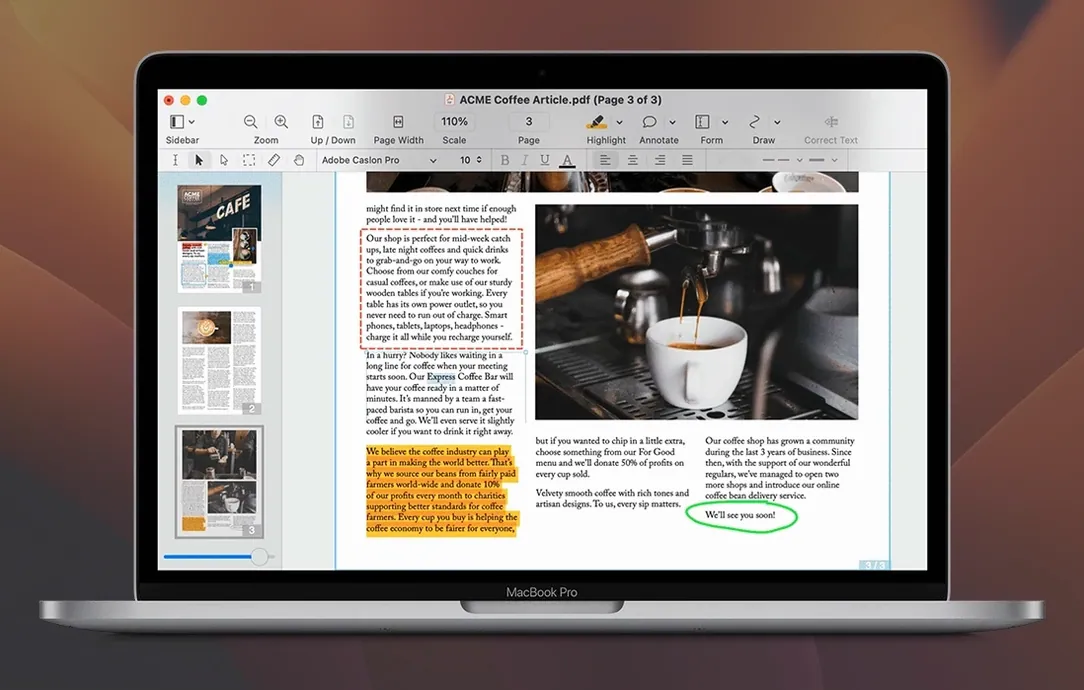
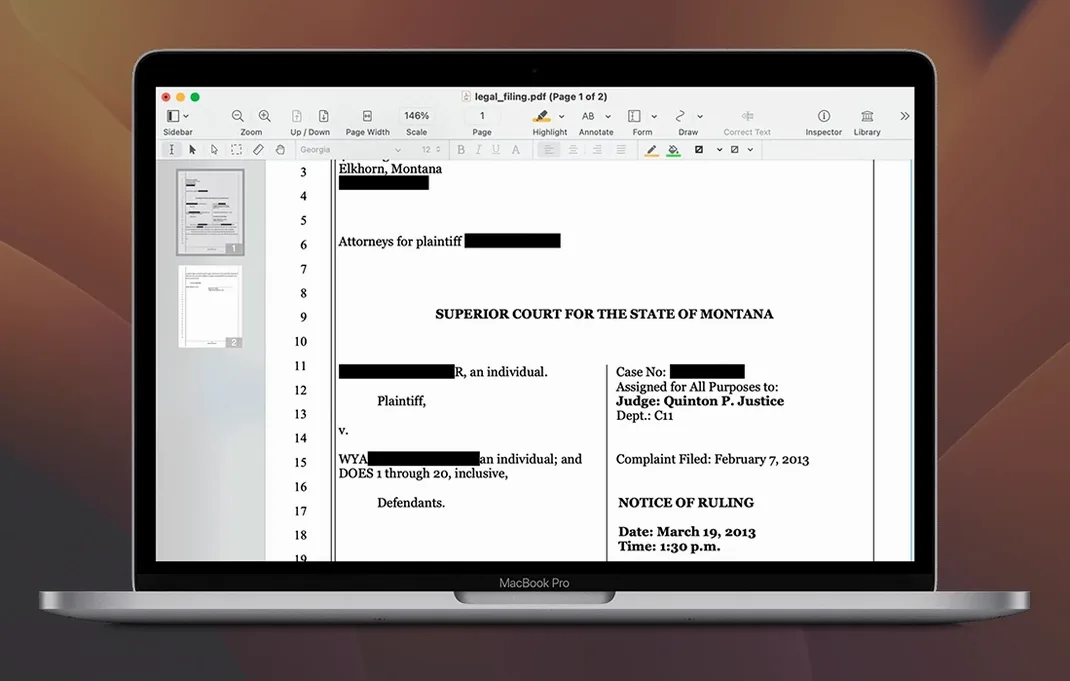
Edit text — Click a line of text and just start typing; the app preserves the original font and formatting.
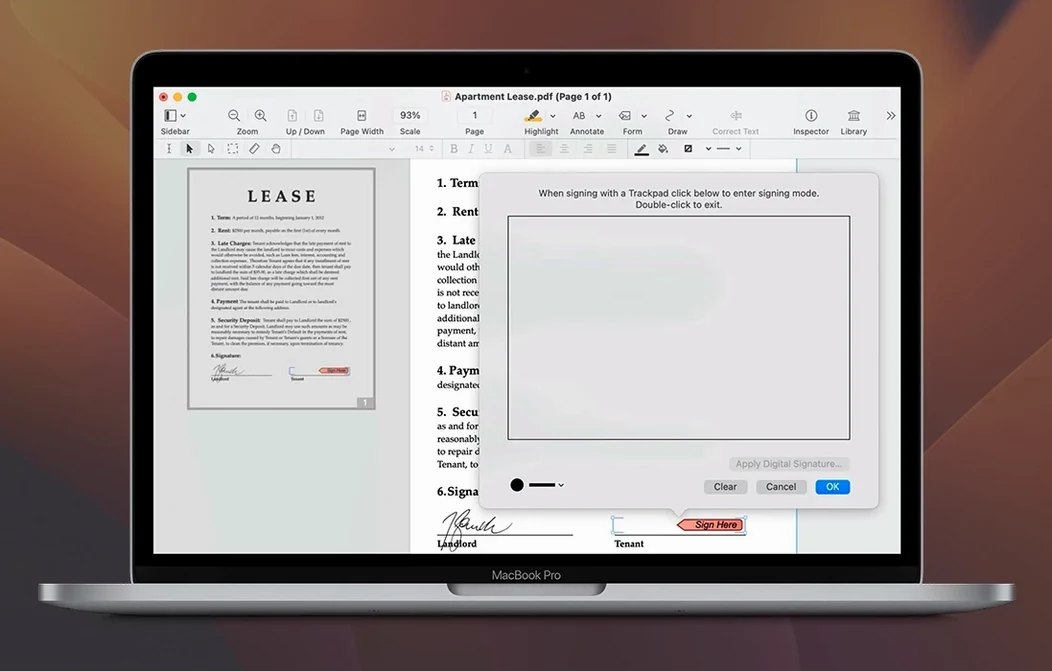
Signature — Create a signature from a trackpad drawing, a scanned image, or a typed name, then drop it onto the page.
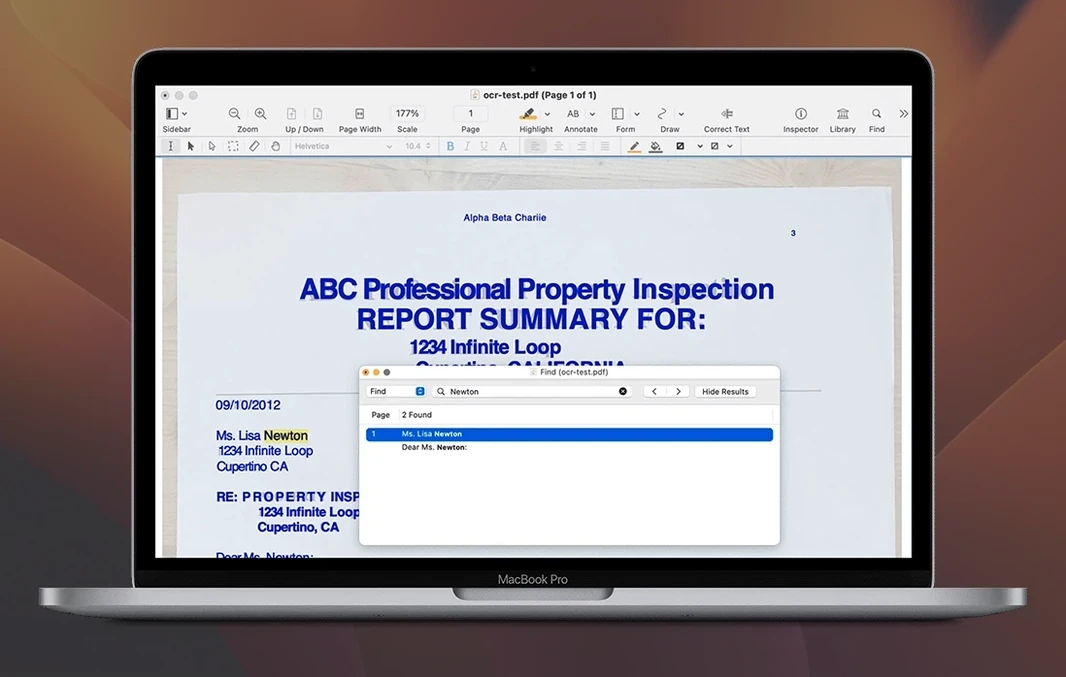
OCR — If the document was a flat scan, the OCR engine makes its text searchable and editable first.
Markup — Highlight clauses, strike through removed terms, or attach an audio note for a coworker to hear your reasoning.
Forms — Fill out any empty fields the sender left, or create your own form fields from scratch on a blank page.
Export & merge — Pull the fixed text out as a rich-text snippet that keeps its columns, or combine the signed contract with supporting files into one portfolio.
If you regularly need to change a few words, drop in a signature, and send a PDF back without leaving the Mac, this tool fits that rhythm.
Smoother Text Editing, Fewer Layout Surprises
Version 13 brought a noticeable shift in how the app handles everyday editing. Before, tweaking a paragraph in a dense report could feel like nudging furniture around a cramped room—text blocks sometimes shifted when you didn't want them to. The 13.x line tightened that up. Editing text in the original PDF now snaps to a more predictable grid, so a two-word correction in a heading doesn't cascade into repositioning the image below it.
OCR got quieter but smarter. Earlier builds would occasionally trip over mixed-font scans, especially documents where a sans-serif header sat above a serif body. The 13.3.1 engine handles those transitions with fewer garbled characters. For anyone dealing with old contracts or scanned academic papers, that means less time manually fixing "clause" back from "dause."
Form creation picked up a small but handy improvement: cross-platform fillable forms now hold their field alignment better when opened on Windows machines. If you're building an intake form on your Mac and sending it to a client who uses Adobe Reader on a PC, the checkboxes and text fields stay where you placed them. Batch processing also got less finicky with large sets—converting a folder of fifty scanned invoices to searchable PDFs no longer requires babysitting the progress bar.
Built-In OCR Kicks In for Scanned Pages
Does it handle scanned documents well, or do I need a separate OCR app? The OCR is built in and activates when you open a flat scanned PDF. It's not a separate tool you have to remember to launch. Point it at a stack of paper documents, and the engine layers a text layer underneath while keeping the original scan image visible. Accuracy depends on the scan quality, but for clear 300 dpi office documents it rarely stumbles on standard business English. Handwritten notes will still defeat it, as they do most OCR engines.
Will it slow down my older Mac? The minimum is Mojave, and the app runs on both Intel and Apple Silicon Macs. On a 2018 MacBook Air with 8 GB of RAM, opening a hundred-page PDF and running OCR adds a few seconds of fan noise, but basic editing and signing stay responsive. The disk footprint hovers around 2 GB after installation, which is modest for a full PDF editor.
Can I convert a PDF to Word without losing formatting? The export engine preserves columns, tables, and most font styling when sending a document to Microsoft Word, Excel, or PowerPoint. Complex layouts with tightly wrapped images may need a quick post-export tidy, but simple reports and contracts usually land intact. The rich-text copy feature also works directly—select a block, copy, and paste into a word processor while keeping the column structure.
Deeper Form Tools Beat PDF Expert's Limits
PDF Expert shares a lot of the same editing and annotation ground, and its interface feels slightly more fluid on macOS for pure reading and highlighting. Where Nitro pulls ahead is in form creation and the depth of its export options. PDF Expert handles filling forms gracefully, but building a new fillable form from scratch or converting a batch of PDFs to Office formats is more Nitro's territory.
Adobe Acrobat Pro covers almost every imaginable PDF task, including preflight checks and color separation tools that Nitro doesn't touch. For a graphic designer or print-production professional, that matters. For someone editing contracts, marking up reports, and occasionally running OCR on a scanned document, Nitro offers the same core editing and signing tools without the weight of features that go unused.
PDFpen—now Nitro PDF Pro—sits in a similar niche but with a different pedigree. Users who came over from the Smile era will recognize the editing bones. Compared to something like Foxit PhantomPDF on Mac, Nitro feels more at home on macOS; Foxit's interface carries a cross-platform stiffness, while Nitro's tool palettes and keyboard shortcuts follow Mac conventions more naturally.
Respecting Invisible Text Boundaries
The most common stumble is treating every PDF like a Word document. Nitro lets you click and type on text, but the underlying text blocks have boundaries. A new user will sometimes click a sentence, start typing, and wonder why words aren't flowing to the next line—usually because the block ends mid-page. Dragging the block handles wider fixes the reflow.
Another classic: importing a scan and expecting OCR to run automatically. You have to trigger it explicitly from the OCR panel or set up batch processing. Until you do, the document remains a flat image, and searching for a client name returns nothing. The app won't warn you; it just treats the scan as a picture until you tell it otherwise.
Signatures trip people up too. Drawing a signature with a trackpad feels natural, but the result often looks shaky compared to scanning a pen-on-paper signature with a phone camera and importing that image. Beginners tend to use the trackpad once, dislike the result, and assume the signing feature is weak. The scanned-image route produces a much cleaner stamp, and Nitro stores it for reuse across documents.
Finally, batch exporting a folder of PDFs to Word without checking the source quality first. If those PDFs were printed from different applications—some from web pages, some from InDesign, some from scanned paper—the conversion results will vary wildly. Running a quick OCR pass and cleaning up obvious layout quirks on a few sample files before committing to a hundred-document batch saves a lot of cleanup later.
- macOS 10.14 Mojave or later
- Intel or Apple Silicon Mac
- 1 GB RAM
- Up to 2 GB free disk space
- Display resolution of 1280×800 or higher
Questions I actually get
Can Nitro PDF Pro make a scanned document editable?
Yes, it includes an OCR engine that converts scanned pages into searchable, editable text.
What kind of annotations can I add?
You can highlight, underline, and strikethrough text, plus record and play back audio annotations directly on the page.
Porch talk 0
Come in or pull up a chair to leave a comment.
Nobody has pulled up a chair yet. If you used it on a real Saturday, say what the hour was.