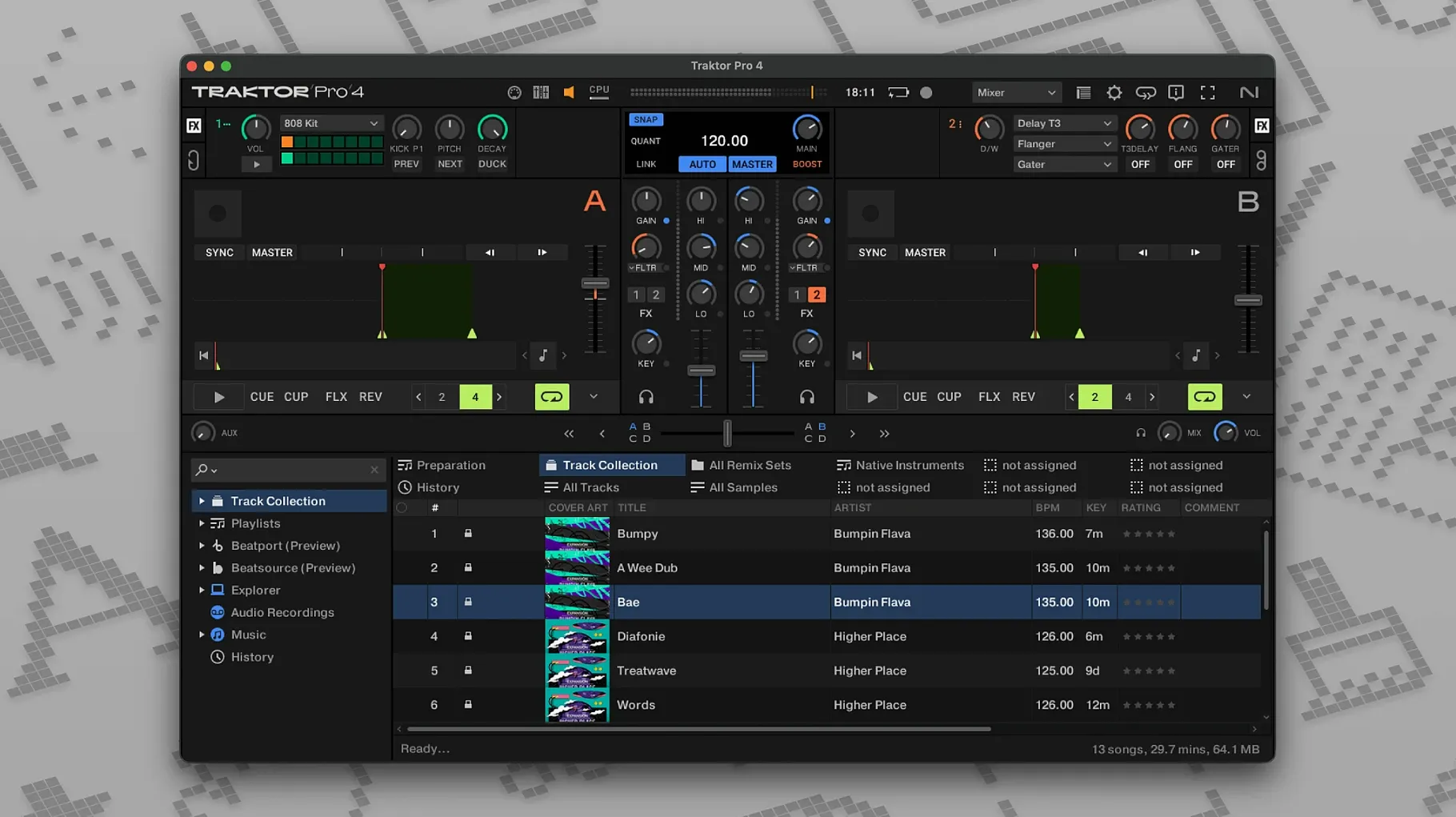
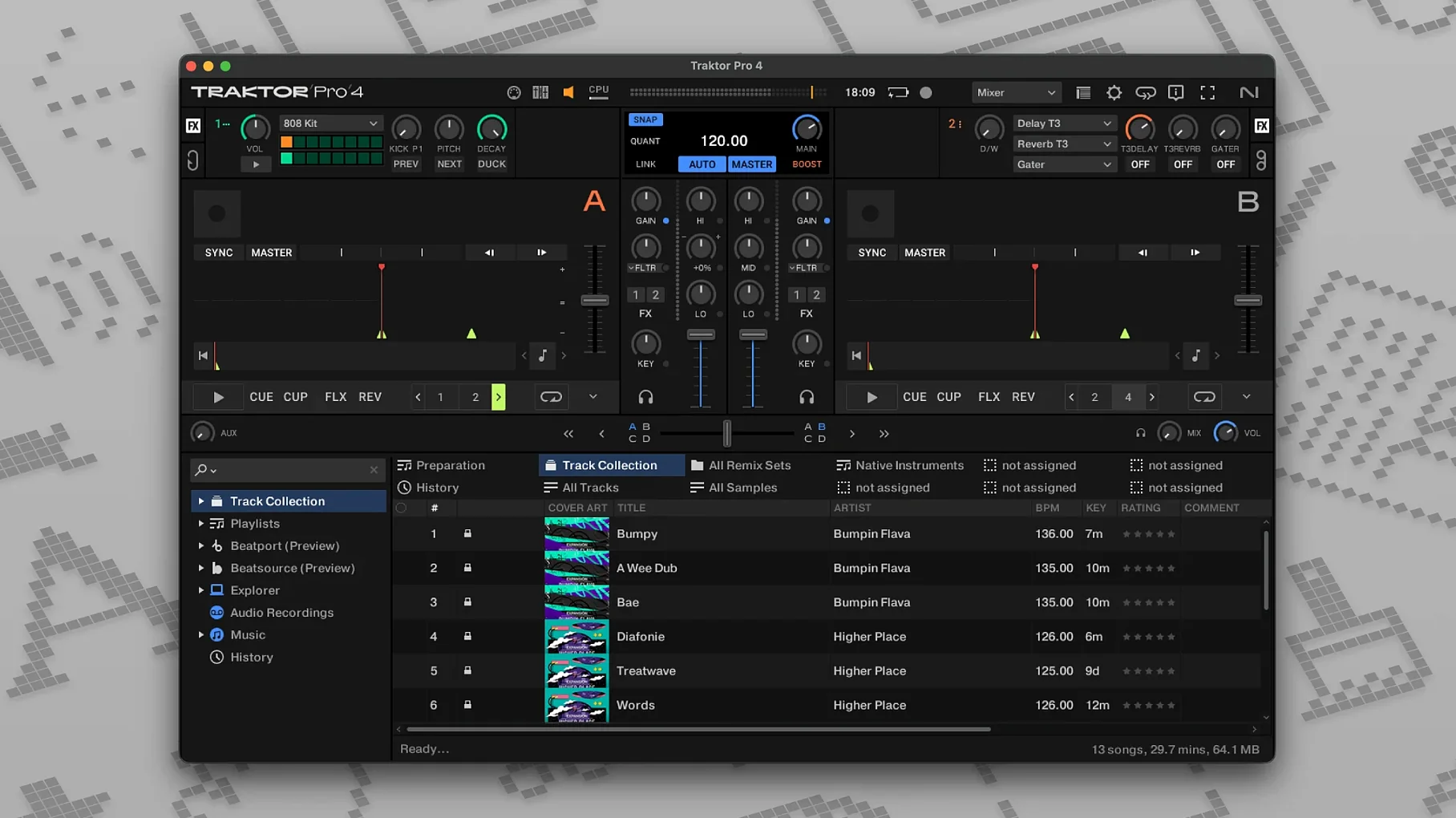
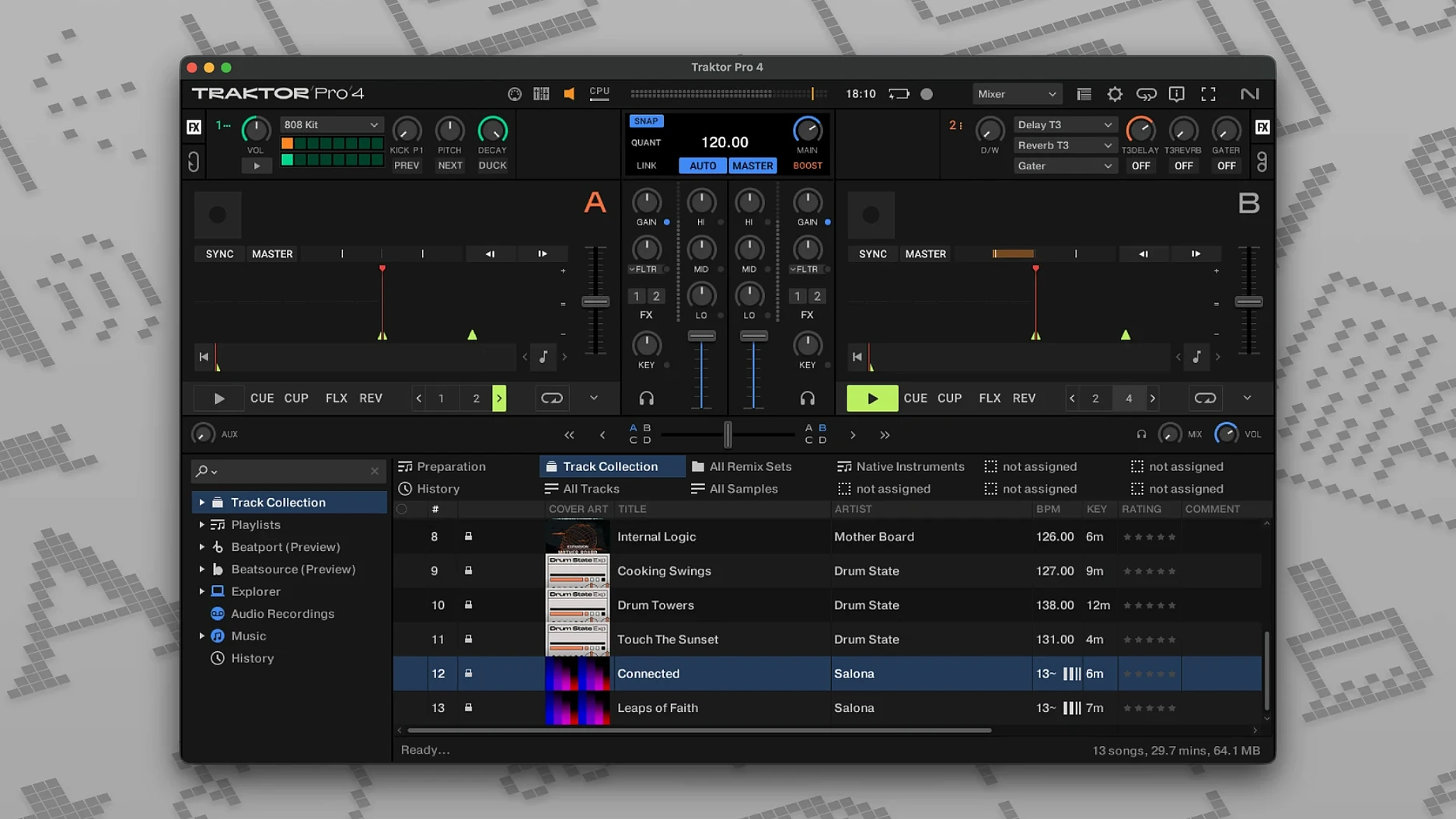
One thing that can throw a DJ is opening their laptop to find a familiar piece of software has suddenly rearranged its entire soul. With Traktor Pro, the current version keeps the layout and muscle memory you have built over years of late-night sets intact. Stem separation is still here for pulling apart drums, bass, and vocals on the fly, and Beatport streaming sits right inside the browser so you can dig for a track the moment a room asks for it.
The core engine, still running cool
Under the hood, everything still orbits around four decks and a mixer that feels direct. You can map your own keyboard shortcuts to slip into reverse playback during a build, or lock the tempo across gear using MIDI Clock. If you own a Traktor Kontrol controller, the jog wheels and faders snap into place without a setup ritual. The software exports finished recordings as WAV or AIFF files, and it pulls artist and title tags from your iTunes library without making a fuss about it.
A familiar toolbox, ready when you are
Compatibility sits at macOS 12 and later, running natively on both Intel and Apple Silicon machines. The installation is just a matter of opening the disk image and running the standard procedure. For anyone who has been on Traktor Pro 2 or an earlier Traktor Pro 3 build, moving to this version means gaining the newer separation tools and streaming access while your cue points, loops, and grid edits come along for the ride. It is a quiet but capable update for DJs who prefer their software to stay out of the way until the fader goes up.
Lid Up, Kontrol S4 Lights On, No Mapping Dialog
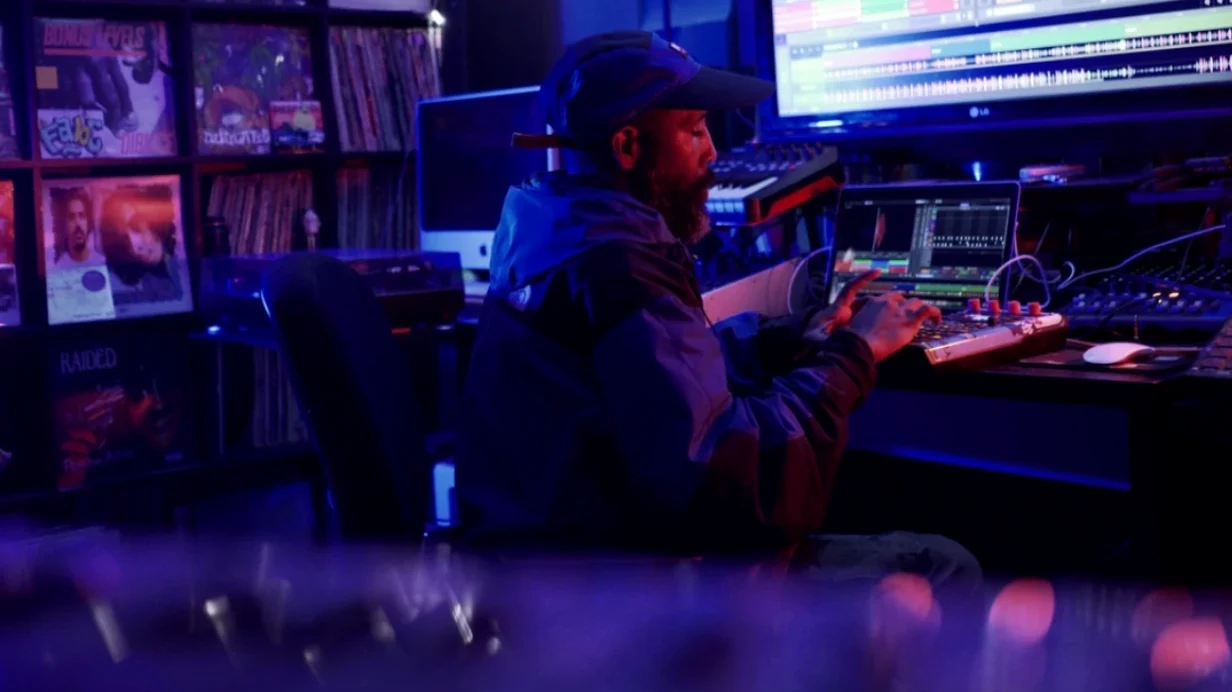
You roll into the booth a little early, plug in your Kontrol S4, and open the lid on a MacBook that has seen a few too many club nights. The controller lights up without a single mapping dialog. That little moment still feels good.
First ten minutes are about digging. You tap the Beatport streaming tab in the browser, run a search for a bassline that has been stuck in your head all afternoon, and drag a handful of candidates into a preparation playlist. Two of them match the key of the tracks already sitting in your main crate, so you drop cue points on the intro kicks and set a loop near the first breakdown. Nothing elaborate. Just breadcrumbs for later.
With the room still quiet, you flip one deck to Stem Deck mode. A two-bar loop from an old funk record gets isolated down to its drum stem, and you nudge the gain until the kick punches through the booth monitors. You save that as a small Remix Deck slot, assign it to a pad on the controller, and forget about it until the peak of the night when a spare snare roll will be the only thing keeping the energy from dipping.
The actual set flows in three-deck territory. Deck A carries the main track, Deck B handles the incoming selection with the low end cut, and Deck C stays loaded with an acapella stem you separated earlier in the week. MIDI Clock runs a steady pulse out to a hardware synth sitting on the side table. Every transition leans on the filter knob and a slow reverse playback tap that pulls the outgoing track backward for two beats before you kill the fader. No sync issues. No frantic mouse grabs. When the set wraps, you hit the record button, export a WAV to the desktop, and let the next DJ plug in.
Right-Click Cue Types You Didn't Know Were There
There is a handful of touches in Traktor Pro that do not announce themselves loudly, but once you know they exist, they change how you move through a set. Here are a few worth poking at.
- Right-click cue type switching. Hover over any cue point marker in the waveform, right-click, and you can flip it between Cue, Load, Fade In, and Fade Out without opening a preferences panel. Useful when a track needs a smooth auto-fade exit rather than a sharp jump.
- Snap and quantize per deck. The global quantize button gets all the attention, but you can override it individually on each deck. Keep Deck A tight to the grid while Deck B floats freely for off-grid vinyl rips and live drum breaks.
- Browser favorites with color labels. Drag any folder or playlist to the favorites star in the browser, then right-click it to assign a color. After a month of heavy library growth, those colored dots are faster than reading folder names.
- Flux mode for slip-style looping. Toggle Flux on and start a loop mid-phrase. When you release the loop, playback jumps to where it would have been as if nothing happened. Great for extending a vocal hook without derailing the arrangement beneath it.
- Command-F search from anywhere. Even with the browser collapsed, Command-F drops focus into the search field. Type a few letters, hit Enter, and the first result loads into the preview player. You never have to reach for the mouse.
Snap and Quantize Are Still On
Everyone stumbles through the first few hours with four decks. These are the stumbles I see repeated most often, usually right before someone blames the software for something that is actually a settings toggle.
Leaving Snap and Quantize on for everything. Both are fantastic safety nets, but leaving them locked on across all four decks means every hotcue jump, loop engage, and beat jump lands exactly on the grid. That is perfect for tightly quantized house, and a creativity killer for loose funk, disco, or anything with a drifting live drummer. Learn to toggle them per deck early.
Ignoring the headroom setting in the mixer preferences. The default headroom value can make a mix sound quiet when you export it, especially if you are riding the channel faders conservatively. A small bump here, combined with the limiter on the master output, gives your recorded WAV files a much healthier level without clipping.
Loading stems onto a deck with the wrong deck type. Stem separation only works on Stem Decks. Dragging a full track onto a standard Track Deck and then hunting for the stem controls in frustration is practically a rite of passage. Switch the deck flavor first from the deck header dropdown, then load the track.
Forgetting to set the recording source. The internal recorder defaults to the master output, which is usually what you want. But if you have previously routed a specific channel for a live stream, Traktor remembers that. A quick check of the recorder panel before the set saves you from discovering a silent recording file an hour later.
Built for Stems and Remix Decks
Traktor Pro is not a one-size-fits-all DJ tool, and that is by design. Certain kinds of users click with it immediately, while others fight the workflow from the first beat.
DJs who build their sets around stems and remix decks. If your style involves live remixing, isolating vocals on the fly, or juggling one-shot samples over a running beat, this software was built with you in mind. The Stem Deck and Remix Deck types are not afterthoughts; they are central to the architecture. No other DJ platform gives you four stem separation channels per deck out of the box.
Hardware tinkerers and MIDI mapping enthusiasts. Traktor's controller manager is deep enough to let you assign almost any function to a knob, button, or fader on any MIDI device connected to your Mac. People who run hybrid setups with an external mixer, a boutique MIDI controller, and a drum machine synced over MIDI Clock find themselves right at home. Custom mappings can be saved, shared, and loaded per setup.
DJs moving up from Traktor Pro 2 or Traktor Pro 3. If you have been on Traktor Pro 2, downloaded a cracked version long ago, and are finally curious about what stem separation and streaming feel like, the familiar layout means you spend an afternoon learning the new tools rather than relearning how to mix. Every cue point, beat grid edit, and loop you saved in the old version carries forward.
Live performers who need a stable clock source. MIDI Clock and OSC output let Traktor act as the rhythmic backbone for a broader stage setup. Synths, sequencers, and lighting rigs can all follow the master deck tempo without drift. This is less about traditional DJ mixing and more about putting Traktor at the center of a performance ecosystem.
If you mainly mix two tracks at a time, never touch MIDI, and prefer a simpler interface, Traktor Pro might feel like a cockpit with more buttons than you need. But for anyone who leans into stems, custom hardware maps, or multi-deck hybrid sets, it hits a sweet spot that few other programs even aim for.
- macOS 12 or later
- Runs natively on Intel and Apple Silicon Macs
Porch talk 0
Come in or pull up a chair to leave a comment.
Nobody has pulled up a chair yet. If you used it on a real Saturday, say what the hour was.