Stems Pad FX like Echoes and Brakers don't just layer an effect — they let you grab a vocal, a drum break, or a bassline and treat it like its own instrument. That's the kind of hands-on control Serato DJ Pro has always been about. It's the core of the Serato suite, built for DJs who play out regularly and need software that doesn't get in the way.
What sits at the center
- Full Stems integration for isolating vocals, melody, bass, or drums in real time
- Stems Pad FX including Echoes and Brakers for performance-level manipulation
- Customizable hardware Slip Release so the software feels matched to your gear
- Official support for more than 90 hardware devices from major manufacturers
Stable hub for your existing mixer
Serato DJ Pro is the reliable centerpiece. It runs on macOS 12 Monterey and later, on both Intel and Apple Silicon machines, and the interface stays in English. If you've already settled on a mixer or controller you trust, there's a good chance it's on the supported list. The software is designed to be transparent — it handles the heavy lifting while you focus on the room. If you mix regularly and want a clear, stable platform that welcomes the gear you already own, this is worth a close look.
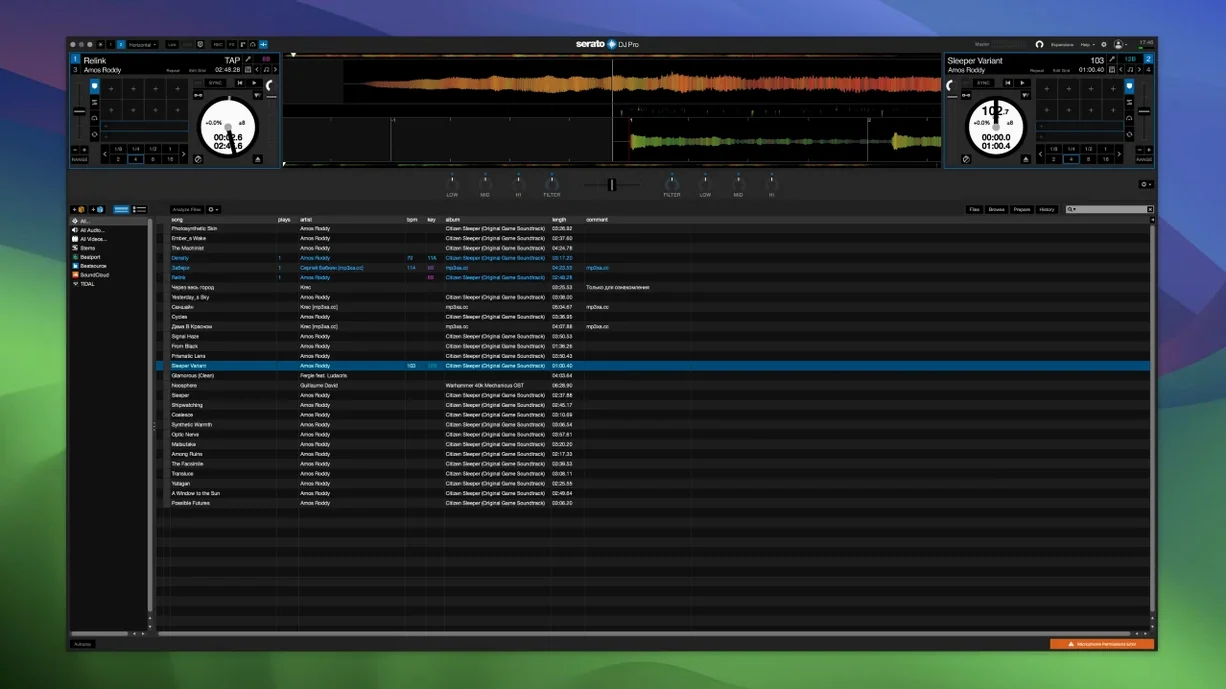
You spend most of a set staring at waveforms and library columns, so the small interface decisions matter more than any headline feature. A few of them are easy to miss on a first pass. The track-end warning, for instance, isn't just a blinking light. You can set it to fade the playing track's volume automatically in the last few bars, which buys you a few extra seconds to line up the next mix when the floor is packed and your ears are busy. Another quiet helper lives in the library: holding Option while dragging a crate onto another crate merges their contents instead of creating a nested folder. It saves you from the kind of mid-set cleanup that nobody wants to do at 1 a.m.
The cue point layout rewards a little exploration. You can colour-code cue markers across your whole library, so red always means a vocal drop, blue always means a breakdown, and your fingers learn the pattern without thinking. If you work with a controller that has performance pads, the pad-mapping panel lets you reassign the bottom row to instant Stems mutes while the top row stays on hot cues. It's the kind of shortcut that takes ten minutes to set up and then saves you from menu diving for the rest of the night. And in the preferences, under the Library + Display tab, the option to show key-shifted track keys alongside the original key is tucked away — but once you turn it on, harmonic mixing with pitch-adjusted tracks becomes a lot less guesswork.
Walk in and plug into 90+ house rigs
Club and bar DJs who play on house gear benefit immediately. With more than 90 officially supported hardware devices, you can walk into a venue, plug your laptop into whatever mixer or controller is already in the booth, and be confident the software will map itself. The time you save not troubleshooting drivers goes straight into reading the room. Mobile DJs who handle weddings and corporate events lean hard on the library management side. Crates and smart crates make it practical to build a request-friendly collection that you can search by key, BPM, or custom tags while someone's aunt is asking for a song you haven't played in three years.
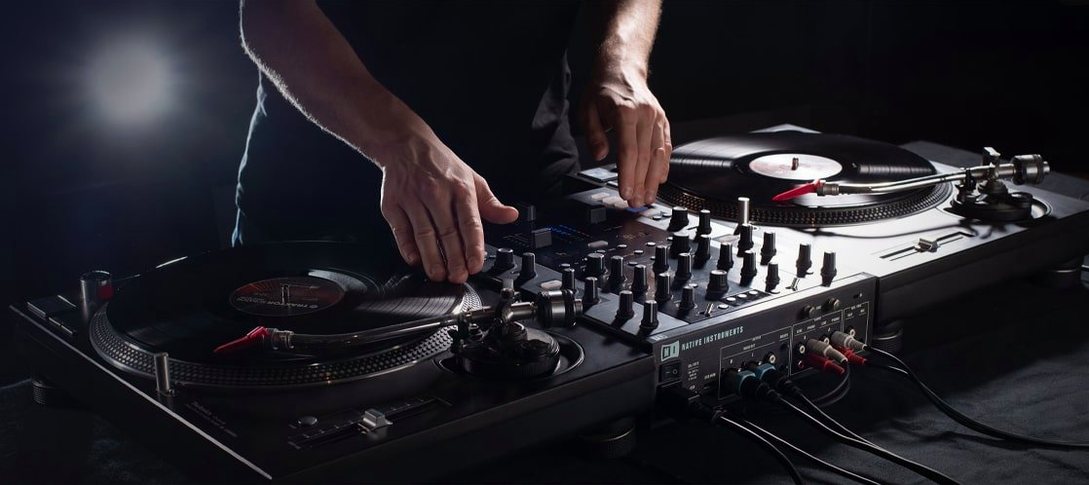
Turntablists and scratch DJs who use digital vinyl systems are another group that settles in quickly. The low-latency response with Serato control vinyl and the customizable Slip Release timing mean your cuts and crabs register the way you expect. Bedroom producers who are just moving into performance also find a comfortable home here, because Stems isolation lets them pull acapellas and instrumentals from their own unfinished tracks on the fly — no need to bounce separate stems ahead of time, just load the full mix and strip away what you don't want live. Anyone who already owns compatible hardware and feels held back by entry-level DJ software will notice the difference in the first half-hour of digging through their library.
Offload Stems analysis to save laptop power
One of the first questions is whether Stems processing bogs down an older machine. The separation algorithms are processor-intensive, but Serato DJ Pro lets you pre-analyze tracks for Stems during library management instead of during a set. On an Apple Silicon Mac, real-time Stems manipulation feels responsive; on an Intel machine from a few years back, pre-processing the files ahead of time keeps the performance smooth. You trade a little prep time for a stable set, and most DJs find that's a fair swap.
Another common thread is about library migration. If you've been using Serato DJ Lite, your crates, cue points, beat grids, and analyzed files carry over without any extra steps — you open the Pro version and everything is exactly where you left it. People coming from other DJ software sometimes worry about losing their hot cues and loops, and the honest answer is that cue data doesn't always translate perfectly between platforms. But the batch analysis tools in Serato DJ Pro are fast enough that re-cueing a migrated library isn't as painful as it sounds, especially once you settle into a colour-coded system.
Hardware compatibility comes up often enough to address directly. With 90-plus devices on the official list, most major controllers, mixers, and interfaces from Pioneer DJ, Denon DJ, Rane, Numark, Reloop, and Roland are covered. If you're using something niche or very new, it's worth checking that it shows up in the supported-hardware page, because Serato locks the full feature set behind recognized hardware. Without a connected, supported device, the software opens in practice mode with limited functionality — you can organize and prepare tracks, but you won't be mixing out to a crowd that way.
A set, from setup to pack-down
You arrive at the venue about half an hour early. The laptop comes out, the USB cable connects to the house mixer — a Rane Seventy-Two in this case — and Serato DJ Pro recognizes it before you've finished your coffee. The decks populate on screen just as the booth monitor warms up. You scroll to a crate labeled Early Warmers, sorted by BPM from slow to steady. The first track loads, you tap a cue point to mark the intro, and the waveforms stretch across the screen in a familiar orange-and-blue gradient.
As the room fills, you start pulling Stems into the mix. A disco track has a drum break you want to loop while the vocals from the next song hover over it, so you mute the bass and melody on the current deck with one pad press and bring the incoming vocal in a cappella. The crowd doesn't know you're isolating stems in real time — they just hear a blend that sounds rehearsed. Mid-set, you lean on the Echoes Pad FX to throw a vocal snippet into a wash of repeats, then drop into a bassline from a completely different genre. The beat-grid alignment keeps everything locked, even when the tempo drifts by a few BPM between songs.
By the last hour, you're deep into the Peak Time crate, and the Slip Release customization you set up earlier pays off. When you nudge the platter on the controller to slow down a transition, the track snaps back into phase exactly where you expect it, not a beat late. After the final song, you close the lid on the Mac, and the library is already saved — crate histories, play counts, and any new cue points you set during the set are written as you go. There's no "save as" dialog to fumble through while the bar staff are stacking chairs.
Alongside other DJ platforms
Next to rekordbox, Serato DJ Pro feels more immediate for performance. rekordbox is tightly woven into Pioneer DJ's ecosystem and excels at export-mode preparation for club-standard CDJs, but its performance mode, while capable, doesn't match the fluidity of Serato's Stems implementation. If you play on USB sticks more often than with a laptop, rekordbox has the advantage. If you perform with a laptop and want real-time stem isolation that doesn't feel bolted on, Serato DJ Pro pulls ahead.
Virtual DJ casts a wider net with its karaoke, video mixing, and live-streaming features, and its stem separation was available earlier. The trade-off is that Virtual DJ can feel sprawling — a lot of menus and customization options that are powerful but take time to tame. Serato DJ Pro is more opinionated about layout and workflow, which means you spend less time configuring and more time mixing. For a DJ who wants a focused tool rather than a Swiss Army knife, the narrower scope is a strength.
Traktor Pro, the long-running Native Instruments platform, still has a loyal following among techno and house DJs who love its Remix Decks and precise effects routing. Its library management, however, hasn't kept pace, and the hardware ecosystem is smaller. Serato DJ Pro's expanding Stems Pad FX and broad controller support make it the safer bet for someone who plays across different venues and doesn't want to carry an audio interface to every gig. The gap in creative effects is closing, too — Brakers and Echoes give Serato a tactile, performance-oriented edge that used to be Traktor's strongest card.
If your main concern is walking into a club with a laptop and working with whatever gear is already there, Serato DJ Pro covers more ground than any of the alternatives. The other platforms have their pockets of excellence, but none of them pair wide hardware support with stem-based performance tools in quite the same way. A search for something like serato dj pro suite 4.0.9 or serato 3.5.5 will turn up plenty of chatter about older builds, but the current version has settled into a stable, feature-complete state that doesn't make you nostalgic for earlier releases.
- macOS 12 Monterey or later
- Supports both Intel and Apple Silicon Macs
Porch talk 0
Come in or pull up a chair to leave a comment.
Nobody has pulled up a chair yet. If you used it on a real Saturday, say what the hour was.