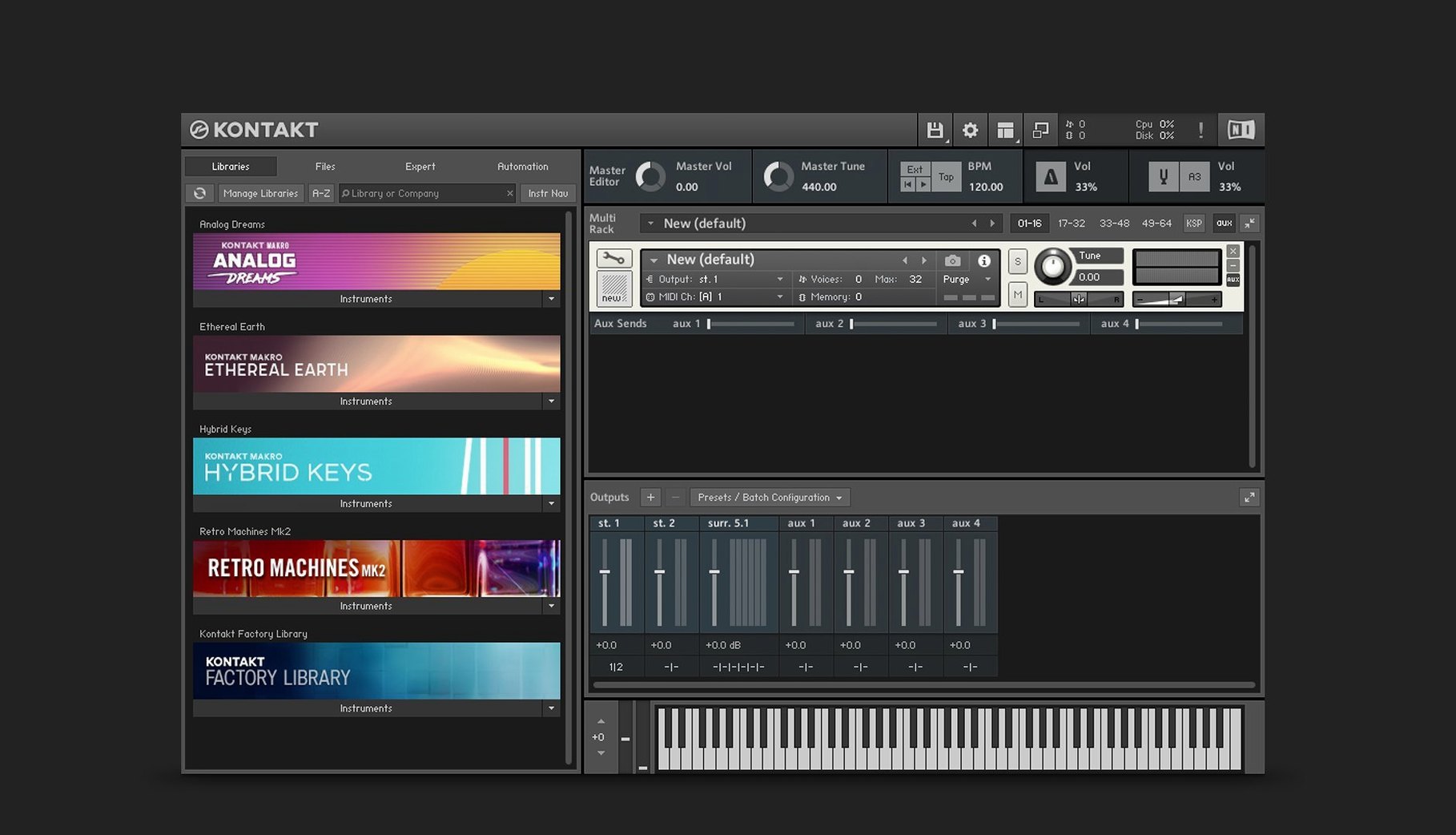
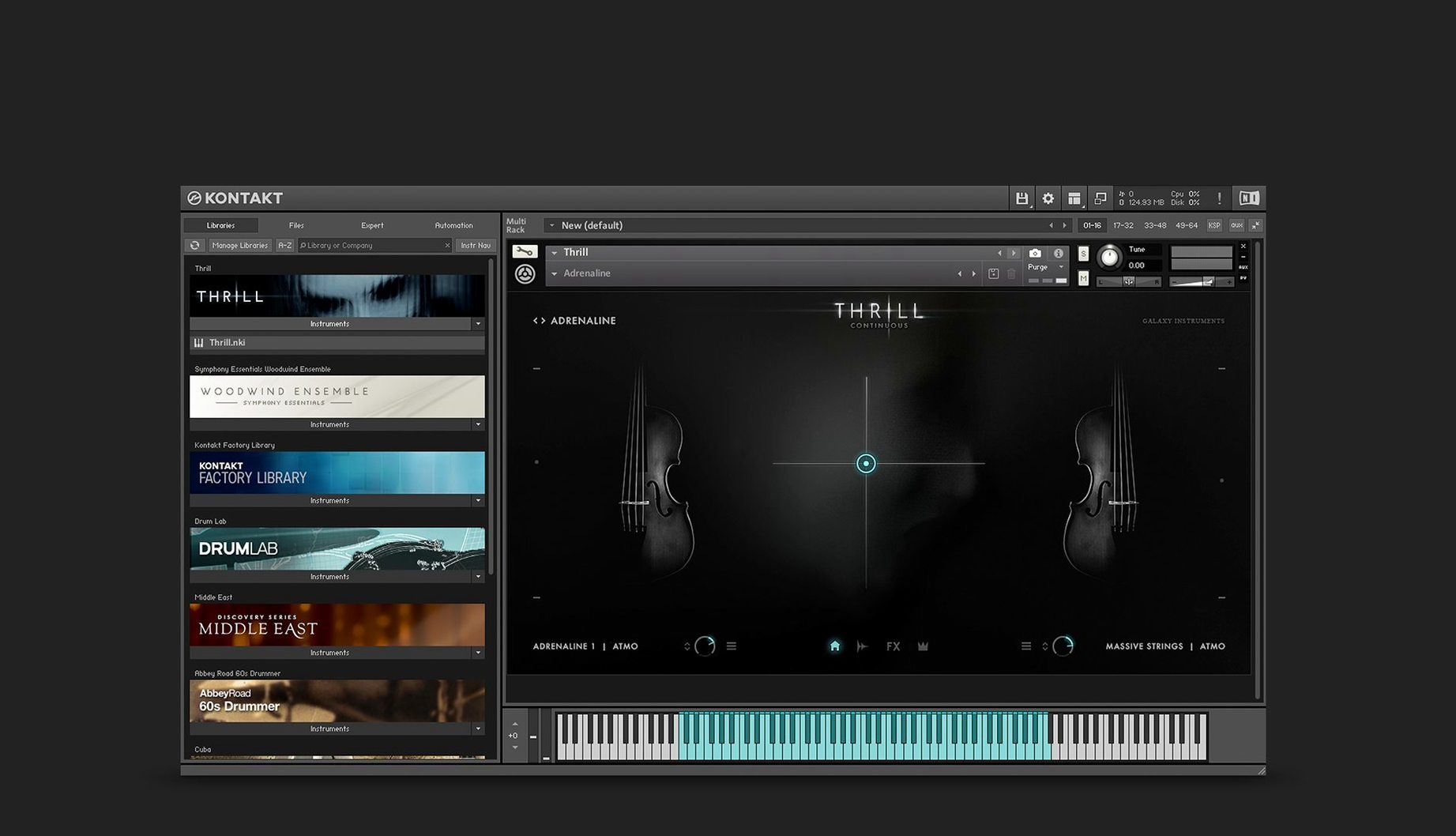
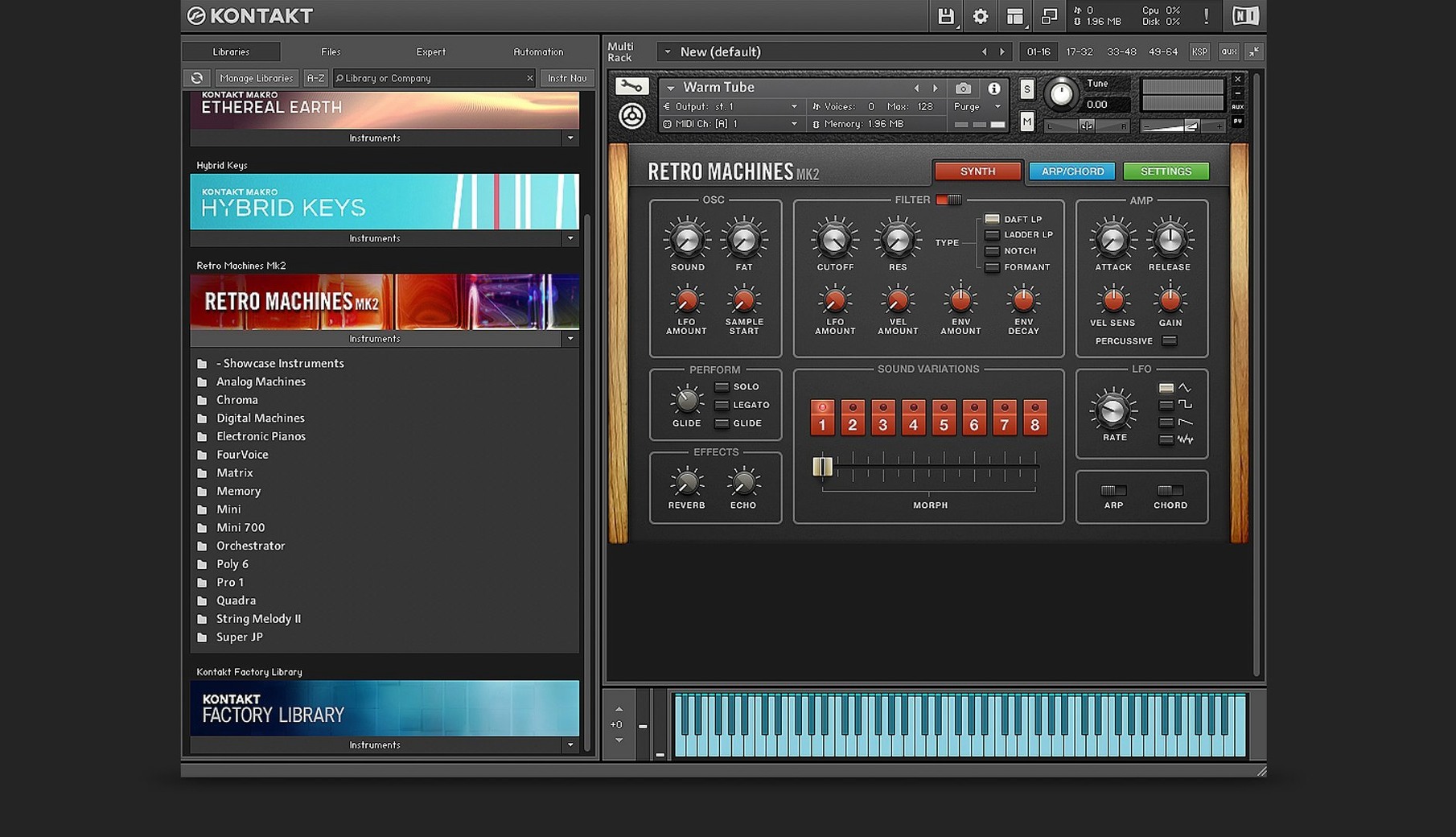
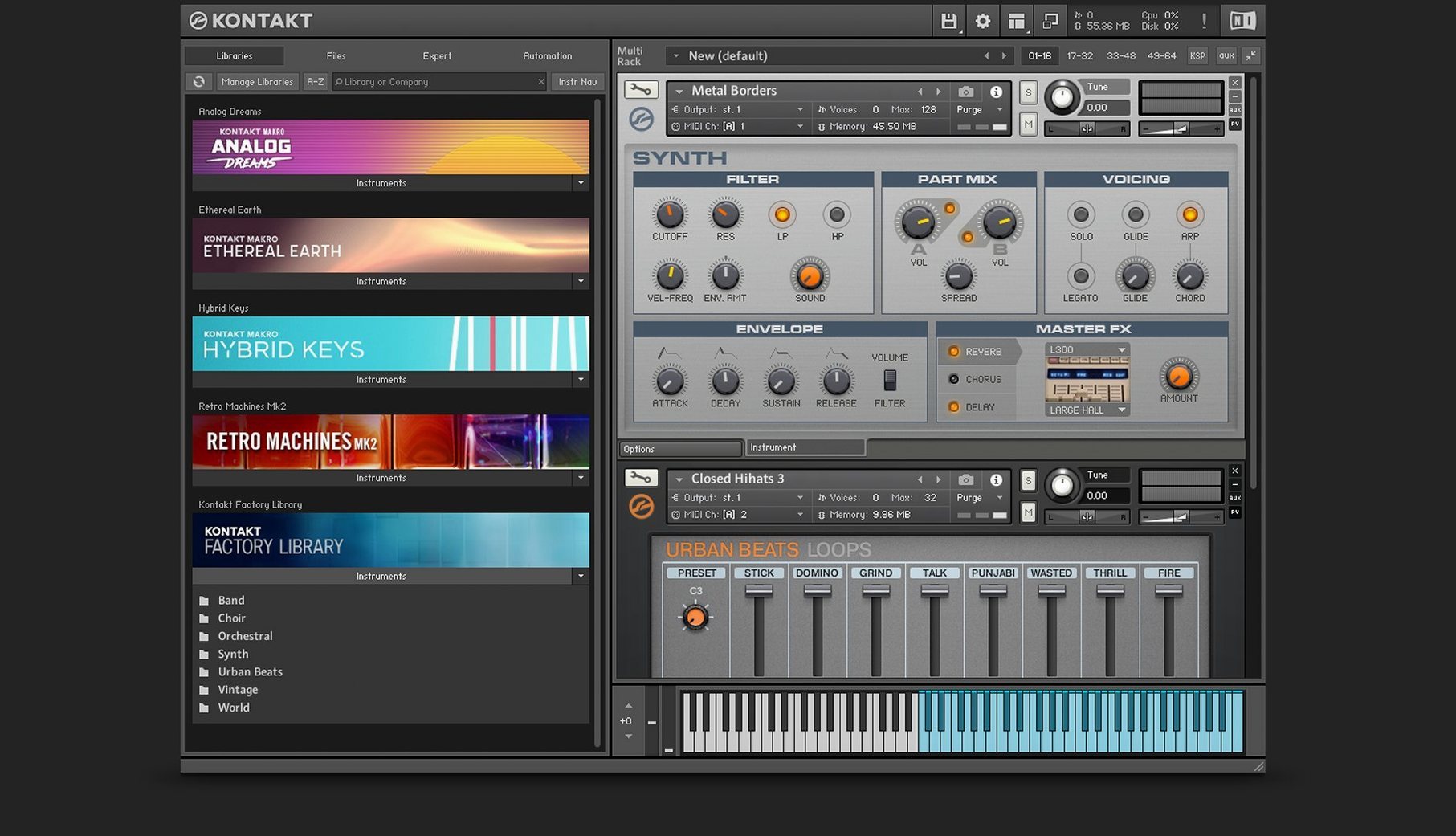
Sixteen internal stereo buses for a single instrument — that was the kind of headroom Kontakt 6 introduced, and the platform has only gotten more ambitious since. If you are wondering whether the current version will run on your setup, the short answer is that Kontakt 8.13.1 needs macOS 14, with native support for both ARM and x86 64-bit architectures. Here is what that means for your everyday session.
- macOS 14 required. You cannot open this version on an older system. The installer expects Sonoma or later, so check your machine before clearing drive space.
- Intel and Apple Silicon are both welcome. The application ships as a universal binary. Whether you are on an M-series MacBook or an Intel Mac Pro, you are covered without translation overhead.
- Leap. A new section built for loops and one-shot samples — grab audio, drop it in, and perform it directly without mapping a key range first.
- Tools. A side pane that connects MIDI manipulation utilities to any loaded instrument. Arpeggios, strumming patterns, and note repeats live here, and you can chain them.
- Wavetable module plus adaptive resonance. The modulation oscillator in the Wavetable engine pairs with filters that automatically tame resonance peaks, keeping things musical when you push the cutoff hard.
- English-only interface. The menus, tooltips, and browser all use a single language, which is worth knowing if you prefer a localized workflow.
If your Mac is on Sonoma or newer, Kontakt 8 slides in cleanly. The Leap and Tools additions make it feel less like a library host and more like a hands-on performance desk — worth a look if you spend your evenings chopping breaks or tweaking orchestral templates.
Bypassing the Player-vs.-Full Confusion
Most people hit the same three speed bumps before they open Kontakt for the first time. A little clarity now saves a frustrated evening later.
Do I need the full Kontakt, or will the Player work? The Player runs any library that carries the "Kontakt Player" badge — those developers have paid for a licence, so the instrument opens fully, no demo timeouts. If you have third-party libraries from smaller sound designers, or you want to dig under the hood and edit zones, mapping, and scripting, the full version is what gets you past the fifteen-minute demo nag and unlocks the edit button. Think of the Player as a playback-only jukebox; the full Kontakt hands you the workshop keys.
Will my old libraries load? Native Instruments has a decent track record with backwards compatibility, so libraries built for Kontakt 5 or 6 generally open here. Some really ancient ones from the Kontakt 3 era might need a resave in a middle version, but if you have been keeping your collection semi-current, you are probably fine. The bigger variable is the file system — libraries on an external APFS drive mount faster than on a spinning disk formatted ExFAT from a Windows machine.
Do I have to stay online? Activation is a one-time handshake through Native Access. After that, you can work offline. If you are searching for a Kontakt 8 crack Mac or a Kontakt 8.7 torrent to sidestep that step, the key to a smooth experience is checking that all library paths are intact and NKIs are properly referenced so you can avoid batch re-saving marathons. Offline use with a clean installation means you open it and it works, no internet required until the next update.
Stretching a Train Horn into a Pad
Here is a task I reach for when I want something that does not sound like a preset. You have a thirty-second recording of rain on a metal awning — or a bowed wine glass, or a distant train horn. Kontakt 8 can turn it into a pad that sits behind a verse without fighting the vocal.
- Drop the sample into Leap. Open the Leap pane from the Default view and drag your audio file straight onto the grid. It becomes a one-shot, playable from C3. Tap a few keys at different velocities to hear how the transient hits.
- Stretch it into a bed. Switch the Leap cell from One-Shot to Loop mode and set the crossfade length so the tail loops smoothly. Crank the time-stretching percentage up — try 200% or 300% — and suddenly a two-second splash becomes a slow, evolving wash.
- Add modulation with the Wavetable module. Insert the Wavetable engine on a second instrument slot and route both through the same instrument bus. Pick a formant-like wavetable, set the modulation oscillator to a slow triangle wave, and let it sweep gently behind the stretched rain loop. The adaptive resonance filter keeps the high end from getting prickly when the sweep peaks.
- Chain a Tool. Open the Tools side pane and drop an arpeggiator onto the pad slot. Set the rate to dotted eighth notes, gate to about sixty percent, and octave range to one. What was a static drone now has a rhythmic pulse that follows your chord changes.
- Bake in some movement. Map the mod wheel to the loop start offset in Leap and to the wavetable position in the second slot. A single controller now shifts both the texture and the rhythmic emphasis, so you can ride it through a buildup without touching the mouse.
The whole process takes about four minutes once you know where the controls live. The result is a pad with your fingerprint on it, not another factory preset with the serial numbers filed off.
Stability, speed, and what it does to your CPU
Nobody wants to babysit a sampler while a session is flowing. After a few weeks of daily use on an M2 MacBook Air, a few patterns emerge.
Loading a medium orchestral template — strings, brass, a couple of percussion patches, about forty instruments total — takes under thirty seconds from a Thunderbolt SSD. The same set on the internal drive shaves another five or six seconds off. Once loaded, switching between instruments in the rack is instant. The new Komplete UI rendering feels snappy at retina resolutions; no blurry text or laggy knobs, even when the instrument uses a high-DPI interface built with Komplete Script.
Memory usage is predictable. An empty instance sits around 200 MB. A fully loaded cinematic template with multi-mic patches pushes past 12 GB, which is where the purge-sample feature earns its keep. You can tell Kontakt to dump articulations you are not tracking, and it reclaims RAM without closing the project. The batch re-save function — buried in the file menu but worth digging out — compacts libraries so they stream faster from disk.
CPU behavior depends on the voice count. A single Leap cell running a stretched loop barely registers. Stack eight instances of the Wavetable module with unison voices turned up, and you will see spikes on a single core. Spreading instruments across multiple Kontakt instances inside your DAW helps the scheduler distribute the load better than one giant sixteen-channel rack. Stability-wise, version 8.13.1 has not thrown a single crash in Logic or Ableton during the testing period, and AU validation finished cleanly on first scan. People hunting a kontakt mac free setup might miss these refinements, but the disk streaming and purge improvements are what keep a session moving when the track count climbs.
Point Content to the Right Drive First
A few moves early on prevent the "why is this not working?" moments that hit around day three.
- Point the content directory before you load anything. Open Preferences and set the download and content locations to the drive where your libraries actually live. Native Access defaults to the system drive, and you do not want 800 GB of strings filling up your boot volume. If you have libraries scattered across externals, use the "Locate" button in Native Access rather than reinstalling.
- Build a Quick-Load catalog. The browser is fine for browsing, but Quick-Load is faster for the ten instruments you reach for constantly. Right-click any NKI and add it to Quick-Load, then organize folders by category — drums, keys, textures, orchestral. You can trigger it with a right-click on an empty rack slot, and it becomes muscle memory within a week.
- Test the multi-core setting. In Options under the Engine tab, the multiprocessor support checkbox defaults to on. For most modern Macs, leave it that way. If you are running an older Intel machine and notice audio dropouts with a heavy session, try toggling it off — sometimes the thread management overhead outweighs the benefit on four-core chips.
- Save your first default template. Once you have a handful of go-to instruments loaded — a piano, a bass, a pad, a drum kit — save the multi as "Default.nkm" in the Kontakt user folder. Next time you launch, it appears exactly as you left it, no hunting required.
- Resave any library that streams sluggishly. If an older library stutters on note-on, open it, choose Batch Resave from the File menu, and point it to the library folder. Kontakt rewrites the sample paths and compacts the file structure. It is a one-time operation per library, and the difference in streaming performance can be night and day — especially on external drives formatted as APFS.
Version 8.13.1 brings a few big ideas to the rack. Here is what changed.
- Tools for MIDI. A new side pane lets you attach creative MIDI processors — arpeggiators, strummers, and more — directly to any instrument slot.
- Leap for loops and one-shots. A dedicated area for dragging in audio, performing it, and mangling it live without diving into the mapping editor.
- Komplete UI and Komplete Script. A refreshed framework for instrument builders who want deeper control over panel design and scripting.
- macOS 14 or newer
- Intel or Apple Silicon Mac (universal binary)
Porch talk 0
Come in or pull up a chair to leave a comment.
Nobody has pulled up a chair yet. If you used it on a real Saturday, say what the hour was.