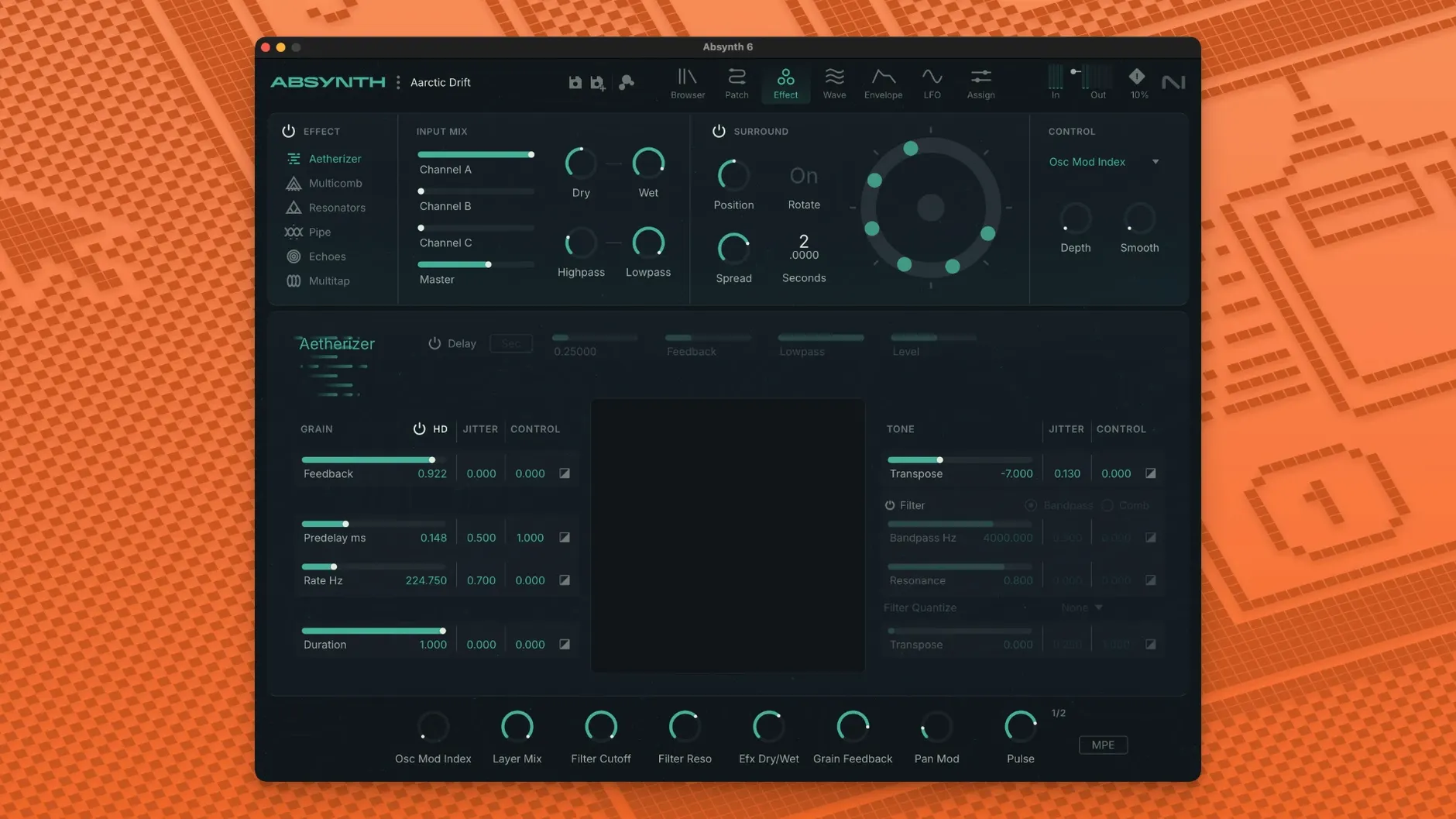
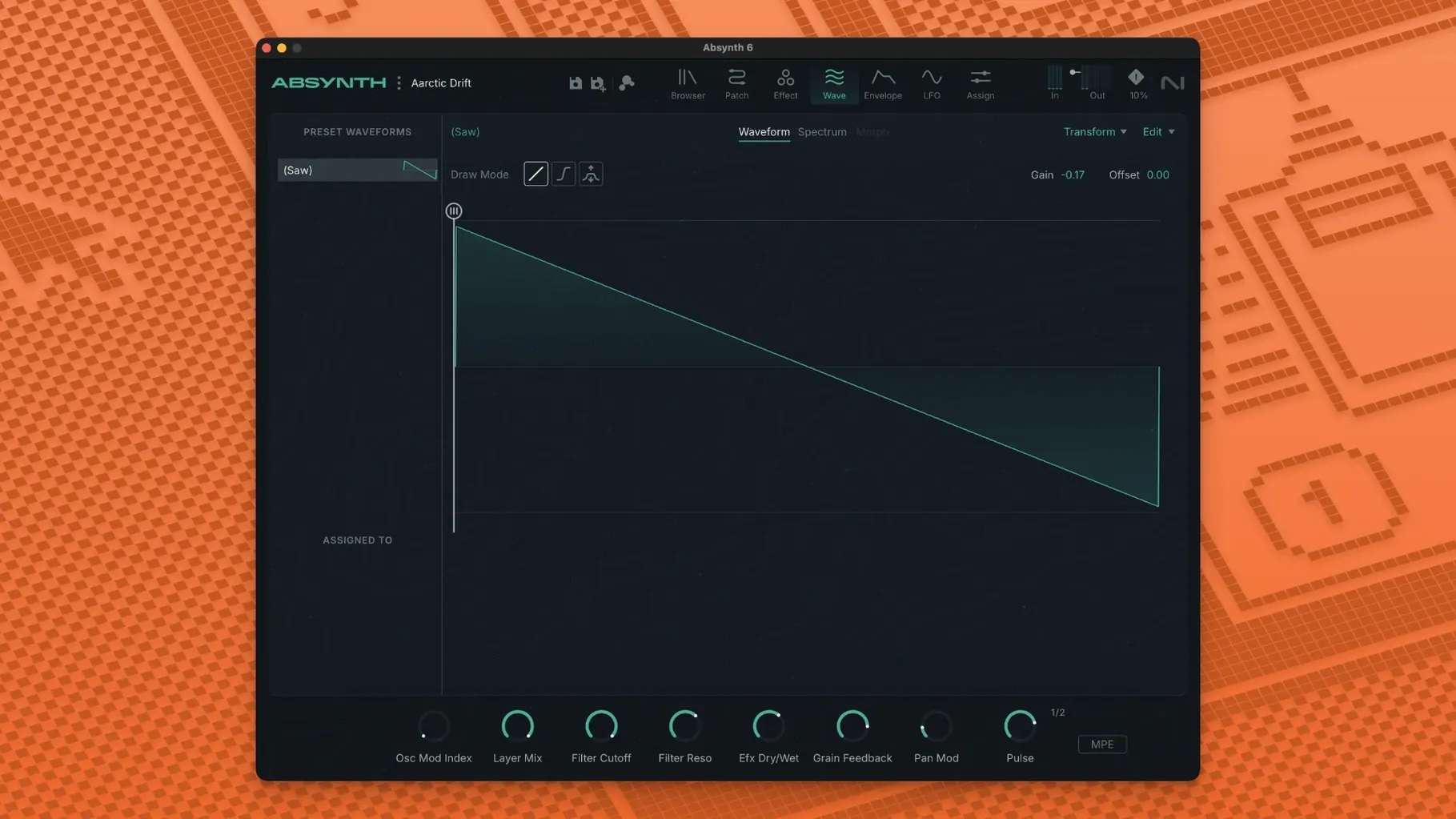
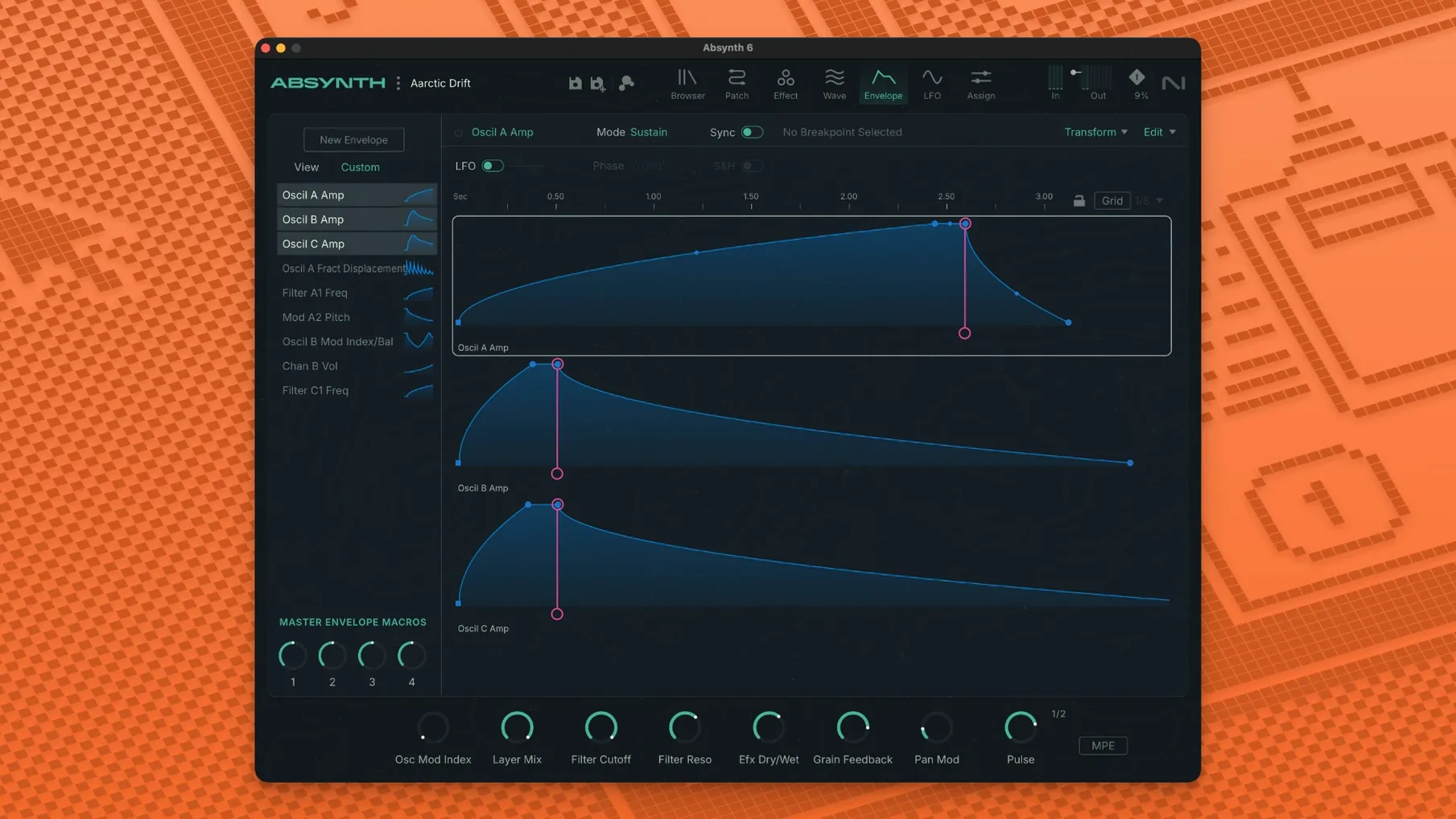
Sound designers and experimental musicians who like to pull a sound apart and put it back together as something new will feel right at home here. Absynth is a semi-modular synthesizer built for exploration, blending different synthesis methods into a single, deep instrument.
Hybrid synth — It doesn't stick to one way of making sound. You get subtractive, FM, granular, and sampling tools that can all interact, letting you patch together complex textures that move.
Semi-modular — The signal path isn't fixed. You can route audio through three oscillator channels and a series of filters and effects in ways that suit the sound you're chasing, without needing a wall of physical cables.
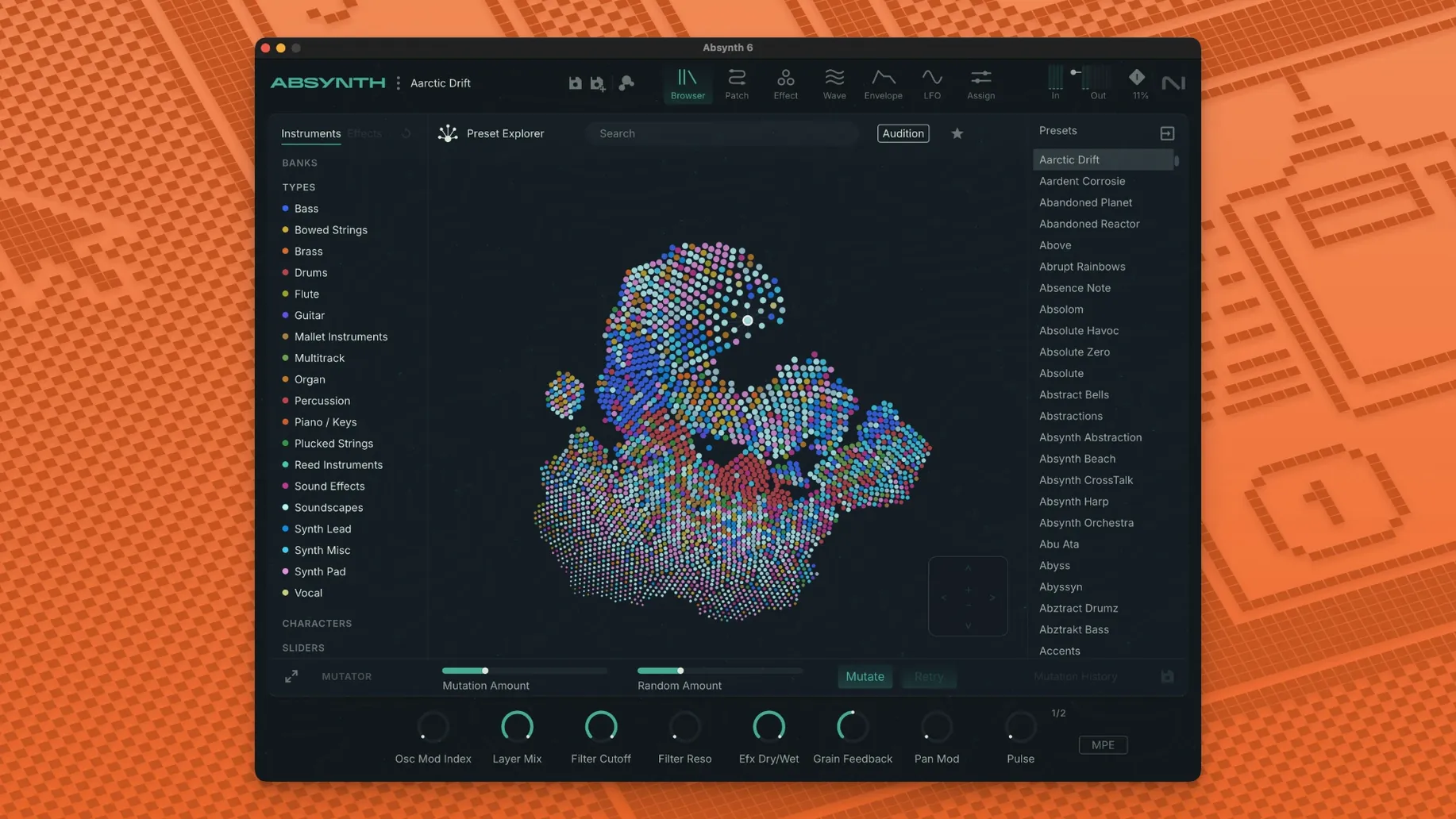
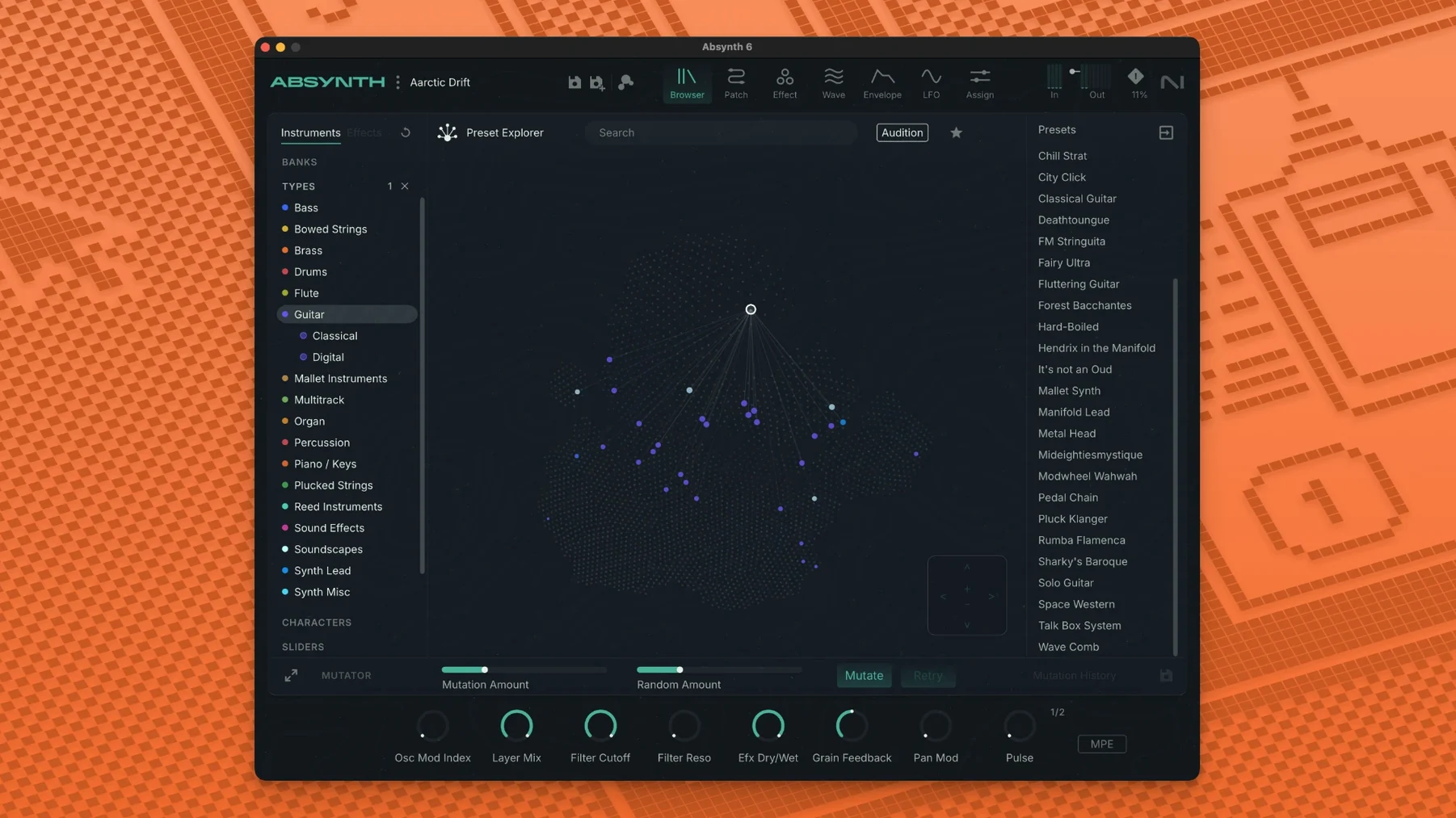
Preset browser — Jumping into a blank patch isn't the only option. The browser lets you search across the included library, including 250 new presets, to find a starting point or figure out how a particular sound was built.
It comes loaded with distinctive processing blocks like the Aetherizer, Cloud Filter, and Supercomb, each capable of smearing, spatializing, or resonating a sound far from its source. With support for up to eight-channel surround, including Quadraphonic and 5.1, it's also a tool for working beyond stereo. If your hardware sends MPE or polyphonic aftertouch, Absynth responds to every nudge and press.
At its core, Absynth thrives on the kind of slow, deliberate patch building where you’re as likely to get lost for an hour as you are to finish a track. It doesn’t chase the snapshot-of-the-moment workflow that some modern instruments lean on. Instead, it rewards patience with movement — long filter sweeps, granular tails that drift across the stereo field, and modulations that feel organic rather than programmed.
Patches load in a second and dense surround-scapes barely touch the CPU
On a recent MacBook Pro running the current macOS, Absynth 6.1.0 settles in without fuss. Loading times for most patches hover around a second or two, and even the denser surround-scapes with multiple Aetherizer instances don’t tax the CPU the way you might expect. If you’re running an older Intel machine, you’ll still get respectable performance as long as you keep the buffer size sensible — 512 samples is a comfortable sweet spot for tracking parts live. Apple Silicon users get the native ARM build, and it shows in how smoothly the interface redraws and how quickly the Sound Mutator crunches through source material.
Memory use stays modest. A single instance in a DAW project typically sits below 200 MB of RAM, which means you can stack several Absynth tracks without the system slowing to a crawl. I’ve had it running alongside drum samplers, convolution reverbs, and a handful of other Native Instruments plugins, and it never once triggered an overload warning or dropped audio. Stability has been a non-issue through dozens of sessions — no crashes when swapping presets mid-playback, no stuck notes during long MIDI automation passes, and the VST3 and AU versions behave identically in every host I’ve thrown at it.
The one thing to keep in mind is project load times. Because Absynth stores the full patch state, big surround presets can add a few seconds when opening a session, but that’s a fair trade for not having to freeze tracks constantly.
Hollow metallic drones with a melodic core for a sci-fi score
Picture a media composer working on a short sci-fi piece. The brief calls for an alien atmosphere — something that feels hollow, metallic, and distant but still has a melodic core. They open Absynth, pull up a wavetable oscillator with a slow LFO assigned to the wave position, then route it through the Cloud Filter to diffuse the tone into a grainy smear. A second channel brings in a sampled glass harmonica pluck, pitched down an octave and fed into the Supercomb for a ringing, resonant decay that seems to trail off into the walls. By the time polyphonic aftertouch enters the picture — pressing harder on certain keys to open the filter — the sound has become a living environment, not just a pad. They bounce a four-minute cue without ever leaving the one instance, and it becomes the underscore bed for half the film. That kind of session isn’t hypothetical; it’s the sort of work Absynth was designed for, and version 6.1.0 makes it feel effortless.
It trades flash for depth — rewards ten minutes of clicking
Does it still hold up if I’m used to newer synths? It doesn’t try to compete on flash. Absynth’s strengths are depth and texture, not quick-knob macro controls or step-sequenced animations. If you’re willing to spend even ten minutes clicking through the signal path, you’ll pull out sounds that a more streamlined synth can’t touch. The preset library also gives you plenty to reverse-engineer, so you don’t have to start from scratch every time.
How does the surround workflow actually work in a DAW? You set the output configuration inside Absynth — Quadraphonic, 5.1, or Octaphonic — and the plugin exposes those channels to your host. In Logic Pro or Ableton Live, that means routing each channel to its own bus and panning them independently. It’s straightforward once you’ve done it once, and the manual covers the signal flow clearly. For people searching an Absynth 6 Mac torrent to try out the surround features, the full range is right there in the installation.
Is it worth the download if I already have a few other Native Instruments synths? Yes, because Absynth occupies a lane none of them do. Massive and FM8 handle wavetable and FM duties in their own ways, but the semi-modular routing, granular sampling, and the Sound Mutator — which blends timbral traits from two different patches into a hybrid — are exclusive to this instrument. Even if you’ve pulled an Absynth torrent in the past for an older version, the MPE support and surround output in 6.1.0 change what’s possible with a MIDI controller that sends per-note expression.
Will I need to tweak anything to get it running smoothly on Apple Silicon? No special configuration is needed. The installer detects your architecture and places the correct binaries. If you’re migrating from an older Intel setup, just run the standard procedure and your DAW will pick up the new plug-in without extra steps. For anyone grabbing an Absynth 3 torrent out of curiosity about the lineage, this version is a substantial leap forward in both sound and compatibility.
If you’ve been sitting on the fence, this is the kind of synth that rewards the curious — download it, load up a surround preset, and let a chord ring out for a while.
Version 6 brought the synth back with a few modern touches woven into its classic architecture.
- Full MPE and polyphonic aftertouch support for expressive controllers.
- Surround sound handling now reaches up to eight-channel formats, including 5.1 and Octaphonic.
- macOS 14 or later
- Apple Silicon or Intel Mac
- 4 GB RAM (6 GB recommended)
- VST3, AU, or AAX host (64-bit)
Porch talk 0
Come in or pull up a chair to leave a comment.
Nobody has pulled up a chair yet. If you used it on a real Saturday, say what the hour was.