
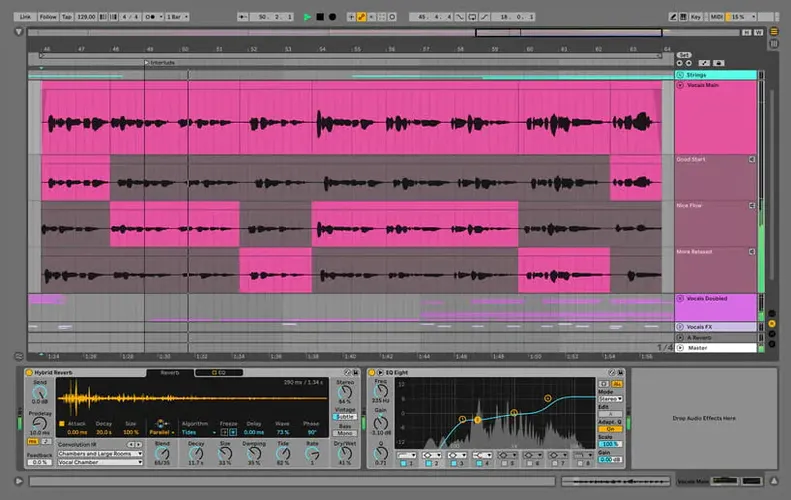
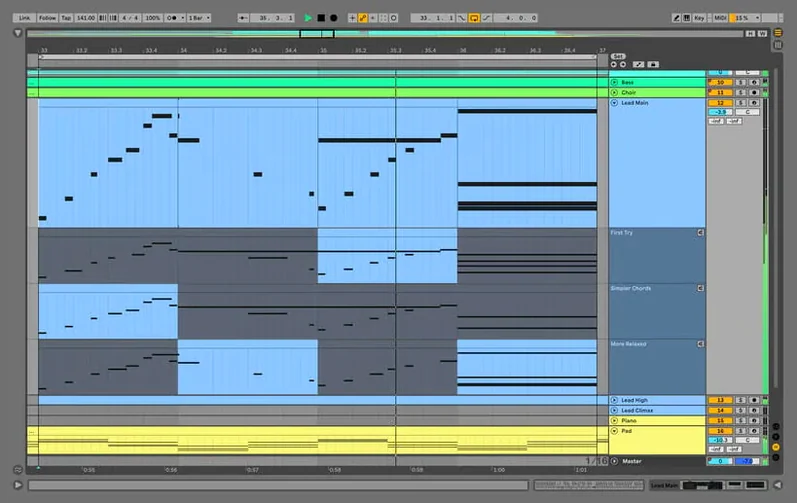
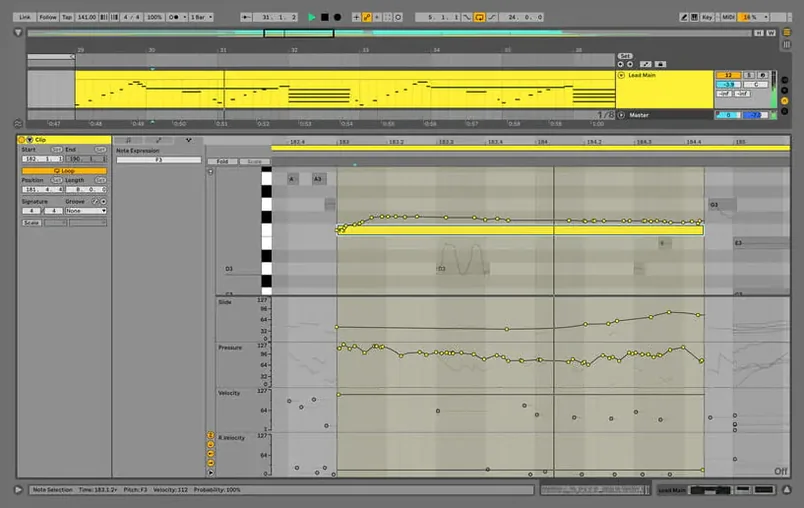
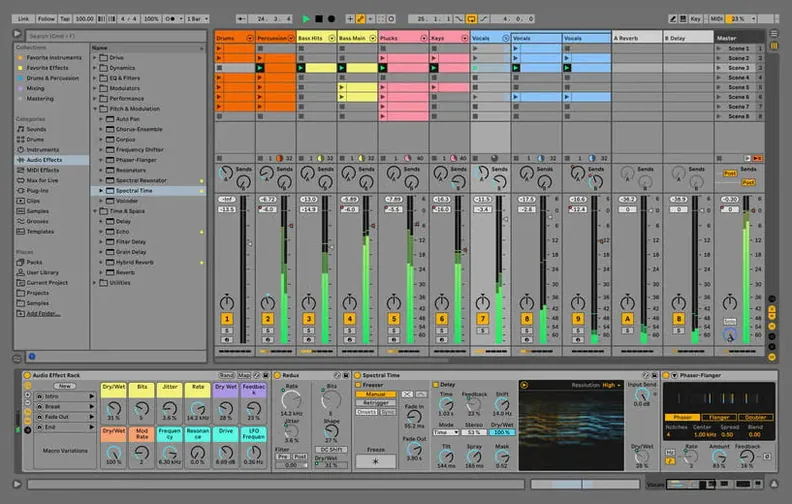
Session View’s grid of clips is where a sketch turns into a song. You fire off a bass loop, stack a drum pattern, and suddenly you’re arranging on the fly—no stopping the transport. That fluid, non-linear way of building a track is what sets Live apart, and version 12.4.6 keeps that core idea front and center on the Mac.
Composing, Sound Design & Live Clip Launching
- Composing with a mix of recorded audio, MIDI instruments, and loops from the built-in library.
- Sound design using an included collection of instruments, kits, and processing effects.
- Live performance where launching clips and scenes in Session View matters more than a linear timeline.
- Running natively on both Apple Silicon and Intel 64-bit Macs.
- Working in English, German, Spanish, Italian, French, or Japanese.
Dense Single-Window Interface & macOS 12 Requirement
- The interface packs a lot into one window—newcomers need time to find where instruments, effects, and browsing live.
- Requires macOS 12 or later, so older systems are left out.
When the Beat Skips or the Transport Stutters
A beat skips right when the idea catches fire, or the transport stutters on a set with forty tracks. These moments feel personal, but they're usually just Live trying to tell you something about your setup. Here are the friction points that come up most in conversations around an ableton live mac download, and what actually fixes them.
Audio dropouts on larger sets
You add a convolution reverb to a return track, maybe a spectral resonator on a group, and suddenly the audio engine coughs. The first move is the buffer size in Preferences > Audio. Bump it to 512 or 1024 samples during mixing—your ears won't notice the latency, and the CPU breathes easier. If dropouts persist, freeze tracks you're not actively editing. Right-click a track header, pick Freeze Track, and Live renders it to a temporary audio file. You can always flatten or unfreeze later.
Plugin scanning stalls on launch
Live scans your plug-in folders every time it starts, and a single misbehaving AU or VST3 can hang the whole process. Hold the Option key while launching Live to temporarily disable custom plug-in folders, then go into Preferences > Plug-ins and rescan one folder at a time. The culprit is usually an older plug-in that hasn't been updated for Apple Silicon—running Live in Rosetta mode (right-click the app, Get Info, check "Open using Rosetta") can bridge the gap while you wait for an update.
Clip warping artifacts
That acoustic guitar loop sounded fine in the browser, but on the timeline it warbles like a cassette left in a hot car. The warp mode matters. For anything with transients—drums, plucked strings, stabs—switch from Beats to Complex or Complex Pro in the clip's Sample box. Complex Pro adds a slight CPU cost but preserves formants, which keeps vocals and melodic material sounding natural. For percussive one-shots, Beats mode with the transient envelope set to single arrow often works best.
Missing files after moving projects
You relocate a project folder and suddenly Live shows orange warning strips at the bottom of clips. Open File Manager (View > File Manager), click "Manage Set," then "Locate" next to the missing files entry. Point Live to the new folder and it'll relink everything in one pass. To avoid this altogether, use Collect All and Save before moving a project—it copies every referenced sample into the project folder.
MIDI controller suddenly unresponsive
Unplugging a controller mid-session sometimes knocks the mapping table out of sync. In Preferences > Link Tempo MIDI, check that your controller still shows under Control Surfaces. If it's greyed out, reselect it from the dropdown. For custom MIDI mappings, hit the MIDI map mode switch (top right, or Cmd-M), wiggle the knob you mapped, and confirm the assignment still points to the right parameter.
From Blank Project to Bassline Fragment on a Saturday Morning
It's a Saturday morning in a small apartment studio. Coffee's still warm, the interface glows, and you've got a bassline fragment buzzing in your head. Here's how a session with ableton live 12.4 mac torrent might unfold from blank project to rough arrangement.
You open Live and the sidebar shows your recent project thumbnails. You hit Cmd-N for a new set. The default template loads—two MIDI tracks, two audio tracks, a return with reverb already patched in. You head straight to the browser, tap the Drums category, and drag a 909 Core Kit onto a MIDI track. A four-bar clip appears in Session View. You double-click it, and the MIDI note editor opens below. Kick on the one and three, snare on two and four, hi-hats on every eighth note. It takes thirty seconds.
Next, you browse Bass > Electric and pull up a round, finger-style patch. You play a few notes on the Mac keyboard (the A row is your white keys, W and E for sharps), find a groove, and record a two-bar loop into the next clip slot. Quantization set to sixteenth notes catches the sloppy timing. You duplicate the scene, mute the bass in the new scene, and record a variation with more syncopation.
By now you've got four scenes: intro drums, drums plus bass, a fuller variation, and a breakdown with just the kick. You trigger scenes with the Return key, listening for transitions. The crossfader stays at center for now—you'll automate that later in Arrangement View. You add a Wavetable synth on track three, tweak the filter cutoff with the mouse, and record the automation directly into a clip by hitting the Session Record button before launching the scene.
When the arrangement feels right—roughly three minutes of material—you hit the global Record button and perform the whole thing: launching scenes, tweaking sends, muting parts on the fly. Every move gets captured in Arrangement View. You switch to that view, and there it is: a timeline with clips, automation envelopes, and scene launches converted to locators. You spend the next hour trimming fade handles, nudging clip edges, and drawing volume curves. You insert an EQ Eight on the bass track and cut below 40 Hz to clean up mud. A Glue Compressor on the drum bus tightens the transients. You bounce the master to an AIFF, then save the set with Collect All and Save so the patch stays portable.
Tweak Record/Warp/Launch Preferences After Install
Out of the box, Live makes sensible choices—but a few quick preference tweaks turn it from a guest room into your own studio. These are the first things I adjust after an ableton live for mac install.
- Record/Warp/Launch > Warp/Fades > Loop/Warp Short Samples: set to Unwarped One-Shot. Live defaults to warping every audio file you drag in, which stretches drum hits unnecessarily. This setting leaves one-shots alone while keeping warping on for longer clips.
- Look Feel > Follow Behavior: switch from "Scroll" to "Page" if you read sheet music or prefer the Arrangement View to stay visually anchored. Page mode flips to the next screenful rather than creeping continuously, which some eyes find less fatiguing.
- Audio > Input Config / Output Config: enable only the inputs and outputs you actually use. Leaving all channels active can cause Live to poll unused hardware and increase the chance of clock conflicts with aggregate devices.
- Plug-ins > Use VST3 Plug-in System Folders: turn this on if it's off. VST3 plug-ins live in standard system locations, and this toggle makes scanning predictable. For AU plug-ins, the system folder is always scanned; the custom folder below is for anything you keep elsewhere.
- Library > Location of User Library: point this to a folder on an external SSD if you build your own rack presets and sample collections. It keeps your creative stash separate from the factory content and makes migrating to another Mac trivial.
The Hang Fix & Workflow Shifts in the 12.x Line
The September 15, 2026 release of version 12.4.6 is a surgical fix, but the 12.x line as a whole has shifted how people interact with Live day to day. The most talked-about change fixed a hang that would strike during rendering, bouncing, or consolidating in large sets—specifically when audio clips used Beats Warp Mode with Transients Granular Resolution enabled. Users with projects pushing sixty or eighty audio tracks would watch the progress bar freeze, sometimes forcing a force-quit. That hang is gone now, which makes final exports on deadline-day feel less like a dice roll.
Beyond the bug fix, the 12.x cycle introduced MIDI Generators and Transformers—devices that sit before an instrument and reshape incoming MIDI notes. A Generator might spit out chord voicings from a single key press; a Transformer might arpeggiate or humanize timing. In a typical session, you drop a Chord Generator before a Piano patch, play a root note, and hear a full progression. It's not just a shortcut; it changes how you audition harmonic ideas without breaking flow to open a separate MIDI editor.
The browser also got a tagging overhaul. Sounds, kits, and presets now carry genre, timbre, and articulation tags that make filtering feel more like a conversation—tap "warm," "analog," and "pad" and the list narrows to a handful of candidates. Combined with the similarity search (right-click any sound and choose "Find Similar"), this cuts scrolling time considerably when you know the texture you want but not the patch name.
Six-Second Cold Launch on Apple Silicon at 128 Samples
Live 12.4.6 on an Apple Silicon Mac launches in about six seconds from an internal SSD, cold. On Intel machines from the last few years, expect eight to twelve. Once running, the audio engine holds steady at a 128-sample buffer for sets under thirty tracks with moderate processing—stock effects like EQ Eight and Compressor barely register on the CPU meter. Drop in a few instances of Hybrid Reverb or Spectral Resonator, and the meter nudges upward, but the M-series chips handle it without audible glitching. Rosetta 2 performance on Intel plug-ins remains solid, though native Apple Silicon builds are noticeably snappier when opening plug-in windows.
Memory use sits around 1.2 GB for an empty set with the default template. A working project with 25 tracks, a dozen third-party plug-ins, and a few frozen audio tracks might climb to 3 to 4 GB. For most modern Macs, that leaves plenty of headroom for a browser and a reference track player running alongside. Live does not aggressively release memory when you close a set—if you work on multiple projects in one session, a restart every few hours keeps the footprint tidy.
Autosave, handled by the AbletonAutoSave helper, runs on a settable interval and writes incremental backups without interrupting playback. By default it saves to a folder next to the project file. The helper lives in the menu bar, starts and quits with Live, and you can set it as low as one minute if you're doing delicate edits that would hurt to lose. On spinning hard drives, faster autosave intervals can cause a tiny audio hiccup; on SSDs, it's transparent.
Stability-wise, the 12.4.6 build closes the biggest known pain point—the Beats Warp Mode render hang. In extended daily use, crashes are rare and usually traceable to a specific third-party plug-in rather than the host. If you're pulling an ableton crack mac from the web, pairing it with a lean set of well-maintained plug-ins keeps the experience predictable. Live's crash recovery is quiet but effective: reopen after a quit, and the last autosaved version appears with a prompt to restore.
The 12.4.6 update, released September 15, 2026, smooths out a specific frustration for anyone working on large projects.
- Fixed a hang that could occur during rendering, bouncing, or consolidating in large Sets with audio clips in Beats Warp Mode and Transients Granular Resolution.
- macOS 12 or later
- Apple Silicon or Intel 64-bit processor
Questions I actually get
Does Ableton Live 12.4.6 run on an M1 or M2 Mac?
Yes, it runs natively on Apple Silicon as well as Intel 64-bit Macs.
What instruments and sounds are included?
It comes with a collection of instruments, effects for sound processing, and a library of sounds, kits, and loops.
What was fixed in the latest update?
A hang that could happen during rendering, bouncing, or consolidating large Sets with audio clips in Beats Warp Mode and Transients Granular Resolution was fixed.
Porch talk 0
Come in or pull up a chair to leave a comment.
Nobody has pulled up a chair yet. If you used it on a real Saturday, say what the hour was.