
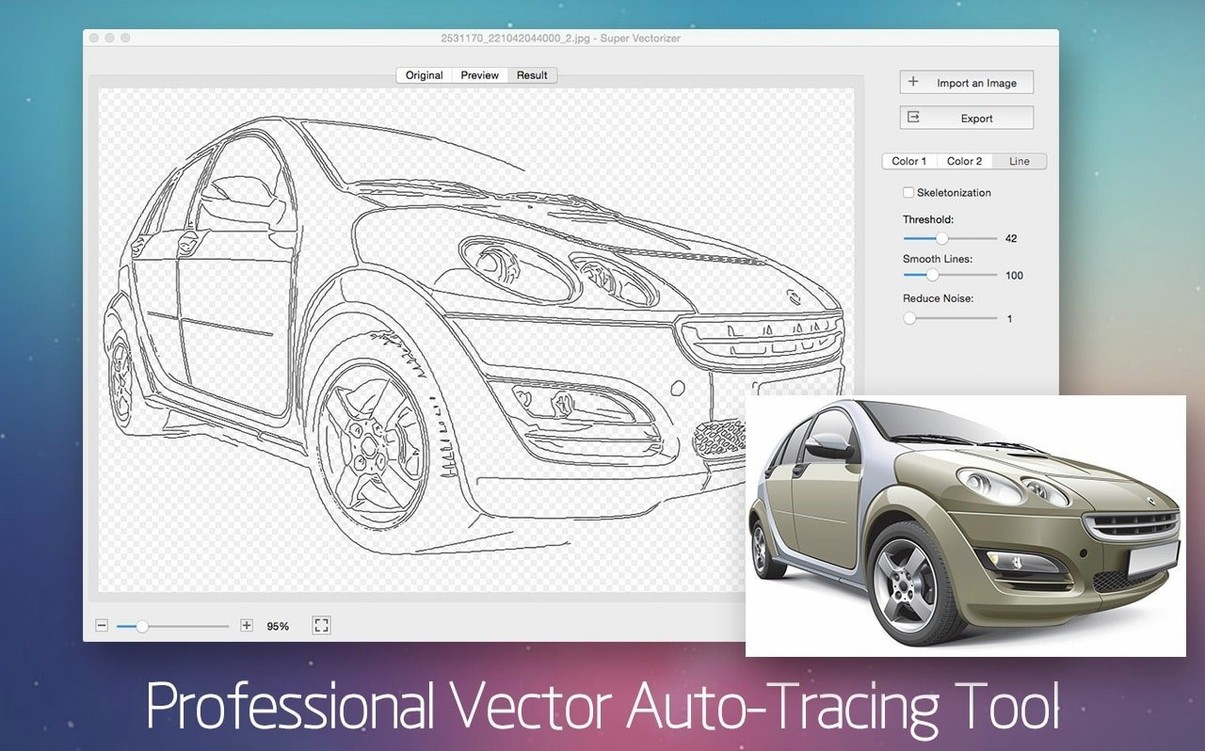
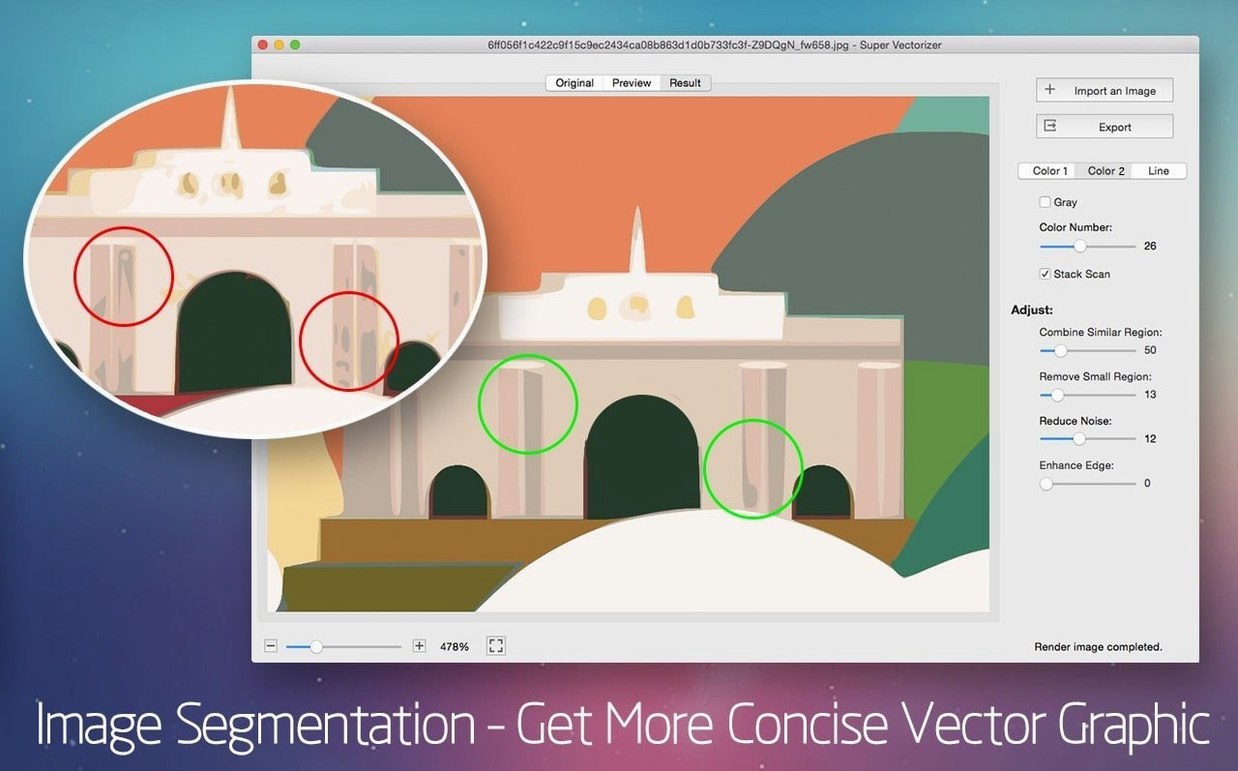
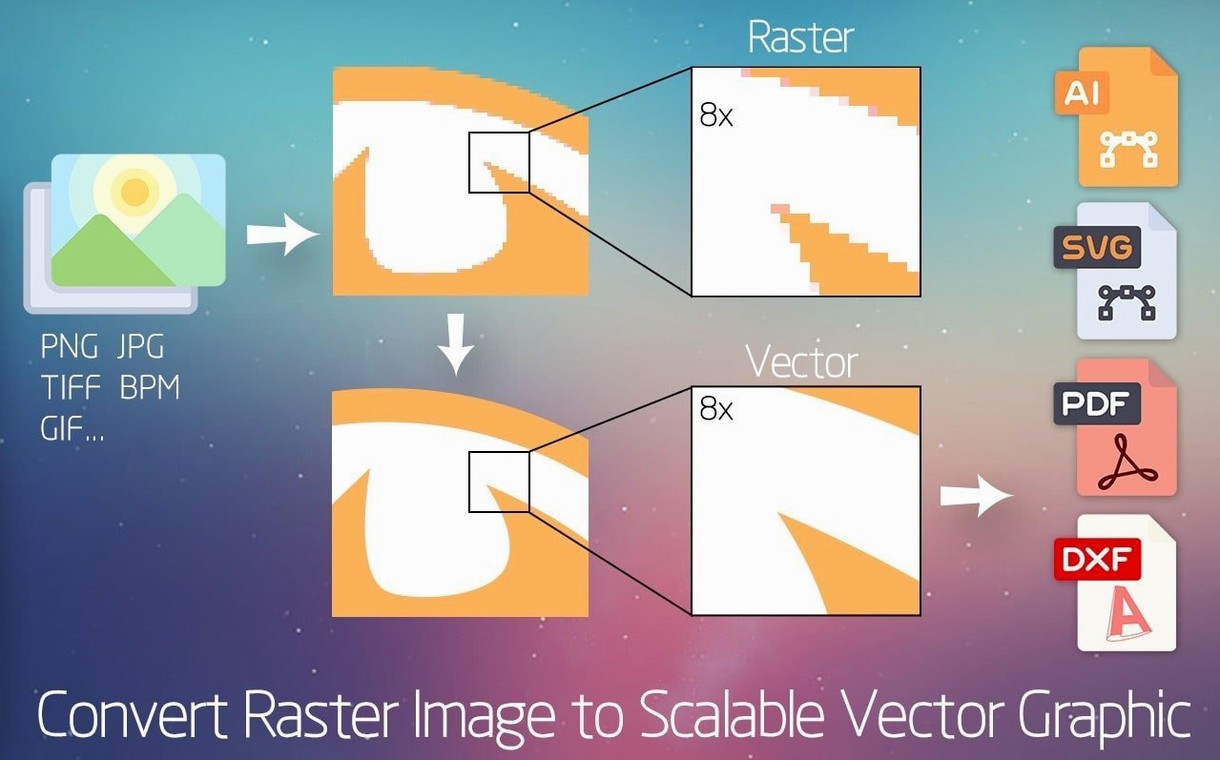
Seventy input formats is a lot of ground to cover, and that's where Super Vectorizer Pro 2.3.3 starts. It swallows nearly any bitmap you throw at it and turns the image into clean vector paths you can edit in another application. The result can hold up to 64 distinct colors, so illustrated maps, logos, and screen-printed designs usually survive the trip with their palette intact.
Runs Natively on Intel and Apple Silicon
The app asks for OS X 10.10 (Yosemite) or anything newer, and it runs natively on both Intel and Apple Silicon machines. If you're still on an older Mac that can't upgrade past Yosemite, you're covered. If you've moved to an M-series laptop, it opens without a hiccup.
Exports AI, SVG, DXF, and PDF with Transparency
Once the conversion finishes, you can export to AI, SVG, DXF, or PDF — four formats that play nicely with Illustrator, Fusion 360, and most cutting software. The app also preserves transparency, so logos with a clear background stay that way. The interface switches between nine languages, which helps if English isn't your first choice. If you need a straightforward way to turn a flat image into something you can scale and tweak, this is worth a look.
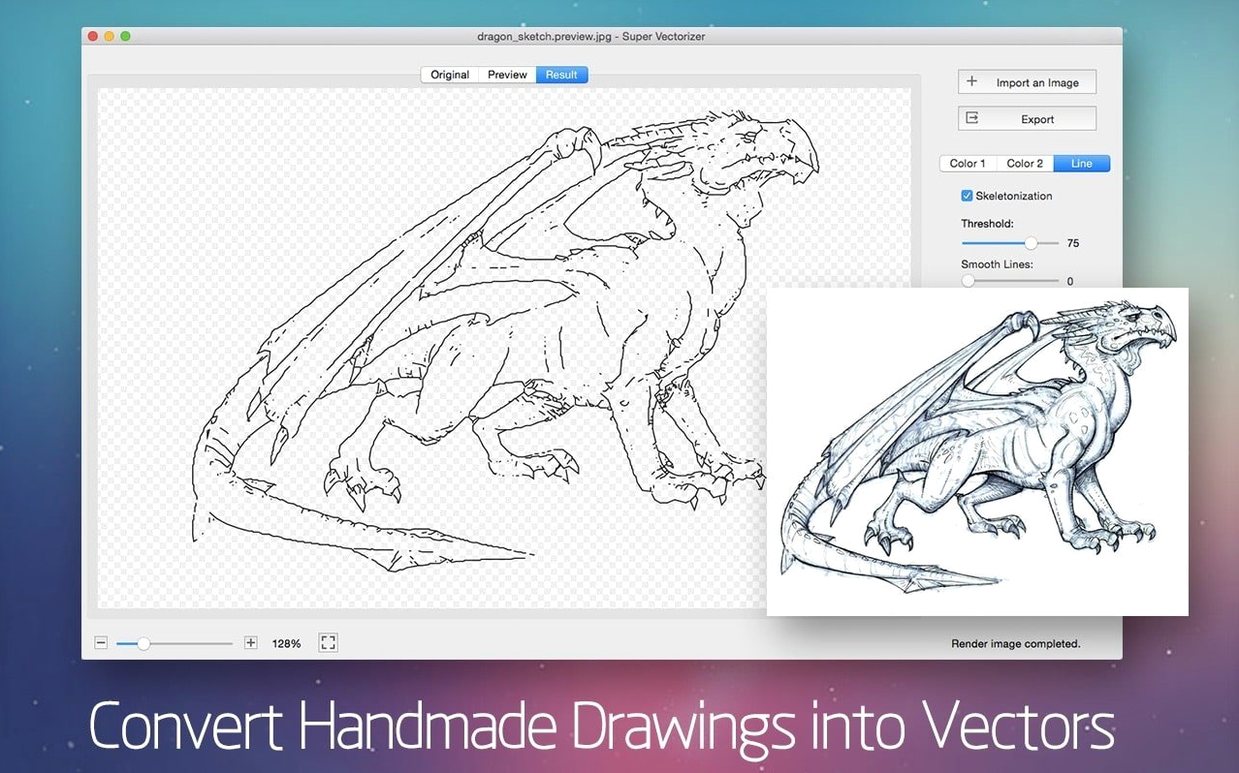
Spend a Saturday morning tracing a pencil sketch of a T-shirt graphic you doodled on a napkin, and you'll notice a few things version 2.3.3 handles differently than earlier releases. The most visible change is how the real-time preview behaves on denser images — it snaps into place faster on Apple Silicon, and the on-screen vector approximation no longer stutters when you drag the color slider past 32 colors. Skeletonization, the feature that reduces thick strokes to single-pixel centerlines, got noticeably cleaner around tight corners; you won't spend as much time deleting stray nodes in Illustrator afterward. The transparent background output also works more predictably with PNGs that use soft drop shadows, something older builds struggled to separate from the foreground.
A quick morning with an old logo scan
Picture a small screen-printing shop in Austin. Somebody hands you a faded, slightly crooked scan of a 1990s baseball team logo — JPEG, 300 dpi, white background yellowed with age. You open Super Vectorizer Pro, drop the file in, and set the color count to 12 because the original only used a handful of navy, red, and gold tones. The preview shows the traced shapes overlaid on the bitmap, and you spot right away that the serif on the letter "R" almost merged with the outline stroke. You back the path simplification slider down a notch and the letterform separates. Five minutes later you export an SVG, pull it into Illustrator, and the pen tool barely needs to touch the anchor points. That's the kind of job where the app earns its keep — flat art, simple palette, tight deadline.
A Bitmap-to-Path Translator, Not a Full Editor
Most people wonder whether Super Vectorizer Pro replaces a full vector editor. It doesn't, and it isn't trying to. Think of it as a dedicated translator: it reads bitmaps and writes paths, then hands the file off to whatever editor you already use. The sims 2 super collection mac download crowd sometimes gets confused about where the tool fits in a creative workflow, but the answer is simple — it lives upstream from your main application, not beside it.
Another common question is how the 64-color ceiling affects photographs. The short version is that continuous-tone photos — portraits, sunsets, anything with gradual shading — rarely convert well in any auto-tracer. Super Vectorizer Pro handles posterized images and flat illustrations beautifully, but a 24-megapixel family photo will turn into a chunky mosaic unless you deliberately want that effect. For logo work and line art, the color limit rarely matters.
And yes, the app handles pencil drawings. A clean graphite sketch on white paper, scanned at 600 dpi in grayscale, often traces better than you'd expect. The skeletonization mode turns thick pencil strokes into single centerlines, which is handy if you plan to laser-engrave the result or bring it into CAD software. Users hunting terms like Super Vectorizer Pro crack will find the official build already supports transparent backgrounds and DXF output, which covers a lot of the same ground.
Dial Back the Path Simplification Slider
The defaults work, but a few tweaks make the app feel more like yours. Start with the path simplification slider — the factory setting leans aggressive, and pulling it back by a third usually gives smoother curves without ballooning the node count. If you trace technical drawings or floor plans, switch the mode to line art before you import; the app weights edge detection differently and you'll get fewer wobbly parallel lines.
Next, check the background removal toggle. It's on by default, which is perfect for logos but frustrating when you need to preserve a subtle vignette. Turn it off for photographs and turn it back on for badge-style graphics. On the export side, default to SVG unless you have a specific reason to use DXF or AI — SVG preserves layer structure and transparency with fewer compatibility headaches when you bounce between Inkscape, Illustrator, and web-based editors. If your workflow involves CNC routers or vinyl cutters, DXF exports with polylines instead of bezier curves, so flip the format in the save dialog and check the result in your cutting software before committing a full afternoon to prep work.
- OS X 10.10 or later
- Apple Silicon or Intel 64-bit processor
Porch talk 0
Come in or pull up a chair to leave a comment.
Nobody has pulled up a chair yet. If you used it on a real Saturday, say what the hour was.
More for the same hour
Everything in Mac Apps
 Subtitle Studio
1.5.11 Mac Apps
31 MB
Subtitle Studio
1.5.11 Mac Apps
31 MB

 SuperDuper!
4.0.7 Mac Apps
10 MB
SuperDuper!
4.0.7 Mac Apps
10 MB

 Sublime Text
4.0 Build 4215 Mac Apps
54 MB
Sublime Text
4.0 Build 4215 Mac Apps
54 MB

 Sweet Home
7.5.7 Mac Apps
Updated 356 MB
Sweet Home
7.5.7 Mac Apps
Updated 356 MB

 SwitchResX
4.14.2 Mac Apps
6 MB
SwitchResX
4.14.2 Mac Apps
6 MB

 TablePlus
6.8.0 Mac Apps
91 MB
TablePlus
6.8.0 Mac Apps
91 MB

 TechSmith Snagit
2026.4.0 Mac Apps
Updated 195 MB
TechSmith Snagit
2026.4.0 Mac Apps
Updated 195 MB

 Techtool Pro
20.1.7 Mac Apps
318 MB
Techtool Pro
20.1.7 Mac Apps
318 MB