

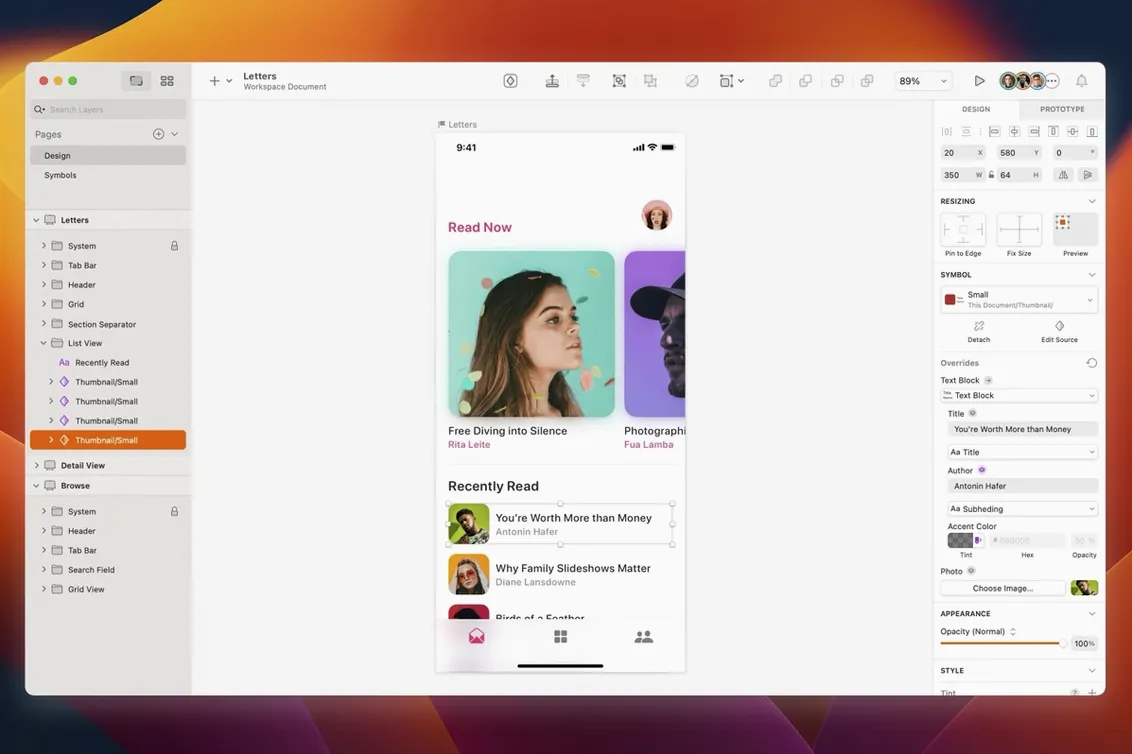
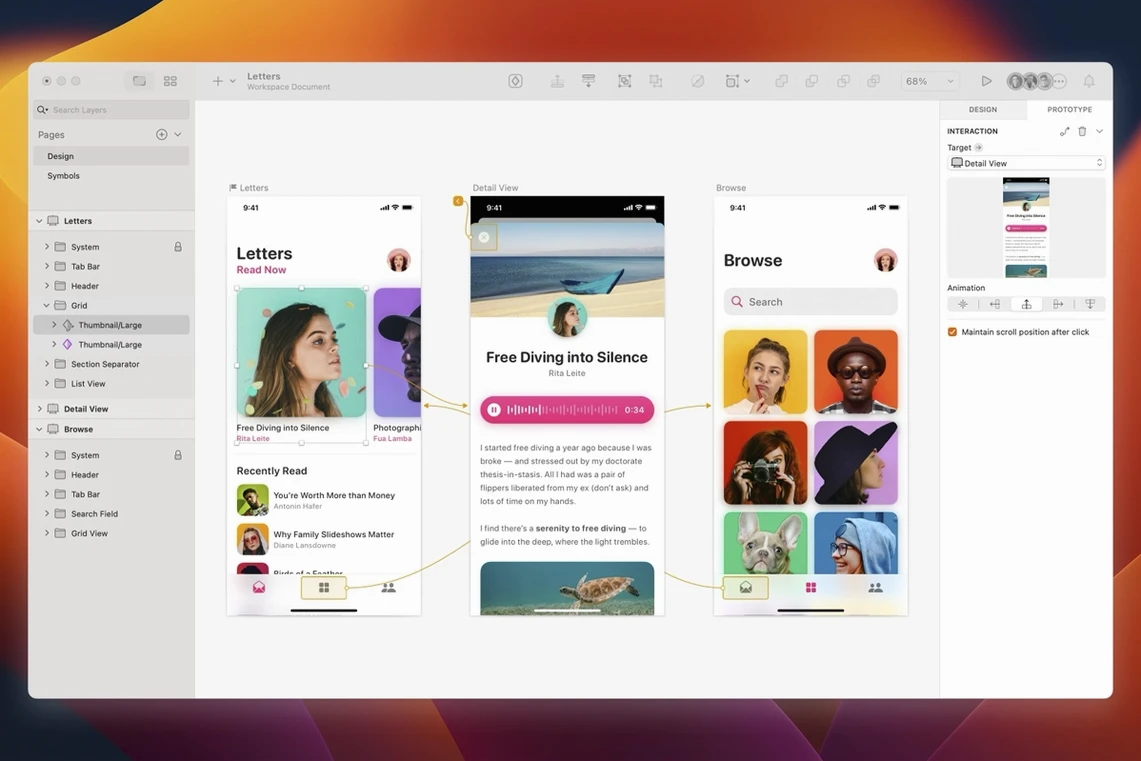
It runs fine on any Mac with macOS 14 or later, Apple Silicon or Intel. No drama there. But if you’ve been using Sketch for years, a new version number doesn’t excite you—the workflow details do. Here’s a short walk through a few of the deeper tools an experienced hand reaches for daily, starting with the canvas itself.
A work session, layer by layer
- Start with wireframes that behave. Before a single pixel is polished, rough layouts go down fast. Sketch’s vector bones are built for this—the real test is whether a stack layout respects a text layer’s minimum width when content changes. In 2026.3.1, that specific stack bug is gone. Your labels expand, but the card around them doesn’t collapse.
- Lean on the plugin ecosystem. The right third-party plugin can take a manual chore down to a single shortcut. Experienced users tend to collect a small set for renaming layers, generating data, or handing off specs. They’re quick speedups once you find the ones that match your rhythm.
- Export with intent. Screen design doesn’t end on the artboard. Getting artwork from a vector layout into a production build—whether it’s slicing icons or handing off measurements—is where Sketch’s export presets earn their keep.
Nothing here rewrites the basics, and that’s the point. If you’re deep into a component library and small visual glitches break your focus, an update like this one tidies the edges without disturbing your work.
Where Sketch sits among your other tools
No design app is an island. A typical afternoon might bounce between a prototype review in Principle, a quick asset tweak in Pixelmator Pro, and a developer handoff that lands in Zeplin. Sketch fits into that chain without demanding you rebuild everything around it.
The Copy CSS attributes feature is a quiet workhorse here. Select any layer, grab the values, and paste them straight into a code editor. It’s not flashy, but when a developer asks for the exact border radius on that card component, you’re not squinting at the inspector and retyping numbers. The macOS clipboard handles it natively—no export step, no intermediate file.
Drag-and-drop plays nicely with Finder too. Pull an SVG out of a Sketch document and drop it onto Xcode, and it lands as a usable asset. The same trick works with Keynote if you’re building a presentation around design concepts. These aren’t advertised integrations; they’re just the Mac doing what it does when an app respects standard pasteboard types.
For collaboration, Sketch links up with prototyping platforms through its plugin layer rather than bolting on a separate cloud service you didn’t ask for. If your team already lives in Abstract or Plant, the handoff feels native. If you’re flying solo, nothing nags you to connect.
Math inside any inspector field
Some of the best features never make it into a release note. Here are a few worth knowing if you spend hours with the inspector open.
- Math in any numeric field. Type
320/3into the width box and Sketch calculates it on the fly. Add percentages, subtraction, whatever. It works in the inspector, in the toolbar, in the export panel—anywhere a number goes. - Rename layers in place. Select a layer, hit
Command-R, and type. The Rename Selected Layers sheet that got a text alignment fix in this version is the batch-rename tool; the single-layer rename is quicker and often overlooked. - Scrub values with the arrow keys. Click a field in the inspector, tap up or down, and values shift by one pixel. Hold Shift for increments of ten. It’s faster than typing when you’re dialing in spacing.
- Measure between layers. Hold
Optionwhile hovering over another layer, and Sketch shows the distance. No guides, no extra plugin—just the measurement you need, when you need it. - Swap symbols from the inspector. Right-click a symbol instance and choose "Swap Symbol" from the dropdown. You can also drag a new symbol from the Components panel directly onto the instance on the canvas. Both methods beat hunting through a menu.
Smooth canvas with hundreds of artboards
A vector app that chugs on a complex document tests your patience fast. In daily use on a document with a few hundred artboards and a shared component library, Sketch stays responsive. Canvas zoom and pan remain smooth even when the symbol count climbs into the hundreds. Memory pressure sits modestly—on an Apple Silicon Mac, expect it to hover around 400–600 MB for a medium-sized project, scaling up gradually with large embedded bitmaps.
The Intel build holds its own too. It’s not going to embarrass an older iMac the way some Electron-based alternatives might. Startup time on either architecture is under four seconds cold, near-instant from the dock once cached.
Stability improvements in 2026.3.1 are incremental but practical. The tooltip clipping fix means hover descriptions near the screen edge actually read correctly now—a small paper cut removed. The blank canvas issue with Writing Tools on macOS Golden Gate is the kind of bug that felt random when it hit; knowing it’s patched restores confidence when you’re switching between design and documentation throughout the day.
If you’ve ever hunted down a sketch torrent for an older release just to stay on a version that felt stable, this build is worth a look. The Florence features settle in without rattling what already worked, and the macOS Golden Gate compatibility work is solid. For anyone who found a Sketch 2025 torrent or a Sketch 2025.1 build and wondered whether upgrading breaks their workflow, the short answer is no. The transition from the 2025 line to 2026 carries the same file format, the same plugin API, and the same resource footprint. Even if you stumbled across a Sketch 101.9 reference and chuckled at the version jump, the app underneath is recognizably the same Sketch—just tidier around the edges.
Version 2026.3.1 brings the Florence release features to the stable channel alongside a few welcome bug fixes for macOS Golden Gate.
- Document windows now pick up the system corner radius, fitting in a little more quietly with the rest of your Mac.
- A fix for tooltips that used to clip awkwardly near the screen edge.
- A stack layout bug with a text layer’s minimum width has been resolved, so components stop misbehaving when type changes.
- macOS 14 or later
- Runs on Intel and Apple Silicon Macs
Questions I actually get
What are the system requirements for the latest version of Sketch?
Sketch 2026.3.1 requires a Mac running macOS 14 or newer, and it runs natively on both Intel and Apple Silicon processors.
Porch talk 0
Come in or pull up a chair to leave a comment.
Nobody has pulled up a chair yet. If you used it on a real Saturday, say what the hour was.
More for the same hour
Everything in Mac Apps
 SiteSucker Pro
6.2.2 Mac Apps
6 MB
SiteSucker Pro
6.2.2 Mac Apps
6 MB

 SketchUp Pro
26.2.242 Mac Apps
1.6 GB
SketchUp Pro
26.2.242 Mac Apps
1.6 GB

 Shadowrocket
2.2.92 Mac Apps
36 MB
Shadowrocket
2.2.92 Mac Apps
36 MB

 SnippetsLab
2.7 Mac Apps
Updated 59 MB
SnippetsLab
2.7 Mac Apps
Updated 59 MB
 Sensei
2.1.2 Mac Apps
30 MB
Sensei
2.1.2 Mac Apps
30 MB

 ScreenFlow
10.5.2 Mac Apps
95 MB
ScreenFlow
10.5.2 Mac Apps
95 MB

 SponsorBlock for YouTube
6.1.6 Mac Apps
Updated 6 MB
SponsorBlock for YouTube
6.1.6 Mac Apps
Updated 6 MB

 Screen Studio
3.7.5-4595 Mac Apps
715 MB
Screen Studio
3.7.5-4595 Mac Apps
715 MB