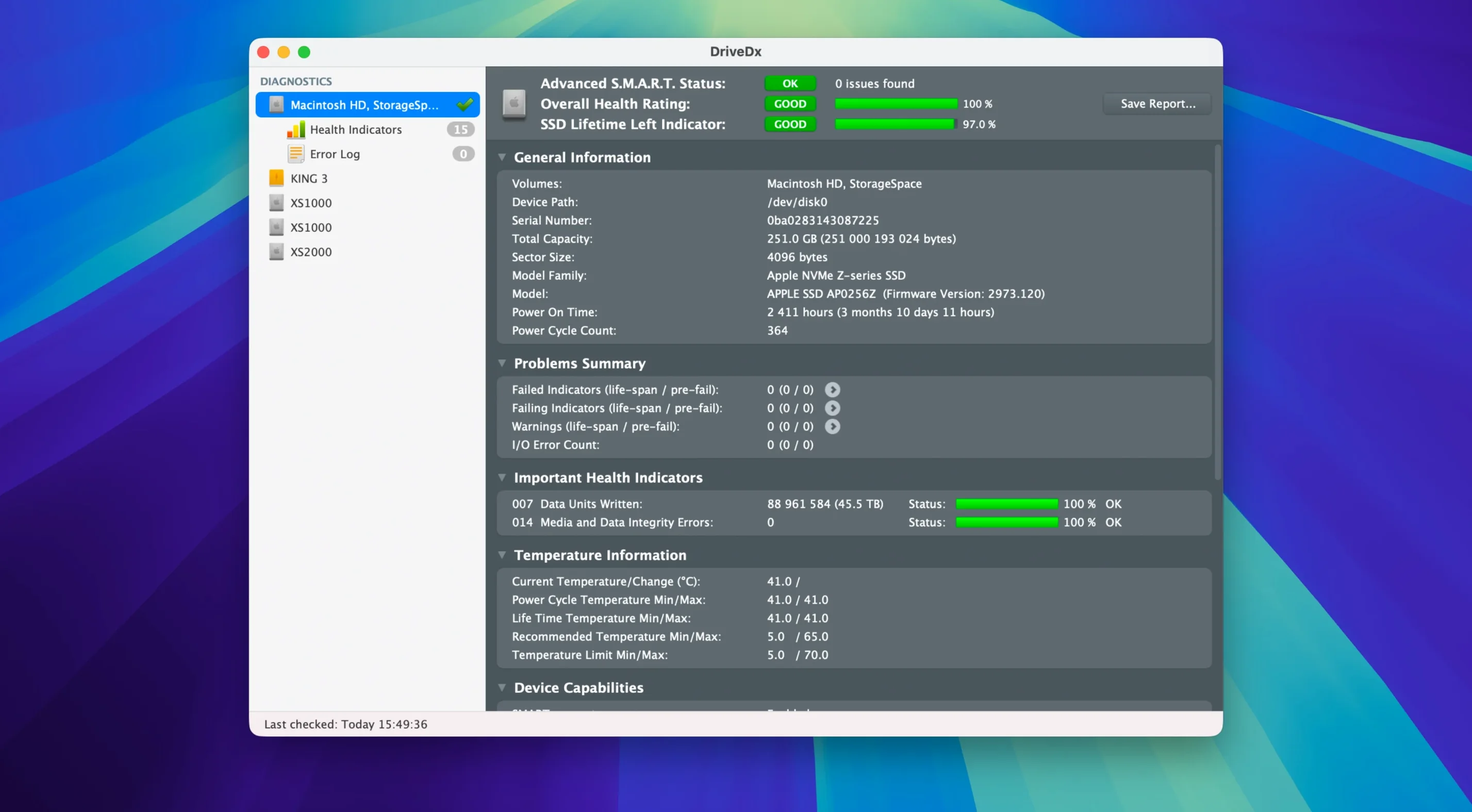
An all-caps "Failing" indicator next to a key attribute like Reallocated Sector Count is the kind of thing that makes you sit up a little straighter. DriveDx 1.12.1 skips the vague warnings and shows you the raw numbers behind your drive's health, turning S.M.A.R.T. data into a clear diagnostic picture. It’s a third-party utility built for anyone who wants to know more than just "Verified."
Drilling into the health indicators
Instead of a single pass/fail verdict, the app sorts drive health into four states: OK, Warning, Failing, and Failed. You can run a short self-test for a quick check or kick off a full self-test that scans every block. For SSDs, it tracks wear leveling and lifetime writes, while on spinning hard drives you’ll see real-time counts for pending bad sectors and I/O errors. The heuristic algorithms weigh these factors together, aiming to predict failure before you lose a file.
Setting up a useful alert
Version 1.12.1 refines the notification thresholds, so you can tweak exactly when the app taps you on the shoulder. Pick an attribute like SSD wear or reallocated sectors, then set your own limit for a warning. It runs natively on both Apple Silicon and Intel Macs, and the driver installer no longer needs Rosetta 2 to do its job. If you like checking in on your hardware just for peace of mind, this is a solid way to do it.
Blank Drive List? Check the Kernel Extension
Sometimes you open DriveDx and the drive list is blank, or an external USB enclosure shows only partial attributes. That hollow feeling in your stomach is familiar, but the fix is usually straightforward. The app relies on a low-level driver to read the full S.M.A.R.T. payload from certain enclosures, and on a fresh install of drivedx 1.12.1 that driver sits waiting for you to enable it. Head into the preferences, find the driver installation button, and let it do its thing — version 1.12.1 handles this without Rosetta 2, so the process is quick even on an M-series Mac. After a restart, the missing drive typically appears with its complete health report.
Another sticking point crops up with USB hubs and some Thunderbolt docks. A few chipsets filter out S.M.A.R.T. commands before they ever reach the drive. If your external SSD shows "Unknown" for wear indicators, try connecting it directly to a port on the Mac itself. In almost every case, bypassing the hub restores the full attribute list.
Don’t Panic Over a Single Warning Flag
The biggest misstep is treating a "Warning" flag as an immediate death sentence. A single reallocated sector on a hard drive that has been spinning for three years is worth watching, not panicking over. The app tracks trends over time, and a one-off blip that stays flat for weeks tells a very different story than a count that climbs every day. Pull up the history graph for that attribute before you start shuffling files off the drive.
New users also overlook the background monitoring toggle. Installing the app, running one full self-test, and then closing it means you miss the whole point — the heuristics work best when they watch attributes change over days and weeks. Tick the option to start at login and set a modest check interval; you will get a notification before a bad situation turns into a catastrophic one.
Finally, some folks grab a drivedx mac crack or drivedx torrent thinking they will save a few steps, and it's worth checking that the driver installer completes without errors and alerts are actually firing in your setup. A clean copy of drivedx mac from a straightforward source keeps everything running smoothly, and the 1.12.1 build is ready for Sonoma right out of the gate.
Wear Leveling Data Other Tools Skip
Situated next to something like Smart Utility from Volitans Software, DriveDx pulls ahead on the depth of its attribute database. Smart Utility gives you a clean, Apple-like interface and a straightforward pass/fail readout, but it does not surface wear leveling history for SSDs or let you set custom alert thresholds per attribute. If you just want a green light, Smart Utility does the job. If you want to know that your Samsung SSD has burned through 12 percent of its rated lifetime writes in six months, DriveDx is the one with the graph to prove it.
TechTool Pro bundles drive health checks into a broader repair-and-test suite. Its S.M.A.R.T. screen is functional, but it lives inside a utility that also repairs volumes, tests RAM, and runs network diagnostics. That breadth means the drive monitoring feels like a sidebar feature. DriveDx stays focused on one thing, and that focus shows in the notification logic and the way it logs attribute changes across reboots. For a system administrator keeping tabs on a fleet of Macs, that single-purpose design matters.
Then there is Disk Drill, which leans heavily toward data recovery. It reads S.M.A.R.T. data as a side feature, useful for checking a drive before a scan, but it does not let you schedule periodic self-tests or graph attribute drift over months. If you are already staring at a failing drive and hoping to pull files off it, Disk Drill is the right tool. If you want to spot the failure coming next year and replace the drive on your own schedule, DriveDx fits that workflow better.
Version 1.12.1 is a maintenance update that sharpens the tool's diagnostics and broadens its compatibility:
- Drive diagnostic algorithms and heuristics were improved for more accurate health predictions.
- The driver installer now runs natively, dropping its old Rosetta 2 dependency.
- Support for Patriot P200 SSDs was improved.
- Ready for macOS Sonoma.
- macOS 10.9 Mavericks or later
- Apple Silicon or Intel Mac
Questions I actually get
Can DriveDx test both internal and external drives?
Yes, it monitors the health of both internal drives and compatible external HDDs and SSDs connected to your Mac.
What's the difference between the short and full self-tests?
A short self-test performs a quick check of the drive's electrical and mechanical components, while a full self-test scans every block on the disk for defects, which takes longer.
Does DriveDx run natively on Apple Silicon Macs?
Yes, it has full native support for both Apple Silicon and Intel-based Macs, and the driver installer no longer requires Rosetta 2.
Porch talk 0
Come in or pull up a chair to leave a comment.
Nobody has pulled up a chair yet. If you used it on a real Saturday, say what the hour was.