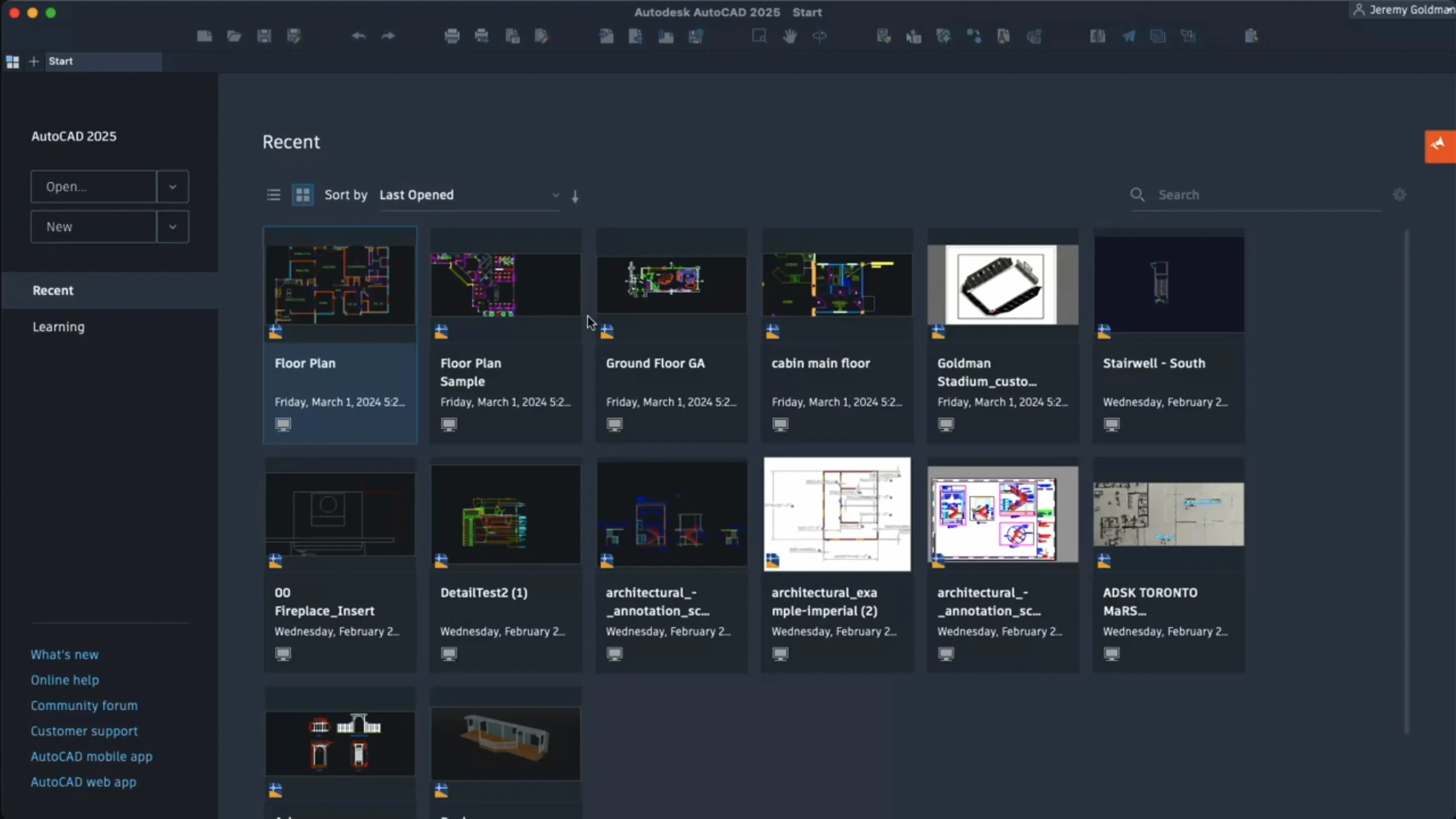
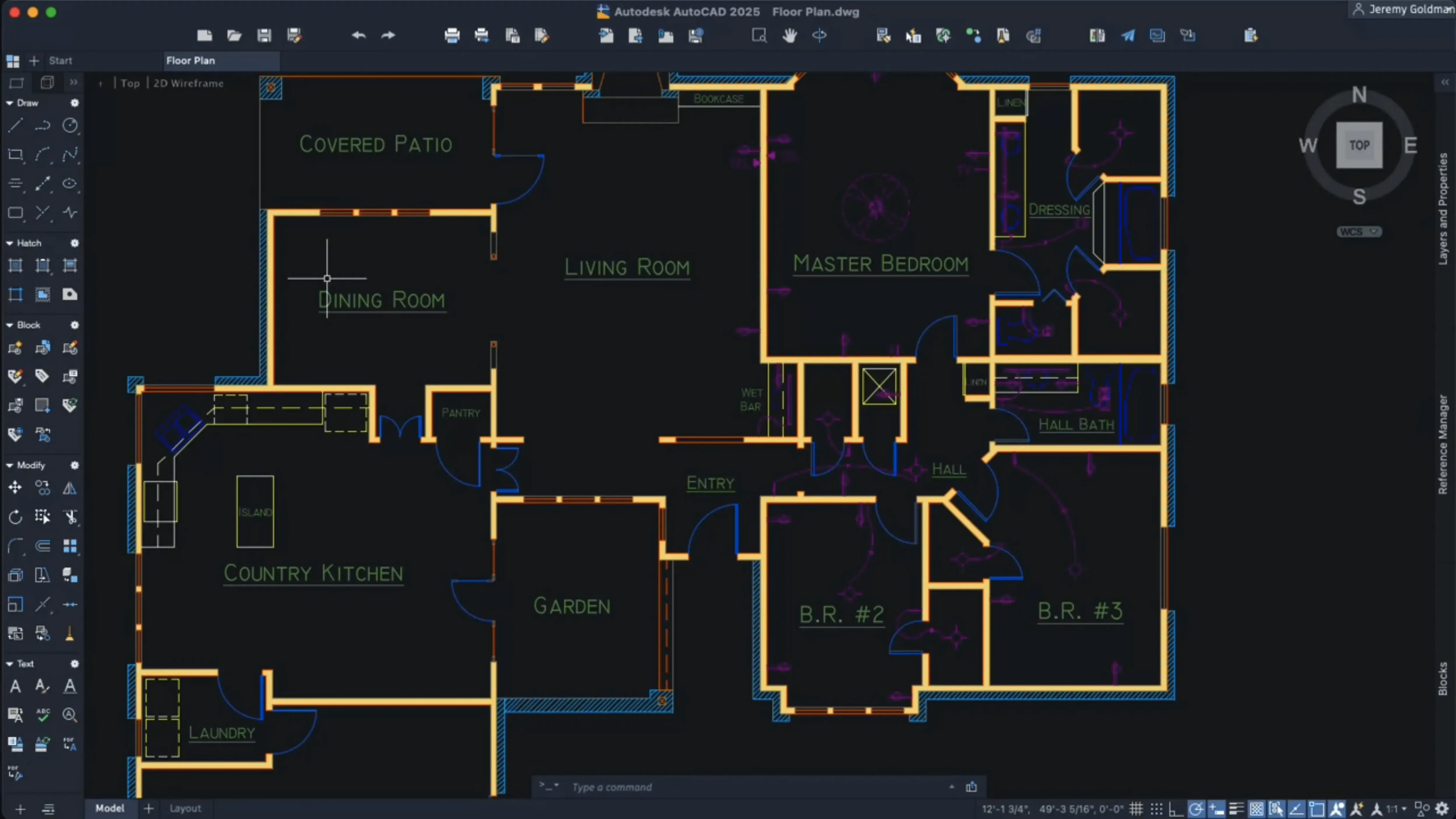
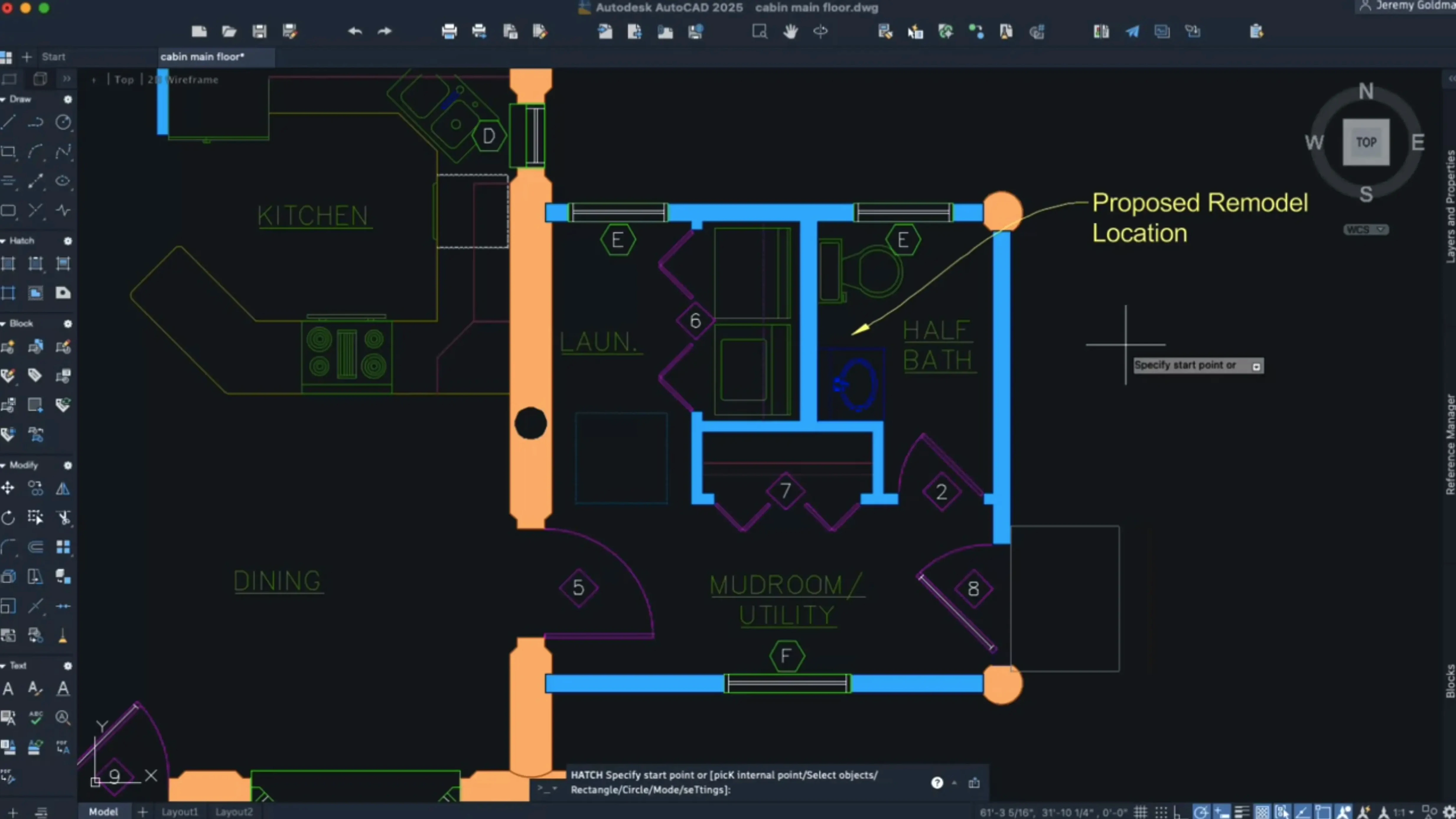
You open a surveyor's DWG on a Friday afternoon. The floor plan is nearly there, but the furniture symbols are loose lines instead of reusable blocks, and a few wall intersections don't quite close. Instead of redrawing, you let the software do the cleanup.
| Key detail | What it means |
|---|---|
| Native Apple silicon | Runs directly on M-series chips for snappier layout tab switching and large coordinate scene optimization. |
| DWG format | The same file format as AutoCAD on Windows, so files move between teams without conversion. |
| Block conversion with AI | Autodesk AI scans a drawing and suggests sets of objects that can become named blocks with scaling and rotation. |
You run Geometry Cleanup first. The command scans the whole drawing and fixes common errors — tiny gaps at wall corners, overlapping lines — so the hatch tool can find closed boundaries on its own. With the plan cleaned, you select the scattered chair and table geometry, and the AI-driven detection identifies repeating clusters. A few clicks later those clusters are proper blocks with grip menus you can adjust via shortcut keys. You drop in shaded hatching along the kitchen contour without tracing a boundary first, then switch layout tabs to set up sheets. The tab switching feels immediate on Apple silicon, and because OpenGL is gone, the Metal graphics engine handles the viewport redraws without stuttering on a complex file.
Same DWG Heart as Windows AutoCAD
Does AutoCAD for Mac feel like the real thing, or is it a watered-down port? That's the question I hear most often, and the short answer is that the 2027 release uses the same DWG file format as the Windows version. You can send a drawing to a colleague on a PC, they open it, nothing breaks. The command set isn't identical down to every last ribbon panel, but the core drafting engine, the block system, the layer manager, and the plotting workflow are the same tools you'd expect. If your work lives in DWG files, you're in the right place.
Another common worry is performance on Apple silicon. The 2027 build runs natively on ARM, not through Rosetta, and the Metal graphics engine handles viewport rendering without the overhead that OpenGL used to carry. Complex drawings with large coordinate scenes benefit from reduced CPU and GPU load, and layout tab switching is noticeably faster than in older Mac releases. If you're coming from a 2023 or 2024 version, the difference on an M2 or M3 machine is hard to miss.
People also ask whether you need to disable SIP (System Integrity Protection). The installation package includes instructions and activation steps, and SIP must be turned off before you proceed. That's not optional. If you're not comfortable with that, you'll want to understand what SIP does before you start. The package includes a guide, and the process is reversible once everything is in place.
Finally, some users wonder if the Mac side gets updates at the same pace as Windows. Autodesk ships both platforms on the same DWG compatibility cycle, and the 2027 release introduces Mac-specific improvements — the move to Metal only, the Geometry Cleanup tool, and the block conversion AI — that aren't leftovers from another codebase. You're not getting a second-class version.
BricsCAD’s Perpetual License vs. Subscription
BricsCAD for Mac is probably the closest peer. It reads and writes DWG files natively, offers 3D modeling, and leans heavily into a perpetual-license model that appeals to people who dislike subscription software. The drafting environment feels familiar if you've used AutoCAD before, though the interface has its own logic. Where AutoCAD for Mac 2027 pulls ahead is the AI-driven block conversion and the Geometry Cleanup tool — BricsCAD has its own automation features, but the specific ability to scan loose geometry and suggest block candidates is an Autodesk-only trick right now. On the flip side, BricsCAD's 3D direct modeling tools are more flexible out of the box, so if you spend your day pushing and pulling solids rather than annotating floor plans, the comparison shifts.
Vectorworks is a different animal. It's built for architects and landscape designers who want BIM data, rendering, and site modeling in one package. The DWG compatibility is solid but secondary to its native Parasolid-based engine. If you're producing construction documents for a firm that lives in Revit or AutoCAD, you'll spend time exporting and cleaning up files. Vectorworks shines when the whole team is on Vectorworks. AutoCAD for Mac fits better when the rest of the office is on Windows and nobody wants to hear about file conversion.
Then there's SketchUp. It's not a direct competitor in the drafting sense — no sheet sets, no command line, no parametric constraints — but plenty of Mac users compare them because SketchUp is approachable. SketchUp handles quick 3D massing and conceptual work beautifully. The moment you need precise, dimensioned, annotated 2D documentation at scale, you'll feel the ceiling. AutoCAD for Mac does the documentation side natively, and the 2027 block tools make organizing repetitive detail work much smoother than in a SketchUp-to-Layout round-trip.
Swap Crosshair Color for Dark Layouts
Open the preferences and head straight to the display tab. The crosshair color is now customizable for layouts, and if you work with dark model space backgrounds, switching to a pale yellow or cyan crosshair saves your eyes on long drafting sessions. While you're there, confirm that Metal is the active graphics engine — the 2027 release dropped OpenGL entirely, so there's nothing to switch, but it's worth checking that hardware acceleration is engaged.
Next, spend a moment with shortcut menus. The 2027 version lets you customize right-click behavior per context, and dynamic grip menus now support shortcut keys in localized versions. If you use a non-English keyboard layout, set up your most-used grip actions so you're not mousing through menus for stretch, move, or rotate. The palettes migrate by default when you switch workspaces, which means your tool sets follow you — but only if you save a workspace after arranging things. Do that now, before you build muscle memory around a layout that vanishes on restart.
Turn on the block conversion awareness. The AI scanning doesn't run automatically on every file open, but you can train yourself to invoke it early in a project. I'd suggest docking the block palette where you can see it and running a quick scan on imported drawings. Even if you don't convert everything immediately, seeing which object clusters the engine identifies gives you a head start on organizing the file.
Fix Hatch Boundaries with GEOMCLEANUP
The biggest one is ignoring Geometry Cleanup before hatching. A new user draws a closed-looking boundary, picks a hatch pattern, and stares at the "valid hatch boundary not found" error until frustration sets in. Run GEOMCLEANUP first. The 2027 release scans for gaps, overlaps, and tiny drafting errors that break boundary detection, and fixing them early makes hatching along a contour — even without existing boundary geometry — work the way it should. Shaded hatching is new this year, and it's worth trying once the drawing is clean.
Another classic stumble: treating blocks as static. The AI-driven detection can find dozens of candidate block sets in a typical architectural plan, but beginners often accept the suggestions without reviewing scale and rotation settings. Take an extra pass through the block creation dialog. Set insertion points that make sense for your detail library — a chair block with a base point floating in mid-air won't snap the way you expect later.
Some users disable SIP, install, and then re-enable SIP without checking that everything still launches. Don't rush that step. Follow the included instructions, and if you do re-enable SIP later, verify that the application opens and that the activation holds. A few minutes of testing beats a late-night scramble before a deadline.
Lastly, don't assume the Windows command set maps one-to-one. Most of the drafting commands are there, but a handful of specialized tools are different or absent on the Mac side. Spend an afternoon working through your typical workflow — plotting, layer states, external references — so you find the gaps on a practice file rather than a live project. The 2027 version handles 3D navigation better than previous Mac releases, so if you bounced off older versions because orbiting a model felt sluggish, give it another try on Apple silicon with Metal driving the viewport.
AutoCAD 2027 for Mac tightens up drafting workflow in a few practical ways.
- Autodesk AI scans drawings for objects that can be converted into blocks, saving you from hunting down repeating geometry by hand.
- Geometry Cleanup finds and fixes common drawing errors so hatching and dimensioning work on the first try.
- OpenGL support is removed; Metal is now the only graphics engine, tuned for modern Mac hardware.
- macOS 12 or later
- 64-bit Intel or Apple Silicon processor
- English interface
Questions I actually get
Does the Mac version use the same files as the Windows version?
Yes, AutoCAD for Mac uses the same DWG file format, so you can share drawings back and forth with Windows users without conversion.
Porch talk 0
Come in or pull up a chair to leave a comment.
Nobody has pulled up a chair yet. If you used it on a real Saturday, say what the hour was.