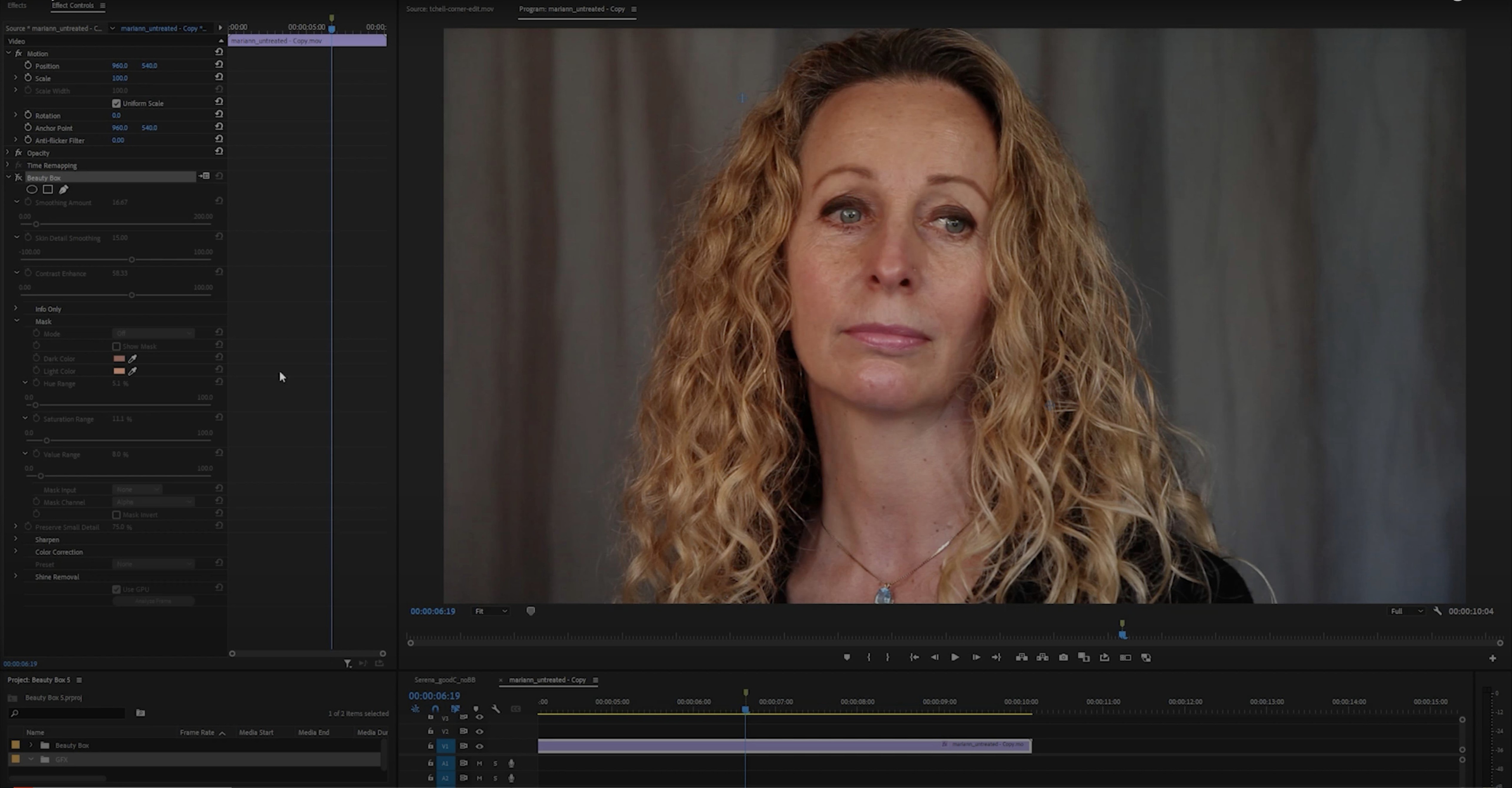
A plug-in's first job is to work where you work, and Beauty Box Photo shows up right inside Photoshop on both Apple Silicon and Intel Macs. It's an Adobe-only build from Digital Anarchy, so it slots into the host app you likely already own for retouching — no standalone launcher to learn.
What it does next to your existing tools
Where a healing brush or clone stamp demands patience, Beauty Box Photo automates skin smoothing the moment it detects a face. It finds skin tones on its own, applying clean-up that leaves texture looking natural. That makes it a sensible companion to your manual retouching layers: let the plug-in handle the broad strokes, then refine with Photoshop's own controls.
A quick install that stays out of the way
Getting it running fits the usual Mac rhythm. Open the downloaded disk image, run the installer, and the plug-in lands in Photoshop's filter menu. No helper apps, no background processes — just a tool that's there when a portrait session wraps up and you want even skin without building a frequency separation stack from scratch.
Tame the Default Smoothing Slider
Out of the box, Beauty Box Photo leans toward a fairly strong smoothing preset — fine for quick proofing, but a little heavy if your style runs more natural. Spending two minutes on the settings panel pays off on every frame that follows.
- Detail Smoothing vs. Color Smoothing. The plug-in splits its work into texture and tone. Try dropping Color Smoothing to around 30% right away; that keeps the skin's natural blush and micro-variation intact while the Detail slider handles actual texture. You can always nudge it back up for studio-lit beauty shots.
- Mask view. There's a checkbox that overlays the detected skin area in white. Turn it on for the first few portraits just to confirm the auto-detection isn't grabbing hair or clothing. Occasionally it'll read a warm-toned sweater as skin, and you'll want to know that before you wonder why the knit looks waxy.
- Sharpening protection. Tucked into the advanced controls is a setting that guards edges — eyelashes, the iris rim, the lip line. Increase it a notch from the default if you're working with high-resolution headshots where those details carry the expression.
- Preset saving. Once you land on a combination that matches your style, save it as a named preset. The plug-in ships with a handful that lean commercial, but your own preset will feel like home base for every session going forward.
Photoshop-Only on Mac
Does this work outside of Photoshop? No — this is an Adobe-only plug-in, and on a Mac it expects Photoshop as the host. It won't appear in Lightroom, Affinity Photo, or any standalone window. If you live in Photoshop for retouching, that's not a barrier; if you're trying to avoid Adobe's ecosystem entirely, it won't fit.
Will it slow down my Mac? Beauty Box Photo leans on CUDA and OpenGL for rendering, so a Mac with a discrete GPU gets real-time previews even on 40-megapixel files. Integrated graphics still work, but you'll feel the difference when scrubbing sliders — previews take a beat to refresh. Either way, it doesn't run a background process or phone home; the hit is only while the filter dialog is open.
Is it going to make everyone look like a mannequin? That's the worry that brings people to a beauty box plug-in with some suspicion. The default preset can overshoot, but the controls are granular enough to back off. With Detail Smoothing low and the mask limited to skin only, you get an even complexion while pores, fine hairs, and the slight asymmetry that makes a face human all stay put. Think of it as skipping the tedious part of skin work, not replacing your eye.
Does it handle different skin tones automatically? Yes — the detection doesn't rely on a narrow band of color, so it reads light, medium, and deep skin tones without requiring you to sample a target area first. In mixed lighting it can occasionally miss a patch where the chin meets the neck, which is why checking the mask overlay early in a session saves you from surprises later.
From Breakouts to Natural Light Final Frame
Let's say it's late Saturday afternoon and you've just pulled a portrait session onto your desktop — natural light through a west-facing window, a subject with a few breakouts they were self-conscious about, and that one frame where the expression is perfect but the skin needs some love.
You open the raw in Photoshop, do your basic tonal adjustments, and duplicate the background layer. From the Filter menu you launch Beauty Box Photo. The analysis runs in a couple of seconds, and the preview shows the default smoothing applied — fine for checking that the face was detected, but you already know you want less.
You toggle the mask overlay on. The white covers the cheeks, forehead, nose, and chin correctly, but there's a sliver on the neck that didn't register because the shadow fell cool. You use the built-in add-to-mask brush — just a quick stroke — and the plug-in extends the coverage without re-running the full detection.
Now you pull Detail Smoothing down to around 40, lift Sharpening Protection a point, and set Color Smoothing to 25. The texture of the skin stays present; what's gone is the blotchiness and the two blemishes near the temple. You hit OK, and Photoshop returns you to the layer stack with the retouch applied non-destructively to your duplicate layer.
Back in Photoshop, you add a layer mask and paint out the smoothing from the eyes and the edges of the lips with a soft brush — ninety seconds of manual finesse that the plug-in couldn't guess. The whole process, from filter launch to final mask, runs under five minutes. That's where the plug-in earns its spot: not by replacing your retouching, but by shrinking the boring middle so you get to the expressive part faster.
- macOS (Apple Silicon and Intel 64-bit supported)
- Adobe Photoshop
Questions I actually get
Does Beauty Box Photo work on Apple Silicon Macs?
Yes, it supports ARM and x86 64-bit architectures, so it runs natively on M-series and Intel Macs inside Photoshop.
Porch talk 0
Come in or pull up a chair to leave a comment.
Nobody has pulled up a chair yet. If you used it on a real Saturday, say what the hour was.