

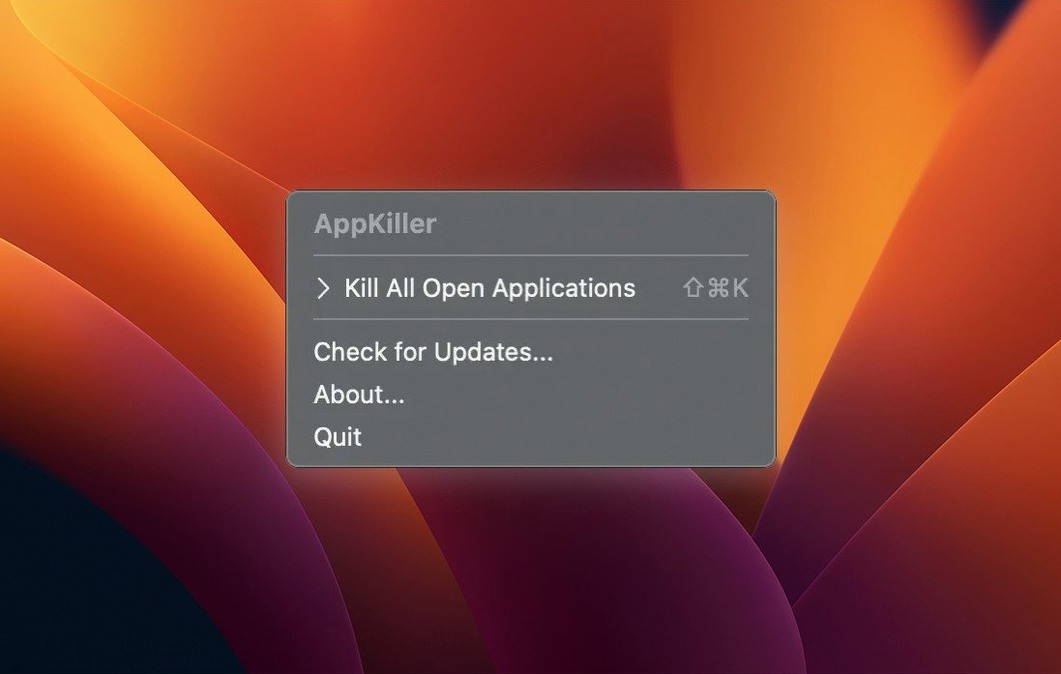
AppKiller runs on just about any Mac you’re sitting in front of. It supports macOS 10.12 and up, and the developer lists compatibility with M1, M2, M3, and M4 machines — so whether you’re on an older Intel workhorse or Apple silicon, it’s ready to go.
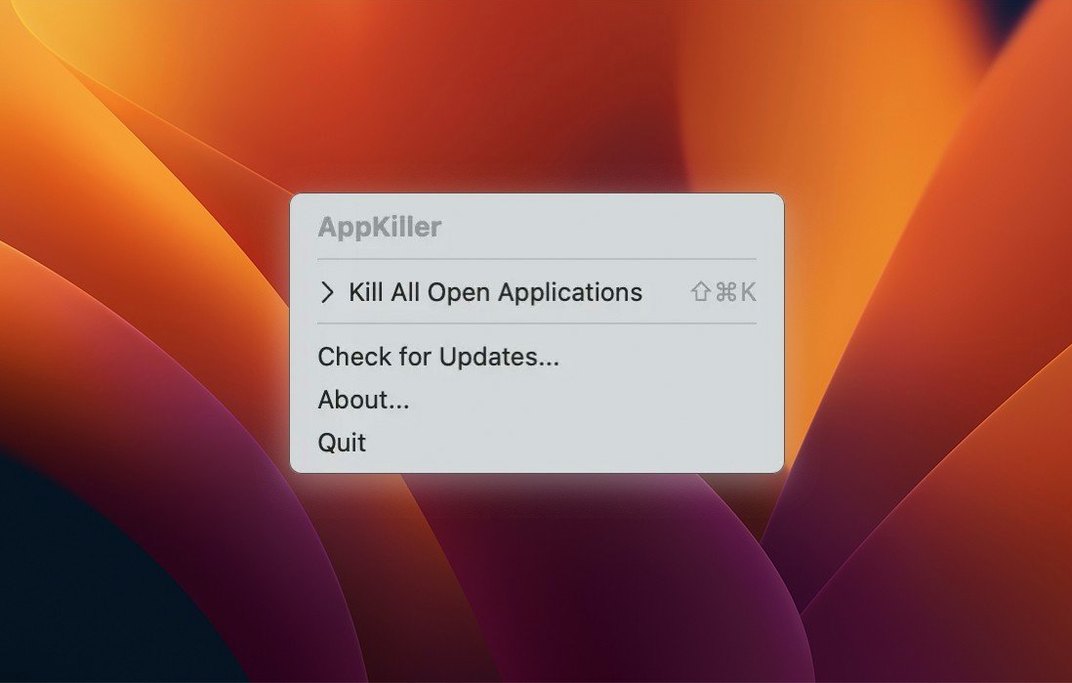
The whole idea is disarmingly simple. You launch it from the status menu, and from that moment you have an eject button for your entire desktop. One click on the menu bar icon, and every open application closes at once. No confirmation windows, no picking through a list. If you’d rather keep your hands on the keyboard, the assigned shortcut is Cmd+Shift+K — press it and your workspace clears out the same way.
Newcomers often wonder what to try first, and I’d say set up the shortcut right away. It’s the kind of thing that feels natural after a day or two, especially when you’re wrapping up a session with a dozen apps scattered across multiple spaces. After that, spend a minute with the status menu; the controls are right there, out of the way until you need them.
The app is described as very fast, and in practice that means it’s a utility you reach for without thinking. If you tend to accumulate browser windows, previews, and chat clients over an afternoon, AppKiller gives you a clean slate in a single gesture. It’s a small tool that fits a specific habit — rewarding if you like your Mac tidy before you step away.
It Won’t Close Without Saving Your Work
People usually want to know whether AppKiller respects unsaved work. The short answer is yes — it sends the standard quit command to every running app, just as if you pressed Cmd+Q yourself. If an application has a dirty document, you'll see the familiar save dialog before it closes. AppKiller doesn't force-quit anything by default, so you won't lose a paragraph you forgot to save.
Another concern is whether it skips certain apps. By default it closes everything, including Finder (which simply relaunches). If you want to keep something running — say, your music player or a backup tool — there isn't a built-in exclusion list. The workaround is simple: hide or minimize the apps you want to preserve, then close the rest manually. It's not a dealbreaker for most people, but worth knowing before you rely on it.
Folks also ask about resource usage. AppKiller sits quietly in the menu bar and consumes almost nothing — you'll forget it's there until you need it. It doesn't run background processes or phone home, so there's no performance penalty between uses.
Bypass the Gatekeeper Block on First Launch
The first launch on newer macOS versions can trip you up. Because the app isn't notarized by Apple, Gatekeeper blocks it the first time. The developer addresses this with an Open Gatekeeper friendly script included in the disk image. Run that, press Enter in the Terminal window that appears, and macOS stops complaining. After that, drag the app into your Applications folder and launch it normally.
Another occasional hiccup: the keyboard shortcut stops responding. This usually happens when another app claims Cmd+Shift+K for its own use. Check your active utilities — screenshot tools, clipboard managers, and launchers are the usual suspects. Reassign the conflicting shortcut in that app, and AppKiller springs back to life. The preference is fixed in the app itself, so you can't customize it to a different combination; resolving conflicts is your only route.
If the menu bar icon vanishes, it's almost always a crowding issue. macOS hides status items when there isn't enough room. Try closing a few other menu bar apps or rearranging them by holding Cmd and dragging the icons left or right. AppKiller will reappear once there's breathing space.
How AppKiller Stacks Up Against Similar Tools
AppKiller's closest relative is probably a plain AppleScript saved as an application — the kind that tells every process to quit. That approach works, but it's slower and you have to build it yourself. AppKiller gives you the same result with a menu bar click and a keyboard shortcut, no tinkering required. For someone who wants the behavior without writing a line of code, it's the more polished path.
Compared to a full session manager like Workspaces, AppKiller takes the opposite approach. Workspaces lets you save and restore specific app sets; AppKiller simply wipes the slate clean. If you jump between projects and need to reopen the same five apps each time, a session manager makes more sense. But if your habit is to close everything before stepping away, AppKiller does one thing and does it without setup.
Some people compare it to an appkiller mac utility that force-quits hung processes. That's a different category entirely — those tools target frozen apps with a kill signal. AppKiller sends a polite quit to everything that's running smoothly. For a stubborn app that's beachballing, you'd still reach for Force Quit or Activity Monitor. AppKiller is for the ninety-five percent of the time when everything is fine and you just want to clear the decks fast.
Version 4.3.0 is a tune-up release. The developer smoothed out performance, cleaned up the codebase, and bundled in minor fixes and enhancements to keep things snappy.
- macOS 10.12 or later
- Apple Silicon or Intel Mac
- Runs from the menu bar
Porch talk 0
Come in or pull up a chair to leave a comment.
Nobody has pulled up a chair yet. If you used it on a real Saturday, say what the hour was.
More for the same hour
Everything in Mac Apps
 Apple Keynote
15.3.1 Mac Apps
356 MB
Apple Keynote
15.3.1 Mac Apps
356 MB

 AnyTrans for iOS
8.9.14 Mac Apps
398 MB
AnyTrans for iOS
8.9.14 Mac Apps
398 MB

 Apple Remote Desktop
3.10 Mac Apps
Updated 16 MB
Apple Remote Desktop
3.10 Mac Apps
Updated 16 MB

 Antivirus Zap - Virus Scanner
3.22.0 Mac Apps
Updated 49 MB
Antivirus Zap - Virus Scanner
3.22.0 Mac Apps
Updated 49 MB

 ArchiCAD
29.2.1 Mac Apps
5.1 GB
ArchiCAD
29.2.1 Mac Apps
5.1 GB

 Art Text 4
4.5.10 Mac Apps
750 MB
Art Text 4
4.5.10 Mac Apps
750 MB

 Artlantis
9.5.2.32853 Mac Apps
370 MB
Artlantis
9.5.2.32853 Mac Apps
370 MB
 AmpliTube
5.8.2 Mac Apps
3.1 GB
AmpliTube
5.8.2 Mac Apps
3.1 GB