

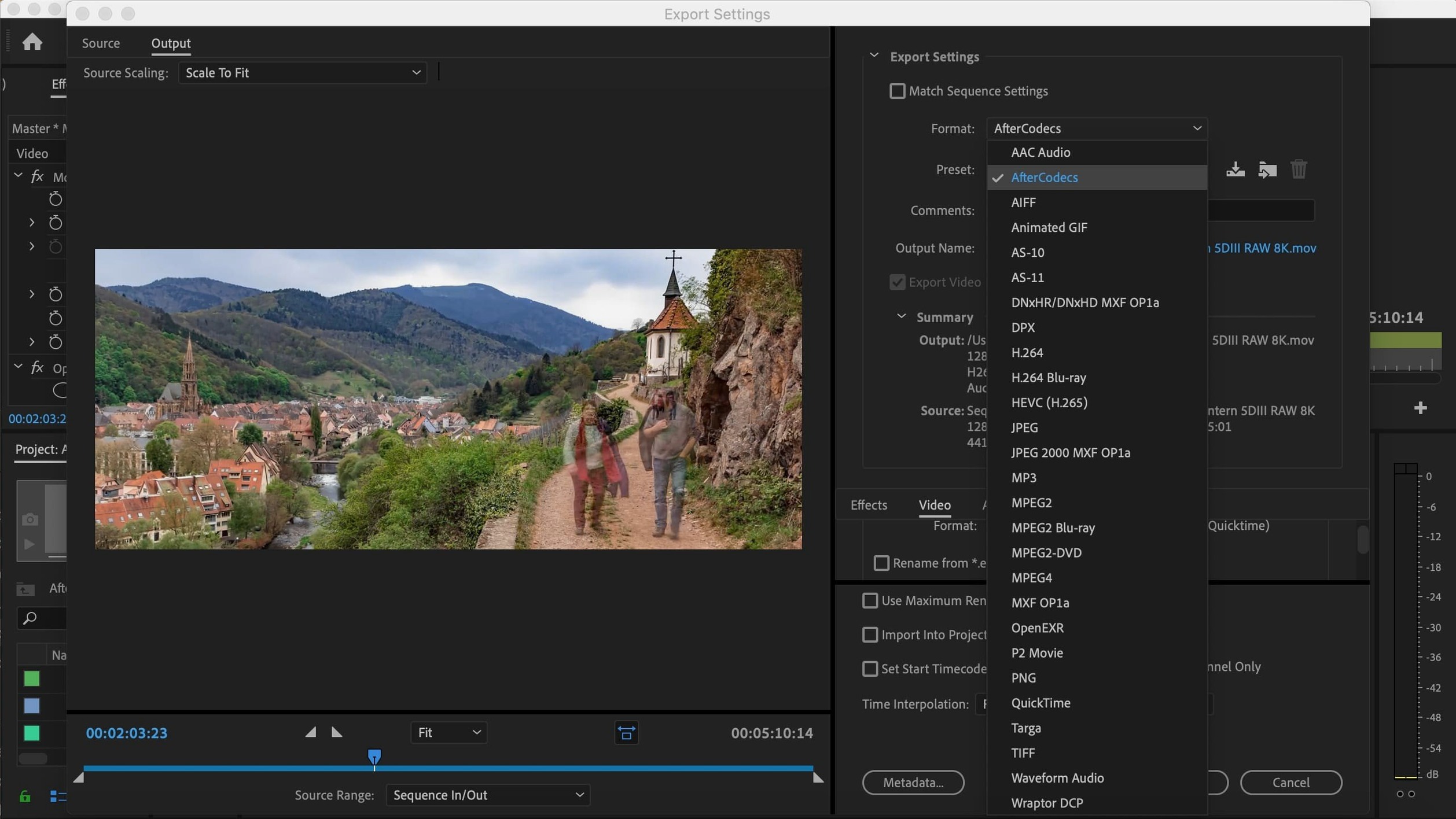
AfterCodecs runs on any Mac that can launch a modern version of Adobe After Effects or Premiere Pro—both Apple Silicon and Intel machines are fair game. It slides into your existing workflow as a render option, not a separate application, so you stay in familiar territory.
Picking a codec for the edit
You choose between Apple ProRes for editing-grade masters or H.264 and H.265/HEVC for delivery and web uploads. The settings feel like a natural extension of the Adobe exporter, with a clean English interface that skips the command line entirely.
Sending to YouTube
There is a dedicated YouTube upload profile tucked into the format options. One selectable setting preps the file for the platform’s encoding recommendations, which saves a few clicks when you are in a hurry to get a draft to a client.
Keeping the queue moving
Rendering happens inside the After Effects render queue, the Premiere export window, or Adobe Media Encoder—no external watch folders or scripts to manage. The whole point is speed, and you notice it most when you are pushing out long timelines and do not want the computer to become a bottleneck.
From timeline to YouTube review in one pass
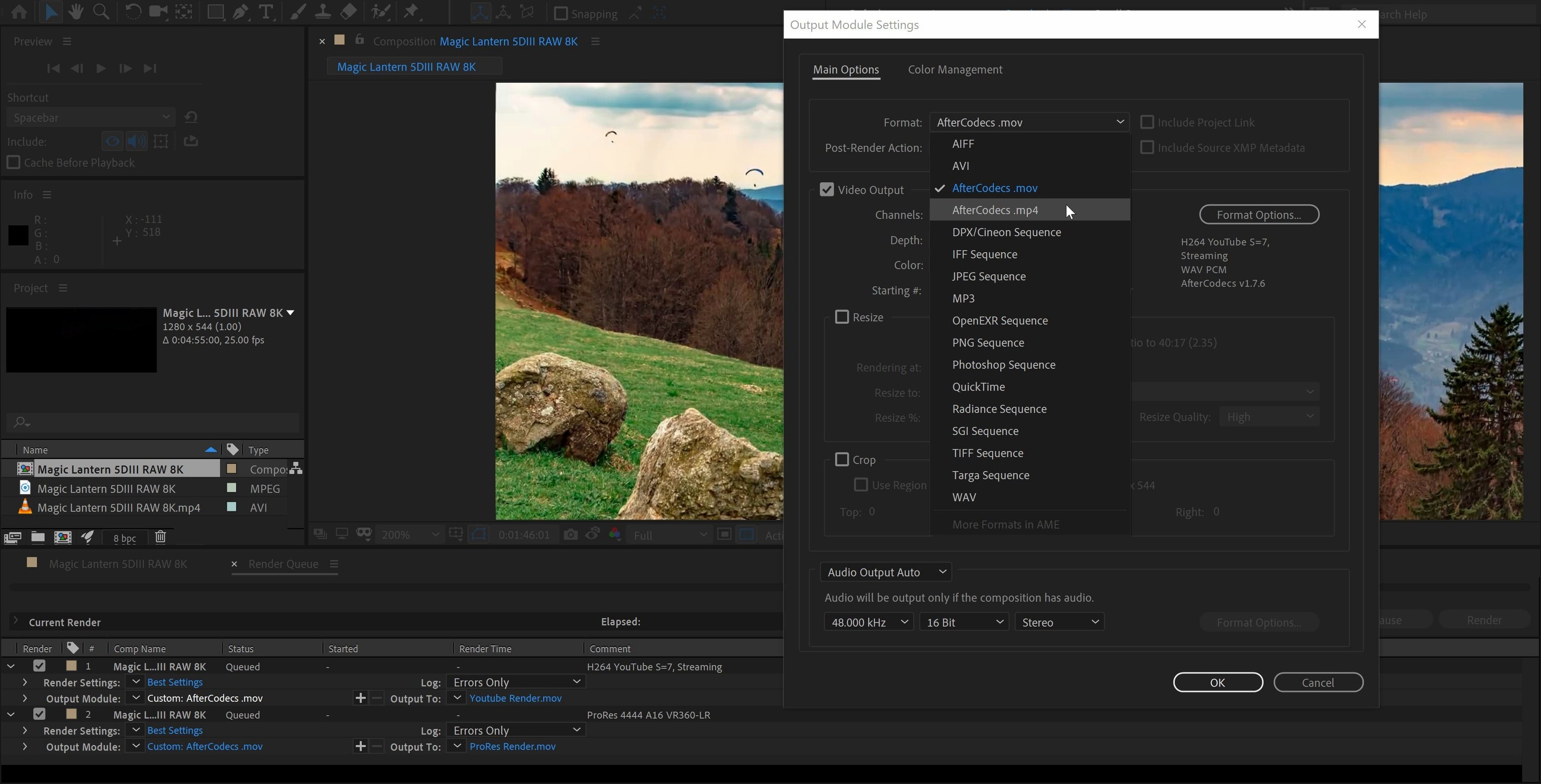
You have a two-minute motion-graphics piece sitting in After Effects, and the client needs a preview link before lunch. Instead of queuing to Media Encoder or fussing with command-line settings, you stay right inside the After Effects render queue. Add the comp to the queue, open the Output Module, and pick AfterCodecs from the format list. Choose the YouTube profile—one click sets the H.264 bitrate, resolution, and audio to something the platform will not re-compress into oblivion. Hit Render, and the file lands on your desktop ready to drag into a browser window. No intermediate ProRes master, no handbrake pass, no waiting for a second application to wake up. It is the kind of straight-line workflow that keeps a freelancer ahead of the clock when three other projects are blinking on the dock.
Motion designers turn the render queue into a delivery tool
Motion designers who live inside After Effects day after day get the biggest lift, because the plug-in turns the native render queue into a delivery tool instead of just a preview engine. Editors cutting in Premiere Pro who need to hand off H.265 dailies without a detour through Media Encoder notice the time savings by the end of the first week. Anyone working on an older Intel MacBook Pro benefits from the speed emphasis more than they might expect—fewer seconds spent rendering means fewer moments staring at a progress bar while the fans spin up. It also clicks with people who simply do not want to learn the command line. The whole tool is built around choices you make inside Adobe panels, in plain English, and that keeps the focus on the footage rather than the plumbing.
Native Apple Silicon and Intel support in one build
One of the first things people ask is whether the aftercodecs mac version plays nice with both Apple Silicon and Intel hardware. It does—version 1.12.1 is a universal build that runs natively on either architecture, so you are not leaving performance on the table if you have upgraded to an M-series machine. Another common thread is whether you need to keep an aftercodecs plugin free download around for quick one-off projects. The plug-in integrates once and stays available in every supported Adobe application; there is no separate free tier or stripped-down version to juggle. Some folks dig around for an aftercodecs free download expecting a trial that locks features behind a timer. What you get is the full exporter panel with all the codecs and profiles present from the moment it is installed. A related curiosity is that you might grab an aftercodecs crack to explore how it runs alongside an Adobe update. The current release already supports After Effects, Premiere, and Media Encoder 2026 v26, and the licensing ties into PlumePack V3, so version compatibility stays straightforward without extra tinkering. If you have ever wondered whether aftercodecs free means sacrificing the YouTube profile or the ProRes options, it does not—every format and preset is right there in the output module dropdown, ready to go.
Version 1.12.1 adds compatibility for the 2026 releases of After Effects, Premiere Pro, and Media Encoder, and introduces support for PlumePack V3.
- macOS (Intel and Apple Silicon supported)
- Adobe After Effects, Premiere Pro, or Media Encoder
Questions I actually get
Can AfterCodecs render directly from the After Effects render queue?
Yes, it can. The plugin adds its export formats right into the standard After Effects render queue, so there is no need to send compositions to Media Encoder first.
Does the plugin work with the latest Adobe CC 2026 apps?
Version 1.12.1 adds support for After Effects, Premiere Pro, and Media Encoder 2026 (v26), so it stays current with the latest Creative Cloud releases.
What video formats can I export with AfterCodecs on a Mac?
You can export using Apple ProRes for mastering, along with H.264 and H.265/HEVC for delivery and online sharing, all from within your Adobe timeline.
Porch talk 0
Come in or pull up a chair to leave a comment.
Nobody has pulled up a chair yet. If you used it on a real Saturday, say what the hour was.
More for the same hour
Everything in Mac Apps
 Affinity Publisher
2.6.5 Mac Apps
783 MB
Affinity Publisher
2.6.5 Mac Apps
783 MB

 Affinity Photo
2.6.5 Mac Apps
789 MB
Affinity Photo
2.6.5 Mac Apps
789 MB

 AI Transcription
2.16 Mac Apps
Updated 5.1 GB
AI Transcription
2.16 Mac Apps
Updated 5.1 GB

 Affinity Designer
2.6.5 Mac Apps
779 MB
Affinity Designer
2.6.5 Mac Apps
779 MB

 Aiarty Image Enhancer
3.14 Mac Apps
129 MB
Aiarty Image Enhancer
3.14 Mac Apps
129 MB

 Aiarty Video Enhancer
3.8 Mac Apps
182 MB
Aiarty Video Enhancer
3.8 Mac Apps
182 MB

 Adobe XD
59.0.12 Mac Apps
2.6 GB
Adobe XD
59.0.12 Mac Apps
2.6 GB

 Adobe Substance 3D Painter
12.1.5 Mac Apps
Updated 3 GB
Adobe Substance 3D Painter
12.1.5 Mac Apps
Updated 3 GB