

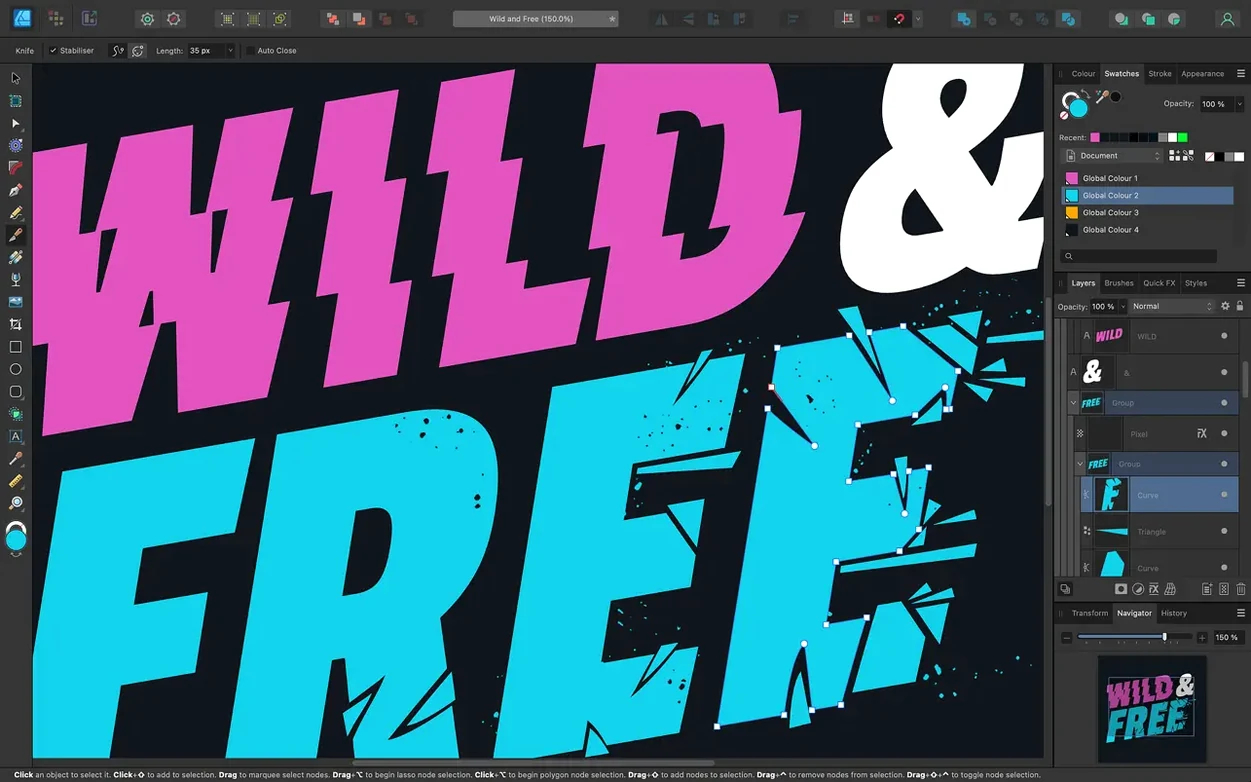
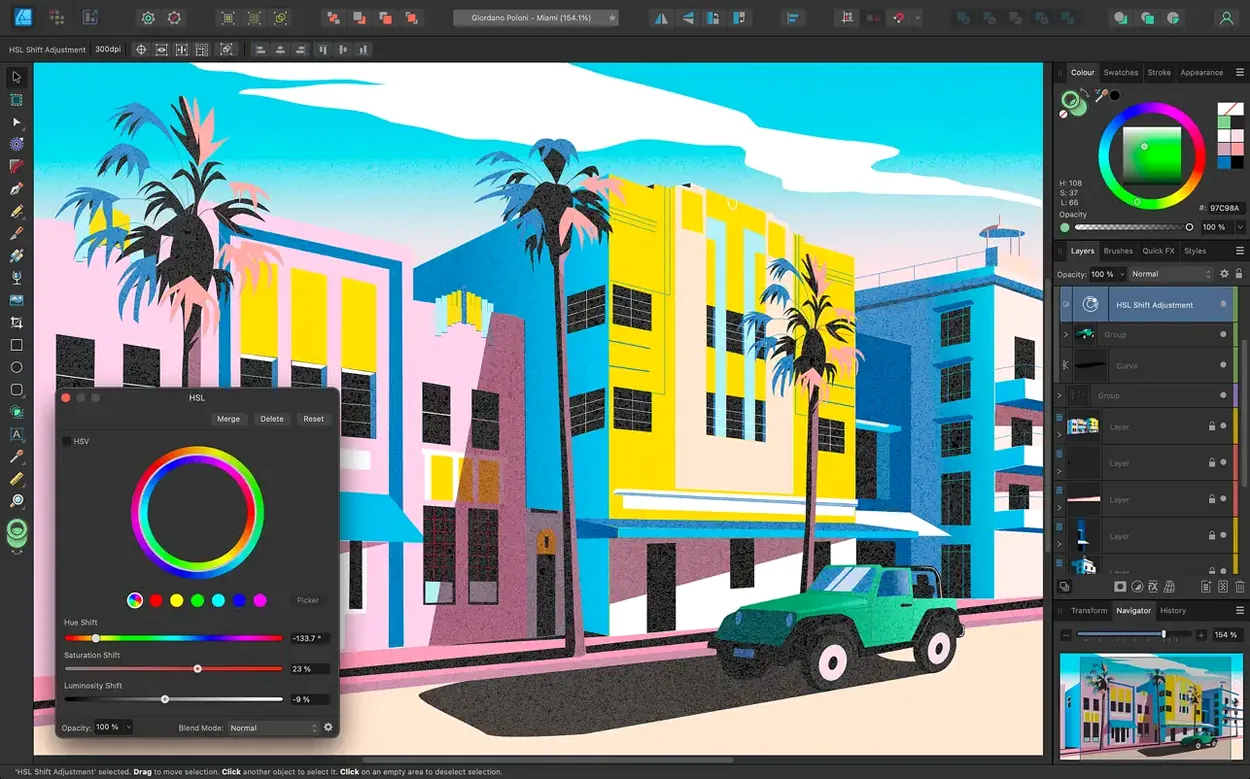
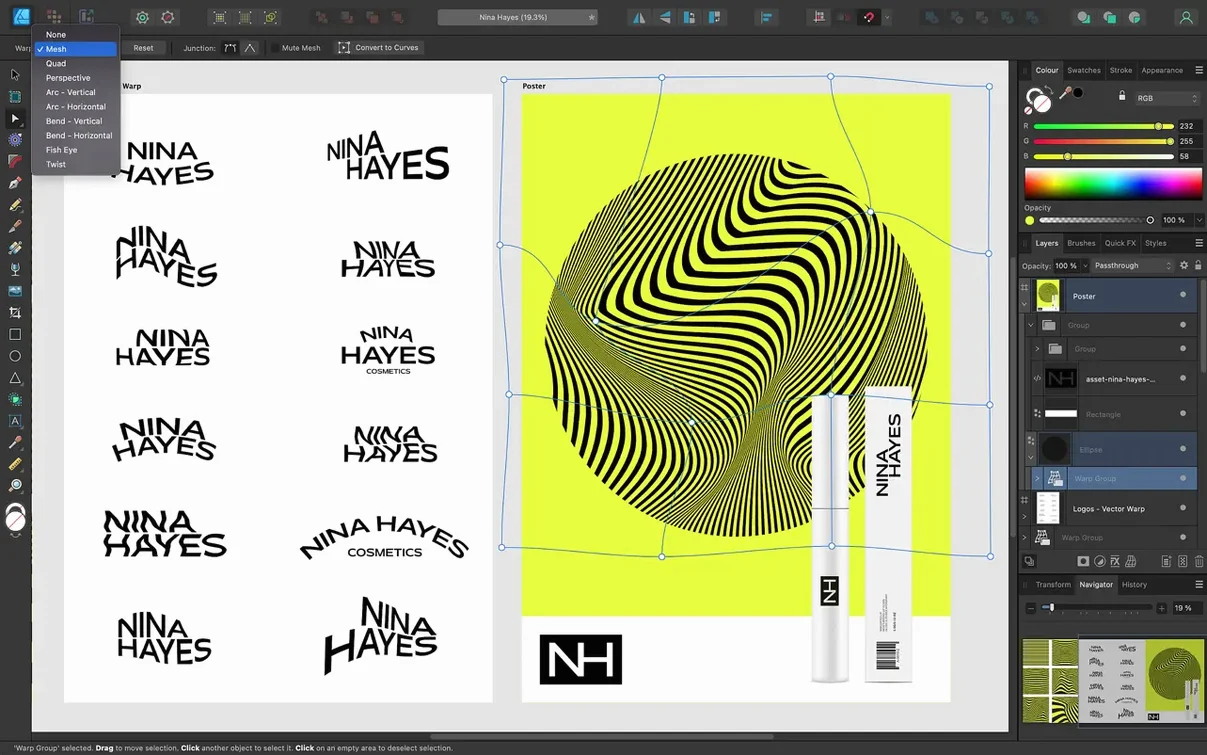
Affinity Designer 2.6.5 is at home on any Mac running macOS 10.15 Catalina or newer, working natively on both Intel and Apple Silicon machines. The version number might be a modest bump, but it carries forward a capable vector drawing engine that keeps the Affinity suite feeling cohesive. You get the same dual workspace approach—slide into a raster mode for texture work, then back to vectors without leaving the canvas—alongside full ICC color management and 16-bit per channel editing for work that needs to stay accurate from screen to print.
- The 2.6 release sharpened the Pencil tool for smoother freehand curves.
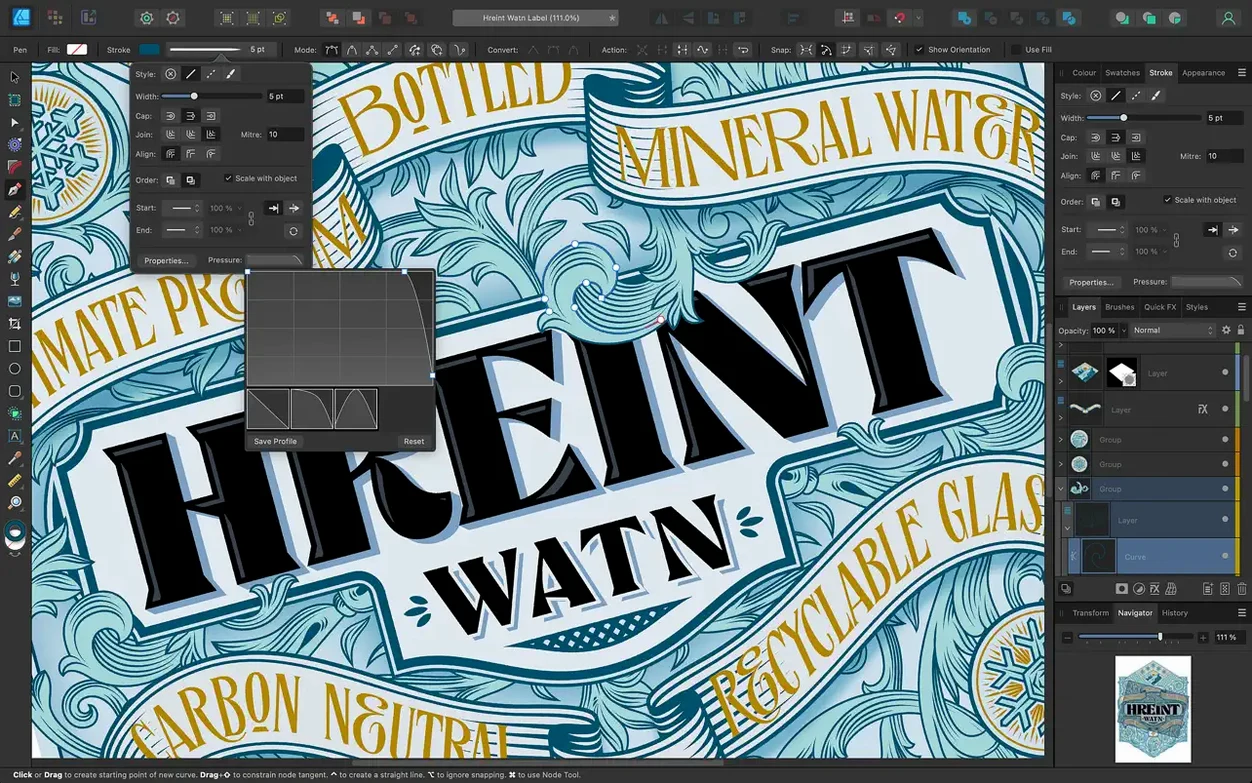
- Stroke Width Tool profiling got an overhaul, with a new Reset Profile option to start fresh.
- Holding Command or Ctrl now toggles marquee select intersection behavior on the fly.
- Ongoing bug fixes and stability improvements keep the daily grind feeling steady.
- Unlimited artboards let you spin up as many variations as a project demands.
- File compatibility covers the essentials: PSD, AI, PDF, EPS, SVG, and common raster formats like TIFF and EXR.
What hasn't changed is the quiet, dependable feel of the tools. The app still speaks your language—English, German, Japanese, and a handful of others—and plays nice with a Force Touch trackpad or Touch Bar if you have one. If you already live in the Affinity ecosystem with Photo 2 and Publisher 2, this update keeps everything in lockstep.
A print designer's late‑night save
Picture a freelance designer wrapping up a gig poster for a local record shop. The client just sent over a grainy logo pulled from a screenshot, the deadline is tomorrow morning, and the whole layout needs to shift from three‑color to a four‑panel fold without rebuilding every border and bleed line. That’s the kind of evening where Affinity Designer 2.6.5 earns its keep. The unlimited artboards let you duplicate the approved layout into a new panel, adjust the bleed guides with a couple of clicks, and drop the replacement logo onto a locked vector layer without disturbing the type below. You can switch the document color model to CMYK in the same dialog you use to assign an ICC profile for the local print shop, and the preview stays snappy even with a dozen linked TIFF backgrounds loaded.
Tracing a vintage badge from scratch
Here’s a real workflow that shows off the vector‑first toolset. The goal: turn a faded, scanned club badge into clean, scalable artwork for an embroidered patch.
- Drop the scan onto the canvas and lock the layer. Set the blend mode to Multiply so your new strokes sit on top like tracing paper.
- Grab the Pen tool and set the mode to Line Mode. For the outer badge shape, click out a few anchor points and drag the handles to follow the curved shield outline. With the 2.6 Pencil tool improvements, you could also sketch the path freehand and let the rope stabilizer smooth out the wobble—either way, the nodes stay manageable.
- Use the Node tool to fine‑tune curves. Hold Command to temporarily switch to the Node tool, tweak a handle, and release to keep drawing. It’s a small thing that stops you from bouncing between toolbars.
- For the lettering along the badge’s top arc, create a circle with the Ellipse tool, then click the Artistic Text tool right on the path. Type the shop name, and the type rides the curve. Open the Typography panel to turn on alternate glyphs or small caps if the font supports OpenType features—nice when you need an old‑timey feel without building custom letters.
- Color the shapes. Use the new Reset Profile option on the Stroke Width Tool to wipe any accidental pressure tweaks and start with a clean, uniform line. Then pick spot colors from the swatches panel so the embroiderer gets exact thread matches later.
- Export as a press‑ready PDF with the trim marks and bleed included. The same file opens later for a screen version—switch to RGB, bump the resolution, and export an SVG for the shop’s website.
The whole session lives inside one file with two artboards: one for the embroidery spec, one for the screen version. No copy‑pasting between documents.
Drag a stroke node and watch the cloud puff up
Tuesday morning, early enough that the coffee’s still hot. You’re refining a set of icons for a weather app—sun, cloud, lightning bolt, the usual suspects. Open the file, and the first thing you notice is that yesterday’s cloud has a stroke that feels too heavy at the tails. Double‑click the curve to enter the Stroke Width Tool, and a thin profile editor pops up along the path. Grab the width handle near the end and drag inward; the taper tightens without adding extra nodes. Halfway through, you realize you’ve nudged a point too far and the whole profile looks lopsided. Tap Reset Profile in the context toolbar, and the stroke snaps back to a uniform weight. You rebuild the taper in three seconds and move on to the lightning bolt.
With the cloud done, you select the bolt and toggle marquee intersect behavior by holding Command while dragging a selection box over a jagged edge—only the nodes fully inside the marquee get selected. It saves you from accidentally yanking a corner point that was meant to stay put. By the time the coffee’s cool, the set is balanced, and you’ve switched to the Pixel persona on one artboard to rough in some soft shadow textures behind the icons. The raster brush strokes sit on a separate layer, editable and erasable, while the vector shapes underneath stay crisp.
Small snags and quick fixes
Even a well‑oiled app has its sticking points. Here are a few you might bump into and how to smooth them out.
- Imported AI files missing gradients. Older Adobe Illustrator files sometimes bring shapes but drop gradient fills. Open the file, select the flat object, and reapply a gradient with the Fill Tool. In most cases, the gradient stops were preserved as unnamed swatches—look in the Swatches panel for recent colors and drag them onto the gradient ramp.
- Pencil strokes feel too jagged. The stabilizer is on by default, but its strength lives in the context toolbar. Crank up the Smoothing slider if your hand is a little shaky, or drop it low when you want every subtle wiggle to register. You can change it mid‑stroke; the next line respects the new setting.
- Canvas panning stutters on large files. Affinity Designer leans on Metal acceleration, but a huge document with many live adjustments can still hitch. Switch the view mode to Outline while you rearrange heavy layers, or rasterize a completed artboard to a linked TIFF and place it back in as a reference. The original vectors stay safe on a hidden layer.
- Type along a path runs backward. If your text flows along a circle in the wrong direction, drag the start handle (the little orange triangle) to the opposite side of the path. Or flip the path direction with the Reverse Path button in the Node tool’s context toolbar.
- Force Touch pressure not registering. On a compatible trackpad, check that the Force Pressure option is turned on in the stroke’s pressure profile. Some brushes ignore pressure unless you toggle it on manually—look for the controller dropdown next to the brush size slider.
If you’ve been browsing for a vector app that handles both clean logo work and painterly texture in one window, the Affinity Designer 2.6.5 build is worth a spot in your dock. Folks who snag an Affinity Designer torrent or poke around for an Affinity Designer Mac crack are often just trying to see if the dual‑workspace flow clicks before committing—and once you’ve rebuilt an entire icon set over a quiet morning, the rhythm tends to stick.
Affinity Designer 2.6.5 is a maintenance release, but the 2.6 update it carries brought a handful of meaningful tweaks.
- Pencil tool improvements for more natural stroke creation.
- Stroke Width Tool profiling refinements and a handy Reset Profile command.
- A Command/Ctrl toggle for marquee select intersection behavior.
- Assorted bug fixes and stability work under the hood.
- macOS 10.15 Catalina or later
- Supports both Intel and Apple Silicon Macs
Questions I actually get
Does Affinity Designer 2.6.5 still support opening Adobe Illustrator files?
Yes, it can open AI files along with PSD, PDF, EPS, SVG, and several raster formats like JPG and TIFF.
Porch talk 0
Come in or pull up a chair to leave a comment.
Nobody has pulled up a chair yet. If you used it on a real Saturday, say what the hour was.
More for the same hour
Everything in Mac Apps
 Affinity Photo
2.6.5 Mac Apps
789 MB
Affinity Photo
2.6.5 Mac Apps
789 MB
 Adobe XD
59.0.12 Mac Apps
2.6 GB
Adobe XD
59.0.12 Mac Apps
2.6 GB

 Affinity Publisher
2.6.5 Mac Apps
783 MB
Affinity Publisher
2.6.5 Mac Apps
783 MB
 Adobe Substance 3D Painter
12.1.5 Mac Apps
Updated 3 GB
Adobe Substance 3D Painter
12.1.5 Mac Apps
Updated 3 GB

 AfterCodecs
1.12.1 Mac Apps
78 MB
AfterCodecs
1.12.1 Mac Apps
78 MB
 Adobe Premiere Rush
1.5.62 Mac Apps
1.6 GB
Adobe Premiere Rush
1.5.62 Mac Apps
1.6 GB

 AI Transcription
2.16 Mac Apps
Updated 5.1 GB
AI Transcription
2.16 Mac Apps
Updated 5.1 GB

 Adobe Premiere Pro
26.5.2 Mac Apps
Updated 4.1 GB
Adobe Premiere Pro
26.5.2 Mac Apps
Updated 4.1 GB