
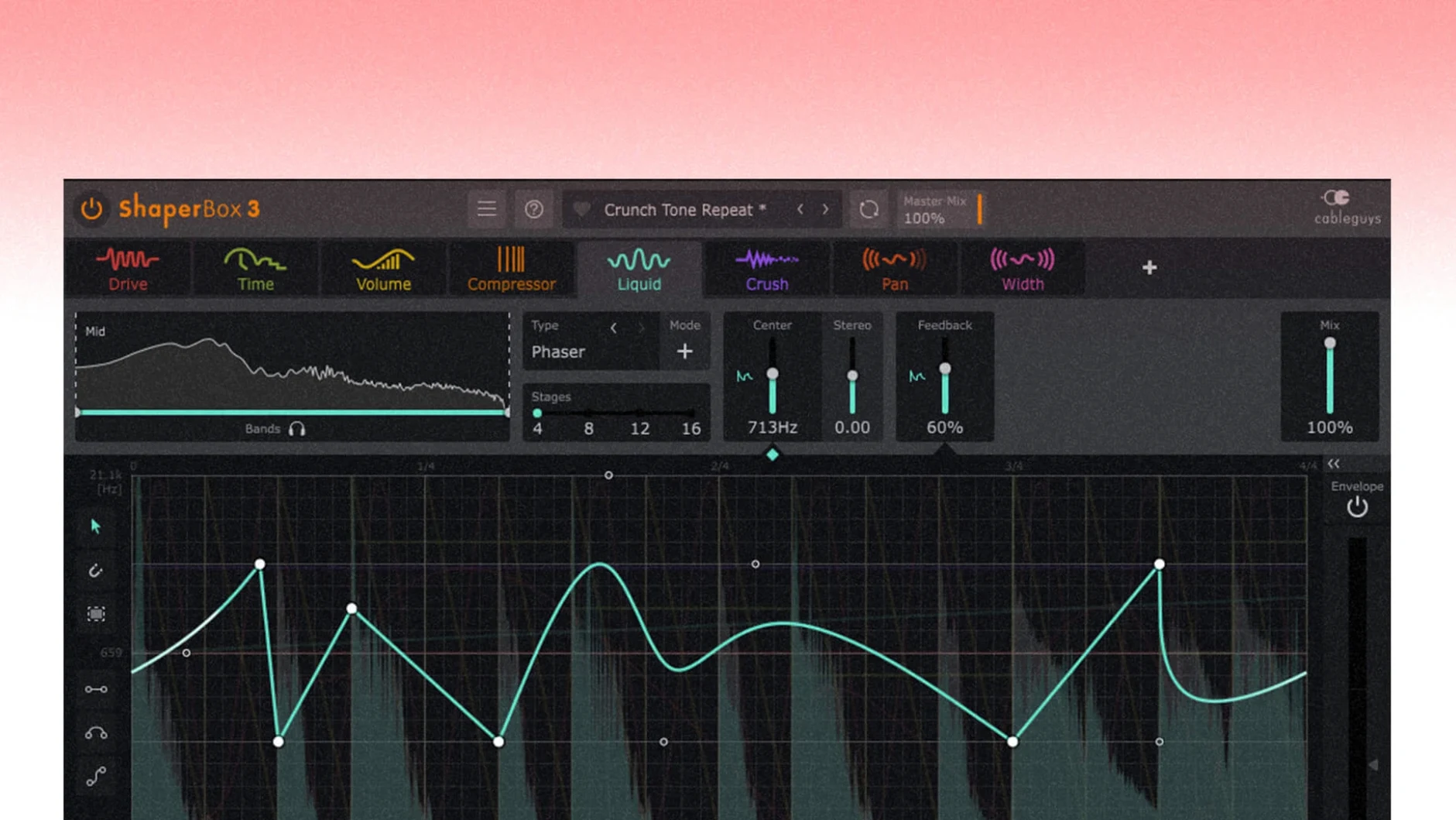
Nine Shaper modules sit inside one window, each one locked to your project tempo. That tight integration means every EQ cut, pan sweep, or time-stretch grain pulses in time with the song—not as an afterthought, but as the core idea.
Kick drum cleanup
Drop VolumeShaper on a kick track and draw an envelope that ducks the tail. A punchier low end without touching a compressor.
Vocal bus movement
Load FilterShaper Core on a vocal bus. A gentle, tempo-synced band-pass sweep pushes the backing vocals in and out of the chorus without riding faders.
Synth pad transformation
On a sustained pad, LiquidShaper adds a flanger that speeds up on the offbeats. The pad breathes and shifts, turning a static layer into something that moves with the arrangement.
The multi-effect space on the Mac has a few heavy hitters, and ShaperBox sits right in the middle of the conversation. The most common comparisons are with Soundtoys Effect Rack, Devious Machines Infiltrator 2, and Xfer Records LFOTool.
Missing the Multiband Envelope Engine in Soundtoys
Soundtoys Effect Rack is the boutique guitar-pedalboard approach. You chain individual plugins—Decapitator into EchoBoy into Tremolator—each with their own character. It sounds gorgeous on anything, but it doesn’t offer ShaperBox’s multiband splitting or the unified draw-your-own-envelope engine. If you want a saturated tape delay with wobble, Soundtoys wins. If you need the low mids of a bassline to duck exactly on the eighth notes while the highs stay open, ShaperBox is the tool for that job.
Infiltrator 2 is the closest competitor and the one that gets brought up whenever someone searches for a shaperbox torrent. It’s a modulation sequencer with a similar drawable-curve philosophy and a pile of effects. Infiltrator pushes further into wild sound design territory—the curve editor is deeper, and the effects get more chaotic. But ShaperBox holds an edge in everyday mix work. The interface is cleaner, the multiband handling feels more immediate, and the preset library steers you toward musical results faster. Infiltrator rewards exploration; ShaperBox rewards speed.
LFOTool is the lightweight option. It does one thing—volume shaping with editable curves—and does it with almost no CPU hit. Plenty of producers keep both LFOTool and ShaperBox around. LFOTool handles quick sidechain-style pumping on a single band, and ShaperBox takes over when the task needs filtering, panning, or time-stretching layered on top.
A session with ShaperBox, step by step
Picture a Wednesday evening. The track is a mid-tempo electronic piece—drums, bass, a chopped vocal hook, and a wide pad that’s been sitting too flat in the chorus.
On the drum bus, an instance of VolumeShaper opens first. The kick and snare hit hard, but the room mics are swallowing the transient snap. A quick curve is drawn: a sharp dip right after the kick transient, then a ramp back up before the snare. The envelope snaps to 1/8-note grid. Within thirty seconds the drum bus breathes without a compressor pumping.
Over on the bass track, FilterShaper Core loads. The low band stays untouched. The mid band gets a narrow band-pass sweep that follows a dotted-eighth pattern. The bass now pulses against the straight kick pattern, creating that push-pull feel that usually takes three plugins and a sidechain routing headache to pull off.
The vocal hook needs something different. LiquidShaper goes on a send, set to a subtle through-zero flanger. The Audio Trigger is enabled, keyed to the kick drum. Every time the kick hits, the flanger feedback ducks briefly, then swells back. The vocal stays clear on the downbeats and gets washy between them.
Finally, the wide pad. TimeShaper stretches the stereo field on the offbeats, pulling the grains slightly out of phase. The pad doesn’t just sit wide anymore; it moves wide in time. A small Density adjustment from the new 3.6.1 automation parameters fine-tunes the grain overlap so it doesn’t get grainy on headphones.
The whole session takes maybe twenty minutes. Four instances of ShaperBox, four different Shaper modules, all locked to the same tempo, all visible in the same familiar interface. No routing puzzles, no plugin juggling.
Barely Registers on an Apple Silicon Mac
ShaperBox runs lean for what it packs. A single instance with one Shaper active barely registers on the Activity Monitor—think 2-3 percent on an Apple Silicon Mac. Stacking multiple Shapers inside one instance adds a little more, but the shared audio engine keeps the overhead lower than running separate plugins for each effect. On an older Intel machine, six or seven instances across a full session might nudge the fan, but it’s well within the range of normal mix-plugin behavior.
The 3.6.1 build tidied up a Logic Pro cursor bug that had been annoying users for a few dot-releases. Dragging a control would sometimes make the pointer vanish; that’s gone now. The audio-artifact fix for silent-input triggering means you can leave Audio Trigger armed on a muted track without worrying about a pop sneaking through when playback starts. Stability in day-to-day use feels solid—no unexpected quits during automation-heavy sessions, no GUI lag when switching between Shaper modules quickly.
Memory use stays modest. The plugin loads its sample content for TimeShaper and LiquidShaper on demand, so an instance that only uses VolumeShaper doesn’t pre-load grain or flanger buffers it won’t touch. That’s the kind of small engineering choice that keeps a session with twenty tracks from crawling to a swap-file grind.
Leaving Unused Bands Active Degrades Your Sound
The biggest early mistake is leaving all three frequency bands active when you only need one. Multiband processing is powerful, but an untouched low band still passes audio through the effect engine. If you’re only shaping the highs with FilterShaper, turn off the low and mid bands in the crossover panel. Your CPU will thank you, and the sound won’t accidentally pick up crossover-phase artifacts you didn’t intend.
Another common stumble: drawing envelope curves that are too sharp. The anti-click smoothing in VolumeShaper is good, but an instant drop from 0 dB to -infinity on a sub-heavy bass will still produce a tick at certain tempos. Round the knee of the curve by a few milliseconds. The rhythmic feel stays intact, and the click vanishes.
People exploring a ShaperBox Mac crack download sometimes overlook the Audio Trigger section entirely because it sits collapsed by default. That’s a missed opportunity. Audio Trigger turns any Shaper module into a dynamic envelope follower keyed to an external signal. A hi-hat track can duck a reverb send; a vocal can push a filter sweep. The trigger threshold and release controls are simple, and once you set them up on one instance, you’ll start reaching for them everywhere.
Finally, beginners often treat the 600 presets as finished sounds rather than starting points. The browser is deep, but a preset named "Pumping House Bass" won’t fit your bass tone perfectly out of the gate. Adjust the crossover points to match your instrument’s frequency range, tweak the envelope depth, and save your own version. The presets teach you what’s possible—they’re not a substitute for ear-tuning the last ten percent.
Version 3.6.1 tidies up a few rough edges and expands what you can automate.
- PitchShaper’s Formant Link, Density, and Grain Size are now automation parameters.
- Fixed an audio artifact that could appear when a MIDI note or Audio Trigger arrived during silence.
- Fixed a Logic Pro issue where the mouse cursor could vanish after dragging a control.
- macOS 10.15 or later
- Apple Silicon and Intel native
- AU, VST3, AAX formats
Porch talk 0
Come in or pull up a chair to leave a comment.
Nobody has pulled up a chair yet. If you used it on a real Saturday, say what the hour was.
More for the same hour
Everything in VST Plugins Serum
2.0.24 VST Plugins
Updated 30 MB
Serum
2.0.24 VST Plugins
Updated 30 MB
 Serato Sample
2.2.0 VST Plugins
612 MB
Serato Sample
2.2.0 VST Plugins
612 MB
 Serato Hex FX
1.2.0 VST Plugins
105 MB
Serato Hex FX
1.2.0 VST Plugins
105 MB
 Slate Digital Fresh Air
1.0.9 VST Plugins
40 MB
Slate Digital Fresh Air
1.0.9 VST Plugins
40 MB
 Slate Digital Murda Melodies
1.1.1 VST Plugins
179 MB
Slate Digital Murda Melodies
1.1.1 VST Plugins
179 MB
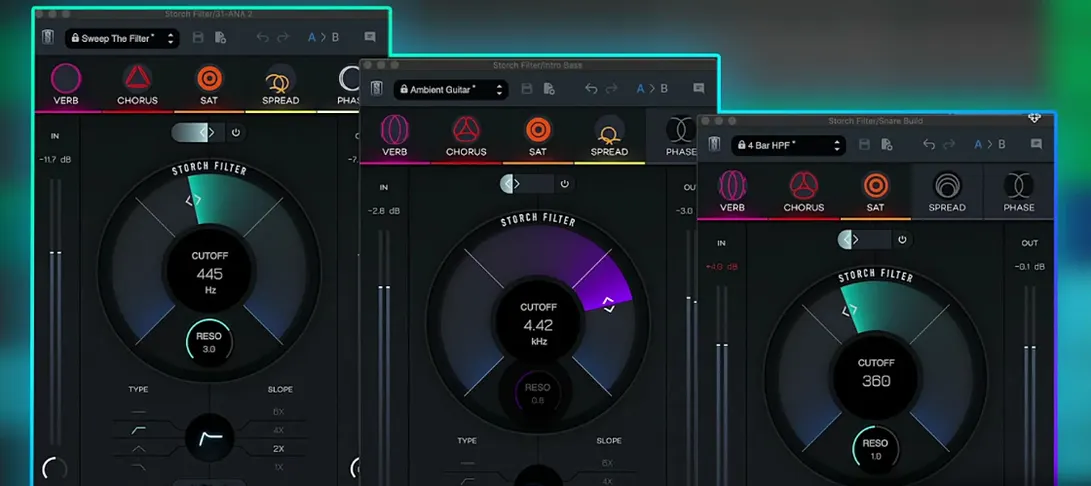 Slate Digital Storch Filter
1.0.6 VST Plugins
69 MB
Slate Digital Storch Filter
1.0.6 VST Plugins
69 MB
 Slate Digital Submerge
1.0.5 VST Plugins
38 MB
Slate Digital Submerge
1.0.5 VST Plugins
38 MB
 Scaler 3
3.3.2 VST Plugins
1.4 GB
Scaler 3
3.3.2 VST Plugins
1.4 GB