

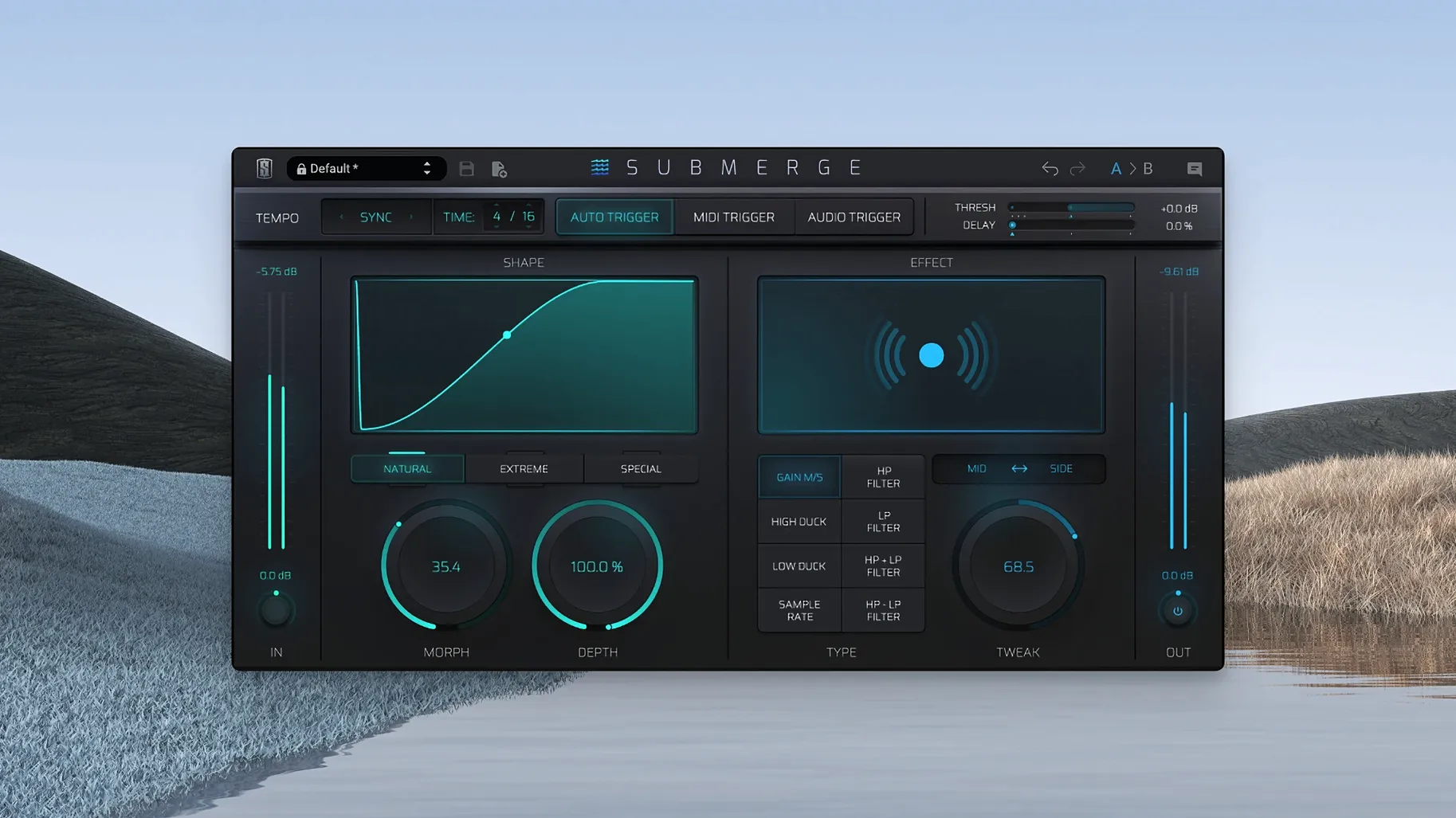
Version 1.0.5 lands as a steady, ready-to-use build of an automatic sidechain plug-in that skips the usual DAW routing tangle. No new features this round, just the current tool you grab and go.
Get the trigger right
Three trigger modes cover different ground. Auto syncs to your project tempo, MIDI reacts to incoming notes, and audio listens to a side-chain input so you can dial in the ducking shape that fits the track without extra routing.
Shape the movement
Natural, extreme, and custom curve types work with Threshold, Speed, Morph, and Depth controls. Tweak the feel from a gentle push-pull to an aggressive pump, and switch on Mid/Side processing when you want the effect to hug the center differently than the sides.
Keep the setup minimal
The whole point is less clicking around in your DAW. No complex routing chains required, just a few knobs that get you to a polished sidechain response quickly.
After a few weeks with Submerge in everyday sessions, the first thing that stands out is how little it asks of your system. On an Apple Silicon Mac running a medium–density mix — say, thirty tracks with a handful of other Slate plugs scattered around — the CPU meter barely twitches. I’ve dropped it onto synth busses, bass groups, and full drum stems without noticing a spike, and the latency stays low enough that tweaking parameters during playback feels immediate rather than laggy. Stability holds up across Logic, Ableton Live, and REAPER; no surprise dropouts or UI freezes, even when you’re flipping between trigger modes mid‑playback. Memory use sits in the single‑digit megabyte range, so tossing it onto eight or ten channels won’t suddenly balloon your session file or choke the RAM. If you’re the kind of producer who runs dozens of ducking instances — one per pad, one per vocal throw, one per bass layer — Submerge won’t punish you for it.
A bass‑ducking walkthrough
Here’s a practical run that shows where Submerge fits into a real workflow. Suppose you’ve got a punchy kick on track one and a deep, held sub‑bass on track two, and the low end gets muddy every time the kick hits. Start by dropping Submerge onto the sub‑bass channel. Set the trigger mode to Audio and route your kick into the side‑chain input — one extra click in your DAW’s plug‑in header, nothing more. Pull Threshold down until the kick starts grabbing the sub, then set the curve to Natural and nudge Speed to about a quarter turn. Now adjust Depth until the sub ducks just enough to let the kick transient cut through, and use Morph to round off the release so the bass swells back in smoothly rather than snapping. From there, try the low‑pass effect from the built‑in eight; dial it down so the ducked signal loses a touch of high‑end grit while the kick punches forward. The whole setup takes under a minute, and you never open a compressor’s side‑chain panel or draw automation — Submerge handles the timing, and your ear handles the taste.
Instant ducking versus drawing modulation from scratch
Compared to Xfer LFO Tool, Submerge feels more immediate for straight‑ahead ducking because you aren’t building modulation shapes from scratch. LFO Tool gives you deeper per‑step editing and filter sequencing, which is great for intricate rhythmic gating, but for “make the bass get out of the kick’s way,” Submerge gets there with fewer decisions. Next to Wavesfactory Trackspacer, the philosophy diverges: Trackspacer carves frequency‑specific space using a dynamic EQ‑like approach, which can be more transparent on full mixes, while Submerge pushes whole‑signal ducking with curve‑shaped movement and effects. Trackspacer works wonders on cluttered bus material, but Submerge adds creative twists — sample‑rate reduction, Mid/Side widening, the inverted push curve — that Trackspacer doesn’t aim for. Against Kickstart 2, Submerge trades Kickstart’s waveform‑based visual grid for real‑time trigger response. Kickstart locks to a tempo grid and draws envelope shapes; Submerge listens to audio or MIDI and reacts, so the ducking follows the performance rather than just the bar lines. If you want to set it and forget it, Kickstart 2 is cleaner. If you want the ducking to breathe with the track, Submerge wins.
You sometimes hear people hunting for a slate digital crack mac or a slate digital mac torrent to test these differences without commitment, and while the web is full of search trails for slate digital torrent links, the version that ends up in your plug‑in folder is the one that matters — version 1.0.5 runs smooth and stable right out of the box.
Beatmakers who skip routing and use Auto mode
Bedroom beatmakers who want instant sidechain movement without routing headaches get the most mileage from Submerge. Drag it onto a pad channel, flip to Auto mode, and the pumping follows your tempo — no compressor math, no drawing curves. Mix engineers working on pop, hip‑hop, and electronic records benefit from the speed of pulling a kick or a clap through a dense arrangement; the Tweak knob alone can shift the groove feel without touching another plug‑in. Sound designers who build rhythmic pads or sci‑fi textures will lean on the eight built‑in effects and the inverted‑curve trick, using Submerge less as a utility and more as a signal destructor. If you’re already in the Slade ecosystem through the Complete Access Hub, it slots in without friction and becomes one of those “add it to every project” tools. Live performers running a laptop rig gain a lightweight ducking stage that triggers from MIDI clips or incoming audio, so backing tracks and live instruments stay separated in the mix at low latency. Anyone who’s ever groaned at the thought of setting up three side‑chain compressors before lunch — Submerge is aimed squarely at you.
- macOS 11 or later
- Apple Silicon native support
Questions I actually get
What trigger modes does Submerge offer?
Submerge gives you Auto mode, which syncs to the project tempo, MIDI mode for triggering via MIDI notes, and Audio mode for a traditional side-chain input.
Porch talk 0
Come in or pull up a chair to leave a comment.
Nobody has pulled up a chair yet. If you used it on a real Saturday, say what the hour was.
More for the same hour
Everything in VST Plugins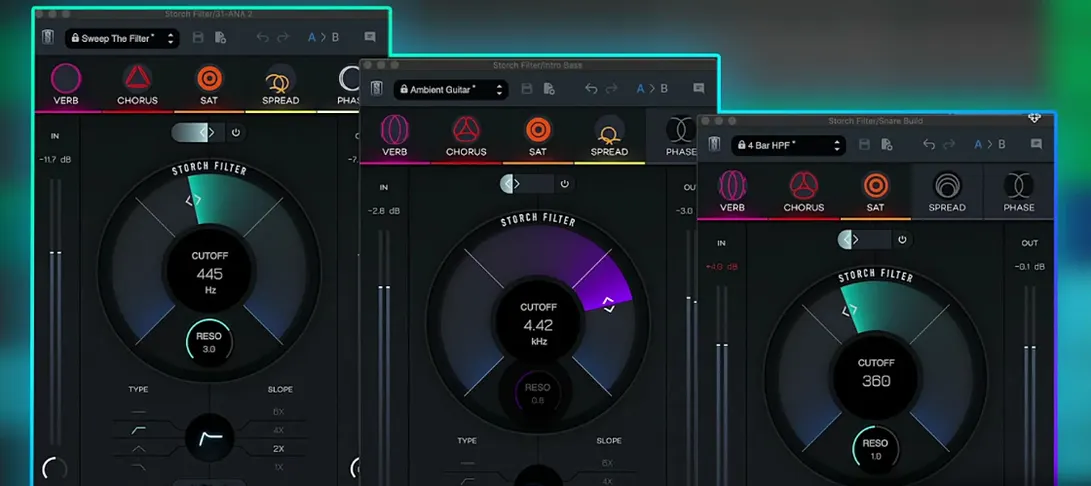 Slate Digital Storch Filter
1.0.6 VST Plugins
69 MB
Slate Digital Storch Filter
1.0.6 VST Plugins
69 MB
 Slate Digital Murda Melodies
1.1.1 VST Plugins
179 MB
Slate Digital Murda Melodies
1.1.1 VST Plugins
179 MB
 Slate Digital Fresh Air
1.0.9 VST Plugins
40 MB
Slate Digital Fresh Air
1.0.9 VST Plugins
40 MB
 Sonic Academy KICK
1.1.8 VST Plugins
Updated 358 MB
Sonic Academy KICK
1.1.8 VST Plugins
Updated 358 MB
 Spire
1.5.19 VST Plugins
158 MB
Spire
1.5.19 VST Plugins
158 MB
 ShaperBox
3.6.1 VST Plugins
111 MB
ShaperBox
3.6.1 VST Plugins
111 MB
 SSG Audio Optimus
1.5.143 VST Plugins
58 MB
SSG Audio Optimus
1.5.143 VST Plugins
58 MB
 Serum
2.0.24 VST Plugins
Updated 30 MB
Serum
2.0.24 VST Plugins
Updated 30 MB