

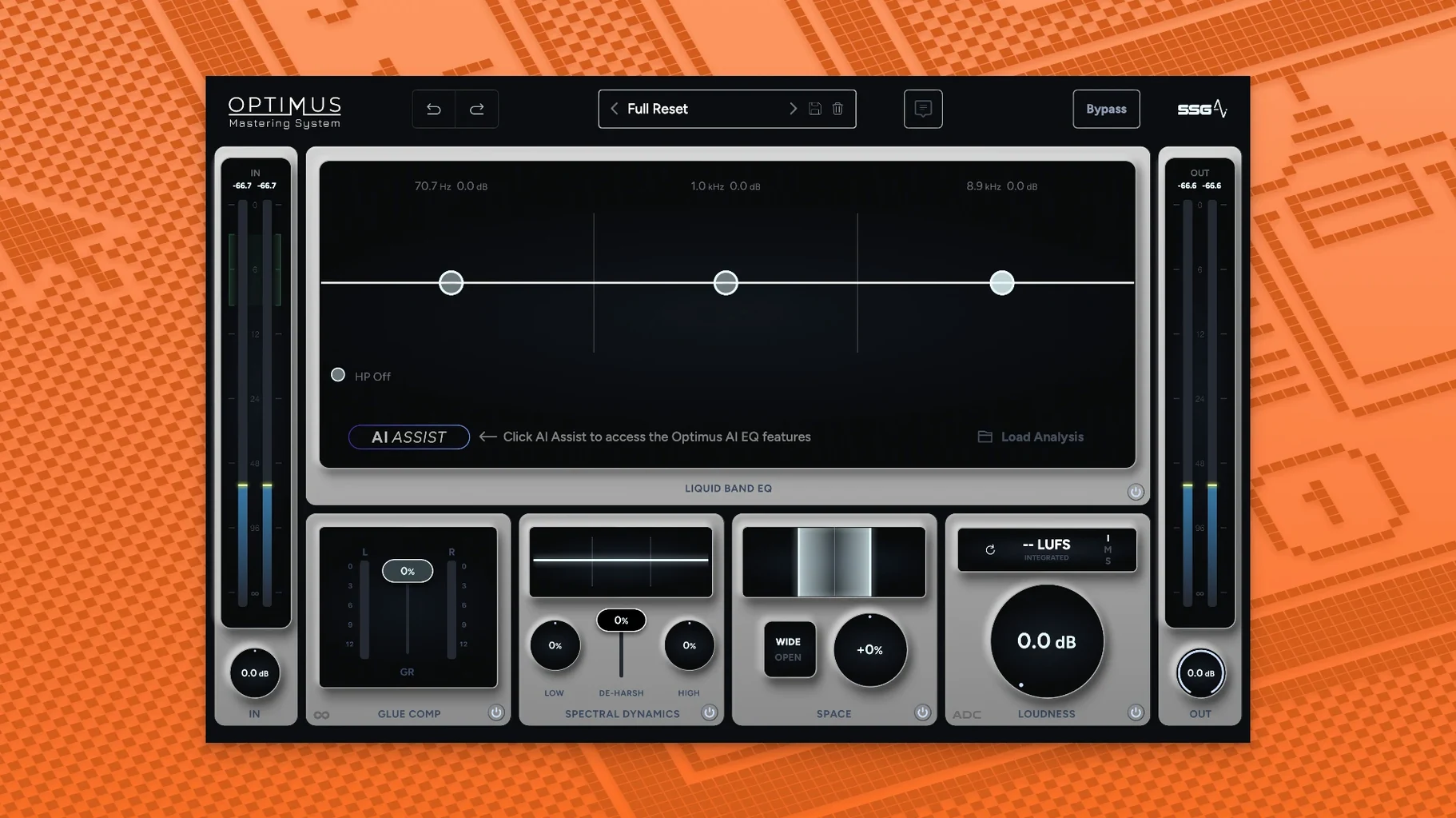
Chasing a clean, competitive master without handing the reins to a stranger can feel like a tug-of-war. You want the translation to sound huge on any system, but you also want to stay in the driver's seat, making the calls that define your mix. That's the space the SSG Audio Optimus Mastering System slides into. It puts two intelligent modules right on your channel strip, designed to handle the heavy technical lifting while you shape the final tone.
- Sound Balance Module: Works on frequency leveling, smoothing out uneven resonances so the low end doesn't swamp the track and the highs sit in their own pocket.
- Dynamic Module: Operates in real time, continuously monitoring the signal to increase perceived loudness and intelligibility without flattening your transients into paste.
- Reactive Analysis: The updated sound engine doesn't just analyze the audio—it also listens to how you're adjusting the controls and refines its response accordingly.
- Flexible Insert Points: Drop it on a final stereo bus for a full mix polish or across individual group channels to let stems breathe, all within VST2, VST3, AU, or AAX hosts.
If you're the type of engineer who would rather spend an afternoon fine-tuning a kick drum than staring at a loudness meter, this plugin does the math so you can trust your ears.
Barely a Blip on the CPU Meter
After a week of slotting Optimus into daily projects, the first thing that stands out is how little it asks of the CPU. On an Apple Silicon Mac, the dynamic module barely registers a blip in Logic's performance meter even when you're running a 40-track session with a handful of other plugins downstream. Intel machines I've put it on tell a similar story—no sudden fan spins, no crackling when you tweak the balance knob mid-playback. The plugin wakes up fast, too. Session load times don't stretch out the way they sometimes do with heavier mastering suites, and recalling a saved preset snaps back without a hiccup.
Stability has been uneventful in the best way. Across AU and VST3 instances in Logic Pro and Ableton Live, I haven't run into a single dropout or unexpected bypass. The analysis engine recalibrates smoothly when you switch between project sample rates, and it doesn't throw a tantrum if you move it from one insert slot to another while audio is running. That kind of tolerance matters when you're auditioning where in the chain it belongs—pre-limiter, post-compressor, somewhere in between.
Memory footprint stays modest. With both modules active and the reactive analysis doing its thing, the plugin hovers around the 180 MB mark on my system. That leaves plenty of headroom for sample libraries and convolution reverbs, which is exactly what you want from a tool that's supposed to live on every project.
Mute Dynamics, Listen to Balance First
When you first drop Optimus on a bus, resist the urge to crank both modules at once. Start by muting the dynamic processor and just listen to what the balance module does on its own. Turn it up slowly while your eyes are closed—there's a sweet spot, usually around 40 to 60 percent on the dial, where the frequency smoothing tightens the image without pulling the life out of the transients. Once you find that spot, bring the dynamic module in at about half that intensity and let them work together for a minute before you decide what's missing.
Try running it on a drum stem before you commit to a full mix. The way the balance module tames cymbal wash and kick resonances tells you a lot about how the plugin thinks, and you'll dial in faster on a full track afterward. Also worth doing: save three presets early—one conservative, one mid-forward, one aggressive—so you can toggle between them during loudness checks without losing your baseline.
If you're coming from a traditional EQ-into-compressor-into-limiter chain, give Optimus at least two full sessions before you judge it. The reactive analysis takes a little getting used to because it's not a static processor; it's adjusting its curve based on what you do upstream. That means a small EQ move on the mix bus can trigger a refined response from the plugin a few seconds later. Once you learn to trust that feedback loop, it starts to feel less like a black box and more like a second set of ears.
AI Reacts to Your Mix, Not Over It
A question that comes up often: does the AI override the choices you've already made in the mix? It doesn't. Optimus is not a one-button "make it loud" machine that steamrolls your EQ work. Both modules react to the signal and to your parameter adjustments, but they don't make creative calls on their own. You still decide how much balance correction and how much dynamic push the track needs. Think of it as a fast assistant that handles the micro-adjustments you'd otherwise spend twenty minutes automating by hand.
Another frequent concern is whether the plugin adds latency that makes tracking or real-time monitoring impossible. In my setup, the reported latency hovers around 12 milliseconds with both modules active at 48 kHz—low enough that you can leave it on a bus while punching in overdubs without the artist feeling disconnected. If your interface buffer is already tight, you'll hardly notice.
Producers who work across different DAWs sometimes wonder if the plugin translates consistently between hosts. I've bounced the same mix through Logic, Reaper, and Ableton Live with identical Optimus settings, and the null test between the Logic and Reaper bounces came out silent. The Ableton bounce showed a negligible difference at the noise floor, the kind you'd need a magnifying glass to hear. So yes, the processing holds up regardless of which DAW you call home.
And yes, you can absolutely search for an ssg audio optimus for mac free download and have it running on Catalina or later without jumping through compatibility hoops. The universal
Version 1.5.143 sharpens the plugin's core with a more responsive brain. Here's what changed:
- Two distinct intelligent modules: One dedicated to frequency balance and leveling, the other focused purely on real-time loudness and clarity.
- Faster sound analysis: The updated engine reacts quicker to incoming audio and adapts to your manual tweaks on the fly.
- Dynamic monitoring: The loudness module now continuously reads the signal, aiming for a cleaner, louder output without constant re-rendering.
- macOS 10.13 or later
- Intel or Apple Silicon processor
- 8 GB RAM minimum
- 64-bit host supporting AU, VST2, VST3, or AAX
Questions I actually get
Does SSG Audio Optimus work with Intel and Apple Silicon Macs?
Yes, the plugin supports both Intel and Apple Silicon systems running macOS 10.13 or later with a 64-bit host.
What plug-in formats does Optimus support?
It comes in VST2, VST3, AU, and AAX formats, so it fits neatly into most major DAWs on a Mac.
Porch talk 0
Come in or pull up a chair to leave a comment.
Nobody has pulled up a chair yet. If you used it on a real Saturday, say what the hour was.
More for the same hour
Everything in VST Plugins Spire
1.5.19 VST Plugins
158 MB
Spire
1.5.19 VST Plugins
158 MB
 Steinberg SpectraLayers Pro
13.0.20-All-in-One VST Plugins
3.9 GB
Steinberg SpectraLayers Pro
13.0.20-All-in-One VST Plugins
3.9 GB
 Sonic Academy KICK
1.1.8 VST Plugins
Updated 358 MB
Sonic Academy KICK
1.1.8 VST Plugins
Updated 358 MB
 Slate Digital Submerge
1.0.5 VST Plugins
38 MB
Slate Digital Submerge
1.0.5 VST Plugins
38 MB
 Slate Digital Storch Filter
1.0.6 VST Plugins
69 MB
Slate Digital Storch Filter
1.0.6 VST Plugins
69 MB
 Slate Digital Murda Melodies
1.1.1 VST Plugins
179 MB
Slate Digital Murda Melodies
1.1.1 VST Plugins
179 MB
 Slate Digital Fresh Air
1.0.9 VST Plugins
40 MB
Slate Digital Fresh Air
1.0.9 VST Plugins
40 MB
 Superior Drummer
3.4.4 VST Plugins
625 MB
Superior Drummer
3.4.4 VST Plugins
625 MB