
Get Steinberg SpectraLayers Pro 13.0.20-All-in-One for Mac
VST Plugins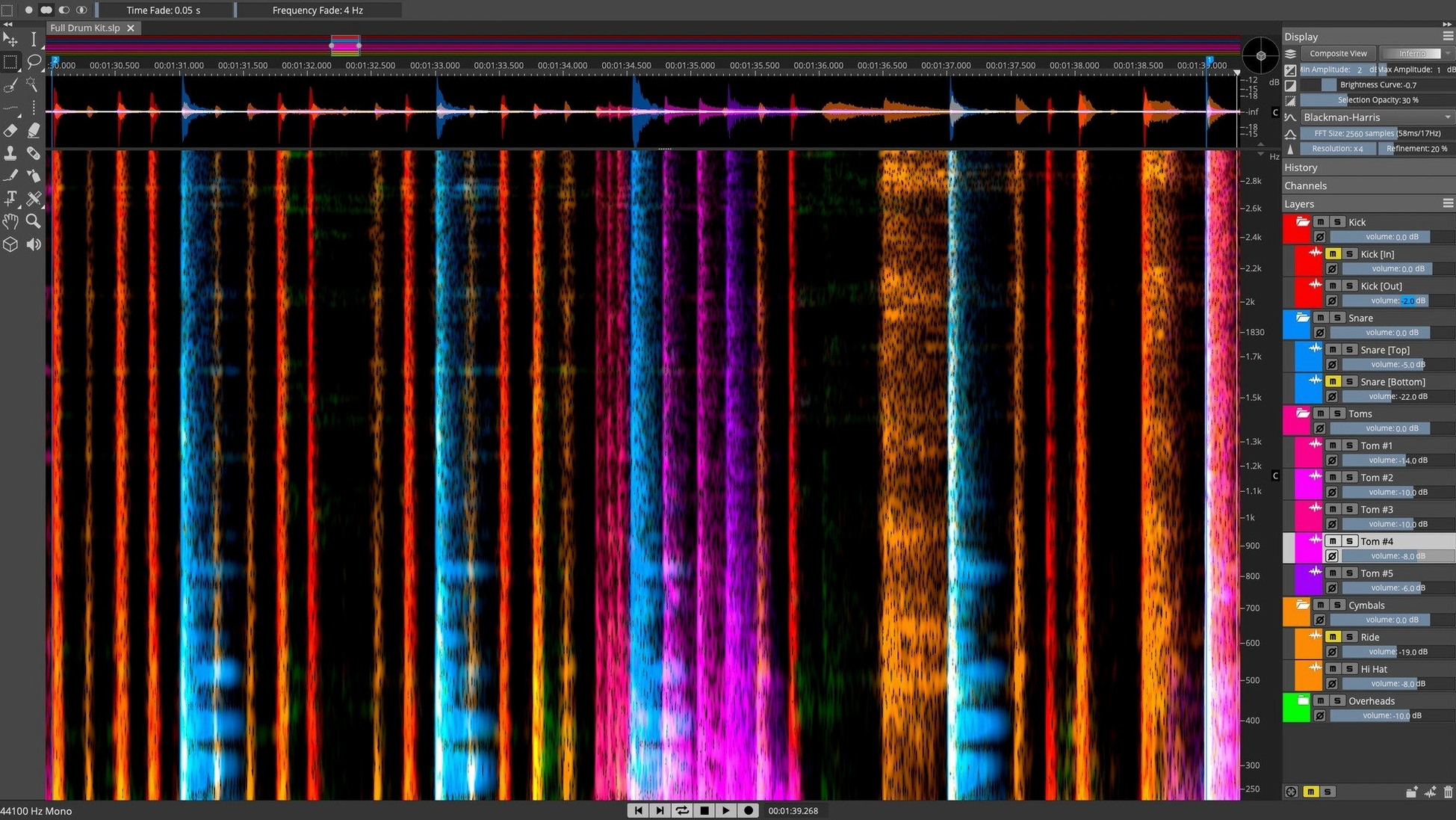
You have a recording where a chair squeak buried a quiet guitar phrase, or a live take where the bleed between mics is fighting the mix. Traditional waveform editors can't see that problem, but a spectral editor can. Steinberg SpectraLayers Pro gives you a direct view into the frequency and time domain, letting you reach into a sound's internal structure.
- AI-driven component unmixing that separates a full mix into individual instrument layers.
- ARA 2 integration for fluid round-tripping between SpectraLayers, Nuendo, and Cubase.
- Support for VST 3, AU, and AAX formats, plus standalone operation on both Intel and Apple Silicon Macs.
- Pattern Finder for hunting down and selecting repeating sonic events across the spectral display.
- Runs on macOS 12 and newer, with direct editing of spectral data as easily as you'd edit text.
If your work pushes past standard clip gain and EQ fixes, this is where you get surgical. It's a deep toolkit for audio repair people, post-production editors, and any mixer who needs to isolate sounds a fader can't touch.
Load a familiar stereo mix first
Don't open a full multitrack session on day one. Drop in a stereo mix you know well — something you've heard on three different systems — and just watch how the spectrogram lights up. Hover over the brighter bands, zoom in on a vocal sibilance, toggle between 2D and 3D view. Getting comfortable with the display itself is half the battle, because SpectraLayers shows you information no waveform editor ever will.
After an hour of poking around, try the Voice Denoiser on a clip with steady background hum. It's one of the gentler AI modules and it gives you a clean before-and-after without a dozen parameter tweaks. From there, move to AI track-to-stems unmixing on that same stereo mix — you'll get separate layers for drums, bass, vocals, and other instruments. The algorithm isn't magic; dense arrangements with doubled guitars can still confuse it, but the separation quality is enough to make you rethink old mix revisions.
A practical habit I recommend early: set a custom key command for toggling between the lasso and the brush. You'll switch tools constantly once you start surgical edits, and the default mouse workflow slows you down more than you expect.
What the 13.0.20 release actually changed
Version 13.0.20 is an all-in-one installer release that wraps the Pro edition into a single disk image for both Intel and Apple Silicon Macs, so you no longer need to check which architecture you're downloading. The installer behavior is standard — open the image, run the procedure, and the application lands where you expect it. Under the hood, the ARA 2 bridge with Nuendo and Cubase received attention in this cycle, with tighter handoff when you send clips between the DAW and the spectral editor. Transfers feel snappier on Apple Silicon, and fewer users are reporting the old ghost-waveform redraw glitch that plagued earlier 13.x builds.
The AI modules didn't get a headline rewrite — the unmixing engines, Pattern Finder, and Voice Denoiser carry forward from the Pro 13 architecture — but the installer notes point to stability fixes that matter in long sessions. If you had random dropouts when running multiple AI processes back-to-back on an M1 machine, you're likely to notice the difference. One small quality-of-life shift: the default zoom behavior when double-clicking a selection now centers the view more predictably, which sounds minor until you've spent a week editing transient clicks out of a 40-minute field recording.
Why EQ-style edits sound hollow
The most common beginner mistake is treating spectral editing like EQ. Grabbing a bright horizontal band and pulling it down feels intuitive, but it leaves a sonic hole shaped exactly like your selection boundary. Natural-sounding repairs need soft-edged selections and a little time spent auditioning the surrounding frequency material. If the edit sounds hollow, you probably drew a hard rectangle and deleted it outright rather than attenuating with a tapered edge.
Another trap: running AI unmixing on an already-mastered track and expecting the stems to sum back to the original bounce. The process introduces phase shifts and subtle level changes per layer — perfectly fine for remixing or repair work, but not transparent enough for forensic null-testing. People also overuse the 3D visualization early on. It's striking, and it helps you understand spectral density in a tactile way, but precise edits are easier in the standard 2D view where frequency-time boundaries are sharper.
ARA 2 users sometimes forget that not every edit propagates instantly both ways. If you trim a clip length in Cubase after doing spectral work, you can break the link without a warning dialog. Save versions before restructuring your DAW timeline, or commit the spectral edits to a new audio file if the arrangement is still in flux.
Runs standalone without Cubase
"Do I need to use Cubase or Nuendo to get anything out of this?" No — the ARA 2 integration is slick, but SpectraLayers Pro runs standalone and talks to any DAW through standard file export or the VST 3/AU/AAX plug-in bridge. You can drag a clip out of Logic, clean it in SpectraLayers, and drag it back without ever touching a Steinberg host. The ARA workflow is a convenience, not a requirement.
"Will this replace my noise reduction plug-ins?" It can, for a specific kind of work. Broadband denoisers are still faster for consistent background hiss across a full track. SpectraLayers earns its place when the noise is irregular — a phone buzz that happens twice, a door slam bleeding into a tom mic — or when you need to separate a source from a mix rather than just quiet the noise floor. Many engineers end up using both: a denoiser for the broad strokes, SpectraLayers for the surgical moments.
"How steep is the learning curve if I've only edited waveforms?" The first week feels disorienting because you're navigating a map instead of a timeline. Once the frequency-on-the-vertical-axis concept clicks, the toolset starts to feel like Photoshop for audio — layers, selection tools, healing brushes, and all. If you've done any image editing with lassos and masks, the mental model transfers faster than you'd guess. Give yourself a few evenings with short, familiar clips before you jump into a paid project. The speed comes after the orientation sticks.
Version 13.0.20 is a maintenance update with installer release notes available.
- macOS 12 or later
- Intel or Apple Silicon Mac
Questions I actually get
Does SpectraLayers Pro work as a plug-in inside a DAW?
Yes, it supports VST 3, AU, and AAX formats, plus deep ARA 2 integration with Nuendo and Cubase.
Can I separate vocals from a full mix with SpectraLayers?
Absolutely. The AI-based component unmixing feature is designed to separate a mix into individual layers like vocals, drums, and other instruments.
Will SpectraLayers Pro run on an Apple Silicon Mac?
Yes, the software runs natively on both Intel and Apple Silicon Macs starting from macOS 12.
Porch talk 0
Come in or pull up a chair to leave a comment.
Nobody has pulled up a chair yet. If you used it on a real Saturday, say what the hour was.
More for the same hour
Everything in VST Plugins SSG Audio Optimus
1.5.143 VST Plugins
58 MB
SSG Audio Optimus
1.5.143 VST Plugins
58 MB
 Spire
1.5.19 VST Plugins
158 MB
Spire
1.5.19 VST Plugins
158 MB
 Sonic Academy KICK
1.1.8 VST Plugins
Updated 358 MB
Sonic Academy KICK
1.1.8 VST Plugins
Updated 358 MB
 Superior Drummer
3.4.4 VST Plugins
625 MB
Superior Drummer
3.4.4 VST Plugins
625 MB
 Supertone Air
1.0.1 VST Plugins
408 MB
Supertone Air
1.0.1 VST Plugins
408 MB
 Slate Digital Submerge
1.0.5 VST Plugins
38 MB
Slate Digital Submerge
1.0.5 VST Plugins
38 MB
 Slate Digital Storch Filter
1.0.6 VST Plugins
69 MB
Slate Digital Storch Filter
1.0.6 VST Plugins
69 MB
 Slate Digital Murda Melodies
1.1.1 VST Plugins
179 MB
Slate Digital Murda Melodies
1.1.1 VST Plugins
179 MB