Students drafting essays, office workers polishing reports, and writers putting down their first chapters all turn to Microsoft Word because the tools feel familiar the moment you open a blank page. Before you hunt for a download word for mac, it makes sense to see if your machine is ready for version 16.93.
macOS 13 floor and dual-architecture installer
The current release asks for macOS 13 or later. It runs on both Intel processors and Apple Silicon, so you do not have to wonder about architecture — the installer handles that on its own. If your system meets that one requirement, Word will launch and let you create, edit, and share documents right away. The app supports collaborative work too, which means you and a colleague can type into the same file without stepping on each other's edits.
The editing tools you actually get
Word comes as part of the Microsoft 365 suite alongside Excel, PowerPoint, Outlook, OneNote, and OneDrive. The January 2025 update focused on quality fixes — equations that previously refused to edit now behave properly, and general performance feels smoother. Twenty interface languages are available, including English, Spanish, German, French, Japanese, and Russian, so you can work in whatever tongue suits your workflow. If you have been searching for a free word for mac, checking the official Microsoft page for the 365 package is the straightforward place to look.
Typing blind to the ribbon and its time-savers
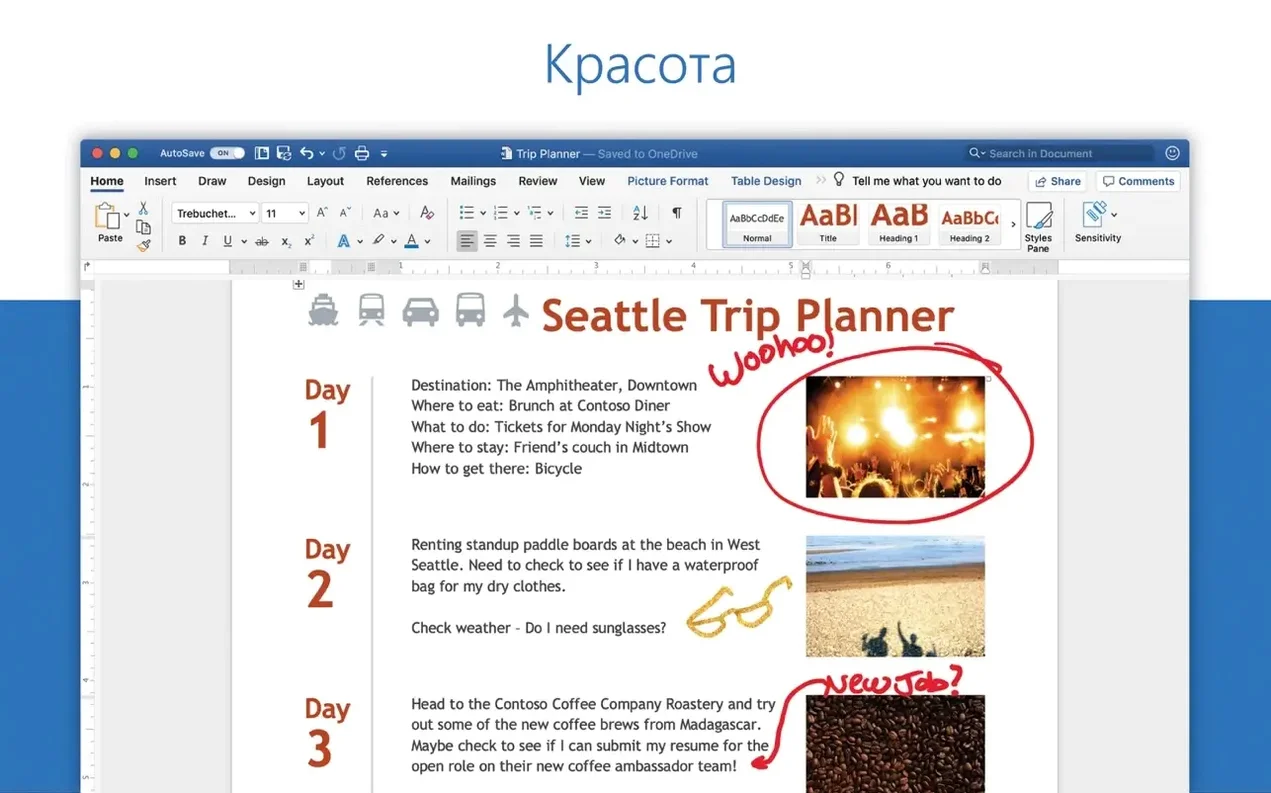
Someone fires up Word for the first time and immediately starts typing, ignoring the ribbon entirely. That works for a grocery list, but it means you miss the tools that save time later. A common misstep is treating Word like a typewriter — hitting Enter twice to create space between paragraphs instead of adjusting the paragraph spacing once in the Styles pane. The result is a document that falls apart the moment you change the font size.
Another habit that trips people up is copying text from a browser and pasting it straight in. Word brings along all the hidden HTML formatting, and suddenly your headings look different from the ones you set up an hour ago. The fix is simple but overlooked: use Paste and Match Style instead of the default paste. Your document stays consistent, and you avoid the headache of chasing rogue fonts.
Beginners also tend to ignore the Navigation Pane. They scroll endlessly through a thirty-page document looking for a section they remember writing, never realizing that applying heading styles turns the pane into a clickable outline. It is one of those features that sits in plain sight on the View tab, waiting to be turned on.
Three preference tweaks before your first real document
Before you write anything important, open the Word preferences and make three adjustments. First, under Save, set the default file format to .docx and confirm that AutoRecover is set to every five minutes — shorter intervals can slow things down on older machines, but five minutes is a sweet spot. Second, visit the Spelling & Grammar pane and toggle on "Check grammar with spelling" if you write anything longer than an email. Third, under View, enable "Show bookmarks" so you can see where you placed them later.
Next, spend fifteen minutes setting up a blank document template you actually like. Pick your preferred font, line spacing, and margin sizes, then save it as Normal.dotm. Every new document inherits those choices, and you stop having to fix Calibri 11pt every single time. While you are at it, pin the Styles pane to the right edge of the window — having it visible makes you more likely to use proper heading levels instead of bold text and prayer.
One tip that pays off early: learn the three custom dictionaries. Word ships with a main dictionary, but you can add technical terms, names, or brand spellings to a custom one so they stop showing up with red squiggles. Go to Tools > Spelling & Grammar > Dictionaries and create one called "Work Terms" or "Project Names." Add words as you encounter them. After a week, the spell checker becomes far less noisy.
If you grabbed a word microsoft torrent to test the waters, the same setup steps apply — the preferences do not change based on where the installer came from. The goal is to make the software feel like yours before you write a single line that matters.
Section breaks before the title page
Say you are putting together a research paper with footnotes, a table of contents, and a bibliography. Starting from a blank document, the first move is not to type the title — it is to set up the section breaks. Place a Next Page section break after what will become the title page, another before the bibliography starts, and another before any appendix. Section breaks let you control headers, footers, and page numbering independently, which means your title page has no number while the body uses Arabic numerals and the appendix starts fresh with Roman.
With the skeleton in place, apply the built-in heading styles. Use Heading 1 for chapter titles, Heading 2 for major sections, Heading 3 for subsections. Do not manually format any of them yet — just assign the style. Once every heading is styled, insert a table of contents via References > Table of Contents. It populates instantly, and when you shift sections around later, a single right-click updates the page numbers.
For citations, use the References > Insert Citation tool. Add each source as you cite it, filling in author, title, year, and publisher. When the paper is done, drop the bibliography at the end with Bibliography > Insert Bibliography. Word builds it in alphabetical order using the citation style you chose — APA, MLA, Chicago, whatever the assignment demands. Changing the style midway updates every citation and the bibliography together, a task that would take an hour by hand.
Footnotes are straightforward: place the cursor where the note belongs, hit Insert Footnote, and type. Word handles the numbering and the layout at the bottom of the page. Before printing or exporting to PDF, run a quick check in View > Draft mode to see all footnotes in a single pane — easier than scrolling through pages hunting for a misplaced note. Finally, lock the document with File > Protect Document if you are sending it to a reviewer and want to prevent accidental edits to the formatting.
Pinned proposal opens right where you left off
It is a Thursday afternoon, and you have a grant proposal due by evening. You open Word and the landing screen shows your recent files. The proposal is pinned there from yesterday's session. Double-click, and it opens at the spot you left off — Word remembers your last cursor position across restarts, so you pick up mid-paragraph without scrolling.
You notice the budget section needs a table. You switch to the Insert tab, drop in a quick four-by-six grid, and type the numbers. Word's table tools let you drag column widths on the fly, and you use the Formula command under Layout to sum the totals instead of reaching for a calculator. While you work, a collaborator is in the same document — their cursor shows up as a colored flag with their name, and their changes appear in real time. You leave them a comment on a line you want them to double-check, using Review > New Comment, and they reply a few minutes later.
Mid-session, you realize you need a phrase translated. Word's built-in translation tool, under Review > Translate, handles the sentence quickly — not perfect, but enough to confirm the meaning before you paste it into the proposal. You also run the Read Aloud feature on a dense paragraph to hear how it sounds spoken. The pacing is decent, and it catches a clunky sentence your eyes skipped over.
The final half-hour is cleanup. You open the Navigation Pane, click through the headings to verify the order of sections, and use Editor on the Home tab to scan for spelling, grammar, and style suggestions. It flags a passive-voice sentence you decide to keep, but you fix three instances of "utilize" that should just be "use." Before saving, you check File > Info > Check for Issues to strip out any personal metadata or tracked changes you do not want the funder to see. The document exports to PDF with one click, and you attach it to the email. The whole session ran inside one window, without switching to another app for anything structural.
Some people arrive at this point after searching for Word 16.102 or a Microsoft Word for Mac crack version, hoping to get the same editing engine without the subscription dance. Whatever path brought you here, the tools inside version 16.93 are solid and ready for the kind of afternoon session just described — collaborative, detail-oriented, and built on habits you pick up over the first few projects.
Version 16.93 landed with a quiet focus on reliability. Here is what changed:
- Quality and performance improvements across the app.
- Fixed an issue where editing equations may not work as expected.
- macOS 13 or later
- Runs on Intel and Apple Silicon
Questions I actually get
Does Microsoft Word for Mac work on Apple Silicon?
Yes. Version 16.93 runs natively on both Apple Silicon and Intel processors.
What macOS version do I need for Word 16.93?
You need macOS 13 or later to install and run the current version of Word.
Can I collaborate with others in Word for Mac?
Yes. Word includes support for collaborative work, so multiple people can edit the same document.
Porch talk 0
Come in or pull up a chair to leave a comment.
Nobody has pulled up a chair yet. If you used it on a real Saturday, say what the hour was.