
If you've spent any time in Google Sheets, you already know the rhythm of a spreadsheet. Microsoft Excel for Mac takes that familiar grid and gives it a sturdier set of charting and analysis tools, especially in this 16.93 build. But before anything else, let's walk through what your Mac needs to run it, then look at what you're working with.
- Check your macOS version. Excel 16.93 requires macOS 13 or later. It runs natively on both Intel and Apple Silicon machines, so no translation layer worries.
- Open a workbook. The app handles the essentials you'd expect: creating, viewing, editing, and sharing .xlsx files without fuss.
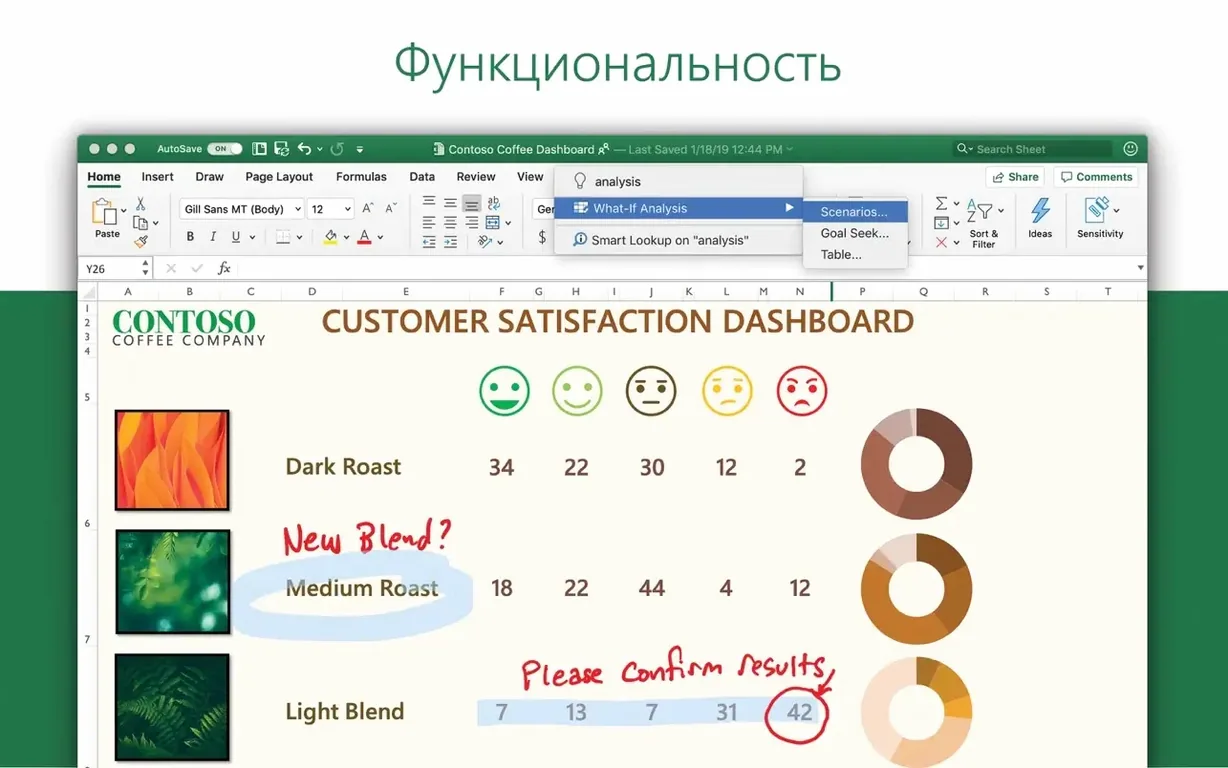
- Make sense of the numbers. New charts are built right in, and the Ideas feature scans your data to suggest trends and visualizations you might not spot on your own.
The interface speaks your language, too, with over twenty options including Spanish, French, Japanese, and Russian. It's a comfortable fit for anyone moving between spreadsheet tools who wants more visual heft.
How Excel Stands Next to Numbers and LibreOffice Calc
Anyone who keeps a few spreadsheet apps on their dock knows they don't all think the same way. Apple Numbers opens with a blank canvas that wants you to arrange tables and charts like furniture in a room — beautiful for a one-page budget or a quick invoice, less so when you need to chain formulas across a dozen sheets. Microsoft Excel nudges you toward structure from the first cell, and the 16.93 build leans into that with chart types and trend suggestions that Numbers simply does not offer. Where Numbers treats a chart as a design element you place by hand, Excel treats it as something the data itself can recommend.
LibreOffice Calc is the closer cousin. It handles complex workbooks, supports pivot tables, and feels familiar to anyone who used Excel a decade ago. The gap shows in the polish. Calc runs on macOS but carries a slight lag when you scroll through a dense sheet or resize a chart, and its interface still draws from an older toolkit. Excel 16.93 feels native on a MacBook Pro's high-DPI display — scrolling is fluid, the ribbon adapts to window size, and the Ideas panel generates visual summaries without you hunting through menus. If your work involves sharing files with colleagues on Windows machines, Excel keeps formatting and formula compatibility tighter than Calc manages. But if you collaborate with someone who refuses to touch anything Microsoft, Calc opens and saves .xlsx files reliably enough for occasional exchanges.
Pin the Ribbon Before Your First Real Workbook
A big application like Excel rewards a few early setup choices. Here are things I wish I had done on day one, not week three.
- Pin the ribbon to your liking. The default ribbon tab layout covers common tasks, but the Data and Formulas tabs are where you live once you move past basic lists. Right-click the ribbon area, choose Customize the Ribbon, and drag those tabs left so they sit closer to Home. It saves a surprising number of clicks.
- Set your default font and sheet view. Excel on Mac still ships with a font that feels slightly large. Open a blank workbook, set the font and size you prefer under Excel > Preferences > General, then save the file as a template named Book.xltx in your startup folder. New workbooks inherit those choices without ceremony.
- Learn the two shortcuts that matter most.
Control + Option + Vopens Paste Special without the mouse.F2(orControl + Uif your Mac function keys are tied to brightness) enters cell-editing mode without double-clicking. Master those and your speed doubles in the first week. - Give Ideas a proper data set. The Ideas feature works best when your data has clear headers and no blank rows breaking the range. Highlight your table, press
Command + Tto format it as a proper Excel table, then click the Ideas button. The suggestions become sharper when the app understands where your columns start and end. - Turn off automatic calculations once. If you work with a workbook that has thousands of formulas, switch to manual calculation under Formulas > Calculation Options. Your Mac stops recalculating every time you adjust a single value, and you press
Command + Equalswhen you are ready.
Payroll Across Three Crews, Tracked Every Morning
Consider someone like Lena, who runs the books for a landscaping company with three crews and a long list of supply vendors. She opens Excel 16.93 on a MacBook Air each morning and starts with a workbook that tracks payroll hours, fuel receipts, and mulch deliveries across separate sheets. Her first task is updating the hours from the crew leads' text messages. She types the numbers into a table she formatted as a proper Excel table months ago, so the formulas in the summary sheet pull the totals automatically — no range adjustments needed.
Next she opens the fuel sheet, selects the last two months of entries, and clicks Ideas. The panel shows her a trend line she had not plotted herself: fuel costs are spiking on Thursdays, which happens to be the day one crew drives farther for a recurring job. She highlights the insight, inserts the suggested chart into a new sheet, and forwards it to the owner before the morning meeting ends. By the time she switches to a vendor invoice, she is using Control + Option + V to paste the delivery quantities as values only, stripping the formatting she copied from an email. The whole session stays inside one window, no web browser tab open to a cloud alternative. For Lena, that matters because the internet at the yard's trailer office is spotty, and Excel 16.93 works the same whether Wi-Fi is available or not.
Old Windows Macros May Stay Silent on Mac
Will my old .xls files from a Windows PC open correctly here? They will, with the usual caveat. Excel 16.93 opens legacy .xls workbooks without complaint, though some macros written for Windows versions of Excel may not run on macOS because the underlying automation frameworks differ. For standard formulas, formatting, and charts, the translation is clean. If you have a workbook full of VBA scripts that control inventory systems, test one before migrating everything. Most people opening straightforward financial models or grade books will notice no difference.
Does this build work without a Microsoft 365 subscription? The Office LTSC Standard for Mac 2024 package, which includes this version of Excel, operates under a volume licensing model rather than a subscription. It does not require signing into a Microsoft 365 account each month to keep the app running, though activation is still necessary during setup. Once activated, the core spreadsheet features — formulas, charts, Ideas, and file sharing — are available without an ongoing connection to Microsoft's cloud services.
Can I collaborate with someone using Google Sheets or a newer Excel? Yes, and the friction is minimal. Save your workbook as .xlsx and share it; Google Sheets imports and exports that format reliably. If the other person uses a newer Excel on Windows or the web, the 16.93 file format is compatible. Features exclusive to the very latest Excel releases — some dynamic array formulas and a few newer chart types — might display as static values or fall back to simpler visuals, but the data itself remains intact.
What about language support for a bilingual team? The app includes interface languages from Russian to Japanese, as listed earlier. Changing the display language under System Preferences > Language & Region on your Mac switches Excel's menus and dialogs accordingly. The spell-checker and proofing tools follow the keyboard language you set, so a French-speaking accountant and an English-speaking auditor can share the same Mac and each work in their preferred language without reinstalling anything.
Waterfall and Funnel Charts Arrive in the Gallery
The jump to 16.93 brought two additions that shift how you spend your time inside a workbook. New charts — specifically more options for waterfall, funnel, and map visuals — mean you reach for the chart gallery less often as a starting point and more often as a confirmation. Where earlier builds asked you to build a chart and then tweak it, this version can suggest the chart type after a glance at your data structure. The Ideas feature is the engine behind that: it scans column headers and value patterns, then offers visualizations that fit without you needing to remember which chart works best for a time series versus a parts-to-whole comparison.
Behind the scenes, the native support for both Intel and Apple Silicon architectures continues to pay off in responsiveness. On an M-series Mac, recalculating a sheet with tens of thousands of rows happens without the beachball that older builds occasionally triggered. The scrolling through a dense pivot table feels closer to a native Mac app than it ever did during the transitional years of Office for Mac. If you moved away from Excel for Mac a few versions ago because of sluggish performance, 16.93 is the build that rewards a second look.
Version 16.93 brings a couple of thoughtful additions for anyone who lives in their data.
- A fresh set of charts gives you more ways to present information clearly.
- The Ideas feature helps surface trends and visual patterns you might otherwise miss.
- macOS: 13 or later
- Architecture: Intel and Apple Silicon
Questions I actually get
Does Excel 16.93 work on Apple Silicon Macs?
Yes, it supports both Intel and Apple Silicon architectures natively, with macOS 13 as the minimum system requirement.
What is the Ideas feature in this Excel version?
Ideas analyzes your data to highlight trends and suggest visualizations, helping you build charts without starting from scratch.
Porch talk 0
Come in or pull up a chair to leave a comment.
Nobody has pulled up a chair yet. If you used it on a real Saturday, say what the hour was.