

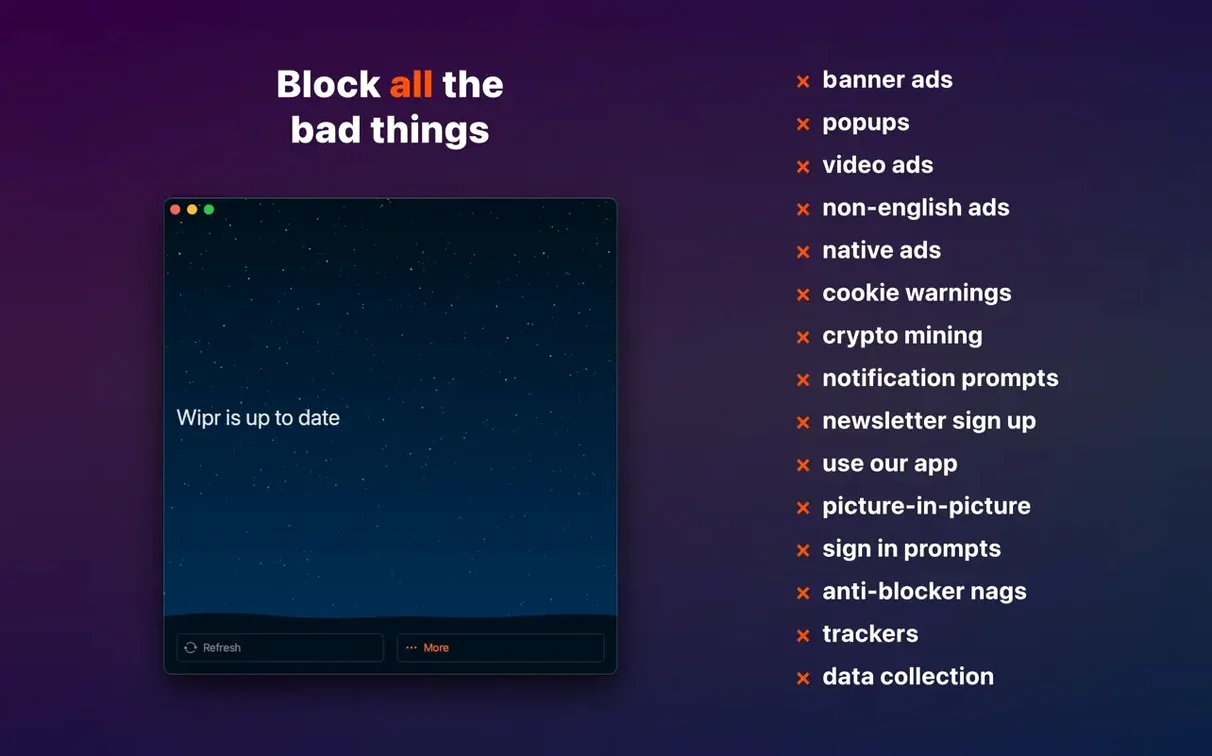
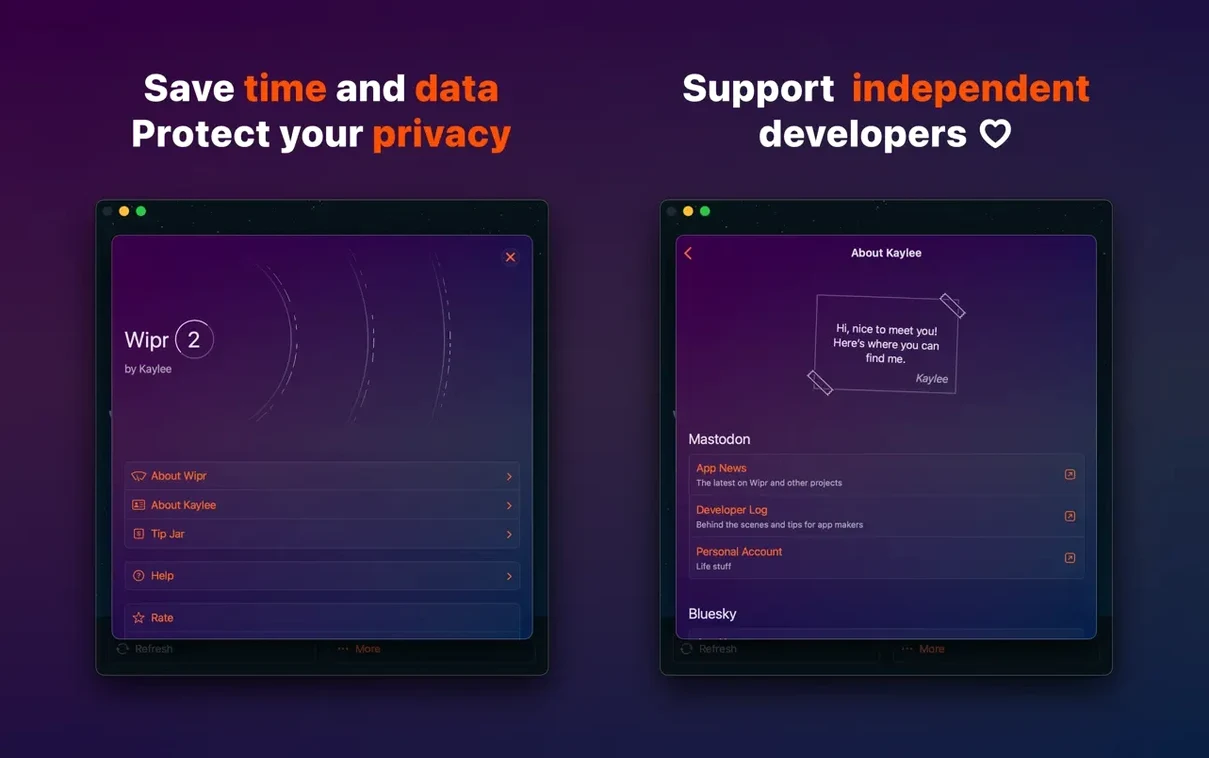
Version 2.38 is a quiet maintenance release that polishes what was already working well. The update lands with a round of accessibility improvements throughout the app and an expansion of Wipr Extra, the on-by-default layer that handles cookie consent banners and other stubborn annoyances, on many more websites. Blocking performance and the zero-configuration design are unchanged, so the app still disappears into Safari and gets out of your way.
- Accessibility improvements across the interface.
- Wipr Extra now tidies up cookie notices and nuisance elements on a broader set of sites.
- Blocks ads, popups, and silent trackers without needing rules lists to fine-tune.
- Universal app that follows you across Apple devices with the same blocking approach.
- Successor to the legacy Wipr, built for current Safari and macOS releases.
The character of Wipr hasn't changed — it's still a set-it-and-forget-it affair. No whitelist management, no “acceptable ads” settings to hunt down. If you felt the old Wipr was starting to show its age under modern Safari, Wipr 2 is the cleaner, current path forward.
Taking Wipr 2 Through a News Binge
Monday morning, coffee in hand, ten browser tabs deep into tech news and a couple of local headlines. That’s a typical start, and it’s also where a content blocker either holds the line or lets the page weight spiral. Here’s how a session looks with Wipr in Safari, no fiddling required.
Open the first article. The page paints almost before your finger lifts from the trackpad. Wipr strips the auto-play video ad and the sidebar tracking pixels silently. You scroll straight into the text. Three more tabs from the same site load with the same clean result — zero cookie consent popups, because Wipr Extra in version 2.38 has already handled them. You notice the reading flow stays uninterrupted. No “accept all” button to hunt for.
Next, a recipe page. These are usually heavy, but the ingredient list and steps appear while the spacer where a mid-content banner would sit simply collapses. The page geometry stays stable; no layout jumps mid-scroll. A tracker-heavy weather site loads last. The radar map animates, and the surrounding ad frames remain empty, just clean white space. The blocking list, refreshed twice a week by the developer, handles patterns that didn’t exist a month ago without you updating anything manually.
End of session: eleven pages read, no manual whitelisting, no “report a broken site” forms filled out. Safari’s memory pressure stays low because the blocked requests never downloaded. That’s the workflow — fire up the browser, read, close tabs. Wipr stays invisible.
Does Wipr Replace Your VPN?
A few questions come up every time someone considers a wipr 2 download. The answers are straightforward, and they reflect how the app actually behaves on a Mac.
Does this replace my VPN or my DNS-level ad blocking? No, and it’s not meant to. Wipr works inside Safari as a content blocker extension. A VPN encrypts your connection and routes traffic; a DNS filter blocks requests at the network level. Wipr stops Safari from even requesting ad and tracker resources, which means less data leaves your machine in the first place. They complement each other. Run all three if you like, but Wipr won’t interfere with either.
Why is the app separate from the old Wipr? Wipr 2 is the successor, built for modern Safari APIs and current macOS releases. The legacy app served well for years, but Apple’s content-blocking architecture changed. The new app uses the latest extension framework, which is why it’s a fresh install rather than an update. If you’re searching wipr 2 free to understand the landscape, know that this version is the actively maintained one with the twice-weekly blocking list updates.
Will it break websites I need for work? Rarely, but it can happen. Wipr doesn’t offer a per-site whitelist in the traditional sense, but Safari’s own per-site extension controls let you disable content blockers for a specific domain with two clicks. If a banking site’s third-party verification script gets caught, you toggle Wipr off for that tab, reload, and move on. The app’s philosophy is that this should be the exception, not a daily routine.
What does “Wipr Extra” actually block? It targets cookie consent banners, newsletter overlays, chat widgets, and similar nag elements that aren’t traditional ads but clutter the page just the same. The 2.38 release expanded its coverage, so more European and North American news sites see those banners vanish without a click.
A Student’s Research Evening
Imagine a graduate student named Amara. She’s halfway through a literature review, bouncing between JSTOR, open-access journals, and a handful of university library portals. Her 2019 Intel MacBook Air spins its fans when too many scripts pile up, so page weight matters.
Amara installs Wipr 2 before the evening session. She doesn’t tweak anything — just enables the extension in Safari’s preferences and opens her first database query. The library portal loads faster than she remembers. No cookie notices interrupt her login flow. A publisher site that usually pelts her with subscription popups stays quiet; the article text renders without a gray overlay asking for her email.
She opens ten papers across six tabs. Safari’s energy impact stays reasonable. By the end of the three-hour session, she hasn’t once closed an ad or clicked “accept cookies.” The blocking happens below her attention. For someone who just needs the browser to stay out of the way while real work happens, that’s the whole point. Amara isn’t thinking about Wipr at all — she’s thinking about her thesis.
Wipr 2.38 tightens up the web-cleaning routine. Alongside interface polish for better accessibility, the Wipr Extra engine has been taught to handle nagging elements on many more sites.
- macOS 10.13 or later
- Runs natively on Intel and Apple Silicon Macs
- Interface languages: English
Porch talk 0
Come in or pull up a chair to leave a comment.
Nobody has pulled up a chair yet. If you used it on a real Saturday, say what the hour was.
More for the same hour
Everything in Mac Apps
 Wirecast Pro
16.5.4 Mac Apps
820 MB
Wirecast Pro
16.5.4 Mac Apps
820 MB

 WinZip Mac Pro
12.0.7282 Mac Apps
36 MB
WinZip Mac Pro
12.0.7282 Mac Apps
36 MB

 Wing Pro
11.1.0.0 Mac Apps
149 MB
Wing Pro
11.1.0.0 Mac Apps
149 MB

 Wondershare Filmora
14.8.17 Mac Apps
924 MB
Wondershare Filmora
14.8.17 Mac Apps
924 MB

 Winclone Pro
10.5 Mac Apps
21 MB
Winclone Pro
10.5 Mac Apps
21 MB

 Wondershare Recoverit
14.0.20.6 Mac Apps
212 MB
Wondershare Recoverit
14.0.20.6 Mac Apps
212 MB

 WidgetWall
3.15.2 Mac Apps
396 MB
WidgetWall
3.15.2 Mac Apps
396 MB

 Wondershare UniConverter
15.7.3.564 Mac Apps
324 MB
Wondershare UniConverter
15.7.3.564 Mac Apps
324 MB