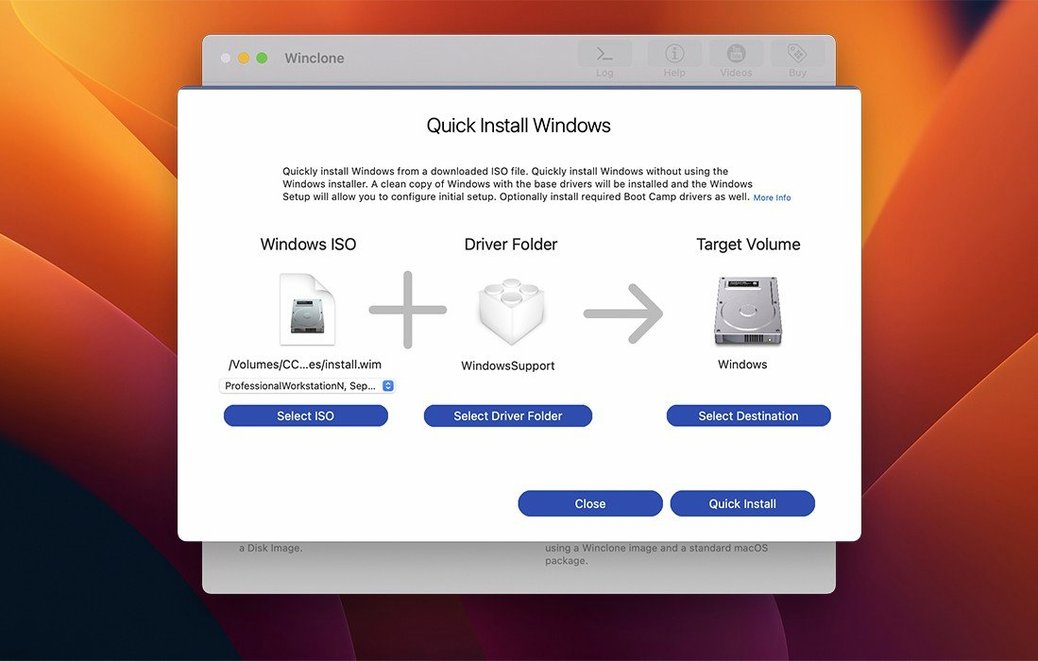
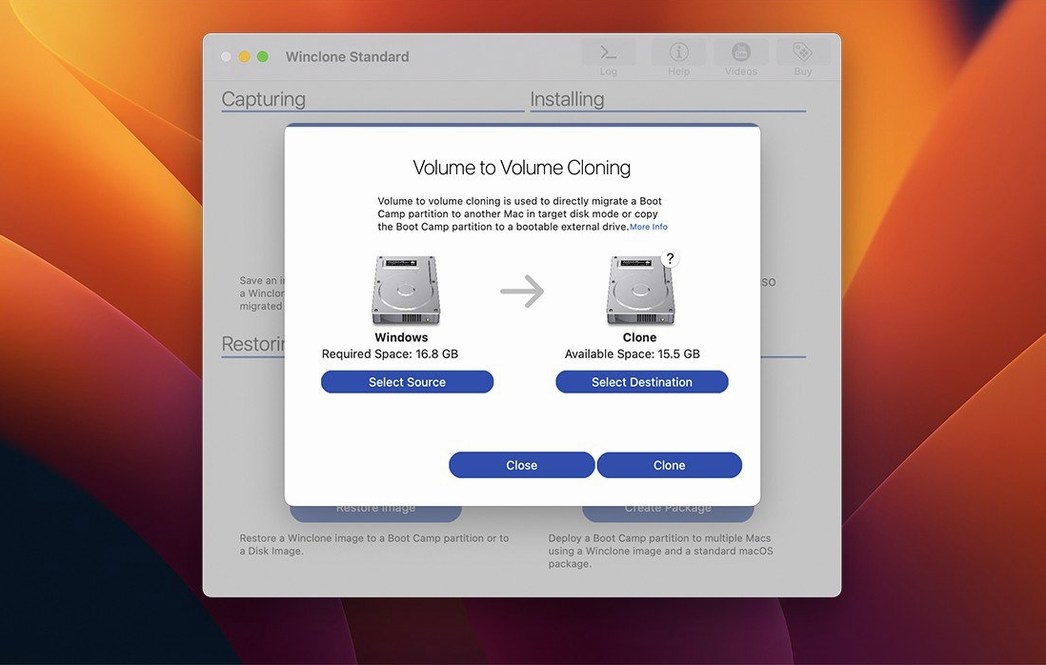
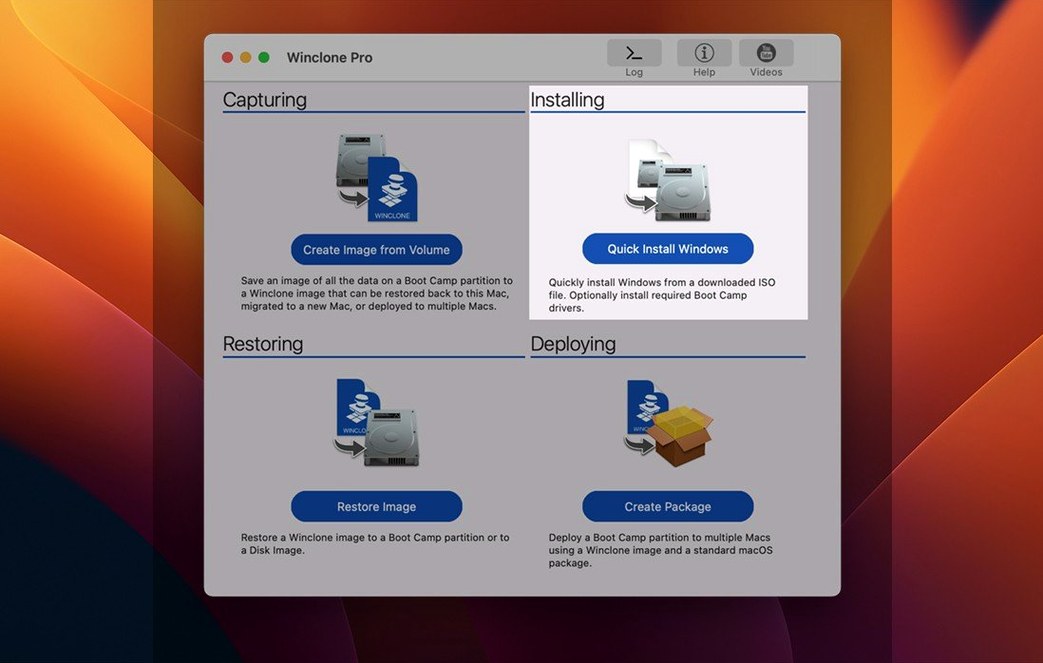
Version 10.5 tidies up OS support and confirms it's ready for macOS Tahoe, keeping the focus on reliable Boot Camp work. If you're just getting started, these are the core concepts to know.
Package deployment — building a master Windows image and pushing it out to multiple Macs, used in school labs and IT rollouts.
Incremental image — a clone that only captures changes since the last backup, saving space and time when you update your Boot Camp partition regularly.
GPT/MBR detection — the app checks for mismatched boot records and reports them, a common headache when Windows won't start after a restore.
EFI bootable — an option for Windows 7 and later that creates a modern boot setup, separate from the legacy BIOS-style installation.
Volume format support — you can restore images to DOS-FAT32, ExFAT, or NTFS volumes, giving you flexibility depending on how the target drive is set up.
Your Boot Camp Partition Survives the Wipe
Most people land on this page with a Boot Camp partition that's grown too big or a Mac that's about to get wiped. They want to know if the Windows side will survive the process. The short answer is yes — that's the whole point — but a few details make the first run smoother.
Can you clone a Boot Camp partition straight to an external USB drive and boot from it? Not directly. The clone is an image file, not a live Windows installation. You store it, then restore it later to an internal partition. If you need a portable Windows drive, you're looking for Windows To Go, which is a different animal.
Do you have to disable SIP every time you use the app? Only once, before installing. After System Integrity Protection is off and the app is in place, you can turn SIP back on and Winclone Pro will keep working. Some folks leave SIP off, but that's a choice, not a requirement.
What about Windows activation? Restoring a clone to the same Mac usually keeps the licence intact because the hardware fingerprint matches. Moving the image to a different Mac is a different story — Microsoft will likely flag the hardware change and ask for reactivation. That's on Microsoft's end, not something Winclone can smooth over.
If you've been searching around for a winclone 10 license key or ran across a winclone torrent in a forum thread, you already know the Pro edition isn't a casual download. The TNT team handled the activation side for this build, so once it's installed, you're not wrestling with nag screens or time limits.
Restore-Finished Alerts So You Can Walk Away
The sound notification after a restore finishes is one of those features you don't think about until you need it. A big clone can take twenty minutes or more, and you're probably doing something else while it runs. A quiet chime lets you know it's done without babysitting the progress bar.
Right-clicking on a saved image in the sidebar gives you a quick path to verify its integrity. Handy when the file has been sitting on a network drive for six months and you want to check it before committing to a restore that might fail halfway through.
The incremental imaging checkbox isn't hidden, but the logic behind it is easy to miss: it compares the current Boot Camp state against the last full image you made, not against the last incremental. That means your chain of incrementals all depend on one base image. If that base file gets corrupted or deleted, the incrementals are useless. Keep the base somewhere safe.
Dragging the partition size slider during a restore isn't just for shrinking — you can expand the file system too, provided the target drive has room. If your Windows side is bursting at 60 GB and you've got a 120 GB partition waiting, the slider handles the resize automatically instead of making you mess with Windows disk tools afterward.
Deploy Master Images via MDT and SCCM
Winclone Pro doesn't live in a vacuum. If you're deploying packages to a lab, it plays nicely with MDT and SCCM workflows — build your master image once on a Mac, capture it with Winclone, then push it out through your existing Microsoft deployment pipeline. The package installer it creates slots right into those tools without extra conversion steps.
On a single Mac, it pairs well with Disk Utility. Before you clone, run First Aid on the Boot Camp volume to catch file system errors early. A clean source means fewer headaches during restore. Some users run a quick chkdsk inside Windows beforehand for the same reason.
Network storage support means you can save images directly to a NAS or a shared folder, which matters if your MacBook has limited internal space. Just be aware that restoring over Wi-Fi is slow enough to test your patience — wired Ethernet cuts the time dramatically, especially with images north of 40 GB.
If you're on a forum hunting for a winclone crack or a winclone cracked build, you've probably already noticed that version 10.5 surfaced quickly after the Tahoe compatibility update dropped. The activation here is baked in, so once you've followed the install steps — mount the image, run the Terminal command to bypass Gatekeeper, drag the app into Applications — you're set. No separate key generator, no patching script to run afterward.
Winclone Pro 10.5 brings updated OS requirements into focus and adds verified compatibility with macOS Tahoe.
- macOS 10.15 or later
- Intel-based Mac
Questions I actually get
Does Winclone Pro show progress during a clone?
Yes, it displays a progress estimate and a completion percentage, and you can set a sound notification for when an operation succeeds or fails.
What's the difference between Winclone and Winclone Pro?
Winclone Pro is aimed at business and education environments and adds package deployment, MDT, and SCCM support, while the standard Winclone edition covers personal Boot Camp cloning and migration.
Porch talk 0
Come in or pull up a chair to leave a comment.
Nobody has pulled up a chair yet. If you used it on a real Saturday, say what the hour was.