
Before you hunt down a Termius crack Mac download, the first thing to check is whether your machine can run it natively. The official desktop app asks for macOS 10.13 (High Sierra) or later, and runs on both Intel and Apple Silicon Macs. If you’re sitting on an older version of the operating system, you’ll be out of luck without a system update.
| Key detail | Value |
|---|---|
| macOS requirement | 10.13 or later |
| Architecture | Intel and Apple Silicon |
| Interface language | English |
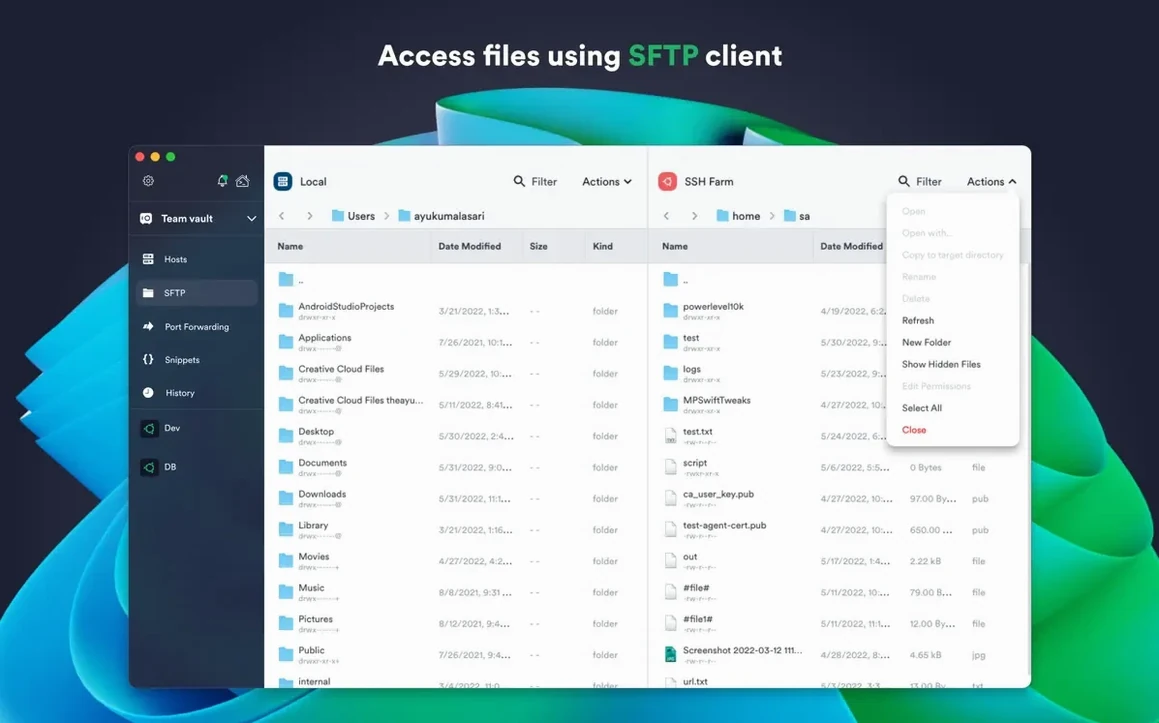
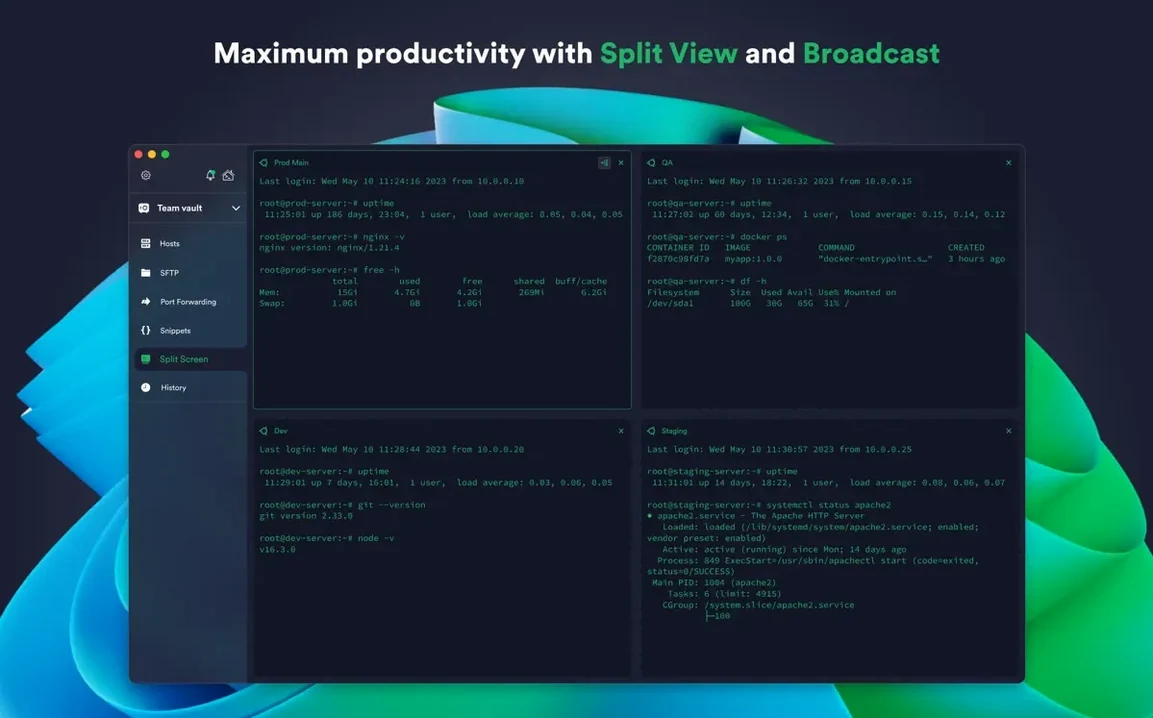
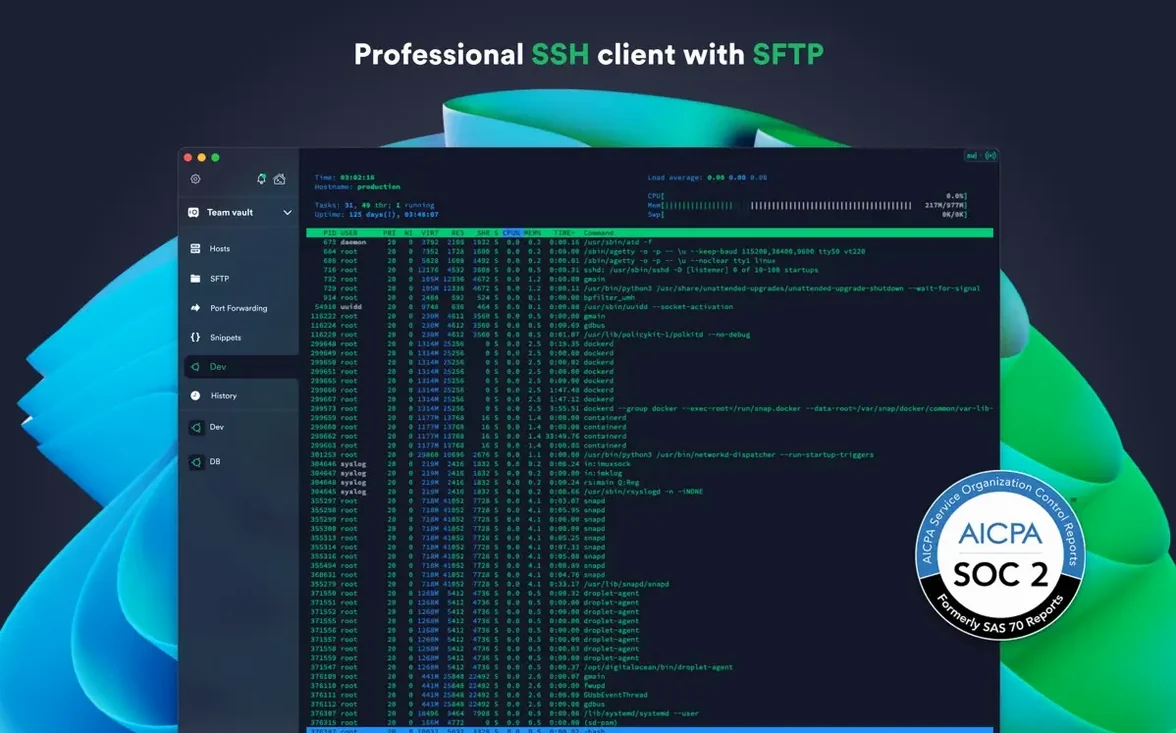
Once you’re past the compatibility gate, what you’re getting is a modern SSH client with SFTP support that syncs across macOS, Windows, Linux, iOS, and Android. It integrates directly with AWS and DigitalOcean, so your droplet and EC2 instances appear without manual setup. For security, the app supports ECDSA and ed25519 keys, the chacha20-poly1305 cipher, and hardware-key authentication through FIDO2. You can lock saved credentials behind Touch ID on a MacBook, assign per-connection terminal themes and fonts, and set custom environment variables. A shared command history keeps your terminal actions visible across sessions.
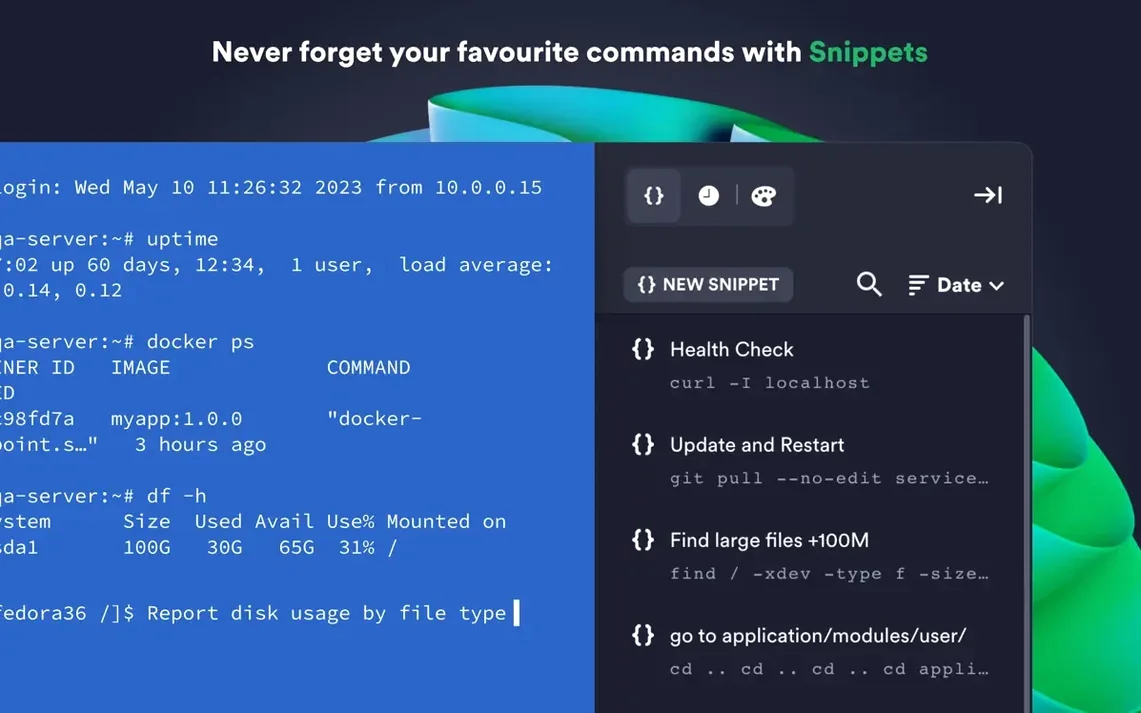
Spend a morning inside Termius and you start collecting tiny moments that add up. Right-click a host in the sidebar and there’s an option to copy its SSH string directly to the clipboard — handy when you need to share a connection with a teammate over chat without fishing through a config file. The snippets panel accepts not just single lines but short shell scripts, and you can assign a label and a keyboard shortcut to each one. I’ve watched a sysadmin friend keep a snippet called “nginx-reload” bound to Cmd-Option-N, and it fires across whichever host is in the active tab. Little things like that disappear into muscle memory.
A few conveniences that are easy to overlook:
- Saved host search: The sidebar search field matches against host names, IP addresses, and even tags. Once you’ve tagged hosts by datacenter or environment, typing “prod-db” pulls up exactly the right box.
- Quick SFTP toggle: With an SSH session open,
Cmd-Shift-Fswitches you straight into the SFTP panel for that host. No reconnecting, no separate credentials prompt. - Environment variables per host: Under a host’s settings, the “Environment” tab lets you inject variables that only exist for that connection. Useful when a script expects
DEPLOY_STAGE=stagingon certain boxes. - Proxy and jump-server chains: The connection flow supports specifying a proxy or a jump host, and the app chains them without extra configuration in your
~/.ssh/config. If you bounce through a bastion to reach production, you set it once in the GUI and forget it. - Font smoothing and cursor shape: Each terminal theme stores its own font choice, line spacing, and cursor style (block, underline, or beam). You can give your database boxes a taller line height and a bold cursor so you never mix up a dev shell with a production one.
A short day with a freelance DevOps engineer
Imagine a freelancer who splits her week between two clients. Client A runs everything on AWS in the Sydney region. Client B is on DigitalOcean droplets in Frankfurt. On Monday morning she opens Termius, and the sidebar already shows both groups — AWS instances pulled in automatically, DigitalOcean droplets synced from a previous setup. She taps the “Client A — Bastion” entry, which chains through a jump host, and the session lands her inside the Sydney VPC. The SFTP panel is one keystroke away because she needs to drop a revised docker-compose.yml onto the staging orchestrator. By 10 a.m. she has cycled through five hosts, three snippets, and a shared-command-history entry that reminds her exactly which kubectl command she ran on which pod. Nothing required opening a separate key manager or re-typing a long connection string. The encrypted cloud sync means her MacBook and the Windows machine at Client B’s office share the same host list and credentials, so she never has to rebuild her setup from scratch on a borrowed desk.
Graphical Host Sidebar Over Raw SSH Configs
Compared with the built-in Terminal app and a hand-tuned ~/.ssh/config, Termius trades raw minimalism for a graphical organizer. The built-in Terminal costs nothing, supports AppleScript, and launches in a fraction of a second, but it has no host sidebar, no snippet library, and no cross-device sync. Termius wraps those conveniences around the same shell you already use, so you keep your zsh or bash environment intact while gaining visual session management.
Next to Royal TSX, the difference comes down to breadth versus depth. Royal TSX connects to SSH, RDP, VNC, and a handful of web-based management consoles, making it a swiss-army tool for Windows-heavy shops. Termius stays narrower — it focuses on SSH, Mosh, Telnet, and serial connections — but its cross-platform sync and mobile apps feel more polished for someone who lives in terminals across macOS, iOS, and Android. If you need RDP, Royal TSX earns its place. If your world is Linux shells and cloud instances, Termius fits with less visual clutter.
Tabby (formerly Terminus) takes a different approach: it’s open source, plugin-friendly, and runs inside Electron. Tabby gives you a configurable layout and a plug-in system that can surface Docker containers or a quick system monitor. Termius feels more cohesive out of the box — the snippets, host tagging, and cloud sync form a single workflow rather than a collection of plug-in parts. Tabby appeals to tinkerers who enjoy customizing their terminal shell; Termius appeals to people who want a ready-made cockpit for their remote hosts.
Beachballs Fade After Sleep-Wake Resumes
Version 9.35.4 calls out “stability improvements,” and from a week of observation that translates to fewer beachballs when waking the app from sleep with a dozen open tabs. Earlier 9.x releases tightened the host-tagging interface and smoothed the FIDO2 authentication flow, so tapping a hardware key mid-session doesn’t stall the terminal. A quiet but important change is the shift toward consistent rendering on Apple Silicon: earlier builds occasionally drew blocky fonts on scaled external displays, and recent updates have settled that down. The snippets engine got a behind-the-scenes rewrite in recent months, too — long scripts that used to lag when dropped into the panel now paste instantly. If you skipped the 9.2 and 9.3 releases, the accumulated effect is an app that starts faster, keeps SSH tunnels alive more reliably across sleep cycles, and doesn’t prompt you to re-authenticate sync as often. None of these are bullet-point blockbusters, but together they remove the small frictions that once made a Termius torrent or an older build that “felt lighter” an appealing path to explore. The current version simply gets out of the way more cleanly.
- macOS 10.13 or later
- Intel or Apple Silicon Mac
- English language interface
Questions I actually get
What security features does Termius offer on a Mac?
The app supports Touch ID for protecting stored credentials locally, plus ECDSA and ed25519 keys, the chacha20-poly1305 cipher, FIDO2 hardware-key authentication, and two-factor authentication for your account.
Porch talk 0
Come in or pull up a chair to leave a comment.
Nobody has pulled up a chair yet. If you used it on a real Saturday, say what the hour was.