

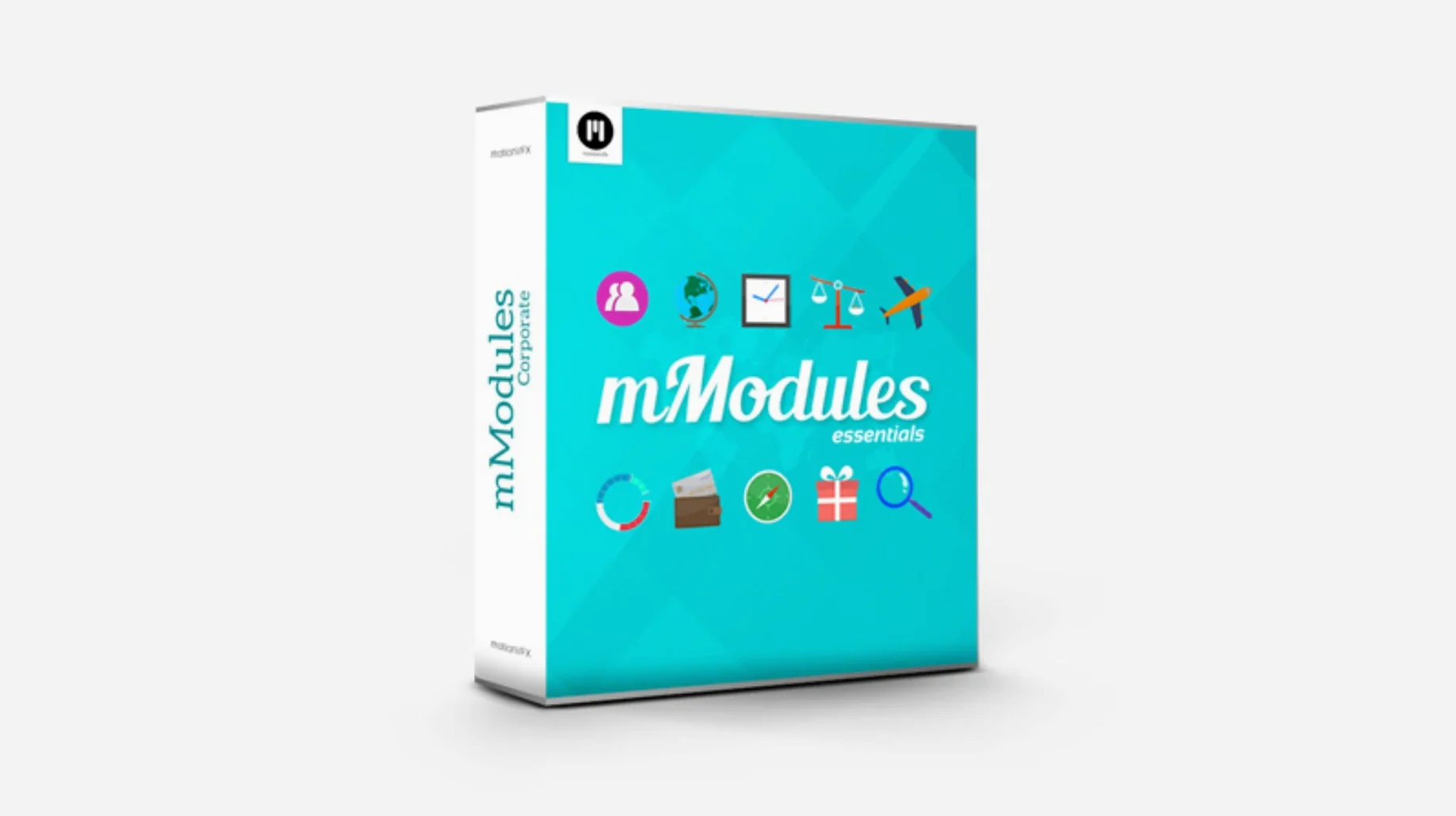
mModules is a plugin that delivers 60 ready-made elements straight into Final Cut Pro X.
Set up the templates
Unpack the archive and move the folder into /Users/Your User Name/Movies/Motion Templates/Titles. Once they're in place, the elements show up inside Final Cut Pro without any extra activation.
Find them in your browser
The pack appears under the motionVFX category in both the Titles Browser and the Generators Browser, so you can grab a lower-third or a background graphic from the same familiar spot.
Work with the sound
Because the elements are native Final Cut Pro templates, any audio clips you layer underneath them stay fully editable on the timeline—there's no baked-in soundtrack to fight with.
A quiet editing session: building a product teaser from scratch
Picture a Saturday morning with a half-empty coffee mug and a handful of clips that need to become a 30-second teaser for a local coffee roaster. The footage is already in the timeline — close-ups of espresso pulls, a few wide shots of the roasting drum, a couple of slow-pan B-roll clips of the shop interior. What's missing is the polish: clean lower-thirds for the roaster's name, a subtle logo reveal, and some geometric accents to tie the cuts together.
Open the Titles Browser and scroll to the motionVFX category. Grab a split-screen lower-third that places the shop name on the left and holds a thin animated line underneath it. Drop it onto the first clip of the barista pulling a shot. The template snaps into place with its build-in animation already timed — no keyframes to nudge. Drag the ends to match the length of the clip, and the animation scales with the duration.
Next, switch to the Generators Browser under the same motionVFX category. Pull in a subtle particle drift element and layer it above the roasting-drum footage. Lower the opacity to around 40 percent so the motion stays visible without distracting from the beans tumbling in the drum. Because the element lives as a generator, it covers the full frame and lets the video underneath breathe through it.
The logo reveal comes from a circular burst template — one of the 60 elements in the pack. Place it at the 22-second mark, right where the music hits a brief rest, and the shop's round logo appears inside the burst's expanding ring. Adjust the scale in the inspector to match the logo's dimensions, and the whole moment feels intentional without touching Motion or After Effects.
Throughout the edit, the timeline stays clean. No compound clips to unpack, no nested sequences to chase down. Every element behaves like a native title or generator, so trimming a clip or slipping an edit point doesn't break anything. The audio track — a warm acoustic guitar bed — runs uninterrupted underneath the graphics, and ducking the music under a voiceover takes the usual keyframe adjustments in the timeline, with the templates staying completely transparent to the audio routing.
By the time the coffee's cold, the teaser is rendered and ready for a quick client preview.
How mModules sits alongside other motionVFX packs
Anyone browsing motionVFX templates for Final Cut Pro will notice the catalog splits into distinct lanes. mModules holds 60 general-purpose elements — lower-thirds, backgrounds, transitions, and small accent animations — while something like mTitle Simple Pack narrows the focus to clean, typography-forward title treatments. The Simple Pack's titles lean toward corporate explainer videos and interview-driven pieces, where the text is the star and the motion stays understated. mModules gives you broader visual variety: a glitch overlay, a light-leak burst, a geometric shape build. If the Simple Pack is a well-tailored shirt, mModules is a drawer full of accessories you can pair with almost anything.
Then there's mTransition Bundle, which is exactly what the name suggests — a collection of wipes, zooms, and distortion-based transitions. Those are designed for moving between clips, not for layering over them. mModules overlaps here a little, since a few of its elements work as transitional moments when placed across a cut, but the Transition Bundle goes deeper into edge-to-edge frame transitions with complex motion blur and chromatic displacement. Editors who already own the Transition Bundle might still grab mModules for the static overlays and lower-thirds that the transition pack doesn't cover.
Compared with mFilm, the difference sharpens further. mFilm simulates film stocks, grain patterns, and color treatments — it's a texturizing and grading toolkit. mModules doesn't touch color or grain at all. It's purely graphical: shapes, text layouts, motion accents. The two packs complement each other well. Apply a Kodak-style grain and a slight teal-and-orange wash from mFilm, then overlay a subtle dust-element generator from mModules, and the footage picks up a tactile, lived-in feel that neither pack could deliver alone.
How the workflow fits with other apps and macOS features
The folder-based installation — dropping the unpacked contents straight into ~/Movies/Motion Templates/Titles — means mModules integrates with a few macOS corners that editors often overlook.
Start with Finder tags. Before unpacking the archive, tag the downloaded folder with something like "FCP Templates" or "motionVFX." After the files move into the Motion Templates directory, the original tagged folder stays searchable. Months later, when you're wondering whether you still have a particular element installed, a quick Spotlight search for the tag pulls up the source folder, and from there you can check the contents against what appears in the Titles Browser. No launching Final Cut Pro just to confirm an installation.
Time Machine backups are another quiet benefit. The Motion Templates folder sits inside the user's Movies directory, which Time Machine covers by default on most Macs. If a macOS update or a manual cleanup accidentally removes the motionVFX category from the browser, restoring the folder from a Time Machine snapshot taken the week before brings everything back without re-downloading or re-unpacking anything. The templates don't rely on a license file or an activation server, so the restored files work immediately.
For editors who also use Apple Motion, the templates open as Motion projects, which means you can inspect how a particular element was built or tweak its parameters beyond what the Final Cut Pro inspector exposes. Drop the template into Motion, adjust the timing curve on a shape's build-out, save it back to the same folder, and the change appears inside Final Cut Pro on the next launch. It's not a required step — the 60 elements work straight out of the folder — but having the door open to Motion turns mModules from a static pack into a starting point for custom graphics.
Compressor and HandBrake work naturally with projects that use these templates, because the elements render as part of the Final Cut Pro timeline. No third-party rendering engine, no separate export pass. Send the project to Compressor for a ProRes master, or drop the exported file into HandBrake for a compact H.265 delivery, and the graphics bake in cleanly without any plugin-related export errors.
License Friction Vanished
Over the updates that brought mModules to its current state, the most noticeable shift in everyday use was the removal of any activation step. Early motionVFX products sometimes required a separate license manager or an online check-in, but the pack now installs by simply moving files into the Motion Templates folder. For editors who jump between a desktop Mac and a MacBook Pro, that change alone removes the friction of deactivating and reactivating plugins when switching machines. Copy the folder to the laptop's matching directory, and the templates appear in the browser on the next launch.
The category placement inside Final Cut Pro also consolidated over time. Instead of scattering elements between the Titles and Generators browsers in a way that required hunting, the motionVFX category now appears consistently in both locations, with the appropriate elements surfacing in each. Generators sit under Generators, titles under Titles. The predictability helps when you're working fast and just want to reach for a lower-third without scrolling past background elements that don't belong in that browser.
Performance improvements arrived quietly, mostly around how Final Cut Pro caches template thumbnails. Older builds could stall the browser for a few seconds while the previews populated; the current version draws the thumbnails quickly, even on machines with large template libraries. On an Intel Mac running a busy timeline, the difference between waiting for a thumbnail grid to fill in and having it ready before the mouse reaches the panel is tangible.
The template parameters exposed in the Final Cut Pro inspector also became more consistent. Earlier releases sometimes hid a font choice or a scale slider inside a nested dropdown; now the most commonly adjusted controls — text, size, color, opacity — sit at the top level of the inspector panel. Less clicking, less scrolling, fewer interruptions to the editing rhythm. For a pack of 60 elements that touches so many different graphic styles, that kind of interface consistency makes the whole collection feel like a single tool rather than a grab bag.
- macOS version and architecture not specified by the developer
- Requires Final Cut Pro X
Questions I actually get
Where do mModules templates appear in Final Cut Pro?
They appear under the motionVFX category in both the Titles Browser and the Generators Browser.
What is the install path for the templates?
After unpacking, move the contents to /Users/Your User Name/Movies/Motion Templates/Titles.
Porch talk 0
Come in or pull up a chair to leave a comment.
Nobody has pulled up a chair yet. If you used it on a real Saturday, say what the hour was.
More for the same hour
Everything in Mac Apps MotionVFX - mLowers Universal for FCP
Mac Apps
71 MB
MotionVFX - mLowers Universal for FCP
Mac Apps
71 MB
 Motionvfx - mTitle Cinematic
Mac Apps
5 MB
Motionvfx - mTitle Cinematic
Mac Apps
5 MB
 MotionVFX mKBHD
Mac Apps
12 MB
MotionVFX mKBHD
Mac Apps
12 MB

 Mountain Duck
5.3.2 Mac Apps
187 MB
Mountain Duck
5.3.2 Mac Apps
187 MB
 MotionVFX mInfographics
Mac Apps
8 MB
MotionVFX mInfographics
Mac Apps
8 MB

 MouseBoost Pro
5.2.8 Mac Apps
Updated 17 MB
MouseBoost Pro
5.2.8 Mac Apps
Updated 17 MB

 Movavi Screen Recorder
23.1.1 Mac Apps
110 MB
Movavi Screen Recorder
23.1.1 Mac Apps
110 MB

 Motion
6.3 Mac Apps
2.6 GB
Motion
6.3 Mac Apps
2.6 GB