
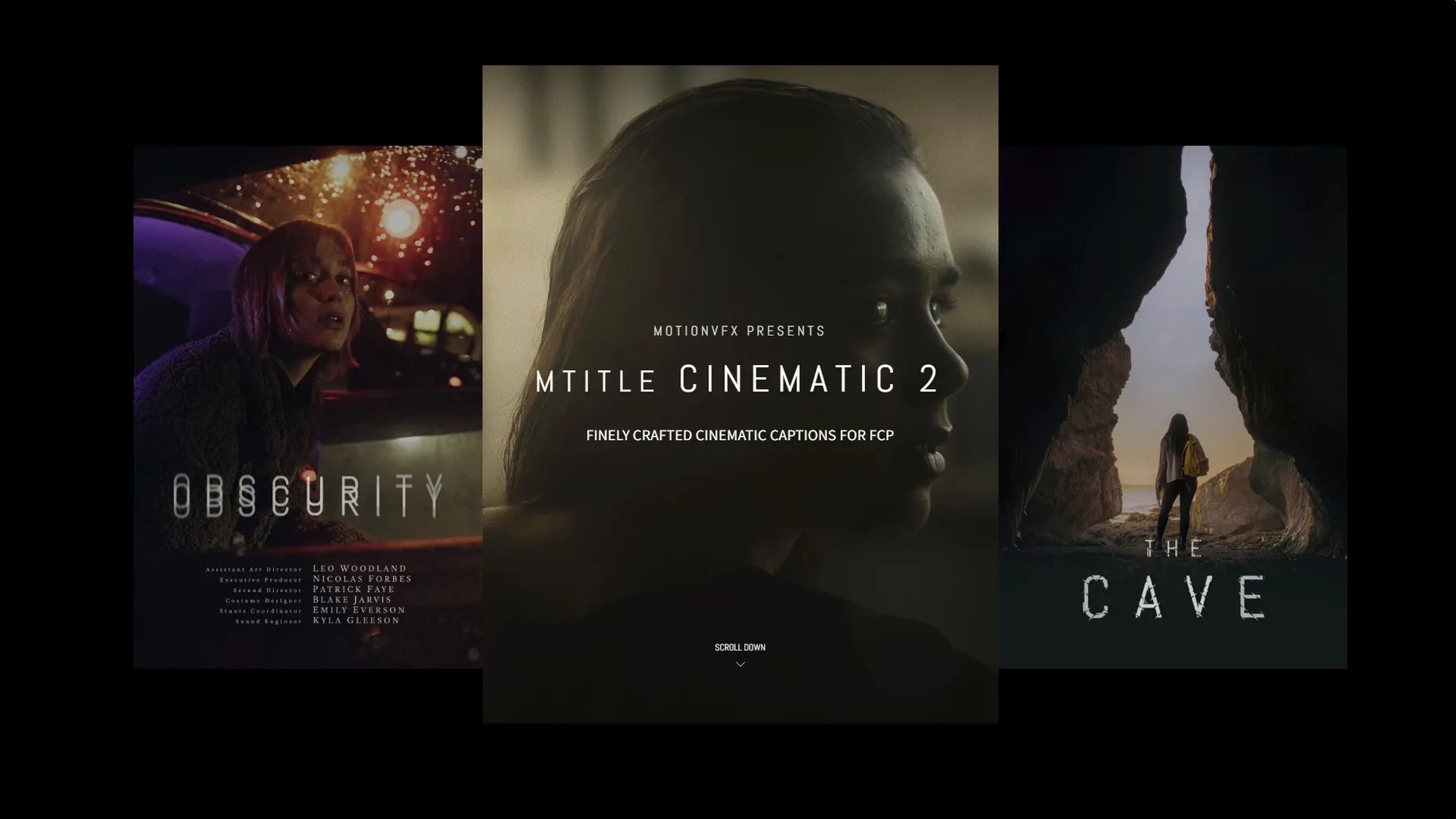
If you've spent time in Final Cut Pro's built-in title browser, you know the look — clean and capable, but rarely the moody, wide-frame feel of a film trailer. mTitle Cinematic picks up exactly where those stock options leave off.
mTitle Cinematic — a set of 50 captions built for a horizontal aspect ratio, delivered as a Final Cut Pro title plug-in.
Host — Final Cut Pro 10.4.6 or Motion 5.4.3.
Style — cinematic; the kind of slow, deliberate typography that sits comfortably over establishing shots and drone footage.
Count — 50 captions in the package, each leaning into that wide-screen language.
The titles don't bring their own soundtrack, but their pacing and weight suggest a score — they're designed to feel like picture lock, not an afterthought. Drop one over a quiet landscape or a slow push-in and the scene immediately carries more tension.
When Templates Show Up as Blank or Missing
Dragging a title onto the timeline only to see a blank screen or a red "Missing Plugin" warning is the kind of thing that stops an evening cold. It usually comes down to where the templates landed on your drive.
The folder structure matters more than you'd think. mTitle Cinematic expects its files inside /Users/username/Movies/Motion Templates/Titles — not a subfolder you created, not the system library, not an external drive Final Cut Pro hasn't indexed yet. If the titles don't appear in the browser, quit Final Cut Pro, check that the mTitle Cinematic folder sits directly inside the Titles directory, then relaunch. Nine times out of ten, that's the fix.
Another headache: titles that play back choppy on a machine that handles 4K footage without flinching. These are animated captions with easing curves and layered motion — they lean on the GPU differently than a simple crossfade. If you spot stuttering, toggle the viewer quality to Better Performance while you block out your edit, then switch back to Better Quality before you export. And keep an eye on the timeline: stacking a cinematic title over a clip that's already got a color grade and a stabilization pass can add up fast.
Font substitutions sneak in too. A few titles in the pack ship with typefaces that might not live on your system. If the text looks off — tighter tracking, a different weight — open the title in Motion 5.4.3, identify the missing font, and either install it or swap in something close. The animation holds; only the letterforms change.
Resist the Urge to Overload Every Clip
Throwing a flashy opener onto every clip is the first instinct, and it's the fastest way to make a project feel like a showreel instead of a story. mTitle Cinematic was built for restraint. A single title card over a wide establishing shot does more work than three scattered across a thirty-second sequence.
Another trap: ignoring safe zones. The pack's horizontal design assumes a wide frame, but if you're delivering for a platform that crops to 4:3 or adds pillarboxing on mobile, text can get clipped. Turn on Final Cut Pro's Title Safe overlay before you lock your edit and nudge any caption that creeps too close to the edge.
Beginners also tend to shorten the title's default duration without adjusting the animation curves. A five-second opener squeezed into two seconds looks rushed, not punchy. If you need a faster reveal, slice the clip, then open the title in Motion and trim the in-point of the animation — don't just drag the edge in the timeline and hope the easing holds up.
And a small thing that trips up newcomers: duplicating a title in the browser instead of copying it on the timeline. The plugin reads parameters from the template file, so if you tweak text in one instance and then drag in a fresh copy expecting it to match, you'll be resetting every setting from scratch. Copy and paste the title you already customized instead.
Building a Cold Open with Just Two Cards
Picture a short film opening — drone shot pushing over pine trees at dawn, no dialogue, just the hum of wind and a low synth swell. You want two text elements: a location card and a restrained title card, both from the mTitle Cinematic pack.
Start with the establishing shot on the primary storyline. Browse to the Titles browser, find a wide-bottom caption that leaves the upper two-thirds of the frame untouched, and drop it above the clip. Type the location — say, NORTH CASCADES, 1978 — and set the font weight to something thin enough that it doesn't fight the treeline. Pull the opacity down to 85%; you want the text to feel like it's printed on the air, not pasted on the lens.
Now drag the playhead to two seconds before the location card fades out. Place a second title — something centered and slower to animate — on a higher track. This one carries the film's name. Let the animation breathe across six seconds. While the first title was about setting a place, this one sets a mood, so resist the urge to add a drop shadow or a stroke. The pack's built-in motion already carries the weight.
Play it back from the top. If the transition between the two titles feels abrupt, add a one-second crossfade on the location card's tail and let the film title fade up underneath it. The overlap keeps the viewer anchored while the information shifts from geography to story.
Export a short test clip before you commit to the full timeline. Watch it on a phone screen, not just your editing monitor. If the second title's tracking feels too wide for a small display, pull it back a few points. The mtitle cinematic aesthetic holds up best when the typography scales gracefully — wide, but never cramped.
- macOS 10.14.4 or later
- Final Cut Pro 10.4.6 or Motion 5.4.3
Questions I actually get
Does mTitle Cinematic work with DaVinci Resolve?
No, it's built specifically for Final Cut Pro and Motion. The files install as Motion Templates that only those hosts recognize.
Porch talk 0
Come in or pull up a chair to leave a comment.
Nobody has pulled up a chair yet. If you used it on a real Saturday, say what the hour was.
More for the same hour
Everything in Mac Apps MotionVFX mModules
Mac Apps
5 MB
MotionVFX mModules
Mac Apps
5 MB

 Mountain Duck
5.3.2 Mac Apps
187 MB
Mountain Duck
5.3.2 Mac Apps
187 MB
 MotionVFX - mLowers Universal for FCP
Mac Apps
71 MB
MotionVFX - mLowers Universal for FCP
Mac Apps
71 MB

 MouseBoost Pro
5.2.8 Mac Apps
Updated 17 MB
MouseBoost Pro
5.2.8 Mac Apps
Updated 17 MB
 MotionVFX mKBHD
Mac Apps
12 MB
MotionVFX mKBHD
Mac Apps
12 MB
 Movavi Screen Recorder
23.1.1 Mac Apps
110 MB
Movavi Screen Recorder
23.1.1 Mac Apps
110 MB
 MotionVFX mInfographics
Mac Apps
8 MB
MotionVFX mInfographics
Mac Apps
8 MB

 Movavi Video Converter
22.5.0 Mac Apps
79 MB
Movavi Video Converter
22.5.0 Mac Apps
79 MB