

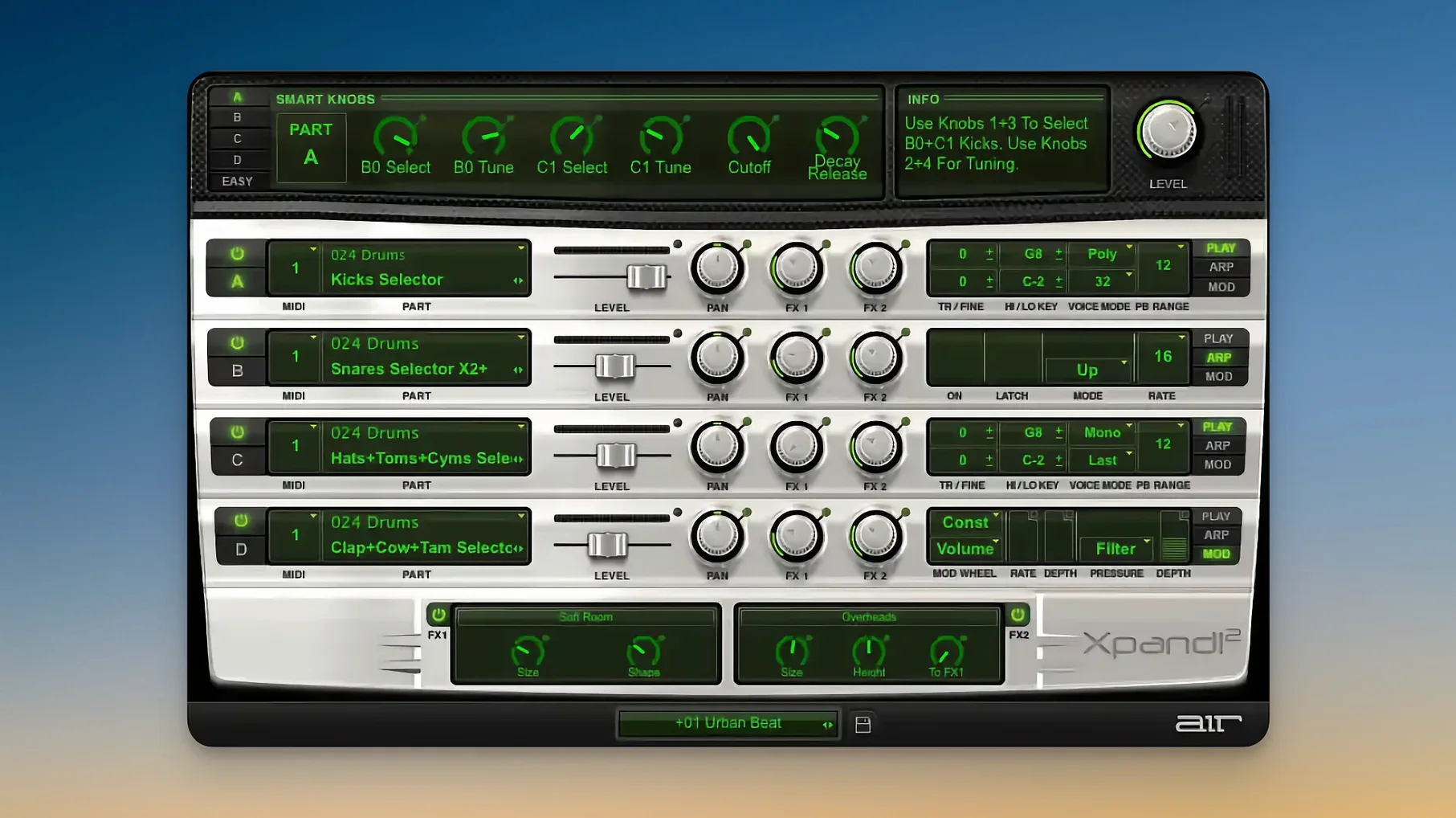
Four active sound slots per preset means you can stack a wavetable pad, a gritty FM bass, a sampled string swell, and a filtered arp all from a single patch window. In a busy session, that keeps your track count manageable while the sound stays wide.
Where does it typically sit in a project?
On a MIDI instrument track, usually as the main sound source for sketching or filling out a production. Because each slot gets its own note range, you can split a keyboard between a bass on the left hand and a polyphonic lead on the right without loading a second instance.
Per-part effects before the combined output
Each of the four parts can run through its own effects before the signal leaves the plugin. Dial in a touch of chorus on a wavetable layer and a separate Chaos Delay on a percussion slot, then route the whole mix to a reverb bus for a shared tail that glues everything together.
How does the arpeggiator slot into a workflow?
Every one of the four slots has its own arpeggiator with independent mix and modulation settings. Set a monophonic sequence on one part and let the other three play sustained pads — all synced to the project tempo — and you have a rhythmic bed that moves without cluttering the piano roll.
A friend of mine who scores short films keeps Xpand!2 on a track template labeled “Quick Palette.” When a director asks for a mood shift halfway through a spotting session, he pulls up a split patch — low strings on the left hand, a soft mallet tone on the right — and plays it in live while the picture rolls. No scrolling through libraries, no loading a second instrument. The director hears the change immediately, and my friend stays in the creative flow instead of digging through menus. That’s the kind of moment where four slots and independent note ranges feel less like a feature checklist and more like a conversation saver.
He told me once that the real magic isn’t the preset count; it’s how fast you can reshape a sound with the six smart controls. A pad that’s too polite gets a twist of the Brightness knob during playback. An arp that’s fighting the dialogue gets its mix pulled back on slot three without touching the other layers. In a room full of people, speed matters more than depth, and Xpand!2’s surface-level controls keep you out of the weeds.
Single multitimbral plugin across Logic and Live
Xpand!2 plays well with macOS’s Audio Unit hosting and shows up reliably in Logic Pro, Ableton Live, and other DAWs that support the format on Apple Silicon. Because it’s a single multitimbral plugin, you can route each of its four parts to separate aux tracks in Logic using the multi-output version. That means a bass slot hits its own channel strip for compression, a pad slot gets a different EQ curve, and the arp slot ducks under a sidechain from the kick — all from one instance. It’s a clean way to build a rich arrangement without scattering a dozen instrument tracks across the mixer.
MIDI Learn is straightforward on a Mac. Right-click a smart control, move a knob on your controller, and the assignment sticks across sessions. If you use MainStage for live performance, loading a multi-split Xpand!2 patch into a concert gives you four independent sound zones that respond to program changes, sustain pedal, and pitch bend just like hardware. Drag the scalable interface to fit a Retina display or shrink it to a corner of the screen when you’re focused on arrangement view.
Spotlight integration isn’t its job, but the plugin’s preset browser sorts quickly by category — pads, basses, arps, and so on — so you can audition sounds with arrow keys the way you’d skim files in Finder. If you’re the type who hunts for a specific timbre on forums, you might stumble across searches like xpand torrent or xpand 2 mac torrent, but the plugin itself doesn’t rely on anything outside its own library. The 29-category preset structure is self-contained and fast to navigate once you learn the naming conventions AIR used.
Quick answers before the first launch
Does it strain an older Apple Silicon Mac?
Not really. The four-slot architecture is efficient, and voice count depends on how many parts you set to polyphonic. A single Xpand!2 patch using two polyphonic layers with moderate unison will idle comfortably on an M1 MacBook Air. Push all four slots to 64 voices with heavy effects, and you’ll see the meter creep up, but that’s true of any synth. Most presets are built to play well together, so you spend more time playing than freezing tracks.
Legacy Creative Collection sessions open intact
If those sessions used the version that shipped with the Creative Collection, the patch names and parameters are the same. Opening a legacy project that referenced Xpand!2 on an Intel Mac works on Apple Silicon too, provided your DAW runs natively. The plugin format hasn’t changed; only the architecture support improved with version 2.3.1.
Is the 2500-preset library overwhelming?
It can be, if you scroll without a plan. The category tags help, but the smarter move is to audition with the six smart controls already mapped to your controller. A preset that sounds thin at first might thicken up with a quick tweak of the Timbre knob, and suddenly it fits the track. People who search for xpand2 torrent or xpand 2 torrent often assume they need a bigger library; the truth is, the stock sounds do a lot once you touch the macros.
How stable is the arpeggiator under MIDI clock?
Solid. Each slot’s arp syncs to host tempo without drifting, and you can set different rates per part — quarter notes on a bass pulse, sixteenths on a hi-hat layer — and they stay locked. If you route MIDI from an external sequencer, the plugin responds to start and stop messages just like any tempo-synced device.
- macOS 13 or newer
- Apple Silicon processor
Questions I actually get
Can I switch a part between polyphonic and monophonic mode?
Yes, each of the four parts can be set to polyphonic or monophonic voice mode independently, giving you legato leads or full chord stacks in the same patch.
Does it run natively on Apple Silicon Macs?
Yes, version 2.3.1 supports Apple Silicon, so you can run it without Rosetta overhead on modern Macs.
What kind of effects are built in?
It includes 50 effects such as reverb, delay, chorus, and Chaos Delay, with two effect processors available per slot for shaping individual parts.
Porch talk 0
Come in or pull up a chair to leave a comment.
Nobody has pulled up a chair yet. If you used it on a real Saturday, say what the hour was.
More for the same hour
Everything in VST Plugins XLN Audio XO
1.8.10-2026.09.04-Complete VST Plugins
2.3 GB
XLN Audio XO
1.8.10-2026.09.04-Complete VST Plugins
2.3 GB
 XLN Audio Life
1.2.3 VST Plugins
442 MB
XLN Audio Life
1.2.3 VST Plugins
442 MB
 Wavesfactory Trackspacer
2.5.10 VST Plugins
107 MB
Wavesfactory Trackspacer
2.5.10 VST Plugins
107 MB
 WaveLab Pro
13.0.30 VST Plugins
WaveLab Pro
13.0.30 VST Plugins
 VocalSynth 2
2.6.1 VST Plugins
259 MB
VocalSynth 2
2.6.1 VST Plugins
259 MB
 VocalNet
1.0.4 VST Plugins
669 MB
VocalNet
1.0.4 VST Plugins
669 MB
 Valhalla DSP Bundle
2025.12 VST Plugins
61 MB
Valhalla DSP Bundle
2025.12 VST Plugins
61 MB
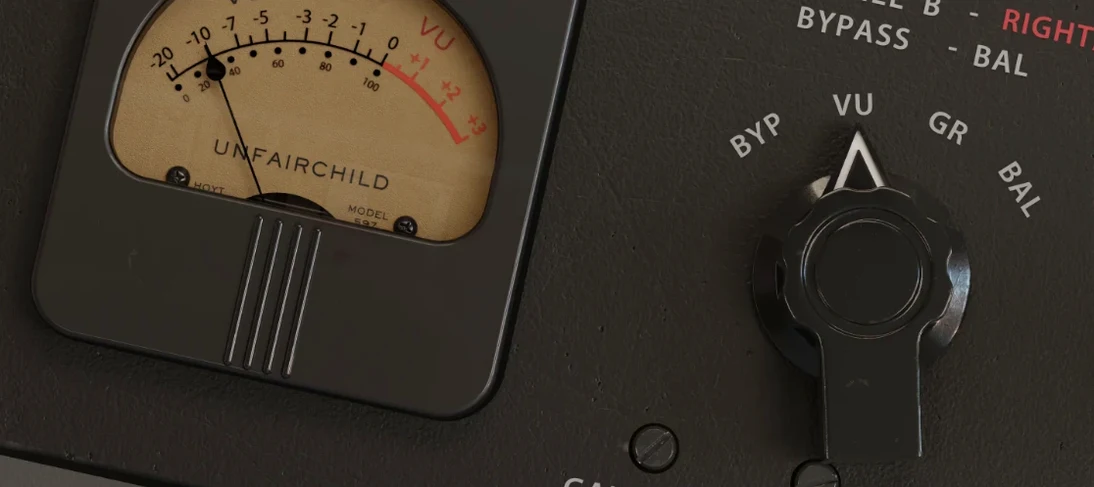 UnderTone Audio UnFairchild
1.0.8 VST Plugins
220 MB
UnderTone Audio UnFairchild
1.0.8 VST Plugins
220 MB