
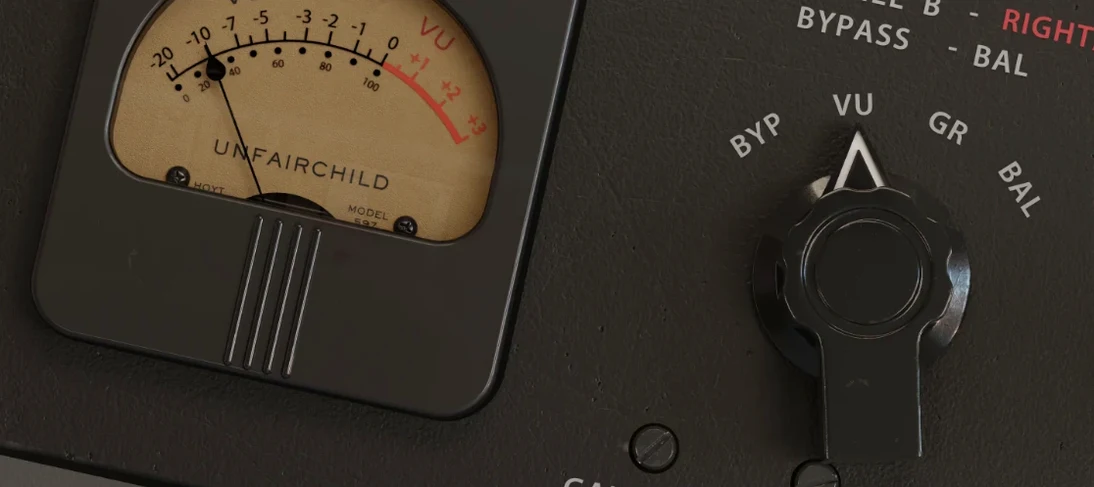
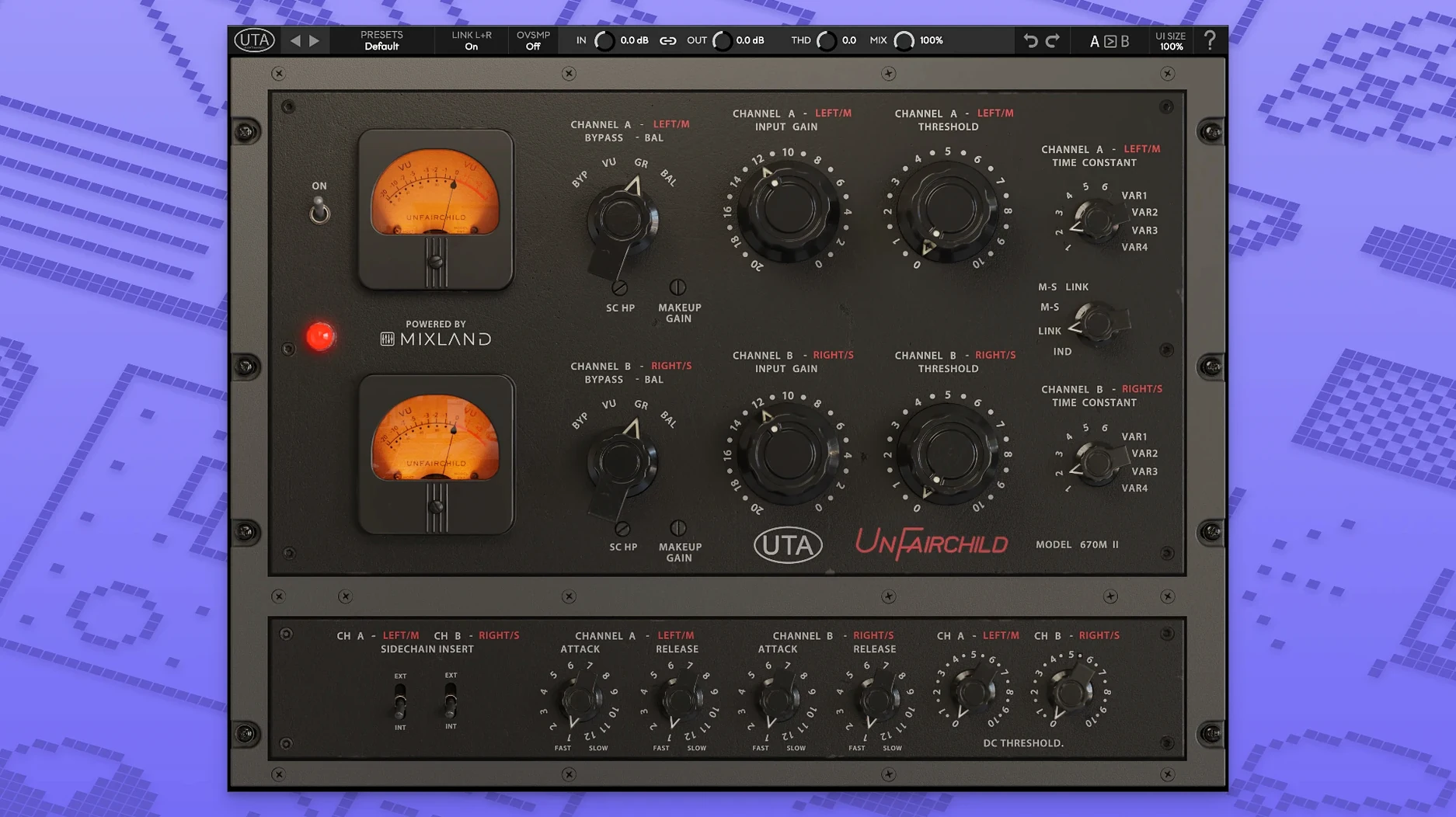
The Feed-Back/Feed-Forward switch alone tells you this isn't a one-trick box. Flicking between those two modes reshapes the knee and the grab, so the same ratio and threshold settings behave like you've patched in a different unit. That choice, borrowed directly from the 670M mkII hardware, is where you start tailoring the UnFairchild to a source instead of just squashing it.
Feed-Forward Glue That Preserves Transients
Across a drum bus, Feed-Forward gives you the kind of fast, assertive hold that glues a kit without softening the transients into mush. The six original preset time constants—three fast, three slow—let you dial in a pocket quickly, while the four variable constants open up fine-tuned release shapes for vocals or bass where a stock setting almost works but breathes wrong. On a mix bus, the MS function is the quiet asset: you can leave the center image punchy and let the sides breathe with a gentler squeeze, widening the stereo field without pulling the lead vocal back. The overall THD control lives on the output side, so pushing it doesn't alter the gain reduction; it just layers in harmonic density from subtle transformer-style warmth to a more saturated glue.
What makes it a studio tool, not a clone
Built with MIXLAND and Eric Valentine, the plugin keeps true bypass, output level control, and the full hardware signal path modeling without adding clutter. It runs natively on Apple Silicon and Intel Macs from macOS 10.13 onward, so it slots into aging and current rigs alike. When a 670-style compressor usually means two flavors, having Feed-Back and Feed-Forward plus variable THD and mid-side routing makes this the version you reach for when the hardware is booked or the recall needs to be instant.
Pushing a Colored EQ Into Denser Saturation
Drop it after a colored EQ and the THD stage reacts differently than it does on a clean input, letting you push into a denser saturation without touching the gain reduction. That chain—something like a Pultec-style bump into the UnFairchild—gives a vocal a forward, finished texture before you ever touch a fader. On drum shells, insert it as the first plug-in, then route the side-chain input from a high-passed copy of the kick so the compressor ducks the room mics in time with the downbeat. It follows macOS's Audio Unit routing cleanly, so Logic users can nest it inside a summing stack and apply MS processing to grouped backing vocals while the lead stays dry. And because it writes standard automation lanes for every parameter including the DC Threshold, riding the compression character across a song section is as simple as drawing a curve—no clunky workarounds.
Small moves that are easy to overlook
- Fine L/R balance lives as a trim, not a pan. If a stereo overhead capture is a touch heavier on the hi-hat side, nudging the balance here means the compressor reacts evenly before you ever reach for a channel fader.
- The DC Threshold isn't a set-and-forget control. Lowering it on a bass DI track tightens the low end without thinning the note sustain—it's a cleanup tool disguised as a calibration screw.
- Wet/dry at 30% on a parallel drum crush keeps all the snap and adds the weight of the slammed signal behind it. The dry path passes unprocessed, so the transients from the original mics cut through exactly as you tracked them.
- Variable time constant 4 on a lead vocal with the release pulled longer than the presets allow can smooth out a singer who rides the edge of sibilance and chest resonance in the same phrase.
- True bypass isn't just a compare button—it fully disengages the modeling, so switching it in and out during a dense chorus tells you instantly whether the THD layer is helping or just thickening the low mids.
Dual Topologies Instead of One Flavor of Tube Saturation
Most 670-inspired plugins lock you into one feedback topology—usually Feed-Back—and trade on a single flavor of tube saturation. That's where the UnFairchild stretches its legs. You get both Feed-Back and Feed-Forward, which means you aren't forced to stack a second compressor just to get the transient-shaping bite the stock mode can't deliver. Compared to a well-known emulation that excels at silky, vintage sheen, the UnFairchild feels more like the console-mounted unit itself: less polished, more reactive, with a THD stage that you can overdrive without the bottom end folding in on itself.
Against another popular vari-mu plugin that added mid-side via a firmware update, the UnFairchild's implementation was baked in from the hardware design—the MS matrix sits before the gain reduction, so the detection circuit responds to the encoded signal rather than applying a decode-compress-recode trick after the fact. It's a small architectural difference, but you hear it in the way the stereo image stays locked when you push into deeper gain reduction. If you've grabbed an unfairchild plugin hoping for instant 670 character and found it sounded cleaner than expected, that's the Feed-Forward path doing its job; switch over to Feed-Back and the familiar grab returns. Having both in one window means you stop reaching for a second compressor to make up for the one the other emulation left out.
- macOS 10.13 or later
- Apple Silicon or 64-bit Intel processor
- Audio Units, VST3, or AAX host
Porch talk 0
Come in or pull up a chair to leave a comment.
Nobody has pulled up a chair yet. If you used it on a real Saturday, say what the hour was.
More for the same hour
Everything in VST Plugins Ultra Audio Ultra
1.1.4 VST Plugins
293 MB
Ultra Audio Ultra
1.1.4 VST Plugins
293 MB
 UJAM VOXCRAFT
1.1.1 VST Plugins
261 MB
UJAM VOXCRAFT
1.1.1 VST Plugins
261 MB
 UJAM Symphonic Elements STRIIIINGS
1.3.1 VST Plugins
4.4 GB
UJAM Symphonic Elements STRIIIINGS
1.3.1 VST Plugins
4.4 GB
 Valhalla DSP Bundle
2025.12 VST Plugins
61 MB
Valhalla DSP Bundle
2025.12 VST Plugins
61 MB
 uJAM Cinedream
1.0.1 VST Plugins
3.5 GB
uJAM Cinedream
1.0.1 VST Plugins
3.5 GB
 UJAM Beatmaker VICE
2.4.0 VST Plugins
262 MB
UJAM Beatmaker VICE
2.4.0 VST Plugins
262 MB
 VocalNet
1.0.4 VST Plugins
669 MB
VocalNet
1.0.4 VST Plugins
669 MB
 VocalSynth 2
2.6.1 VST Plugins
259 MB
VocalSynth 2
2.6.1 VST Plugins
259 MB