

Get UJAM Symphonic Elements STRIIIINGS 1.3.1 for Mac
VST Plugins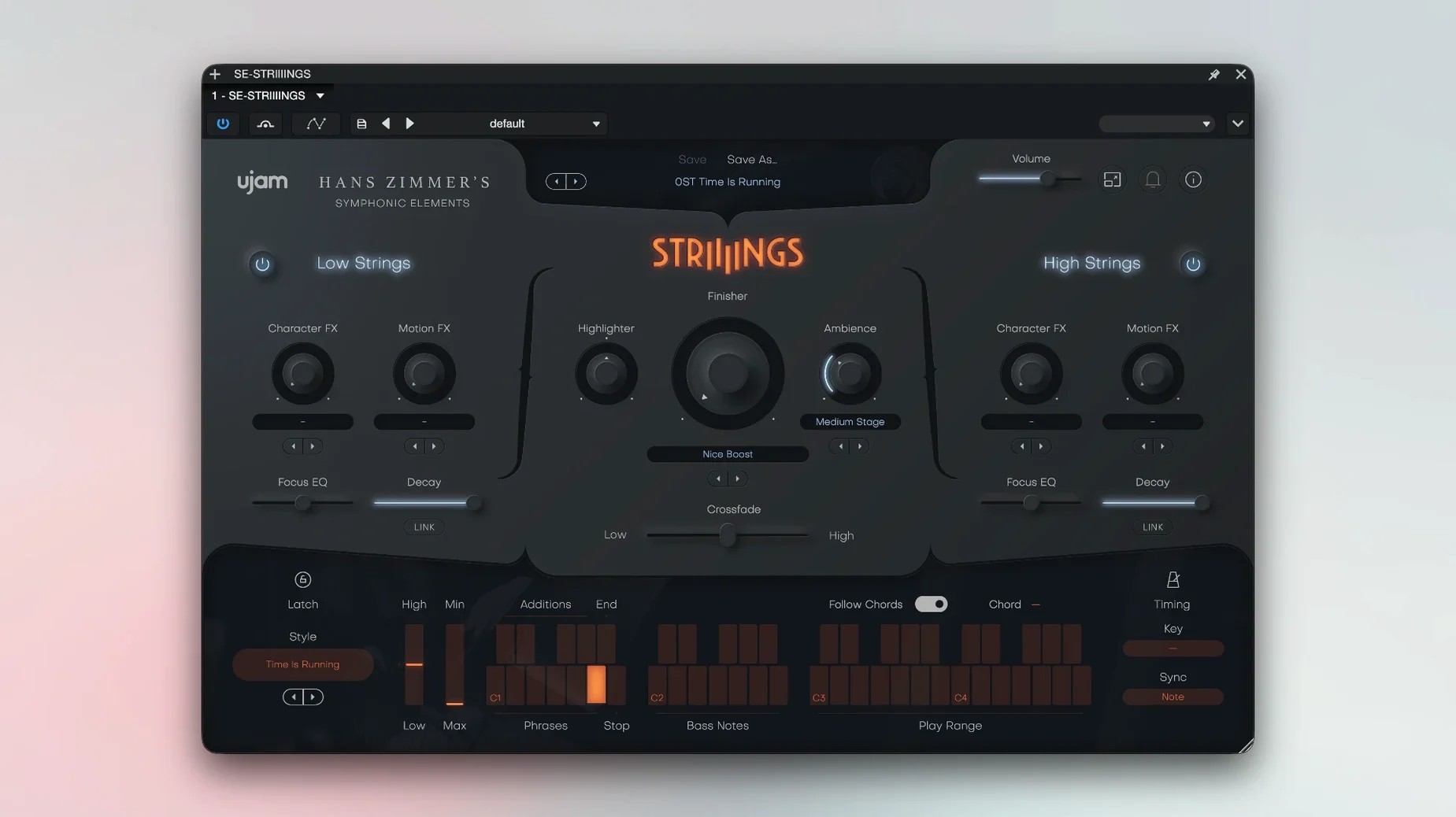
Two layers, one crossfade. That is the core of UJAM Symphonic Elements STRIIIINGS — a 64-bit virtual instrument that splits an orchestra into Low Strings (basses and celli) and High Strings (violins and violas), then lets you blend them with a single control. It is the kind of tool you reach for when a cue needs motion behind a dialogue scene or width under a chorus.
| Detail | Spec |
|---|---|
| Styles | 60 |
| Sound designer presets | 200+ |
| Layers | Low Strings, High Strings |
| Minimum macOS | 10.14 Mojave |
| RAM | 4 GB |
In a typical session, STRIIIINGS works well on a dedicated instrument track routed to your usual reverb and delay buses. The Low Strings layer gives you weight without crowding the low mids, while High Strings add air and movement. Because the crossfade is right there on the interface, you can ride it while arranging instead of stopping to load another patch. The sound-design side is just as flexible: among the 200+ presets are textures that lean more synthetic than orchestral, which makes the plug-in useful on sound design buses and even as a source for granular or pitch-shifted effects further down the chain. If you build cinematic cues and want one instrument that covers both bedsheet string pads and darker, processed textures, this one earns its place in the template.
Another common stumble is treating the Crossfade control like a volume fader. It is not a simple mix knob — it rebalances the voicing between the two sections, so sweeping it mid-phrase shifts the harmonic weight of the chord. A chord that sounds grounded at forty percent crossfade can turn brittle past seventy because the high strings take over the inner voices. The fix is simple: set the crossfade before you play, then leave it alone or automate small moves rather than sweeping the full range.
A related mistake is loading a preset, hearing a lush orchestral wash, and immediately drowning it in a long cathedral reverb. Many of the 200+ sound designer presets already bake in generous ambience from the Hans Zimmer source recordings. Adding another tail on top often smears the transient detail that gives the low strings their definition. When a preset feels cloudy, try pulling the external reverb send down to zero first — the built-in space might be all you need.
It recalls your last patch, no screenshots needed
The plug-in remembers its state between sessions, which is a quiet time-saver. Close a project with a half-dialed patch, reopen it the next morning, and everything sits exactly where you left it — no recall notes, no screenshot of the interface.
There is also a handful of shortcuts that do not appear in any toolbar. Double-clicking a control returns it to its default value, which is handy when a preset tweak has wandered too far and you want to start fresh without reloading the patch. Holding Shift while dragging any knob slows the movement for finer adjustments — especially useful on the Crossfade when you are hunting for the exact blend point where the low and high sections lock together. On Mac hosts that support it, the plug-in also responds to automation from a connected MIDI controller right out of the box; no MIDI-learn mapping ritual required unless you want custom assignments.
Scoring a tense cue with uneasy strings
Imagine a late-evening session in Logic. A short film cue is on the timeline — a tense two-minute scene with sparse dialogue and a ticking clock. The director wants strings that feel uneasy but not melodramatic.
You create a new software instrument track and load UJAM Symphonic Elements STRIIIINGS. On first launch, the plug-in appears with its default patch, a broad ensemble texture sitting right in the middle of the crossfade. You mute everything else and play a few block chords to get a sense of the room. The sound is warm but a little too polite for the scene.
You start browsing styles. Each of the 60 styles reshapes the ensemble character — some tighten the attack, others introduce a swelling bowing pattern. You land on a style that has a slow, pulsing movement baked into the sustain, almost like a breathing string section. That alone pulls the cue closer to the mood the director described. From there, you open the preset browser and scroll through the sound designer patches until one catches your ear: a processed texture where the high strings crackle with a faint granular edge and the low strings drone with a cello-like weight.
Now you nudge the Crossfade left, toward the Low Strings layer, until the high crackle is barely a whisper. The scene still needs a lift at the midpoint, so you draw a short automation ramp that pushes the crossfade toward the High Strings for about eight bars, then pulls it back. The edit takes under a minute and the harmonic shift lands exactly on the visual cut where the clock stops.
You add a touch of saturation from the channel strip — nothing heavy — and send a modest amount to a short room reverb. The built-in ambience does most of the spatial work. By the time you play the scene with dialogue and sound effects, the strings sit in the pocket without calling attention to themselves. The patch you started with is long gone, replaced by a custom blend that took fewer moves than tuning a synthesizer. That is where STRIIIINGS feels most natural: not as a traditional string library you painstakingly program, but as a texture machine you steer while the timeline keeps moving.
- macOS 10.14 Mojave or newer, through macOS Tahoe 26
- Intel or Apple Silicon Mac
- 64-bit software only
- 4 GB of RAM
Questions I actually get
What is the difference between Low Strings and High Strings in STRIIIINGS?
Low Strings covers basses and celli, while High Strings covers violins and violas. A Crossfade control lets you blend the two sections.
How many presets does UJAM Symphonic Elements STRIIIINGS include?
The instrument includes more than 200 sound designer presets alongside its 60 styles.
What are the Mac system requirements for STRIIIINGS?
It runs on macOS 10.14 Mojave through macOS Tahoe 26, requires 4 GB of RAM, and works as a 64-bit plug-in on Intel and Apple Silicon.
Porch talk 0
Come in or pull up a chair to leave a comment.
Nobody has pulled up a chair yet. If you used it on a real Saturday, say what the hour was.
More for the same hour
Everything in VST Plugins uJAM Cinedream
1.0.1 VST Plugins
3.5 GB
uJAM Cinedream
1.0.1 VST Plugins
3.5 GB
 UJAM VOXCRAFT
1.1.1 VST Plugins
261 MB
UJAM VOXCRAFT
1.1.1 VST Plugins
261 MB
 UJAM Beatmaker VICE
2.4.0 VST Plugins
262 MB
UJAM Beatmaker VICE
2.4.0 VST Plugins
262 MB
 Ultra Audio Ultra
1.1.4 VST Plugins
293 MB
Ultra Audio Ultra
1.1.4 VST Plugins
293 MB
 UnderTone Audio UnFairchild
1.0.8 VST Plugins
220 MB
UnderTone Audio UnFairchild
1.0.8 VST Plugins
220 MB
 Valhalla DSP Bundle
2025.12 VST Plugins
61 MB
Valhalla DSP Bundle
2025.12 VST Plugins
61 MB
 Toontrack EZmix Bundle
3.2.2 VST Plugins
977 MB
Toontrack EZmix Bundle
3.2.2 VST Plugins
977 MB
 VocalNet
1.0.4 VST Plugins
669 MB
VocalNet
1.0.4 VST Plugins
669 MB