

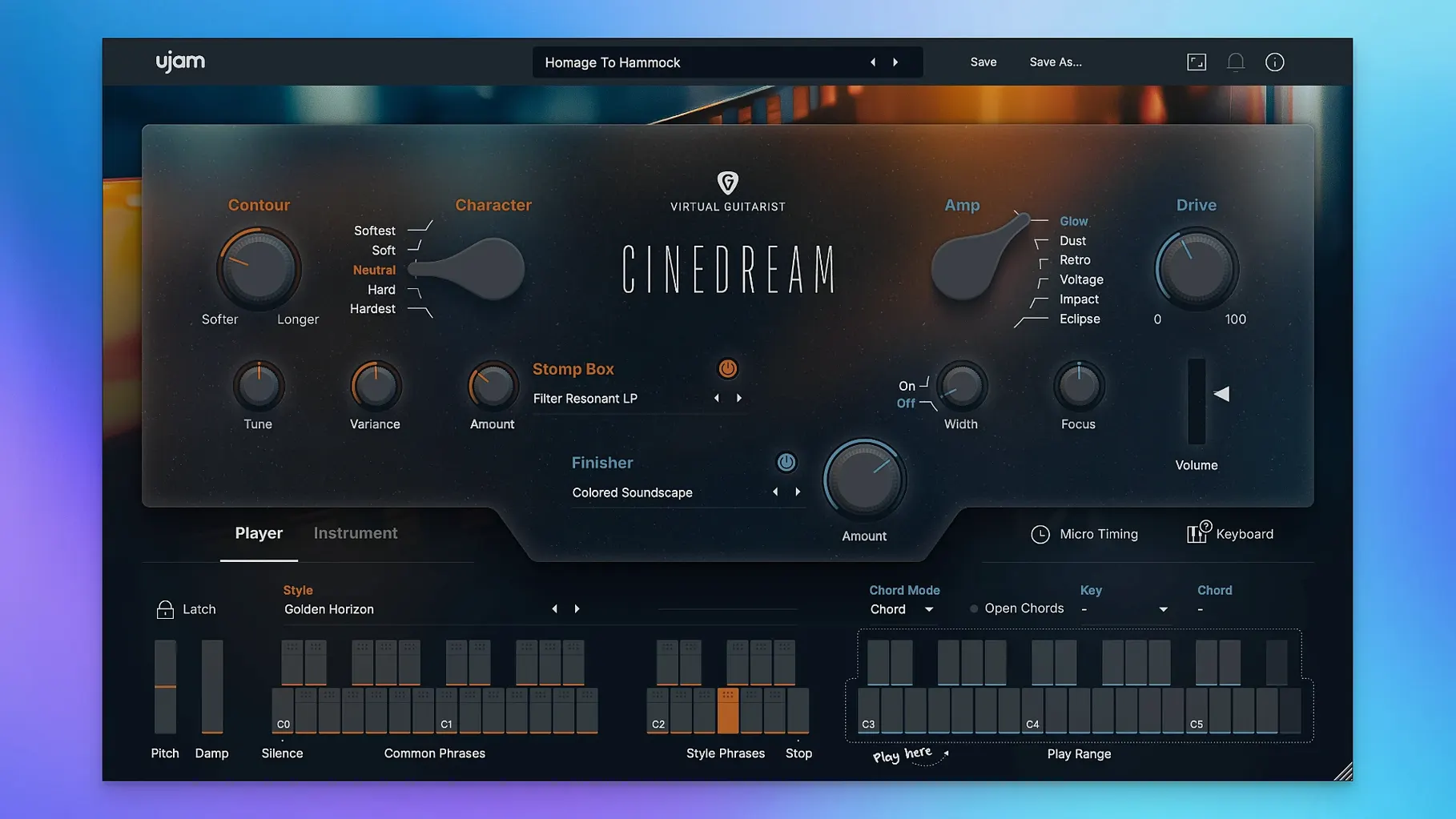
The Mod Wheel swell catches you off guard — a slow bloom of reversed attack that feels less like a guitar and more like light through dusty glass. That's the moment you realize Cinedream isn't about strumming patterns or lead lines. It lives in the space between.
Baked-in ambience on a texture bus
- Texture beds on a dedicated bus: Drop it on an instrument track, send it to a long reverb bus, and let it run underneath a cue. The processed real-guitar sound already arrives with the wet, cinematic treatment baked in, so you're nudging a fader, not building from scratch.
- Stereo pad tracks: Load it as AU2, VST3, or AAX and treat it like a synthesizer pad that happens to have wood and wire somewhere in its past. It works well on its own track, nudged low behind a piano or string arrangement.
- Sound design layers on an aux: Feed it into a delay throw and mute the dry signal. You get these trailing, smeared harmonics that move without calling attention to themselves.
- Quick mood on a scratch track: The ready-made styles mean you can grab a tone — dark, airy, pulsing — and commit before the idea cools off.
Keeping the focus where it belongs
Cinedream doesn't try to be a do-everything guitar. It's part of UJAM's Virtual Guitarist series, but it lives at the ambient end of the pool. On a Mac — Intel or Apple silicon, running anywhere from macOS 10.13 through Tahoe 26 — it slots in as the thing you reach for when a scene needs texture more than melody. The 8 GB RAM requirement and compact display minimum mean it fits on most rigs without fuss. If you find yourself building cinematic beds with three different delays and a shimmer reverb just to make a guitar disappear, this is worth a slot in your template.
What version 1.0.1 tightened up
The jump to 1.0.1 didn't add a flashy new effects rack or double the style count. Instead it addressed the kind of friction that shows up after a few late-night sessions — plugin scans that hang, a GUI that forgets its size between Logic and Live, and the occasional click when switching styles mid-phrase. That's the stuff that pulls you out of a mood, and this update was clearly about staying in it.
- The AU2 component now passes validation on Apple silicon without requiring a manual Rosetta toggle. If you've been running native, the plugin loads clean on the first scan.
- VST3 host sync tightened up. Tempo-locked textures stay in phase across bar lines, even when the DAW tempo ramps gradually rather than jumping to a new BPM.
- The GUI remembers its last window size per host. Resize it once in Ableton, and it stays that way next session — no more dragging corners at 2 a.m.
- A few of the darker style presets had a low-mid buildup that crept into the 200 Hz range. That resonance is now shaped differently, so you spend less time reaching for an EQ to clean up mud you didn't ask for.
None of this rewrites what Cinedream is. It just means less housekeeping between the moment you load it and the moment you're actually listening.
One composer's evening with a deadline
Picture a documentary scorer who's already got her string arrangement mapped out and her piano bed comped. The director sent notes at 7 p.m. — the cue needs something warm but indistinct underneath the voiceover, something that suggests memory without being nostalgic in an obvious way. She's tried a felt piano with the attack rolled off. Too recognizable. A synth pad felt sterile against the archival footage.
She drops Cinedream onto a stereo instrument track, pulls up a style called something like "Faded Light," and holds a single minor chord on the chord trigger. The evolving guitar part that comes back isn't a performance — it's a slow harmonic drift with the transients already softened into something closer to bowing than picking. She sends it to her reverb bus, nudges the Mod Wheel up a third of the way to thin out the attack further, and prints three minutes of texture in one pass. The director approves the cue at 8:15. She didn't play a single note on a guitar.
That's the lane this plugin occupies: not the spotlight, but the thing that makes the spotlight look better. For anyone chasing a cinedream plugin download after hearing it on a friend's session, the appeal is usually the same — they want access to that slow, cinematic decay without spending an afternoon building it from impulse responses and reverse delays.
Pre-install considerations
Does it actually sound like a guitar, or is it just another pad synth with guitar samples?
The source is a real recorded guitar, and you can hear the finger noise and string resonance if you push the mix toward the dry side. But the processing chain — the one that gives it the cinematic treatment — lives between the sample and the output, so by the time you hear the default styles, the attack has already been reshaped. It's more accurate to call it a guitar that's been deliberately turned into atmosphere, rather than a synthesizer imitating one. If you pull the Mod Wheel all the way down and keep the effects minimal, the instrument underneath does sound like a guitar. The magic is how far you can push it away from that and still have it feel organic.
Does it work for anything besides film scoring?
The "cinematic" label can make it feel pigeonholed, but ambient electronic producers use it the same way they'd use a granular synth — as a source of slow-moving harmonic material. It sits comfortably in lo-fi hip-hop intros, in the quiet breakdown section of a rock track, and under spoken-word pieces. If your music has moments where density and mood matter more than a clear melodic line, Cinedream fits. The style browser gives you enough range that you're not stuck in "trailer bed" territory unless you want to be.
How heavy is it on an older Mac?
On an Intel machine running macOS 10.13 with 8 GB of RAM, a single instance with a held chord and both effects slots active hovers around a modest CPU load. It's built more on playback of processed audio phrases than on real-time physical modeling, so it doesn't spike the way some convolution-heavy reverbs do. Multiple instances — say, four or five across different cues in a Logic session — stay manageable if you freeze tracks when you're done tweaking. The 4 GB disk footprint is mostly the sample content, not something that grows over time.
Shortcut for deadline-driven composers
Film and game composers land here naturally, especially anyone working on short-turnaround projects where the difference between "done" and "still tweaking" is a single texture they can't quite nail. Cinedream shortens that search by giving you a handful of directions — dark, airy, pulsing, saturated — that already sound finished. You're not auditioning raw guitar tones; you're auditioning moods.
Ambient and electronic producers who've been layering field recordings and reversed reverb tails to build pads will find it does a lot of that work inside one plugin. It's not a replacement for sound design as a practice, but it's a shortcut for the moments when you need a result, not a process. If you stumbled across a cinedream plugin free download while looking for texture tools, the immediate draw is usually that pre-processed quality — the sense that someone already did the sound-design heavy lifting.
Bedroom producers working in tighter spaces, on laptops or older iMacs with the minimum 1280-by-768 display, benefit from the compact UI. It doesn't sprawl across the screen or demand a second monitor. You open it, pick a style, hold a chord, and move on. That kind of speed matters when your recording window is the hour between dinner and when everyone else in the house goes to sleep.
If you're the kind of Mac user who builds templates with placeholder tracks for texture and atmosphere — a "pad" bus, a "drone" track, an aux for blurred harmonics — Cinedream earns its slot on one of those channels. It's not the instrument you play. It's the instrument you feed a chord and let run, and it gives back something that sounds like you spent a lot longer on it than you actually did.
- macOS 10.13 or later
- Intel or Apple silicon Mac
- 8 GB RAM
- 4 GB free disk space
- 1280 × 768 minimum display
- Internet connection for setup
Porch talk 0
Come in or pull up a chair to leave a comment.
Nobody has pulled up a chair yet. If you used it on a real Saturday, say what the hour was.
More for the same hour
Everything in VST Plugins UJAM Beatmaker VICE
2.4.0 VST Plugins
262 MB
UJAM Beatmaker VICE
2.4.0 VST Plugins
262 MB
 UJAM Symphonic Elements STRIIIINGS
1.3.1 VST Plugins
4.4 GB
UJAM Symphonic Elements STRIIIINGS
1.3.1 VST Plugins
4.4 GB
 UJAM VOXCRAFT
1.1.1 VST Plugins
261 MB
UJAM VOXCRAFT
1.1.1 VST Plugins
261 MB
 Ultra Audio Ultra
1.1.4 VST Plugins
293 MB
Ultra Audio Ultra
1.1.4 VST Plugins
293 MB
 UnderTone Audio UnFairchild
1.0.8 VST Plugins
220 MB
UnderTone Audio UnFairchild
1.0.8 VST Plugins
220 MB
 Valhalla DSP Bundle
2025.12 VST Plugins
61 MB
Valhalla DSP Bundle
2025.12 VST Plugins
61 MB
 Toontrack EZmix Bundle
3.2.2 VST Plugins
977 MB
Toontrack EZmix Bundle
3.2.2 VST Plugins
977 MB
 Toontrack EZkeys
2.1.5 VST Plugins
707 MB
Toontrack EZkeys
2.1.5 VST Plugins
707 MB