

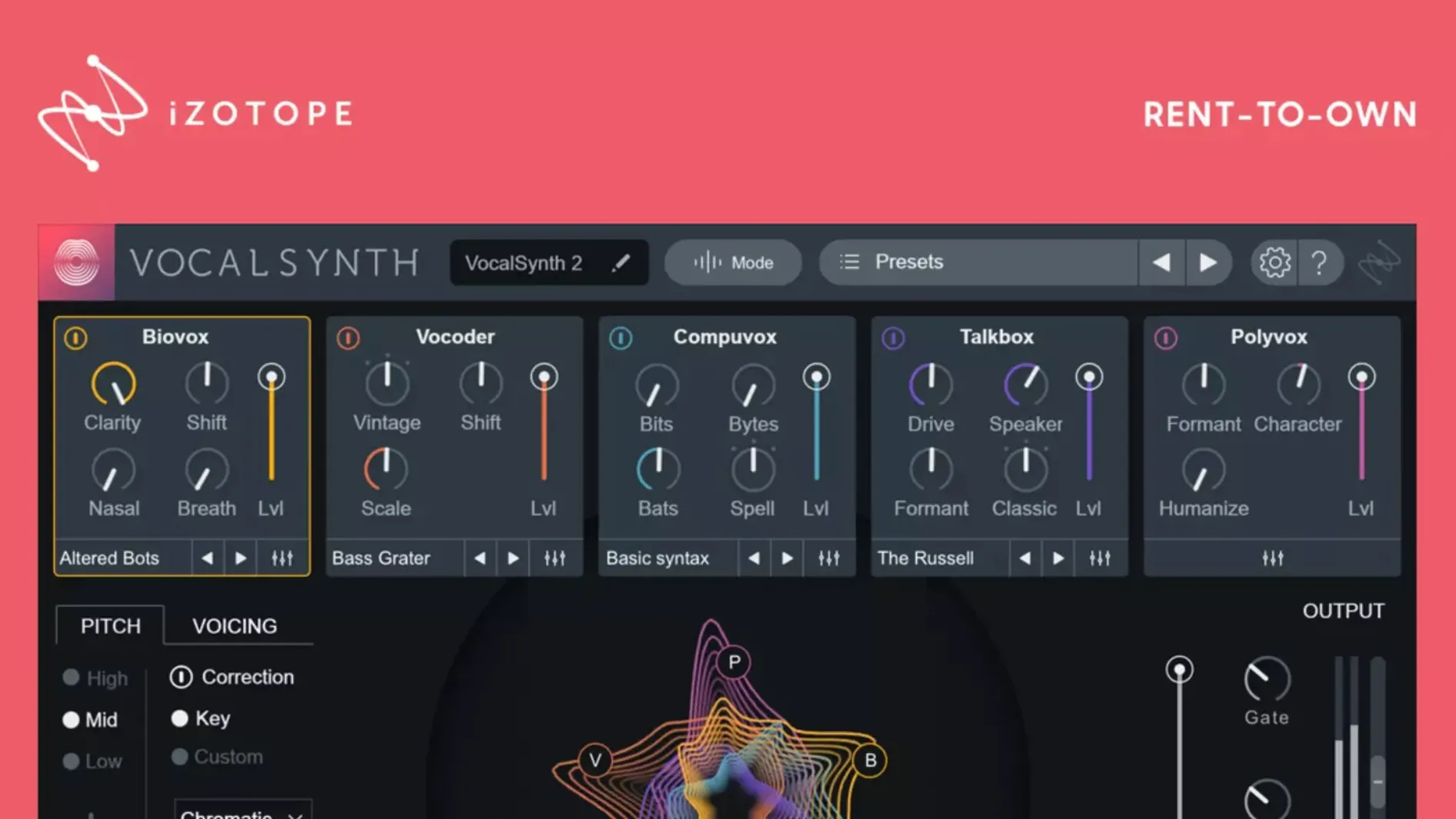
A vocal track is sitting flat in the mix. It needs texture, maybe a little grit or an airy sheen that EQ alone won't provide. VocalSynth 2 steps into that moment with five effect modules you can blend in parallel, each pulling the voice in a different direction.
Five flavors of vocal processing
Drag a fader up on any of the modules and the sound shifts. Polyvox adds harmonized doubling, Vocoder gives that classic talk-box character, Compuvox pushes things into glitchy, digital territory, Talkbox brings throaty, analog resonance, and Biovox uses a spectral model of the human vocal tract. The enhanced spectral display reacts as vowels change, giving you a visual read on how the modules engage with the sound.
How it drives the mix
Processing mode matters here. Auto mode follows the performance in real time, MIDI mode lets you play the effect from a keyboard, and Sidechain mode allows another track to trigger the processing. Combined with the visual feedback from the spectral display, dialing in a part feels direct—almost like shaping clay. If you use Ozone or Neutron elsewhere in the session, the plug-in communicates within that iZotope ecosystem, slotting into a broader mixing workflow. Anyone looking to move beyond static vocal chains and into more animated, modular vocal design should take a close listen.
Blank spectral display? Toggle the graphics fix
The spectral display is a highlight, but it can also be the source of head-scratching. On first open, some Mac users see a blank or frozen visualizer—usually a graphics hiccup tied to older Metal drivers. A quick toggle of the window size or switching the plug-in window from floating to fixed inside your DAW often jolts it back. If that doesn't do it, disabling "Auto" mode momentarily and switching back refreshes the rendering pipeline.
Another frequent bump: MIDI mode stays silent even when notes are coming in. VocalSynth 2 listens on a specific MIDI channel by default, and if your controller is transmitting on a different channel, the plug-in just sits there. Check the channel assignment in the plug-in header—it's easy to overlook after a long session. For producers digging into a vocalsynth 2 download for the first time, the sidechain routing can also trip things up. Make sure the trigger track's output is actually being sent to the plug-in's sidechain input in your DAW's routing panel, not just assigned in the VocalSynth 2 interface.
Lastly, authorization hiccups after updating bit some users moving from 2.5.0. The fix is straightforward: run the activation routine included in the package again, even if it previously showed as authorized. The 2.6.1 update specifically addressed this, so grab that version if you're hitting the wall.
Neutron can hear the processed vocal via inter-plug-in bus
VocalSynth 2 plays well beyond its own window. Drop it after a dry vocal chain and before Neutron's mixing tools, and the two plug-ins communicate tonal data through iZotope's inter-plug-in bus. That means Neutron's Assistant can hear the processed vocal—not just the raw take—and suggest EQ moves that account for the added harmonics. If you're using Tonal Balance Control on the master bus, the combined spectral readout reflects how VocalSynth 2's layers sit across the frequency spectrum relative to your reference targets.
On the macOS side, the native Apple silicon support means Logic Pro users on M-series machines can stack instances without the audio dropout that plagued Rosetta-translated plug-ins. The plug-in also respects macOS's low-latency audio pipeline, so tracking with effects on is feasible at buffer sizes you'd normally reserve for a dry signal. Producers searching for a vocalsynth 2 free download to test before committing often run it inside GarageBand first—it loads as an Audio Unit without fuss, though the sidechain routing is more limited there than in Logic or Ableton Live.
Apple silicon support frees the M1 MacBook Air
The jump to version 2.5.0 was the big one for Mac producers. Native Apple silicon support arrived, and sessions that previously needed freezing tracks on an M1 MacBook Air suddenly ran with headroom to spare. Loading times shrank noticeably—the plug-in appears in the insert slot almost instantly now, where Rosetta versions sometimes paused for a beat. Monterey 12.3.x compatibility also landed in that release, which matters if your studio machine stays current with macOS security updates.
Version 2.6.1 cleaned up a specific annoyance: some users who updated from 2.5.0 found their existing authorization wasn't being recognized, effectively locking them out of a plug-in they already had working. It was a quiet fix, but if you've ever opened a project and seen a plug-in replaced by a silent placeholder, you know how disruptive that is. The included activation instructions walk through re-establishing the license, and once it's set, the plug-in remembers it across DAW restarts.
Version 2.6.1 addresses a small but important fix:
- Resolved a problem where existing authorization was not recognized for some users after updating from version 2.5.0.
- Requires macOS
- Supports both Intel and Apple silicon Macs
- Interface language: English
Questions I actually get
What processing modes does VocalSynth 2 offer?
It includes Auto mode for real-time tracking, MIDI mode for keyboard control, and Sidechain mode for triggering effects from another audio source.
Does VocalSynth 2 run natively on Apple silicon Macs?
Yes, native Apple silicon support was added in version 2.5.0.
Porch talk 0
Come in or pull up a chair to leave a comment.
Nobody has pulled up a chair yet. If you used it on a real Saturday, say what the hour was.
More for the same hour
Everything in VST Plugins VocalNet
1.0.4 VST Plugins
669 MB
VocalNet
1.0.4 VST Plugins
669 MB
 WaveLab Pro
13.0.30 VST Plugins
WaveLab Pro
13.0.30 VST Plugins
 Wavesfactory Trackspacer
2.5.10 VST Plugins
107 MB
Wavesfactory Trackspacer
2.5.10 VST Plugins
107 MB
 Valhalla DSP Bundle
2025.12 VST Plugins
61 MB
Valhalla DSP Bundle
2025.12 VST Plugins
61 MB
 UnderTone Audio UnFairchild
1.0.8 VST Plugins
220 MB
UnderTone Audio UnFairchild
1.0.8 VST Plugins
220 MB
 Ultra Audio Ultra
1.1.4 VST Plugins
293 MB
Ultra Audio Ultra
1.1.4 VST Plugins
293 MB
 UJAM VOXCRAFT
1.1.1 VST Plugins
261 MB
UJAM VOXCRAFT
1.1.1 VST Plugins
261 MB
 UJAM Symphonic Elements STRIIIINGS
1.3.1 VST Plugins
4.4 GB
UJAM Symphonic Elements STRIIIINGS
1.3.1 VST Plugins
4.4 GB