
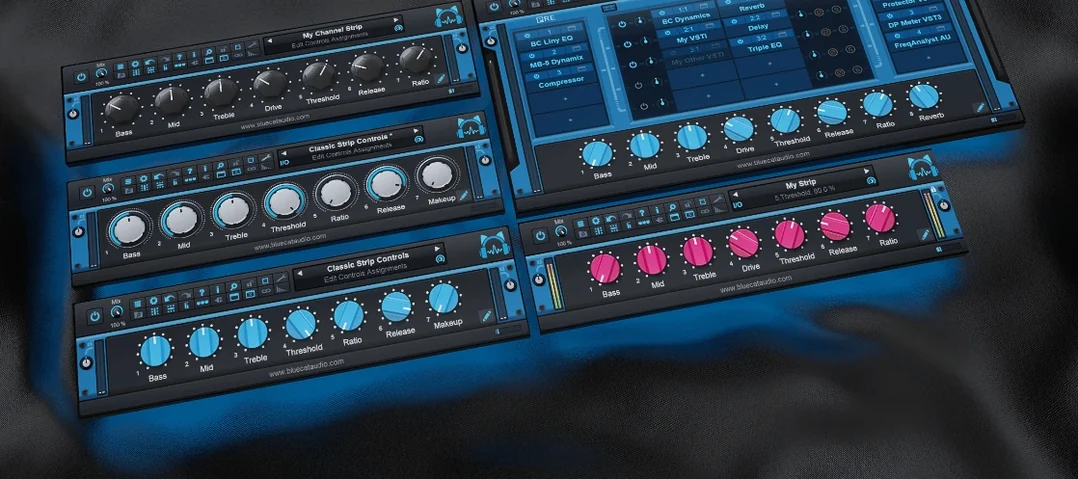
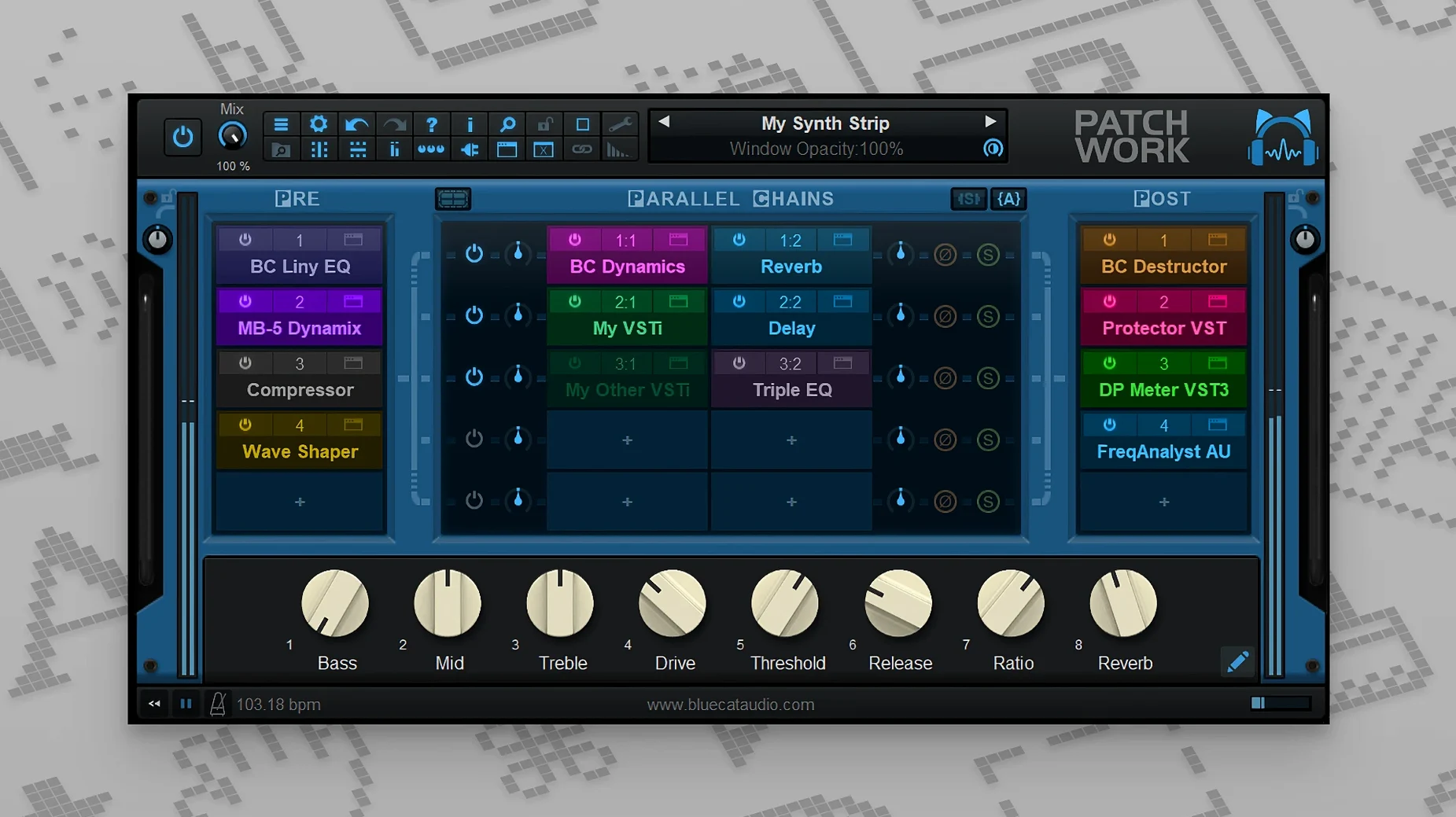
Mixers who treat a single channel strip like a pedalboard reach for this. It's a place to stack sounds until they're something else entirely.
Parallel chains — Up to 64 pre-amp, dynamics, or modulation slots can run in series or split into parallel rows. One guitar track feeding a clean DI and a saturated amp sim simultaneously, without duplicating the source.
Drag-and-drop routing — Preset building happens by dragging plug-ins from the file system into a slot. Connections between them are drawn as virtual cables, with the ability to create split points for frequency-dependent processing.
Post-recording — A built-in 16-channel recorder captures the wet output, post-effects, for resampling or auditioning chains later.
Macros & MIDI — Individual plug-in bypass states, interface visibility, and parameters respond to MIDI CCs. Complex chains can be collapsed into a few mapped knobs, turning a wall of plug-ins into a single performance instrument.
Shell hosting — Third-party AU, VST, VST3, and AUv3 formats sit together in one window. A single instance of PatchWork keeps the whole chain recallable as one DAW preset.
You open a session with a bass DI that feels flat, so you drop PatchWork onto the track. The plug-in window opens to a clean grid — no effects loaded yet. You start dragging: an 1176-style compressor from your VST3 folder lands in the first slot, a Pultec-style EQ follows in the second, and a saturation plug-in in the third. The virtual cable connecting them lights up as you click each one. That's the straight-ahead chain. But you're curious — you right-click below the first row, add a parallel branch, and drag an amp sim into it. Now the signal splits. One path stays clean and punchy; the other adds growl. A quick tweak of the blend knob inside PatchWork and the bass sits differently in the verse. You save the whole chain as a preset called "Verse Grit" and move on to the next section of the song.
Later in the same session, you recall a bundled plug-in for widening and drop it after the EQ. The search bar inside the plug-in browser found it before you finished typing "stereo." You bypass it with a MIDI footswitch mapped earlier in the week, toggling it off for the bridge. By the end of the hour, the bass channel holds eleven plug-ins across three parallel rows. Your DAW still sees a single insert slot occupied.
Template builders collapse 12 slots into one recallable preset
Mixing engineers who build templates — They set up elaborate channel strips with parallel compression, multiband splitting, and harmonic shaping, then recall the whole thing as one factory preset. A single PatchWork instance replaces a dozen individual plug-in slots that would otherwise need to be loaded one by one on every new session.
Sound designers working in post-audio — They feed a dry Foley recording through a chain of spectral processors, convolution reverbs, and pitch shifters, then record the wet output directly to disk with the built-in recorder. The 16-channel capture means they can print multiple variations simultaneously and audition them later without rebuilding the chain.
Live performers using a MacBook on stage — They map plug-in bypass and wet/dry to a MIDI controller, collapse a dozen effects into four knobs, and treat the laptop as a pedalboard. PatchWork loads fast and recalls reliably between songs, which matters more than feature count when the house lights go down.
Bedroom producers with older Macs — They run a lightweight DAW that limits insert slots or doesn't support certain plug-in formats natively. PatchWork gives them a sandbox for VST3 instruments and Audio Unit effects inside a host that otherwise wouldn't see them, keeping the CPU manageable by freezing chains that get too heavy.
Drop a download straight into the grid, no rescan needed
Drag-and-drop installation from Finder means you can pull a bluecat patchwork free download from a shared network folder and drop it straight into the plug-in grid. No rescanning, no restart. The plug-in scanner catches new additions silently and adds them to the searchable browser automatically.
For users who combine hardware and software, PatchWork sits between a MIDI controller and any plug-in parameter. A rotary knob on a hardware synth can sweep an EQ frequency inside a VST3 effect that lives two layers deep in a parallel chain. macOS's Audio MIDI Setup sees the controller; PatchWork routes the CC messages to the right destination. You can even trigger plug-in UI open and close commands via MIDI, keeping the screen uncluttered during a performance.
It also plays nicely with the system clipboard. Copy a chain of plug-ins from one instance, paste them into another on a different track. The routing, parameter values, and bypass states all carry over intact. This turns PatchWork into a kind of effects clipboard for your whole project, especially when you're mixing an album and want the same vocal treatment across five songs without rebuilding it each time.
When a session calls for resampling, the built-in recorder captures post-chain audio directly to a WAV file that you can drag into your DAW's timeline. No real-time bounce, no routing to a bus and printing back. It's a fast loop between experimentation and committed audio, and it keeps the undo history of your DAW clean.
A producer's Sunday afternoon
Marcus produces lo-fi hip-hop on a 2015 iMac running an older version of Logic. He collects freeware Windows VSTs through a bluecat patchwork torrent his friend shared, but they won't run natively on macOS. He wraps them in PatchWork, which bridges the format, and stacks a bit-crusher, a cassette emulation, and a spring reverb into a single chain. Three plug-ins that Logic would never recognize now sit on his snare bus, sounding exactly like the worn-out texture he wanted.
He maps the cassette emulation's wow and flutter to a MIDI slider on his controller, records a pass where he rides the warble in real time, and prints the snare stem through the built-in recorder. The stem appears in his project folder, pre-processed and ready to arrange. An hour of work saved, and he didn't leave his chair. That's the loop PatchWork was built for — plug-in compatibility, chain recall, and a direct path from idea to printed audio, all inside a single window that doesn't care what format your favorite plug-in happens to be.
If you've outgrown the insert slots your DAW gives you, or you just like seeing the signal flow drawn out, this is your sandbox.
The 2.7.5 update tightens the connection between your hands and the plug-in chain. MIDI event types have been expanded for deeper parameter control, and you can now map a controller to toggle individual plug-in bypass states or show and hide interfaces on the fly.
- macOS 10.9 or newer
- Intel or Apple Silicon Mac (64-bit only)
- Host DAW supporting VST, VST3, or Audio Unit plug-ins
Porch talk 0
Come in or pull up a chair to leave a comment.
Nobody has pulled up a chair yet. If you used it on a real Saturday, say what the hour was.
More for the same hour
Everything in VST Plugins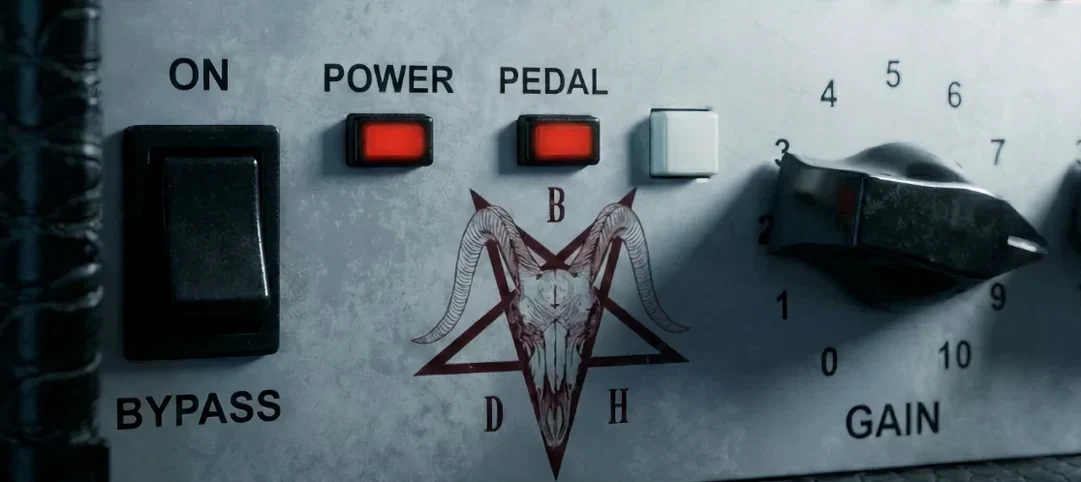 Bogren Digital Ampknob BDH 66o6 Plus
1.2.118 VST Plugins
253 MB
Bogren Digital Ampknob BDH 66o6 Plus
1.2.118 VST Plugins
253 MB
 Cableguys Snapback
1.1 VST Plugins
37 MB
Cableguys Snapback
1.1 VST Plugins
37 MB
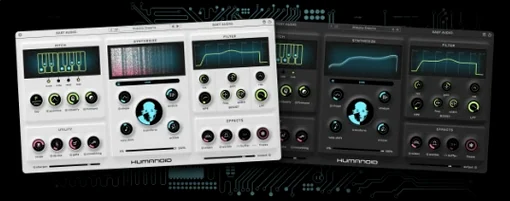 BABY Audio Humanoid
1.2.2 VST Plugins
Updated 39 MB
BABY Audio Humanoid
1.2.2 VST Plugins
Updated 39 MB
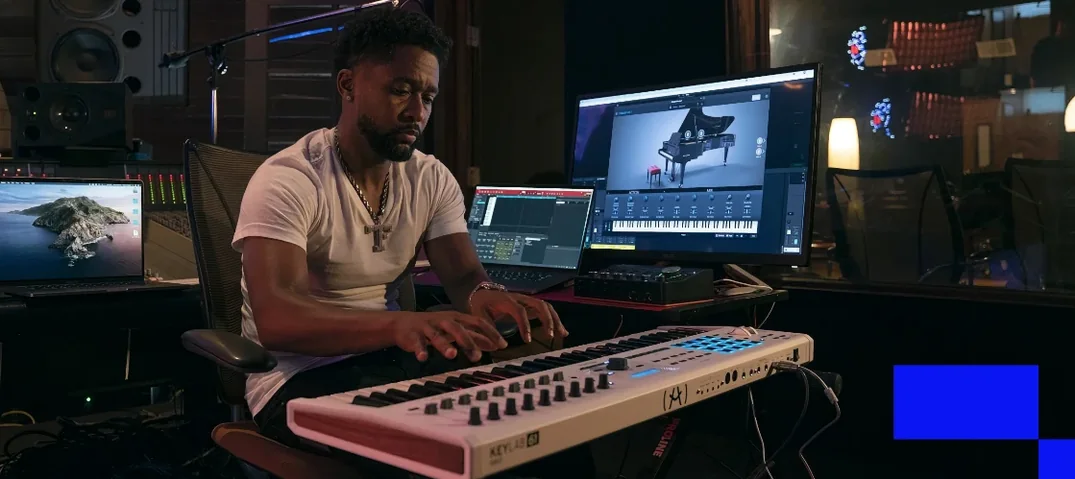 Arturia V Collection 11 Pro
2025.20.26 VST Plugins
53.8 GB
Arturia V Collection 11 Pro
2025.20.26 VST Plugins
53.8 GB
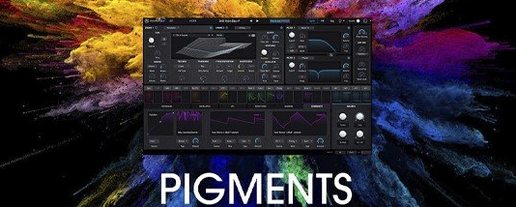 Arturia Pigments
7.0.1-6772 VST Plugins
1.8 GB
Arturia Pigments
7.0.1-6772 VST Plugins
1.8 GB
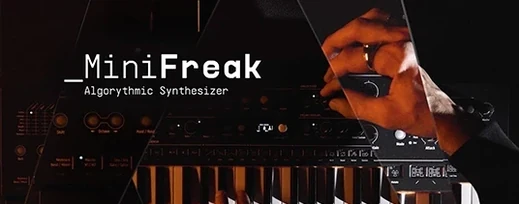 Arturia MiniFreak V
5.0.1-5869 VST Plugins
Updated 477 MB
Arturia MiniFreak V
5.0.1-5869 VST Plugins
Updated 477 MB
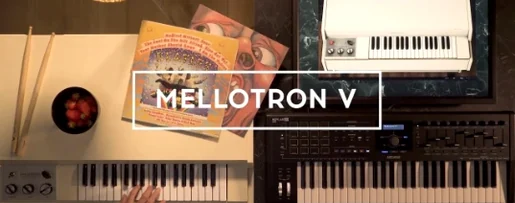 Arturia Mellotron V
1.9.3 VST Plugins
2.1 GB
Arturia Mellotron V
1.9.3 VST Plugins
2.1 GB
 Arturia FX Collection
2026.02 VST Plugins
16.1 GB
Arturia FX Collection
2026.02 VST Plugins
16.1 GB