
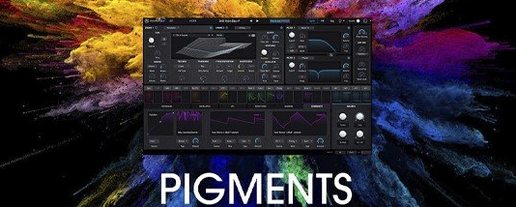
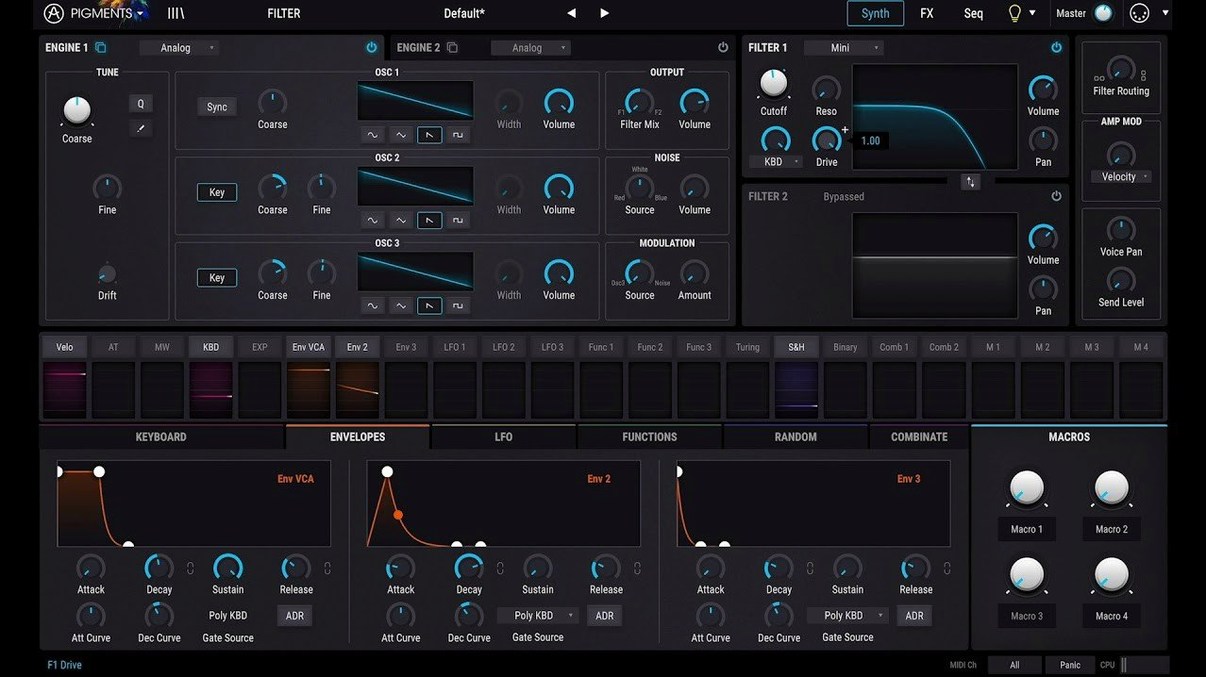
You grab one of the new Rage filters in Pigments 7's redesigned Play Page and realize the signal path has changed before you even touch the modulator. That’s the headspace this synth creates. The architecture invites you to reach for a mod source almost as soon as you load a patch. Drag an envelope onto the Corroder effect, tweak the wavetable position with a random LFO, and the sound starts pulling itself apart in a way that feels alive rather than broken. It transforms a static preset into a performance that reacts to every nudge of the mouse.
- Drag-and-drop modulation — you literally grab a source and drop it on any parameter. Four clicks and an oscillator is dancing to a sequencer lane.
- Built-in effects — the Corroder effect in version 7.0.1 adds textural decay that sits beautifully between reverb tails and lo-fi grit.
- Generative sequencing — the arpeggiator and sequencer can spit out patterns you didn’t program, making a held chord evolve for minutes.
- 150 new factory presets — they lean into the updated filter and effect roster, giving you immediate starting points for dark pads, percussive plucks, and shifting textures.
- Dual-engine flexibility — wavetable, virtual analog, and sample-based engines share the same modulation system, so hybrid patches feel cohesive.
If you spend more time designing than arranging, Pigments rewards that tendency. The 7.0.1 update — with its Ripple and Reverb filters, plus fresh wavetables and noise samples — makes the factory library feel like a tour of what the mod matrix can actually do. It runs on macOS 11 and up, and the installation package walks you through getting it authorized and running without guesswork.
Where Pigments Fits Among Heavyweight Synths
Put Pigments next to Xfer Serum, and the conversation usually starts with wavetables. Serum’s wavetable editor is deeper — you can draw harmonics freehand and watch them morph in real time. Pigments counters by treating wavetables as one engine among several, not the centerpiece. You get virtual analog, sample playback, and harmonic additive synthesis in the same patch, all routed through the same modulation system. Serum asks you to master one engine deeply. Pigments asks you to blend three or four without leaving a single window.
Against Native Instruments Massive X, the difference is philosophical. Massive X rewards precision: its routing feels like wiring a modular rack, and the performer modulators give you gestural control that suits bass design and tight rhythmic patches. Pigments is looser. The drag-and-drop modulation and color-coded interface make it faster to throw an envelope at an effect and hear what breaks. Massive X might yield a tighter low end if you spend the time. Pigments gets you to a patch that breathes and shifts before the coffee cools.
Where Pigments pulls ahead is the generative side. The sequencer and arpeggiator can randomize pitch, velocity, and gate length per step, and you can assign those lanes to any mod destination. Neither Serum nor Massive X bakes that into the synth itself. You need external MIDI plugins or DAW tricks to approximate it. For anyone chasing evolving textures or soundtrack cues, that alone tilts the decision.
Mod Matrix as a Field-Recording Crossfader
Sound designers working on game audio and film cues tend to live in the mod matrix. The ability to route a random LFO to wavetable position, then crossfade that with a sample engine loaded with field recordings, means a single held note can tell a story. The new Ripple and Reverb filters in 7.0.1 extend that with watery, pitch-smearing tails that sit beautifully under dialogue.
Bedroom producers who lean on presets but want to learn synthesis find the in-app tutorials a quiet advantage. They overlay directly on the interface, walking you through what each knob does while you hear the result. That lowers the barrier to making your own patches — something Massive X and Serum assume you already know how to do.
Live performers gravitate toward the redesigned Play Page. It surfaces macro controls across four performance knobs and an XY pad, letting you morph between drastically different timbres without touching the engine tabs. Mapping cutoff, Corroder mix, and sequencer rate to a single fader turns a pad into a rhythm section. That playability makes Pigments viable on stage, not just in the studio.
Macro Feedback Now Mirrors the Sound
The Play Page redesign is the most immediate shift. Before, performance controls felt tacked on — functional but not inviting. Now the layout puts macro assignments front and center, with visual feedback that mirrors what you hear. You reach for it instinctively, which changes how you audition presets and build live sets.
The Rage, Ripple, and Reverb filters expand the filter section beyond standard lowpass and comb models. Rage introduces aggressive, almost bit-crushed distortion before the filter stage. Ripple adds resonant, liquid movement — useful on plucks and arpeggios that need to feel wet without drowning in delay. The Reverb filter smears transients in a way that replaces an entire effects chain for ambient work.
The Corroder effect deserves its own mention. Placed after the filter or at the end of the chain, it introduces a grainy, tape-degradation texture that responds dynamically to input level. Drive it with a loud oscillator and it crumbles; feed it a soft pad and it adds warmth. Combined with the new noise samples — 20 of them, ranging from vinyl crackle to industrial hum — you can build patches that sound sampled from old gear without leaving the plugin.
The 150 factory presets added in 7.0.1 are not filler. They showcase the new filters and Corroder effect deliberately, giving you reverse-engineerable examples of what the updated engine can do. If you grab a pigments plugin crack to explore the library, those presets double as tutorials — drop a Ripple filter on a different wavetable and you’ve already learned something the interface doesn’t spell out. The 50 new wavetables and 30 samples round out the raw material, particularly the vocal and glassy textures that suit cinematic work.
Version 7.0.1 refines the front panel and deepens the sound-shaping toolkit.
- Redesigned Play Page puts performance controls front and center.
- New Rage, Ripple, and Reverb filters expand the tone-shaping palette.
- Corroder effect adds textured, lo-fi decay to the effects chain.
- 150 new factory presets, 50 wavetables, 30 samples, and 20 noises join the library.
- macOS 11 or later
- Intel or Apple Silicon Mac
Questions I actually get
What kind of synthesis does Pigments use on Mac?
Pigments is Arturia’s flagship all-in-one software synthesizer that combines wavetable, virtual analog, and sample-based engines with extensive modulation and built-in effects.
Porch talk 0
Come in or pull up a chair to leave a comment.
Nobody has pulled up a chair yet. If you used it on a real Saturday, say what the hour was.
More for the same hour
Everything in VST Plugins Arturia MiniFreak V
5.0.1-5869 VST Plugins
Updated 477 MB
Arturia MiniFreak V
5.0.1-5869 VST Plugins
Updated 477 MB
 Arturia Mellotron V
1.9.3 VST Plugins
2.1 GB
Arturia Mellotron V
1.9.3 VST Plugins
2.1 GB
 Arturia V Collection 11 Pro
2025.20.26 VST Plugins
53.8 GB
Arturia V Collection 11 Pro
2025.20.26 VST Plugins
53.8 GB
 Arturia FX Collection
2026.02 VST Plugins
16.1 GB
Arturia FX Collection
2026.02 VST Plugins
16.1 GB
 Arturia Emulator II V
1.6.2 VST Plugins
700 MB
Arturia Emulator II V
1.6.2 VST Plugins
700 MB
 Arturia Efx AMBIENT
1.0.0 VST Plugins
285 MB
Arturia Efx AMBIENT
1.0.0 VST Plugins
285 MB
 Arturia Augmented STRINGS
2.0.0 VST Plugins
4.9 GB
Arturia Augmented STRINGS
2.0.0 VST Plugins
4.9 GB
 Arturia Analog Lab V
5.12.0 VST Plugins
4.4 GB
Arturia Analog Lab V
5.12.0 VST Plugins
4.4 GB