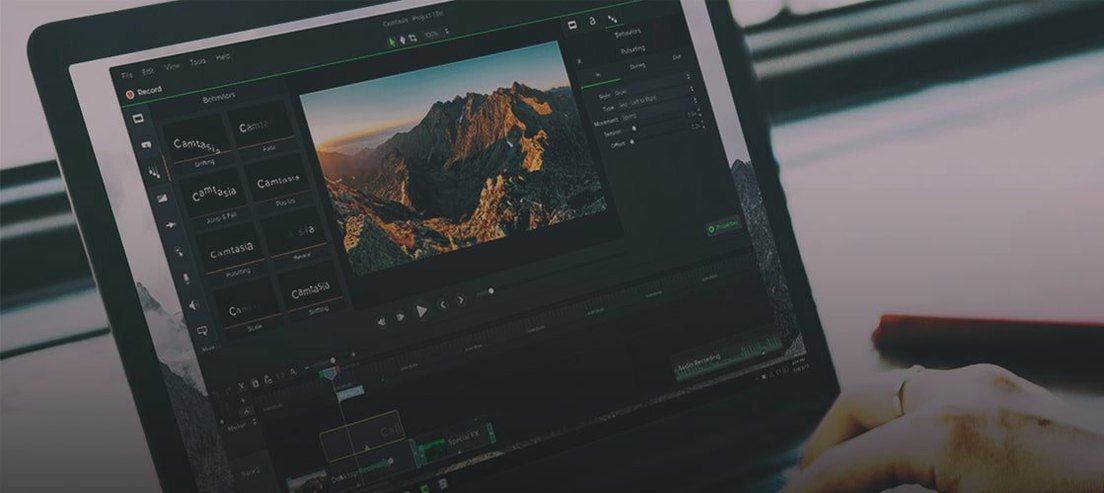
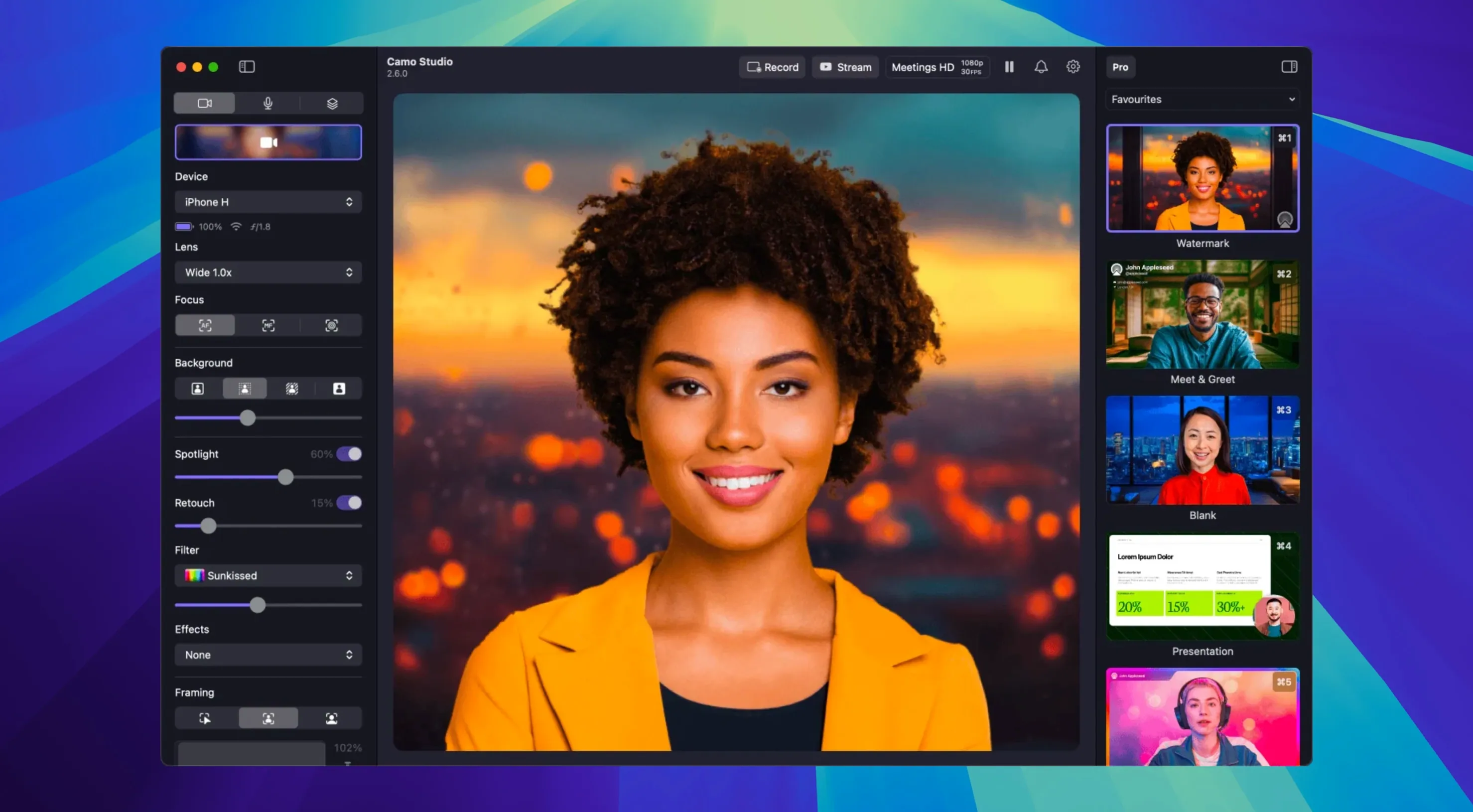
If you already rely on OBS for streaming or Zoom for calls, Camo Studio slides in next to them as the piece that handles how you actually look. It takes the feed from an iPhone, a mirrorless camera, or a tablet and gives it the kind of polish most meeting apps never offer — AI face retouching, a Portrait mode with real bokeh, and automatic framing that keeps you centered even when you shift in your chair.
| What it does | What runs it |
|---|---|
| Camera control & video production | macOS 12.3+ (Apple Silicon & Intel) |
| Version 2.9.0 | Also works with tablets |
What makes it feel like a natural addition rather than an outsider is the way it plugs into the apps you already use. Build a scene with layers, text, logos, and web overlays inside Camo Studio, then that composed feed shows up in Teams, OBS, or FaceTime as if it was a plain webcam. The 18 built-in filters and LUT support mean you can match the look of your stream to the rest of your brand. Version 2.9.0 brought audio noise reduction and dual-format recording, so you catch clean sound and a backup file at the same time. Toss in digital stabilization and you have a setup that cleans up a handheld phone feed without extra hardware. If you regularly switch between a desk camera and a handheld shot on the go, the combo of auto framing, overlays, and noise reduction makes it worth a look.
Picture a freelance trainer who runs live coding workshops three times a week. Her desk faces a window, so by mid-afternoon she’s a silhouette. She’s tried adjusting blinds, buying a ring light, and fiddling with the webcam settings in Zoom, but every session starts with a minute of “Can you see me okay?” Camo Studio changes that pattern. She plugs in an older iPhone she had in a drawer, positions it on a small tripod, and enables the Video Call mode. The software lifts the shadows on her face without blowing out the window behind her. She adds a small logo overlay in the corner and saves the whole arrangement as a scene. Next time she launches a call, it’s all waiting — same framing, same light correction, no scrambling. Between sessions she records isolated clips of code walkthroughs at 4K, keeping the microphone audio clean with the noise reduction that arrived in version 2.9.0. It’s not a streaming studio; it’s just a desk that finally works for video.
Dodging the three-step device handshake
Most hiccups with Camo Studio aren’t about the app itself — they’re about the handshake between devices and the apps that consume the feed. Here are the three I hear about most often.
Phone not recognized after plugging in. The Mac sees the device as a storage drive or charges it without opening the camera feed. The fix is almost always the order of operations: unlock the phone, open the Camo companion app on the phone, then plug in the USB cable. If that doesn’t do it, check that the cable carries data — some charge-only cables won’t work. A quick test is connecting the phone to the Mac and seeing if it appears in Image Capture or Finder; if it doesn’t, swap cables.
Zoom or Teams doesn’t show Camo Studio as a camera option. After installing Camo Studio, the virtual camera device needs a moment to register. Quit the meeting app completely and relaunch it. On Apple Silicon Macs, you may also need to grant camera permission in System Settings under Privacy & Security. Once that’s toggled on, the Camo Studio Camera should appear in any app that lists cameras.
Frame rate drops during a call while using overlays. Rendering multiple layers — a background replacement, a text overlay, and a web widget — pushes the phone’s processor. If the video stutters, try lowering the output resolution or frame rate in Camo Studio’s settings. Dropping from 60 fps to 30 fps often clears it up without making the feed look jerky. Also, close any other camera-using apps on the phone; they can fight for the sensor.
Where it splits from Continuity Camera
Camo Studio isn’t alone in the “phone as webcam” space, but its approach sets it apart from the built-in tools and the lightweight alternatives.
Continuity Camera. Apple’s own solution ships with macOS and works with zero setup — wireless or wired, it just appears in your camera list. It supports Portrait mode and Center Stage on recent iPhones. Where Camo Studio pulls ahead is in control. Continuity Camera gives you a clean feed; Camo Studio gives you manual focus, white balance sliders, LUT support, overlays, and audio noise reduction. If you want to set a look and keep it across apps, Camo Studio is the deeper tool. If you just need a quick, sharp camera for a single call, Continuity Camera wins on simplicity.
EpocCam. Elgato’s EpocCam turns an iPhone into a webcam and integrates tightly with the Elgato ecosystem. It’s a solid pick for streamers who already own a Stream Deck. Camo Studio matches it on core features but goes further with AI face retouching, dual-format recording, and a richer scene composer. EpocCam leans toward the gaming and live-streaming crowd; Camo Studio feels built for the broader set of people who split their day between meetings, recordings, and the occasional live broadcast.
IVCam. IVCam has been around for years as a budget-friendly option that covers Windows and Mac. It handles the basics — phone as webcam, audio passthrough, some brightness controls. It doesn’t offer LUT management, AI retouching, or the overlay system Camo Studio includes. IVCam suits someone who wants a one-button connection and doesn’t care about scene building. Camo Studio suits the person who wants to compose a feed once and have it look intentional everywhere.
For anyone who landed here while looking for a camo studio crack or a camo studio torrent, you’ll get the full set of scene tools, noise reduction, and dual-format recording in the standard download — no digging through a camo studio pro torrent or a camo pro torrent necessary. The same applies if you searched for camo studio cracked: the app is ready to run as soon as you drop it into Applications and connect a phone.
Version 2.9.0 rounds out the audio and recording side nicely. New additions include:
- Dual-format streaming and recording on macOS
- Isolated recordings, so you can capture clean tracks separately
- Audio noise reduction built in
- Control from AI agents on macOS
- macOS 12.3 or later
- Apple Silicon or Intel 64-bit Mac
Questions I actually get
Does Camo Studio run on macOS Tahoe?
No, Camo Studio requires macOS 12.3 or later and does not work on macOS Tahoe.
Porch talk 0
Come in or pull up a chair to leave a comment.
Nobody has pulled up a chair yet. If you used it on a real Saturday, say what the hour was.