

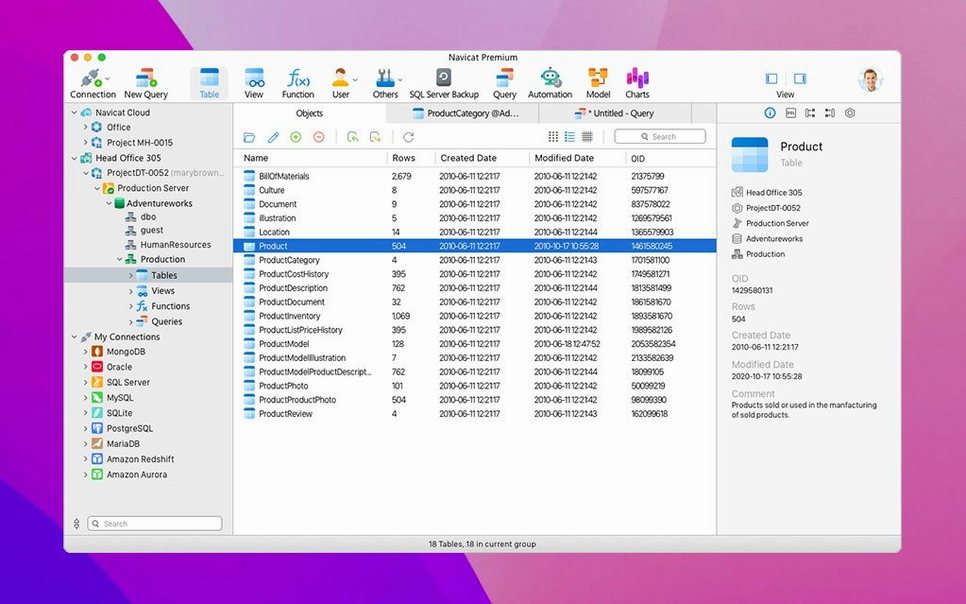
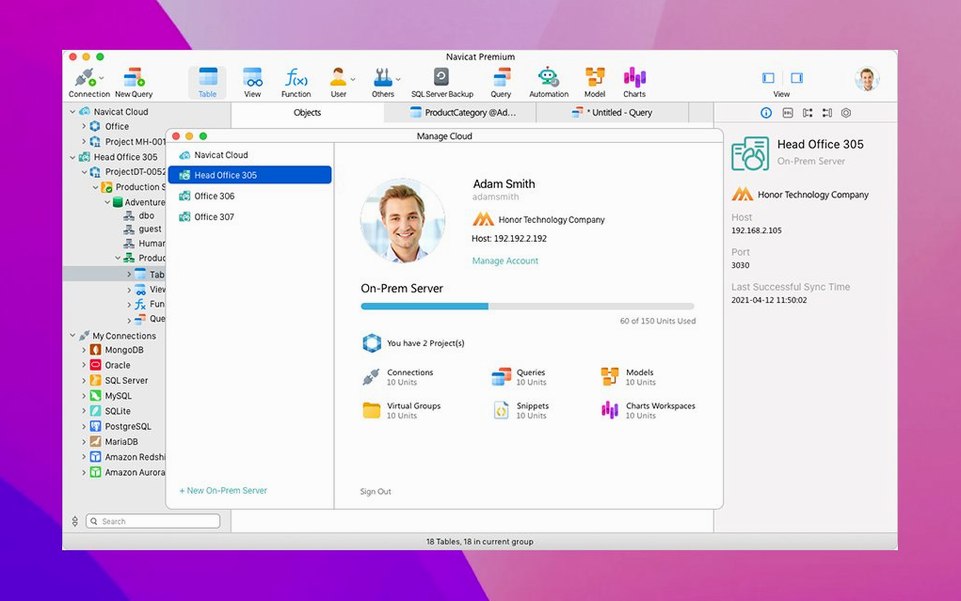
Navicat Premium is a database administration and development app that puts connections to multiple database types inside one Mac interface. It combines functions found in other Navicat apps, so you can manage local and remote servers without switching tools.
Start with a simple connection. The app supports multiple connections to local and remote database servers, and SSH Tunnel keeps remote sessions safe. Once connected, open the SQL console to create and run queries, then try the SQL Minifier when a long statement needs tidying.
Next, explore the data tools. You can import and export data in XLS, CSV, TXT, DBF, and XML formats, and data synchronization helps keep separate databases aligned. Unicode support means names and text outside plain English come through cleanly.
For everyday upkeep, look at the backup tools and the job scheduler. Backups give you a quick safety net, while the scheduler handles routine maintenance on a timetable. Newcomers should try these first; they cover the most useful ground without digging into advanced design features.
Gatekeeper Blocking Your First Launch
Mount the disk image, drag the app into Applications, and you're nearly set—but a couple of things tend to trip people up during those first launches. The Gatekeeper bypass step catches some off guard. After mounting, you run Open Gatekeeper friendly, paste the line into Terminal, and press Enter. If the sign-in window pops up afterward, just close it; the app is already ready to go.
Another headache shows up when a connection refuses to establish, even though credentials look right. Before digging through logs, check whether the SSH Tunnel or HTTP Tunnel settings match what the remote server expects. A mismatch there—say, the wrong port or a missing private key—can stall a connection that worked fine in a standalone client. Start plain: connect without the tunnel first to confirm the database itself is reachable, then layer the tunnel back in.
Character encoding confusion surfaces occasionally, especially when migrating data between engines. The app handles Unicode well, but if you see garbled text after an import, the source file's encoding likely doesn't match what you told the wizard. CSV exports from Windows machines still arrive in older code pages sometimes. Open the file in a plain text editor, note the actual encoding, and resubmit the import with that setting.
Color-Coding Production and Dev Connections Early
Spend the first afternoon setting up your core connections and grouping them by project. The connection list grows fast once you add staging, production, and local development instances. Color-code each group from the start—red for production, blue for development—so a quick glance tells you where you're about to run that DROP statement.
Next, record two or three queries you run daily and save them. The query builder helps here, but typed SQL stored in the favorites pane saves you from rebuilding joins every time someone asks for the same customer report. While you're at it, schedule one backup job for a non-critical database and let it run overnight. The job scheduler is straightforward, and a dry run builds confidence before you trust it with production data.
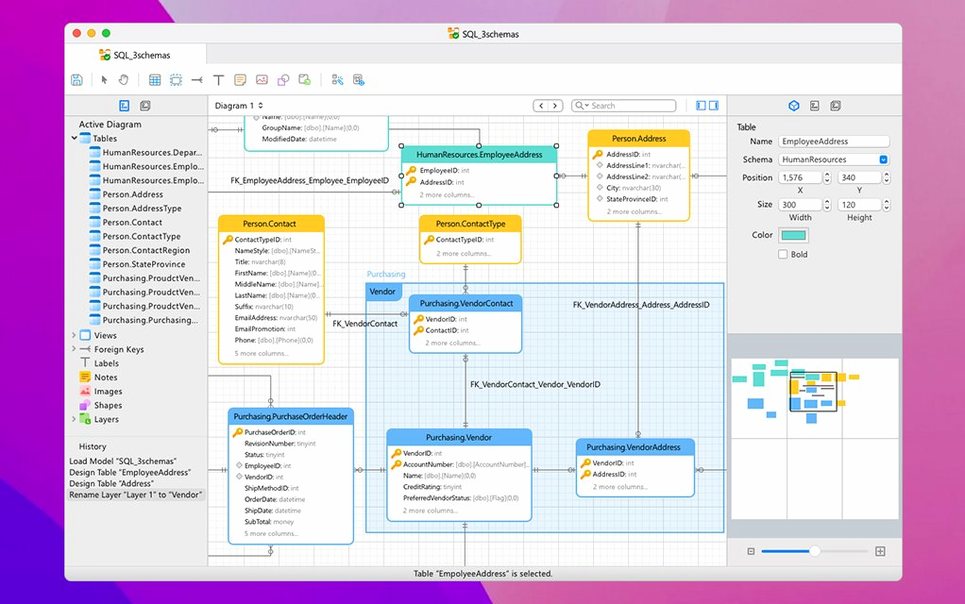
Give the data modeling tools a spin on a sample schema you already know. Reverse-engineer an existing database into the ER data model and tinker with relationships visually. Even if you prefer writing DDL by hand, seeing a diagram of foreign keys catches missing indexes you might otherwise overlook.
Database Engine Count vs. TablePlus’ Simpler Scope
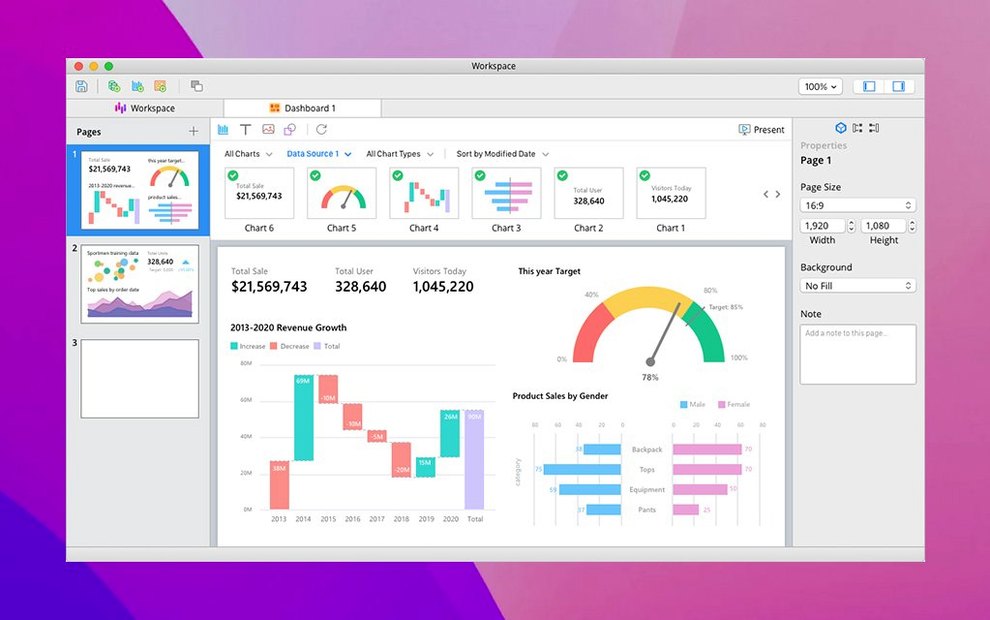
TablePlus takes a lighter approach. It opens fast, sports a native Mac look, and covers MySQL, PostgreSQL, SQLite, and a few others with a clean query editor. Where Navicat Premium pulls ahead is the breadth of engines—Oracle, MongoDB, Redis, and Snowflake are built in rather than bolt-ons—and the extras like data synchronization, scheduled jobs, and the report wizard. TablePlus suits quick edits and browsing; Navicat Premium is closer to a full admin console.
DBeaver shares the multi-database ambition and supports an enormous list of engines through JDBC drivers. Its community edition is open source, and the Mac experience feels more toolkit than polished appliance. Navicat Premium bundles data modeling and business intelligence tools without hunting for plugins, and the interface stays consistent whether you're tweaking a MongoDB document or a PostgreSQL function. If you value a unified design over limitless driver configurability, the difference is apparent within an hour.
Sequel Ace (and its predecessor Sequel Pro) focuses tightly on MySQL and MariaDB. For a single-engine workflow, it's quick and friendly. The moment you need to join data across a PostgreSQL warehouse and a SQL Server instance, you're juggling separate apps. Navicat Premium keeps those cross-engine migrations and queries under one roof. The import and export wizard alone saves a mess of intermediate files when you're moving tables between Oracle and MySQL.
If you touch three or more database engines in a typical week—or you're the person everyone calls when a migration stalls—the all-in-one approach here is worth the ramp-up time. Start with a couple of connections, set up one scheduled backup, and let the broader toolset reveal itself as you need it.
Version 17.3.12 tidies up a handful of lingering issues and smooths out overall performance across the toolkit.
- macOS 11 (Big Sur) or later
- Works natively on both Apple Silicon and Intel 64-bit Macs
Questions I actually get
Is Navicat Premium the right choice for someone who works with several database types?
Yes. It combines functions found in other Navicat apps, so you can design, manage, and maintain multiple database types from one interface instead of running separate tools.
Porch talk 0
Come in or pull up a chair to leave a comment.
Nobody has pulled up a chair yet. If you used it on a real Saturday, say what the hour was.
More for the same hour
Everything in Mac Apps
 Musify
5.3.0 Mac Apps
68 MB
Musify
5.3.0 Mac Apps
68 MB

 MuMu Player Pro
1.6.10 fix inquten Mac Apps
715 MB
MuMu Player Pro
1.6.10 fix inquten Mac Apps
715 MB
 m’s HalfTone
1.5.3 Mac Apps
6 MB
m’s HalfTone
1.5.3 Mac Apps
6 MB

 Mp3tag
1.14.1 Mac Apps
13 MB
Mp3tag
1.14.1 Mac Apps
13 MB

 Movist Pro
2.17.2 Mac Apps
60 MB
Movist Pro
2.17.2 Mac Apps
60 MB

 Movavi Video Suite
22.4.1 Mac Apps
294 MB
Movavi Video Suite
22.4.1 Mac Apps
294 MB

 Movavi Video Editor
22.4.1 Mac Apps
126 MB
Movavi Video Editor
22.4.1 Mac Apps
126 MB

 Movavi Video Converter
22.5.0 Mac Apps
79 MB
Movavi Video Converter
22.5.0 Mac Apps
79 MB