

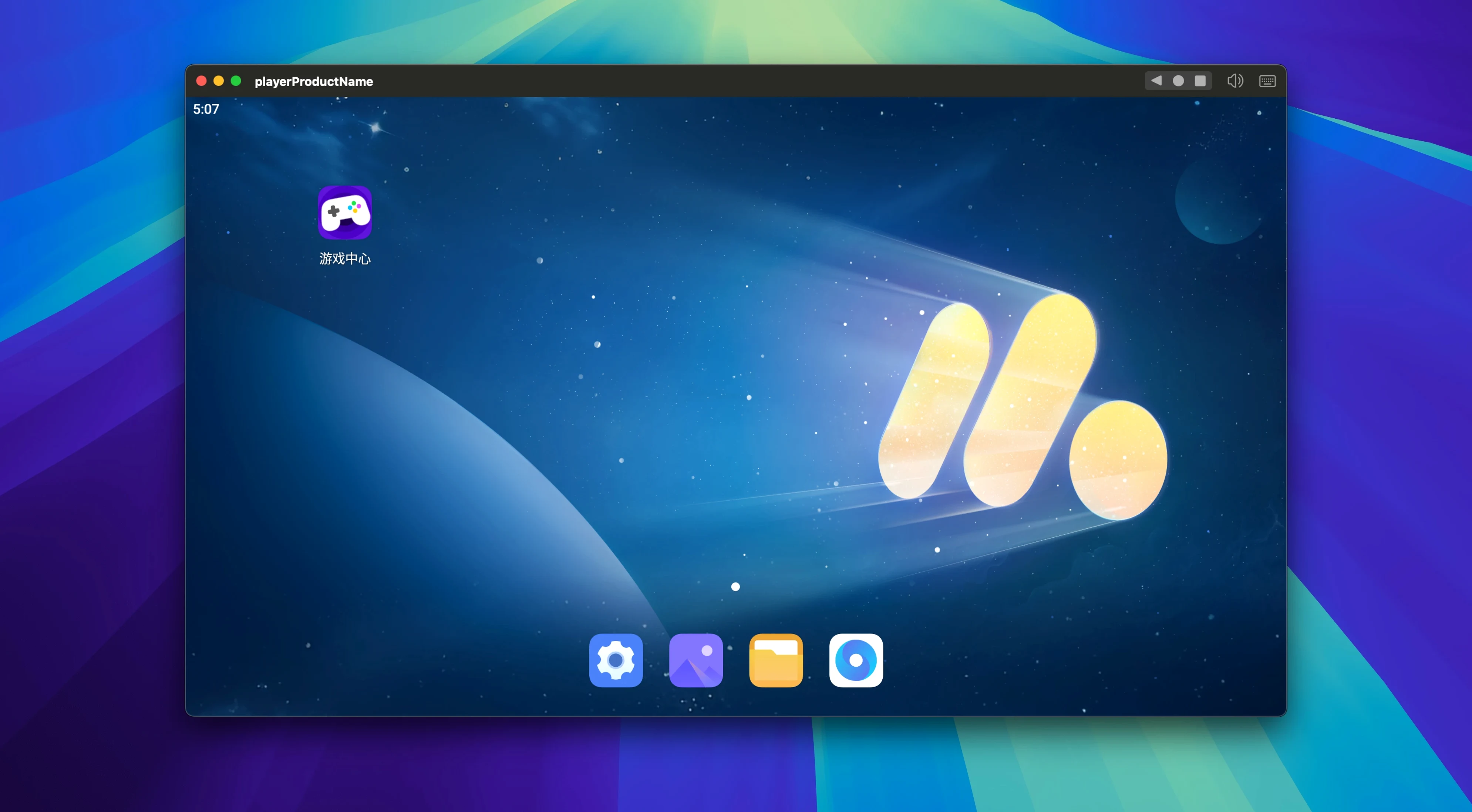
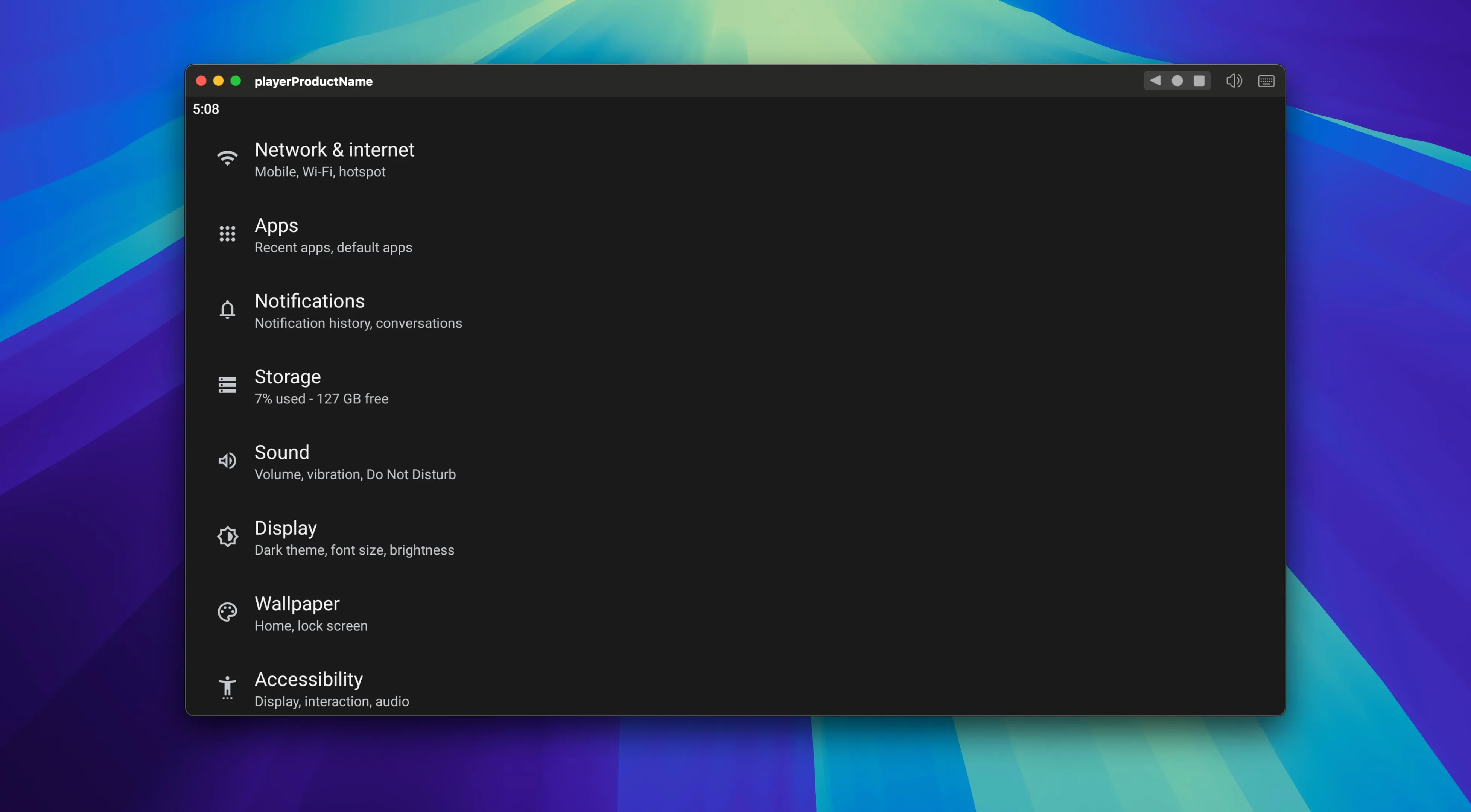
Version 1.6.10 lands with a handful of fixes for recent macOS releases, while everything that made the emulator useful remains untouched. It's a maintenance update that keeps the engine running smoothly on Apple Silicon.
Run Android apps on your desktop
Drag an APK straight into the window and it installs without fuss. Once an app is running, keyboard and mouse controls map naturally to taps and swipes, so you aren't stuck poking at a virtual screen.
Capture what's on screen
Built-in screen recording and screenshot tools let you grab gameplay clips or document app behavior. No extra software needed — just hit the button in the toolbar.
Dial in the performance
Frame rate settings range from a battery-friendly 30 FPS all the way up to a smooth 120 FPS. Adjust it per session depending on whether you're reading or gaming.
Folks usually wonder about a few things before committing disk space to an Android emulator, so let's clear those up. The first question is almost always about compatibility with Apple Silicon. MuMu Player Pro is built exclusively for ARM Macs, which means it runs directly on the M1, M2, M3, and M4 chips without Rosetta translation. That native architecture is why the frame rates hold steady and the fan stays quiet even during longer gaming sessions. Another common concern is where the apps come from. The emulator opens like any Android device — you sign into the Google Play Store and install from your library, or you drag an APK file you already have onto the window. There's no bundled store you're locked into. People also ask whether keyboard mapping works for games that weren't designed for physical controls. The answer is yes, but it takes a few minutes of setup. You can assign WASD to a virtual joystick, map keys to tap points, and save those layouts per game so you only do the work once.
A shooter setup from start to finish
Say you want to play a first-person shooter that was built for touchscreens. Here's a workflow that gets you from an empty desktop to a match in under ten minutes. First, launch MuMu Player Pro and sign into the Play Store with the Google account you use for Android apps. Search for your game and install it the way you would on a phone. While it downloads, open the keyboard mapping tool from the sidebar — it's the icon that looks like a gamepad. Once the game loads, you'll be staring at a tutorial screen with virtual joysticks and fire buttons scattered across the display. Don't touch them yet. Click the mapping tool again and drag a directional pad overlay onto the left thumbstick area, then bind it to the W, A, S, and D keys. Next, place tap-point overlays on the fire, reload, and jump buttons, assigning each to a mouse button or a nearby key like R and Space. Save the profile with a name that includes the game title and the date. Now adjust the in-app graphics settings — most shooters let you toggle between quality and performance modes — and push the emulator's FPS slider to 90 or 120 in the toolbar. That's it. You're playing with a mouse and keyboard, and the on-screen controls fade into muscle memory.
Bump Resolution to Your Mac’s Proportions
Out of the box the emulator picks sensible defaults, but three adjustments make a noticeable difference. Head to the display settings first and bump the resolution to match your Mac's screen proportions. The default is fine for a phone-shaped window, but on a 16-by-10 or 14-inch MacBook panel a custom resolution prevents black bars and uses every pixel. Next, in the performance pane, lock the frame rate at 60 FPS for everyday apps and switch to 90 or 120 only when you launch a game. Leaving it pegged at 120 drains the battery faster without improving the experience in a notes app or a messaging client. The third change is less obvious: open the audio settings and route sound to the same output device you use for macOS. If you wear Bluetooth headphones, toggling this once keeps audio from jumping to the Mac speakers every time you start a new session.
An app tester's afternoon
Lena builds mobile interfaces for a small design studio. She keeps MuMu Player Pro pinned to her dock because it lets her check Android builds without reaching for a test phone. On a typical Tuesday, she opens the emulator at 9 a.m., drags an APK from a Slack thread into the window, and watches the install progress bar. The app appears on the home screen a few seconds later. She rotates the interface twice — once to landscape, once back to portrait — to confirm that layout constraints hold. A quick screenshot goes into a Figma frame for annotation. Mid-morning, a colleague asks whether a button label reads correctly on a medium-density display. Lena switches the resolution to 720p, snaps another screenshot, and moves on. By lunchtime she's cycled through four builds, recorded a ten-second screen capture of a transition bug, and mapped a few keyboard shortcuts for repeated taps on a login form. The whole workflow happens on one machine, and she never unplugs her phone from the charger on her nightstand.
Version 1.6.10 addresses a few known hiccups that appeared in recent macOS updates.
- macOS 11 or later
- Apple Silicon Mac
Questions I actually get
Which Macs can run MuMu Player Pro?
It's built exclusively for Apple Silicon Macs and requires macOS 11 or later.
What languages does the interface support?
The app is available in English and Simplified Chinese.
Porch talk 0
Come in or pull up a chair to leave a comment.
Nobody has pulled up a chair yet. If you used it on a real Saturday, say what the hour was.
More for the same hour
Everything in Mac Apps m’s HalfTone
1.5.3 Mac Apps
6 MB
m’s HalfTone
1.5.3 Mac Apps
6 MB

 Musify
5.3.0 Mac Apps
68 MB
Musify
5.3.0 Mac Apps
68 MB

 Mp3tag
1.14.1 Mac Apps
13 MB
Mp3tag
1.14.1 Mac Apps
13 MB
 Movist Pro
2.17.2 Mac Apps
60 MB
Movist Pro
2.17.2 Mac Apps
60 MB

 Movavi Video Suite
22.4.1 Mac Apps
294 MB
Movavi Video Suite
22.4.1 Mac Apps
294 MB

 Movavi Video Editor
22.4.1 Mac Apps
126 MB
Movavi Video Editor
22.4.1 Mac Apps
126 MB

 Navicat Premium
17.3.12 Mac Apps
Updated 333 MB
Navicat Premium
17.3.12 Mac Apps
Updated 333 MB

 Movavi Video Converter
22.5.0 Mac Apps
79 MB
Movavi Video Converter
22.5.0 Mac Apps
79 MB