
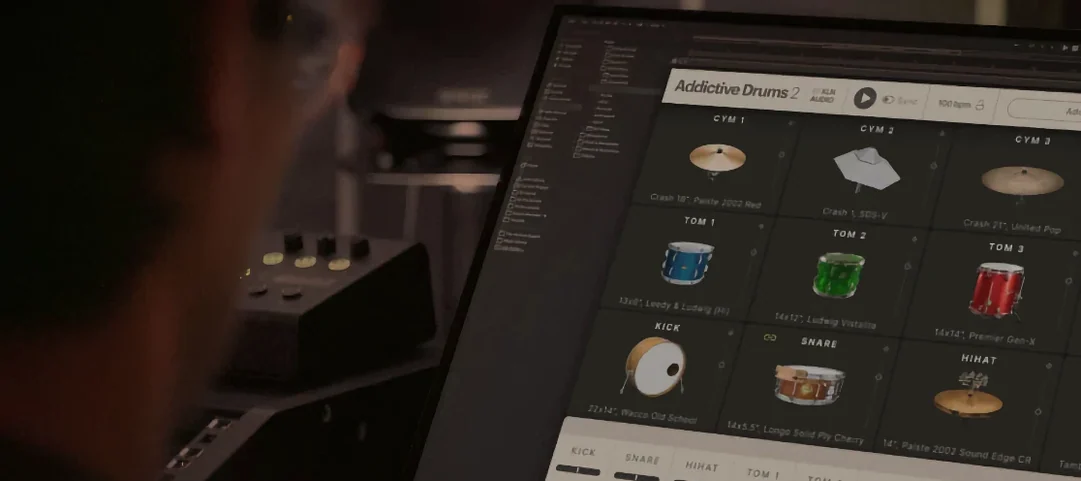
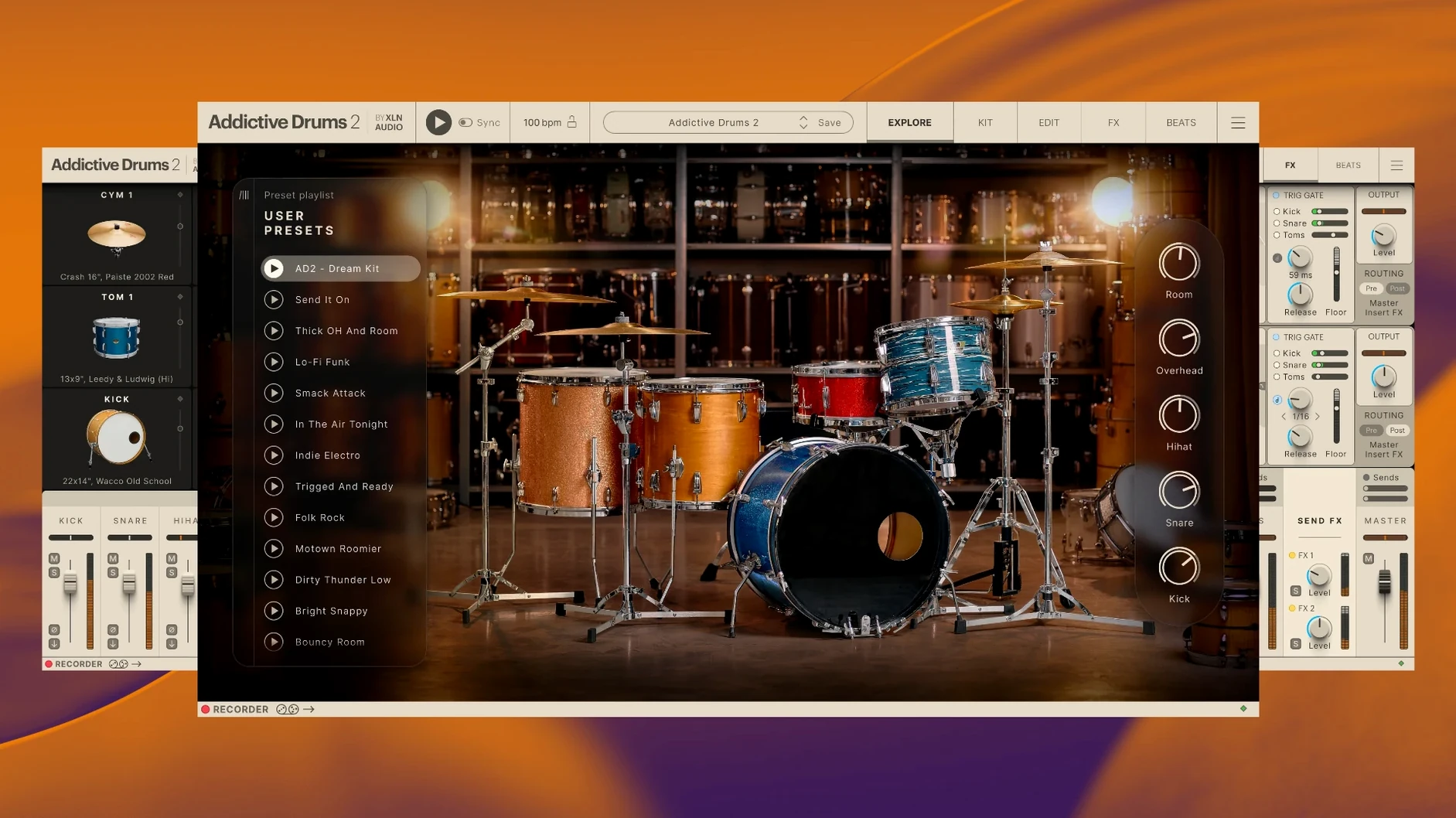
Scroll through the Fairfax Vol. 1 kit pieces and it hits you — that snare has the exact tight, ringing crack you need for a gospel pocket. Building a custom setup in Addictive Drums 2 is like walking into a well-stocked drum room where every shell, cymbal and room mic is fair game. You pull a deep maple kick from one ADpak and pair it with a piccolo snare from another, all without leaving the single plugin window.
The Complete Collection throws the doors wide open. Every ADpak, MIDIpak and Kitpiece Pak XLN Audio has released sits right inside the browser, so a dusty boom-bap hip hop beat or a crisp modern funk groove starts with the same first step: dragging sounds onto the kit grid. The onboard effects channel strip lets you shape the tone before you even hit record, which means less time mixing and more time playing.
Mapping it to your controller or tapping out a pattern on the grid gives you a finished-sounding drum track in minutes. The MIDI library covers fills, intros and full song structures that slot straight into your arrangement. It feels less like programming and more like directing a session player who actually listens.
Some of the best time-savers in version 2.9.1 are under your fingertips, not in a menu. Tap the T key while hovering over any drum piece and you instantly tune it up or down without reaching for the pitch knob. Hold Shift and drag a fader in the mixer to make micro adjustments. Right-click any kit piece and choose Copy to all variations when you have dialed in a snare sound that should carry across every snapshot of your session. These are the moves that become muscle memory after a week.
A few other small conveniences worth knowing:
- Cmd+click on a drum pad triggers it at full velocity, handy when you are auditioning rimshots or ghost notes without a controller plugged in.
- The kit piece search bar in the browser accepts partial names — type "maple" and every compatible shell from every ADpak appears, no need to remember which collection it came from.
- In the Beats browser, filtering by time signature (3/4, 6/8) is tucked into a dropdown that a lot of folks scroll right past. It is a lifesaver when the default 4/4 shuffle does not fit.
- You can drag any MIDI groove directly onto your DAW timeline instead of into the plugin's internal player, which opens up easy editing of kick patterns or hi-hat articulations without bouncing to audio first.
Apple Silicon stability arrives without a rewrite
Version 2.9.1 did not rewrite the engine, and that is a good thing. What XLN Audio focused on was stability on Apple Silicon and a smoother browsing experience when you have the Complete Collection installed. Scrolling through the full ADpak list used to have a tiny hitch on M-series Macs, and that is gone now. The kit piece thumbnails load faster, and switching between kit presets feels snappier — the kind of change you stop noticing after a day but would miss immediately if it reverted.
Under the hood, the audio engine got tighter handling of multi-out routing in Logic Pro and Ableton Live. If you split kick, snare and overheads to separate DAW channels, the timing alignment between those outputs is sample-accurate now. That matters when you are printing stems for a mix engineer. The MIDI drag-and-drop also got a small but meaningful fix: dragging a groove into Studio One no longer drops it a bar late, which had been a quiet frustration in forums for a while.
For anyone working with the addictive drums 2 full package, the update cleaned up how kit piece assignments behave when you swap an entire kit with one click. Previously, custom mappings could reset; now they stick. That alone makes building hybrid kits across ADpaks less of a chore.
That onboard channel strip is not a decoration
The biggest one is treating the internal mixer like an afterthought. The channel strip on every kit piece has a compressor, EQ, saturation and a transient shaper sitting right there, pre-fader. A new producer will often load up Fairfax or the addictive drums gospel kit, hear something that sounds thin, and immediately reach for third-party plug-ins on the DAW channel. That is backwards. Shape the close mics and room mics inside the plugin first — the presets are starting points, not finished sounds — and you will need far less processing downstream.
Another common stumble: ignoring the room and overhead channels entirely. When someone says their programmed drums sound robotic, nine times out of ten they have the room fader pulled down to zero. Push it up until you feel the space, then dial it back until it sits. The Bleed control under each kit piece is equally overlooked; a little hi-hat bleed into the snare mic is what makes a groove breathe.
Beginners also tend to load a single MIDI groove and loop it unchanged for four minutes. The Beats browser has variations, fills and intros for every style. Stack three or four related grooves, drop a fill at the end of every eight bars, and suddenly the performance has shape. If you are working on an addictive drums hip hop pattern, try nudging the hi-hat MIDI notes slightly off the grid after dragging them in — the engine responds to velocity and timing in a way that quantized blocks simply do not.
A kit for a warm, tube-pushed kick in your head
You open a blank project and load Addictive Drums 2 as a stereo instrument track. The default kit loads, but you have a sound in your head already — something warm and dry, tube-driven, with a kick that punches through a dense arrangement. You open the browser, type "Black Oyster" into the search, and drag the full kit onto the grid. The shells land in place, cymbals pop into their slots, and you tap the kick pad a few times to feel the weight of it.
That kick is close but needs more attack. You click the kick piece, open the channel strip, and push the transient shaper's attack knob to about 2 o'clock. The EQ gets a gentle bump at 4 kHz for beater click. You pull up the room fader halfway, then add a touch of the onboard plate reverb to the snare top mic only. Three minutes in and the kit already sounds like it was tracked in a treated live room.
Next you open the Beats browser, filter by "soul" and drag a groove into the internal player. It is a solid pocket but the verse needs something sparser. You drag a second variation, drop a fill at bar seven, and copy the whole sequence out to your DAW timeline by dragging the MIDI block straight onto the arrange window. The notes land as editable MIDI, so you thin out the kick pattern in the verse and shift a few snare hits to ghost notes by lowering their velocity.
With the arrangement roughed in, you route the kit to multi-out: kick on 3/4, snare on 5/6, overheads on 7/8, room on 9/10. The timing between outputs is tight, no phasing when soloing the close mics against the room. You print a rough mix, then nudge the overhead panning slightly wider using the mixer inside the plugin. The final stems go to your mix bus with almost nothing on the DAW channels except a gentle bus compressor. The heavy lifting happened inside Addictive Drums 2, where it belongs.
If you have been auditioning kits one at a time and wondering why your drums do not sit right, or if you grabbed the addictive drums latest version and barely scratched past the presets, spend an afternoon inside the channel strip and the Beats browser. The engine rewards the time you put into it.
And for those working with addictive drums midi packs, a final tip: treat the included grooves as raw material, not finished parts. Drag them in, slice them up, re-voice the kick pattern, and layer a shaker from a different MIDIpak on top. The magic is in the combination.
If you have been layering samples to fake a live room feel, this is the shortcut you have been ignoring.
- macOS 10.13 or later
- 64-bit host (Intel and Apple Silicon supported)
Questions I actually get
What do I need to run Addictive Drums 2 on a Mac?
You need macOS 10.13 or later and a 64-bit host. It runs natively on both Apple Silicon and Intel processors.
Porch talk 0
Come in or pull up a chair to leave a comment.
Nobody has pulled up a chair yet. If you used it on a real Saturday, say what the hour was.
More for the same hour
Everything in VST Plugins Addictive Keys
1.7.3 VST Plugins
4.2 GB
Addictive Keys
1.7.3 VST Plugins
4.2 GB
 Ample Guitar M
4.1.0 VST Plugins
5.2 GB
Ample Guitar M
4.1.0 VST Plugins
5.2 GB
 Ample Sound Ample Guitar LP III
4.0.1 VST Plugins
9.2 GB
Ample Sound Ample Guitar LP III
4.0.1 VST Plugins
9.2 GB
 Arturia Analog Lab V
5.12.0 VST Plugins
4.4 GB
Arturia Analog Lab V
5.12.0 VST Plugins
4.4 GB
 Arturia Augmented STRINGS
2.0.0 VST Plugins
4.9 GB
Arturia Augmented STRINGS
2.0.0 VST Plugins
4.9 GB
 Arturia Efx AMBIENT
1.0.0 VST Plugins
285 MB
Arturia Efx AMBIENT
1.0.0 VST Plugins
285 MB
 Arturia Emulator II V
1.6.2 VST Plugins
700 MB
Arturia Emulator II V
1.6.2 VST Plugins
700 MB
 Arturia FX Collection
2026.02 VST Plugins
16.1 GB
Arturia FX Collection
2026.02 VST Plugins
16.1 GB