


Adobe Dimension is a 3D design app built for creating product mockups, packaging visuals, and photorealistic scene compositions without a deep background in 3D software.
| Version | macOS Required |
|---|---|
| 4.1.7 | macOS 11 (Intel) |
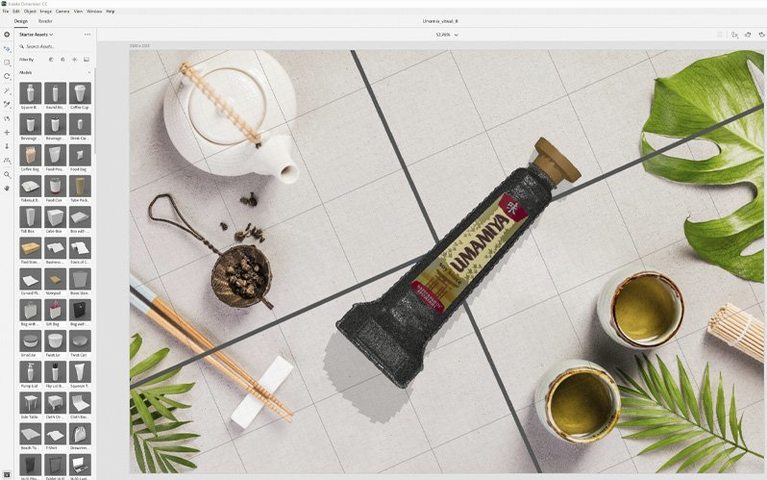
Most people hunting down information on this release want to know if it handles the basics without sending them down a 3D modeling rabbit hole. It does. You can drag a logo or vector graphic onto a model, pick a material, and watch the app sort out the lighting, perspective, and shadows. If you need to refine things further, you can export layered scenes straight into Photoshop CC. The interface is kept approachable, and Adobe Stock has a library of optimized 3D models ready to drop in. For someone who needs a clean product shot or a combined 2D-and-3D layout, Dimension gives you a single place to compose and render it. It is a good fit for graphic designers who want realistic mockups without learning a full 3D suite.
For Illustrator pros who dread 3D jargon
Graphic designers who spend their days in Illustrator and Photoshop but break into a cold sweat at the mention of vertices or UV maps. These are folks who need a bottle label mockup by Thursday, not a semester of 3D fundamentals. Branding teams fall into the same camp — when a client wants to see their logo on a tote bag, a coffee cup and a store shelf all in the same afternoon, Dimension delivers without the friction of exporting between three different apps.
Packaging designers are another natural fit. The app understands how artwork wraps around curved surfaces, so slapping a cereal box design onto a 3D carton feels more like placing a smart object than wrestling with a 3D package. Illustrators who want to stage their flat artwork in a dimensional scene also find a comfortable home here — drop a character illustration onto a book cover model, tweak the camera angle, and suddenly the portfolio piece has depth without leaving the Adobe ecosystem.
On the flip side, hardcore 3D artists who live in Blender or Cinema 4D will hit the ceiling fast. Dimension is not a modeler, and it does not pretend to be. If you need to sculpt organic shapes or rig a character, this is the wrong tool. But for the designer who occasionally needs a photorealistic product shot and would rather not outsource it, Dimension fills that gap neatly.
Mocking up a coffee rebrand from flat vectors
Imagine a small branding studio taking on a local coffee roaster's rebrand. The designer has the new logo ready in Illustrator and a few label variations laid out. The client wants to see how the branding reads on a matte black bag against a rustic wood table, with morning light raking across the scene.
Inside Dimension, the designer grabs a foil pouch model from Adobe Stock, drops it into the scene, and places the label artwork directly onto the surface. The app adjusts the curvature and shading automatically — no manual UV tweaking. A wooden surface material gets applied to the ground plane, the environment light is swapped to a warm sunrise preset, and the shadows stretch across the tabletop exactly as you would hope. Fifteen minutes after starting, the designer exports a layered PSD and sends three angles to the client. The client approves the direction before lunch. That speed, from flat vector to rendered scene, is where Dimension earns its keep in a working studio.
Swap the default preview for snappier renders
Dimension ships with defaults that are sensible but conservative. A few tweaks make the tool feel more like your own.
- Render preview quality. By default, the viewport renders at a reduced quality to keep things snappy. If your machine can handle it, bump the preview up under Preferences > 3D. Scenes look closer to the final output while you work, which helps when fine-tuning materials and reflections.
- Environment light intensity. The default environment lights tend to run a little dim for product shots. Select your environment in the scene panel and increase the intensity slider — somewhere around 130–150% often gives a cleaner, more commercial look without blowing out highlights.
- Ground plane shadows. Dimension automatically places a shadow catcher, but the softness and opacity are worth dialing in manually. Softer shadows with a slight opacity reduction read more naturally on packaging mockups, especially when the final image will sit on a white web page.
- Camera depth of field. It is off by default, and that is a missed opportunity for product close-ups. Enable it on the camera properties, set a focal distance, and nudge the aperture to around f/2.8. A subtle blur on the background makes the product feel isolated and premium.
- Match image automatics. If you drop in a background photo, the Match Image function analyzes the lighting and perspective. It is good, but it sometimes overcorrects the camera height. After running it, check the camera position and nudge it manually if the angle feels slightly off — a small adjustment often snaps the composite into believability.
If you have been stitching together mockups in Photoshop with smart objects and clipped layers, Dimension is worth a look. It is not a full 3D suite, and it does not need to be. For the designer who wants a rendered product shot on a tight timeline, the tool slots into an Adobe workflow without demanding a new skillset. Those searching for an adobe dimension download mac will find this build runs on Intel hardware under macOS 11 or later, and it integrates with the Creative Cloud ecosystem many studios already rely on.
Version 4.1.7 is a maintenance update that patches security vulnerabilities.
- macOS 11 or later
- Intel processor
Questions I actually get
Can I save my work and open it later in Dimension?
Yes. Adobe notes that Dimension can load previously saved documents, so you can return to a scene without rebuilding it.
Porch talk 0
Come in or pull up a chair to leave a comment.
Nobody has pulled up a chair yet. If you used it on a real Saturday, say what the hour was.
More for the same hour
Everything in Mac Apps
 Adobe Bridge
16.0.8 Mac Apps
Updated 3.7 GB
Adobe Bridge
16.0.8 Mac Apps
Updated 3.7 GB
 Adobe Dreamweaver
21.8.0 Mac Apps
3.2 GB
Adobe Dreamweaver
21.8.0 Mac Apps
3.2 GB
 Adobe Illustrator
30.8.2 Mac Apps
Updated 3.4 GB
Adobe Illustrator
30.8.2 Mac Apps
Updated 3.4 GB
 Adobe InDesign
21.6.0 Mac Apps
Updated 1.5 GB
Adobe InDesign
21.6.0 Mac Apps
Updated 1.5 GB

 Adobe Animate
24.0.15 Mac Apps
6.5 GB
Adobe Animate
24.0.15 Mac Apps
6.5 GB

 Adobe Lightroom Classic
15.6.0 Mac Apps
Updated 3.7 GB
Adobe Lightroom Classic
15.6.0 Mac Apps
Updated 3.7 GB

 Adobe After Effects
26.5.0 Mac Apps
8.8 GB
Adobe After Effects
26.5.0 Mac Apps
8.8 GB
 Adobe Media Encoder
26.5.0 Mac Apps
3.4 GB
Adobe Media Encoder
26.5.0 Mac Apps
3.4 GB